“This is why alchemy exists,” the boy said. “So that everyone will search for his treasure, find it, and then want to be better than he was in his former life. Lead will play its role until the world has no further need for lead; and then lead will have to turn itself into gold.
That’s what alchemists do. They show that, when we strive to become better than we are, everything around us becomes better, too.”
— Paulo Coelho, The Alchemist
This is a rehash of a post from 2013. It was originally about a solo show from that year titled Alchemy. I chose that title because it often feels as though art is akin to alchemy, the ancient and mysterious practice that is defined by its stated goals of turning base metals into gold or silver and creating an elixir that would give man’s life great longevity, possibly immortality.
Most of us likely think of it in terms of some wild-eyed, wild-haired scientist futilely seeking a way to transform lead into gold.
But at the heart of alchemy is the simple concept of the transformation of something ordinary into something more than it initially appears to be. That really strikes home for me. I have often written of sometimes feeling surprised when I finish a piece, as though the end result, the sum of my painting, is often far more than what I have to personally offer in terms of talent or knowledge. Like there is a force beyond me that is arranging these simple elements of this work into something that transcends the ordinariness of the subject or materials or the creator.
This feeling has remained a mystery to me for almost twenty years, driving me to write here in hopes of stumbling across words that would adequately describe this transformation of simple paint and paper or canvas into something that I sometimes barely recognize as being my own creation, so marked is the difference between the truth of the resulting work and my own truth.
Even as I write this, I can see that my words are inadequate to describe this vaporous process. So, I will stop here. But, of course, I will probably continue to try to describe it again and again in the future.
And will inevitably come up short.
I chose the painting here for this rehash because I thought it was a good example. It is simply composed with basic elements. While I was working on it, it felt as though it was a bit dull. Flat. Then at a certain point, it suddenly transformed in almost every way. It felt like it had come to life, from a leaden, flat surface to animated being within the blink of an eye.
The point is, art never stopped a war and never got anybody a job. That was never its function. Art cannot change events. But it can change people. It can affect people so that they are changed… because people are changed by art – enriched, ennobled, encouraged – they then act in a way that may affect the course of events… by the way they vote, they behave, the way they think.
― Leonard Bernstein
This is not meant to be a political post and I will try to not veer into rhetoric. But, as I have pointed out in the past, everything ultimately is political in some way.
I have been thinking lately about the difference between the two presidential candidates. Not the obvious things. Those are too glaringly obvious in almost every way to go unnoticed. I don’t have to go into detail here. You see and know. Even those people who say they don’t know Kamala Harris can see the differences.
And I am not talking about gender or skin color.
The difference that sticks out for me is a little less obvious. It is something that the felonious former president*** lacks, at least in my observations. And it makes me wonder if this particular deficit is a bond between him and his most ardent followers.
What I see him lacking is a sense of art. He is a person who has obviously never felt nor been changed by art. He has seemingly never felt the communion that occurs between someone and any particular piece of art that stirs something deep within them.
For him, art is like everything else in his world–a transactional tool or commodity, something to be used to gain something tangible for himself alone. When he encounters art, it is to be used, not experienced or felt with awe or joy.
There is not art for art’s sake in his worldview.
You could see it in the years he was in office. There was no music in the White House. No celebrations of music and culture at the Kennedy Center. It was a time when the titular leader of our nation refused to honor the arts because its purpose and meaning both evaded him and failed to serve him.
It was a time devoid of art and joy for us a nation.
And that begs the question: Is that same deficit of feeling for art one of the unifying bonds between him and his most slavish followers? Have they never been changed by art, never responded to deeper feelings that art offers? Have they not seen themselves in, and been transformed by, the words, images or music of others?
And if they do lack this relationship with art, does it make them resent those who openly experience and feel art, seeing them as being somehow elite?
I don’t know that there is an adequate answer or if this is even a legitimate question. I just find myself wondering. It seems like it could be so.
But again, I don’t know. I just feel that art, while it may not end the suffering felt by so many, expands the experience one feels of this world, creating new avenues of reality. And denying art limits our possibilities as humans. Much like the sage words at the top from Leonard Bernstein.
The crystal sphere of thought is as concentrical as the geological structure of the globe. As our soils and rocks lie in strata, concentric strata, so do all men’s thinkings run laterally, never vertically.
—Ralph Waldo Emerson, The Method of Nature (1841)
I came across the passage above from an Emerson essay and decided to look it up to find the context from which it came. It originated in an essay/oration that was written in the 1839-1841 period and was titled The Method of Nature.
I am still trying to glean the exact meaning of the essay but the section that contained the line above speaks about how those who, in any time, claim to have the answers to existential questions or insights into the deepest concerns of mankind eventually reveal themselves to be superficial. Their thoughts seldom, if ever, dig deeply enough to reveal eternal truths that might unify all people and times.
As he put it, their thinking runs laterally, not vertically.
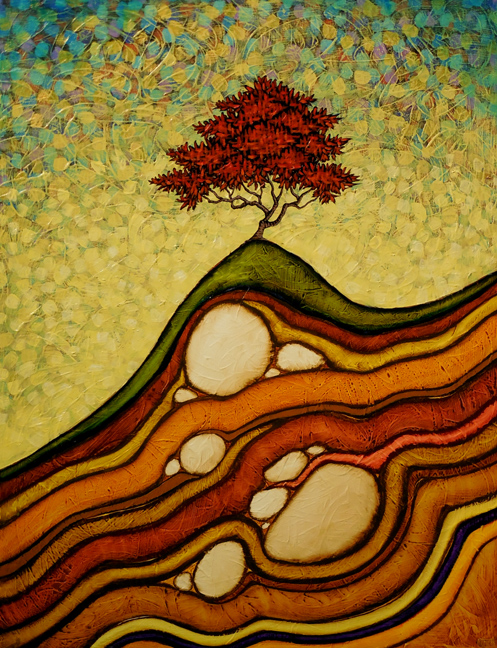
I immediately felt that this might be applied to the painting the top, In the Pocket of Time. It’s a painting (30″ by 24″ on canvas) from 2014 that I brought to the Principle Gallery this past weekend as part of a group of work featured at my Gallery Talk there. It is from a subset of my Archaeology series that I call my Strata work. It is much like the Archaeology pieces without evidence of humans, focusing instead on the layers below the surface.
This particular painting from that Strata series has been with me for a while now. It hung for the last few years in a back bedroom/storage space of my studio. It reminds me of fine wine as it seems to get better with time. I am more and more struck by its surface finish and the rhythm of the strata, as well as how well it transmits its feeling and message from the wall. It’s a piece that speaks directly to me.
Putting Emerson’s thought to it deepened my appreciation of it. I could see in it how we deal always with what is presented on the surface and how seldom we recognize how much more there is to discover if we would only dig a little deeper.
That might be a gross simplification. Or not. Who knows? The words and the mage just seemed to click for me and maybe that’s enough to say.
Let’s tie this up with some music. Here’s a 1992 song from Peter Gabriel titled Digging in the Dirt. The video is from the same time frame as his Sledgehammer song/video and, like it, this video has some interesting visuals.
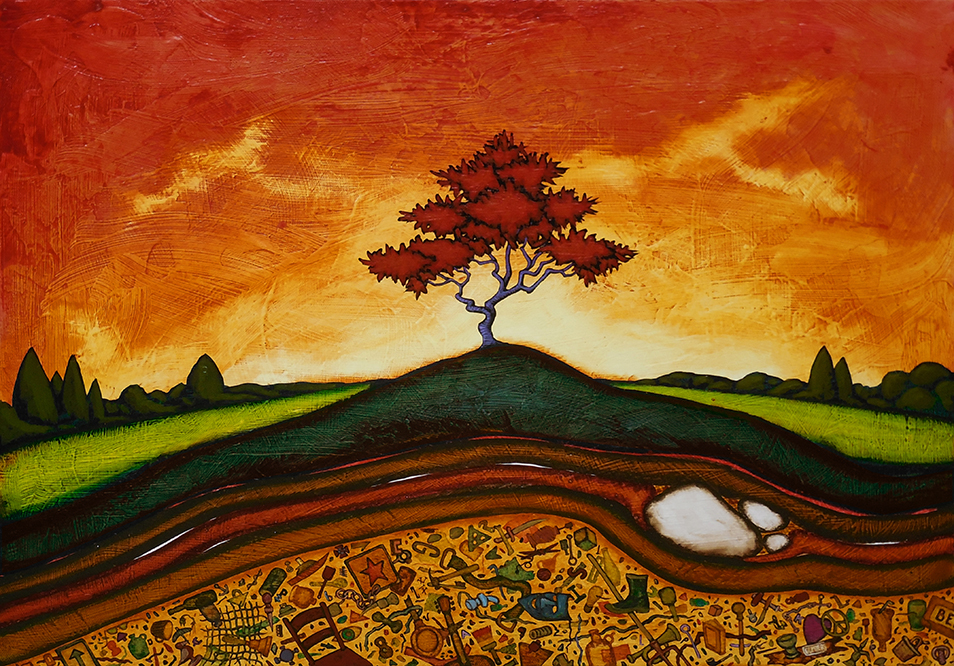
Archaeology: The Golden Age Beyond — At Principle Gallery
At Saturday’s Gallery Talk at the Principle Gallery, I started by speaking about how my painting came about as a result of a lifelong search to identify my own belief system. I feel that everyone has some sort of belief system– even atheism is a belief system– and had always wanted to understand why we were here and what our purpose truly was.
Eventually, the talk turned to the Red Tree. That was fortuitous since it has become an icon for me of some sort of the sort of cobbled together belief system I have come to hold. I went on to read a passage from Hermann Hesse on his own feelings on the meaning and importance of trees.
Hesse holds a place in the formulation of my belief system, something I didn’t mention this during the talk. At a dark low point in my life, I had come across a book, Demian, by Hermann Hesse that I believe saved my life. I have read many of his other works and have gleaned bits here and there but that one resonated most with me and the turmoil I was experiencing at the time.
But I was equally affected when I came across the passage from Hesse below on what we can learn from listening to trees from Hermann Hesse. The late Nobel Prize winning writer included this in his 1920 book, Wandering: Notes andSketches. It well describes much of what I have received from the Red Tree, things that have contributed to my belief system.
There is a lot to like here but I was most struck by the line: Home is neither here nor there. Home is within you, or home is nowhere at all.
That line would be included in the Proverbs section of my belief system.
I thought it would be fitting to include his essay here once again. I have also included a reading of this selection at the bottom. I have listened to several and they often miss the mark for me. This one is fairly good, in my opinion. But perhaps you should just read it in your own voice. Here it is, if you choose that route:
For me, trees have always been the most penetrating preachers. I revere them when they live in tribes and families, in forests and groves. And even more I revere them when they stand alone. They are like lonely persons. Not like hermits who have stolen away out of some weakness, but like great, solitary men, like Beethoven and Nietzsche. In their highest boughs the world rustles, their roots rest in infinity; but they do not lose themselves there, they struggle with all the force of their lives for one thing only: to fulfill themselves according to their own laws, to build up their own form, to represent themselves. Nothing is holier, nothing is more exemplary than a beautiful, strong tree. When a tree is cut down and reveals its naked death-wound to the sun, one can read its whole history in the luminous, inscribed disk of its trunk: in the rings of its years, its scars, all the struggle, all the suffering, all the sickness, all the happiness and prosperity stand truly written, the narrow years and the luxurious years, the attacks withstood, the storms endured. And every young farmboy knows that the hardest and noblest wood has the narrowest rings, that high on the mountains and in continuing danger the most indestructible, the strongest, the ideal trees grow.
Trees are sanctuaries. Whoever knows how to speak to them, whoever knows how to listen to them, can learn the truth. They do not preach learning and precepts, they preach, undeterred by particulars, the ancient law of life.
A tree says: A kernel is hidden in me, a spark, a thought, I am life from eternal life. The attempt and the risk that the eternal mother took with me is unique, unique the form and veins of my skin, unique the smallest play of leaves in my branches and the smallest scar on my bark. I was made to form and reveal the eternal in my smallest special detail.
A tree says: My strength is trust. I know nothing about my fathers, I know nothing about the thousand children that every year spring out of me. I live out the secret of my seed to the very end, and I care for nothing else. I trust that God is in me. I trust that my labor is holy. Out of this trust I live.
When we are stricken and cannot bear our lives any longer, then a tree has something to say to us: Be still! Be still! Look at me! Life is not easy, life is not difficult. Those are childish thoughts. . . . Home is neither here nor there. Home is within you, or home is nowhere at all.
A longing to wander tears my heart when I hear trees rustling in the wind at evening. If one listens to them silently for a long time, this longing reveals its kernel, its meaning. It is not so much a matter of escaping from one’s suffering, though it may seem to be so. It is a longing for home, for a memory of the mother, for new metaphors for life. It leads home. Every path leads homeward, every step is birth, every step is death, every grave is mother.
So the tree rustles in the evening, when we stand uneasy before our own childish thoughts: Trees have long thoughts, long-breathing and restful, just as they have longer lives than ours. They are wiser than we are, as long as we do not listen to them. But when we have learned how to listen to trees, then the brevity and the quickness and the childlike hastiness of our thoughts achieve an incomparable joy. Whoever has learned how to listen to trees no longer wants to be a tree. He wants to be nothing except what he is. That is home. That is happiness.
Art is lunging forward without certainty about where you are going or how to get there, being open to and dependent on what luck, the paint, the typo, the dissonance, give you. Without art, you’re stuck with yourself as you are and life as you think life is.
–Mark Vonnegut, Just Like Someone Without Mental Illness Only More So: A Memoir
Point of Contact — You Could Win It!
I am on the road this morning, heading to Alexandria, VA for the Gallery Talk I will be giving today, beginning at 1 PM. I have some new paintings with me, like the three smaller pieces shown at the top, along with some other cool stuff to give away, including the painting, Point of Contact, shown here on the right. I think it’s going to be a fun talk as well as an insightful one.
I am focusing today (this is written yesterday since I am on the road right now) on luck since someone will have a bit of luck at today’s Talk when they walk away with a favorite painting of mine.
I also thought luck was appropriate since luck or serendipity or whatever you want to call it has played a big part in my career as an artist. I’ve encountered it in my dealings with galleries and people who’ve helped me move along. I’ve seen it play a part in my painting , when what looked like a mistake suddenly turns out to be hugely fortuitous, opening up new avenues that I hadn’t recognized before.
I included the passage at the top from Mark Vonnegut, son of the great Kurt Vonnegut, from his memoir on his struggles with mental health issues. His thought here on art and how it helps one sort out and find a way to escape the trap of living as someone you know yourself not to be makes sense to me and speaks to my own journey and luck as an artist.
That might part of the talk today. Not exactly positive on that but it’s a possibility. I won’t know until I am standing there.
Hope you can make it. If you can, good luck to you!!
1 PM at the Principle Gallery in Alexandria, VA.
Here’s song for the road. It’s a highly entertaining version of Road to Nowhere, the old Talking Heads classic. This from David Byrne‘s wonderful stage show, American Utopia. Lots of fun…
When we speak of man, we have a conception of humanity as a whole, and before applying scientific methods to, the investigation of his movement we must accept this as a physical fact. But can anyone doubt to-day that all the millions of individuals and all the innumerable types and characters constitute an entity, a unit? Though free to think and act, we are held together, like the stars in the firmament, with ties inseparable. These ties cannot be seen, but we can feel them. I cut myself in the finger, and it pains me: this finger is part of me. I see a friend hurt, and it hurts me, too: my friend and I are one. And now I see stricken down an enemy, a lump of matter which, of all the lumps of matter in the universe, I care least for, and it still grieves me. Does this not prove that each of us is only part of a whole?
For ages this idea has been proclaimed in the consummately wise teachings of religion, probably not alone as a means of insuring peace and harmony among men, but as a deeply founded truth. The Buddhist expresses it in one way, the Christian in another, but both say the same: We are all one.
–Nikola Tesla, The Problem of Increasing Human Energy
This is another new painting that is headed to the Principle Gallery with me tomorrow as part of a group of new work. It is titled Harmonia and is 8″ by 8″ on panel. Like a few other of the new pieces, this has an smooth untextured surface that gives it a very glass-like appearance. This is especially so with the transparency of the paints which allows the white ground underneath to shine through, producing an effect as though the piece is lit from behind.
That’s something that I always aim for in my work. When it appears, it shows itself in lesser or greater magnitudes. I think this one is on the higher end. It has a very striking appearance, much more so in person than in the image shown here. Sometimes a photograph loses some of the fullness of a painting, flattening out the colors and not fully capturing their depths, intensity or transparency. I think that is the case here.
The title comes from a belief of mine that is very much attached to the words above from Nikola Tesla, that we are all as one. It’s the same sentiment that echoes from poet John Donne:
No man is an island, entire of itself; every man is a piece of the continent, a part of the main; if a clod be washed away by the sea, Europe is the less, as well as if a promontory were, as well as if a manor of thy friend’s or of thine own were; any man’s death diminishes me, because I am involved in mankind, and therefore never send to know for whom the bell tolls; it tolls for thee.
That is the feeling I get from this piece, that as much as we try to isolate ourselves from the world we are forever attached to and affected by this connection. We live our best lives when we recognize this and achieve some sort of harmony — or should I say truce– between ourselves and the world. It’s a matter of giving everyone and everything the same degree of respect and kindness that we expect to be given by others.
It’s another form of the old love-thy-neighbor adage. It’s been around forever because it contains an eternal truth. Harmony, both inner and outer, might be the prescription for all that ails us. That’s the easy part.
Finding it is another story. But like anything, once you know what you seek it becomes easier to find.
Speaking of harmony, here’s a song that practically oozes with it. It’s Helplessly Hoping from Crosby, Stills and Nash.
The Exile’s Wilderness– Now at the West End Gallery
For the first time in years, he felt the deep sadness of exile, knowing that he was alone here, an outsider, and too alert to the ironies, the niceties, the manners, and indeed, the morals to be able to participate.
― Colm Tóibín, The Master
The painting above, The Exile’s Wilderness, is currently at the West End Gallery as part of my current show there. It was originally painted in early 2020 but without the actual figure that represents the Exile, as seen in the bottom right of the image above. I thought that the painting as it was, sans the Exile figure, was really strong and it quickly became one of my favorite pieces from that period in the early days of the pandemic.
I felt then that the painting didn’t need the figure, that it represented a view seen from the eyes of the exile.
But over the past year or so, as much as I liked this painting without the figure, I began to recognize that it actually needed the Exile in order to provide context. After all, not every person who looks at this will see themselves as an Exile.
So, the Exile entered the picture. And, though I was apprehensive as I proceeded, I was pleased by its effect. It’s contrast to the emptiness of the streets and windows made the figure seem even more alone. More apart. It heightened the overall effect for me.
It completed the circle of feeling that I was seeking in it.
Here’s a poem from Robert Frost, read by Tom O’Bedlam, that fits well with the Exile here. It’s his Acquainted With the Night.
I tried to discover, in the rumor of forests and waves, words that other men could not hear, and I pricked up my ears to listen to the revelation of their harmony.
― Gustave Flaubert, November
I often write here about the need to have one’s voice heard, about how we all have a desire to send our message of who we are out into the world. And I do believe this.
But as important as this might be, I often find myself at this time of the year feeling a little tired of my own voice. And a little regretful, especially after openings or talks where I come away feeling that I spoke too much and didn’t listen enough.
It’s as though there should be a certain balance between the two — talking and listening– and I feel like I am out of this balance. A yin/yang thing, I guess.
I know that I feel a lot better when I listen more and talk less. Maybe this allows the voice of someone else to be heard, someone who may need that more than me in that moment.
And hearing them creates a bit more balance and harmony. For them and for me.
And that feels better because, after all, balance and harmony is what I am seeking with my work.
And myself.
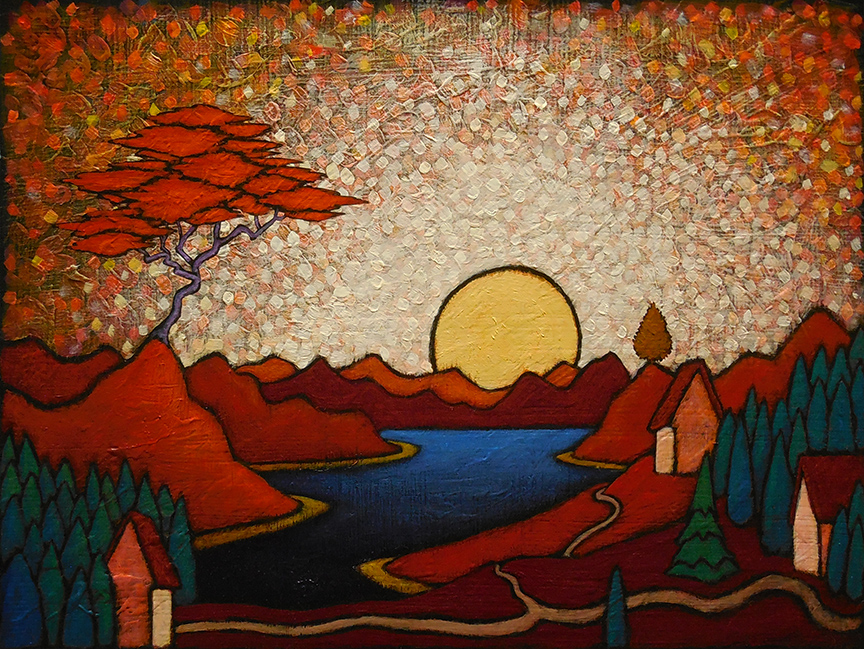
I think that might be the message carried in the piece at top, Surveyor. I see this painting as being about the Red Tree seeking this harmony in the rumor of forests and wavesas Flaubert put it, as well as a having a need to communicate with the other distant tree.
Harmony and communication– it falls within the balance between talking and listening.
Drafting a world where no such road will run From you to me; To watch that world come up like a cold sun, Rewarding others, is my liberty. Not to prevent it is my will’s fulfillment. Willing it, my ailment.
— No Road, Philip Larkin
There’s a lot to do this morning plus my computer is a little glitchy this morning so I won’t say much. I thought I’d pair the small piece above from my current West End Gallery show, In Cool Air, with a reading by Tom O’Bedlam of No Roadfrom poet Philip Larkin. Not sure that they fully mesh in terms of tone and message but I am a sucker for Larkin’s verse with its sometimes cynical and slightly misanthropic viewpoint.
I especially like the final stanza shown above. There’s something to it that I can somewhat equate with what I do.
Or not. Who knows, really?
All I know that on a busy morning, these lines and this small painting felt like a small respite.
It is not easy to convey, unless one has experienced it, the dramatic feeling of sudden enlightenment that floods the mind when the right idea finally clicks into place. One immediately sees how many previously puzzling facts are neatly explained by the new hypothesis. One could kick oneself for not having the idea earlier, it now seems so obvious. Yet before, everything was in a fog.
― Francis Crick, What Mad Pursuit
As a pioneering scientist best known for revealing the double-helix structure of DNA, I guess Francis Crick knows something about Eureka moments.
For those of you who don’t know, Eureka is from the Greek and means “I have found it.” Archimedes, the famed 3rd Century BC scholar, is believed to be the first to have used the term, having ran through the streets naked yelling Eureka! after having a sudden scientific revelation while in his bath. Any sudden discovery, usually of knowledge or enlightenment, has come to be known as a Eureka moment. Goldminers during the California Gold Rush would yell Eureka! when discovering a rich vein of gold and it remains the state’s official motto.
It’s a pretty dramatic thing, this burst of sudden revelation. It can change perceptions of things in a flash and everything surrounding it falls immediately into place. It’s kind of like you’ve been struggling to look at one of those Magic Eye images (autostereograms) that appears as just a mass of dots until something clicks in, allowing your mind to see the image hidden among the dots.
A pattern that was hidden becomes apparent and obvious. And once you see it, it can’t be unseen.
Not counting Magic Eye paintings, I don’t know how many times a person experiences such Eureka moments in their life or if it even occurs for everyone.
I am relatively sure I have had one such moment. Four? Well. maybe two. Or more likely 1 1/2. I don’t know which probably means it wasn’t a real Eureka moment. But I did have that one and if that is the only one I ever have, I am okay with that though I will always seek and hope for another.
That’s the basis for the new painting at the top, Eureka Moment, that is now at the West End Gallery as a late addition to my current solo show there. It certainly captures the feeling I experienced during what be my singular Eureka moment.







 Redtree Times