*****************
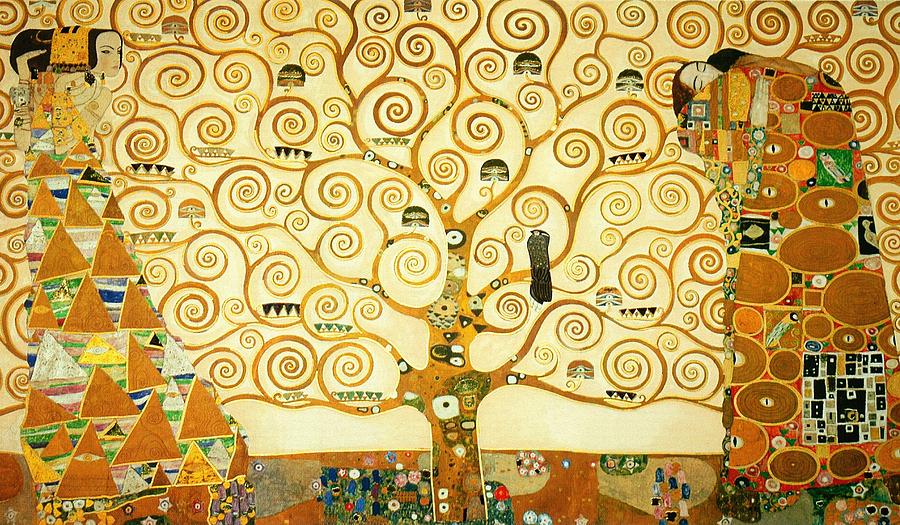
There is always hope, as long as the canvasses are empty.
–Gustav Klimt
*****************
This quote from Klimt made me smile this morning, a little knowing smile. When I am getting ready for a show, such as I am now, the studio is initially filled with prepared empty canvasses of a wide variety of sizes, coated with layers of gesso and topped with a thick layer of black paint. They are everywhere, all propped up against any available surface that will support them.
Having them around is comforting, representing possibility. It is the hope of which Klimt speaks. Each blank canvas has the possibility of being a whole new world, a new experience, a new revelation. There is almost a hum of potential life coming from them.
But as the weeks and months pass and many of the canvasses are painted, taking on their new identities, the supply of blank surfaces dwindles down to the point where there is now only a smattering of blank canvasses scattered around the studio. It is at this point when I get anxious, most likely from no longer being surrounded by those empty surfaces that have come to symbolize hope and potential for me.
It is at this point that I can begin to see the end of this painting session, that soon I will have to stop for a bit to ready the work, to photograph, to stain frames and varnish paintings to make them presentable for the show. This makes makes me a little glum because I am usually very hyped up and wanting to do even more, to further explore all the new avenues that are opening up before me in the paintings in which I am working.
Looking around now and seeing just a few empty canvasses is a reminder of that coming point. It makes me pause in for a moment, anticipating that coming shift of gears, and for that moment I am a bit down. But reading Klimt’s words makes me smile, knowing that I just received a new shipment of canvas the other day which is waiting patiently downstairs to be prepped so that it soon can carry all my hopes and possibilities.
And the glumness fades.






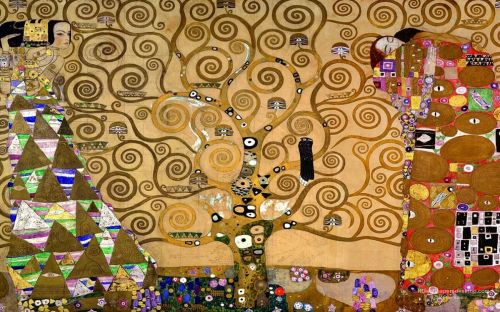 Lately, when I have been very busy, I’ve been sharing some videos of artists’ work set to music. For example, I’ve shared videos of the works of Edward Hopper and Thomas Hart Benton in recent weeks. It’s always interesting to see artists work set to music, especially when they seem to complement one another.
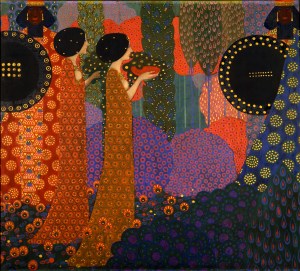 Looking for more info I found that background info on Zecchin was sketchy. He was raised on Murano, one of the famed islands of Venice known for its glass-making. His father was a glass-maker and Zecchin grew up immersed in color and form. He studied art but, feeling his voice would not be heard in the somewhat conservative artistic atmosphere of Venice at the time, put it aside in his early 20’s to pursue a job as civil servant. However, he came back to painting around the age of 30, spurred on by a new movement in Venice of artists inspired by Klimt and other artists.
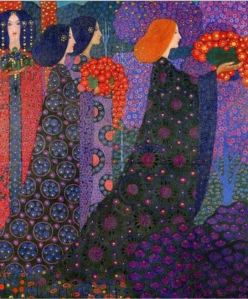 All of this pieces shown here are from his grandest work, a mural completed in 1914 for the Hotel Terminus that consisted of 11 or 12 panels ( I have found conflicting reports) that measure around 300 feet in total length. Called Les Milles et Une Nuit ( A Thousand and One Nights), it depicts the entourage of kings, queens, princesses and princes as they bear gifts to encourage the Sultan to give his daughter’s hand to Aladdin. You can see the influence of Klimt but more importantly you can see the influence of the glass and color of Venice. Unfortunately, the panels are no longer together, having been dispersed throughout the art world over the years.


 Redtree Times