
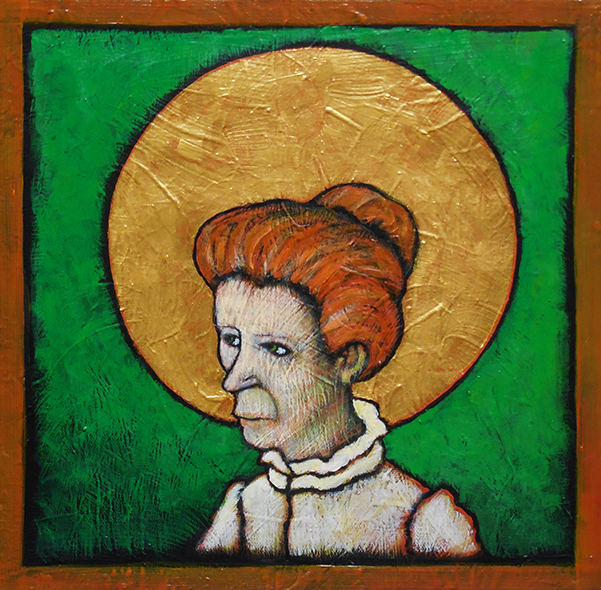
Icon: Peter the Scoundrel
HOW I BECAME A MADMAN
You ask me how I became a madman. It happened thus: One day, long before many gods were born, I woke from a deep sleep and found all my masks were stolen,–the seven masks I have fashioned and worn in seven lives,–I ran maskless through the crowded streets shouting, “Thieves, thieves, the cursed thieves.”
Men and women laughed at me and some ran to their houses in fear of me.
And when I reached the market place, a youth standing on a house-top cried, “He is a madman.” I looked up to behold him; the sun kissed my own naked face for the first time. For the first time the sun kissed my own naked face and my soul was inflamed with love for the sun, and I wanted my masks no more. And as if in a trance I cried, “Blessed, blessed are the thieves who stole my masks.”
Thus I became a madman.
And I have found both freedom of loneliness and the safety from being understood, for those who understand us enslave something in us.
But let me not be too proud of my safety. Even a Thief in a jail is safe from another thief.
–Kahlil Gibran, The Madman: His Parables and Poems (1918)
I was recently looking at some paintings from 8 or 9 years back from a series I call Icons. The subjects are people pulled from my ancestry that were done in a rough way like religious icon paintings. I stopped over this one at the top, Peter the Scoundrel. This one has been one of my least favorites from the series for a variety of reasons, some aesthetic, but mainly because the character it portrays, my 3rd great-grandfather, was such an enigma.
His name was Peter Bundy though it’s hard to tell if that was his real name or just one of the several aliases he assumed in his lifetime. I shared his story here back in 2016 and what a convoluted and confusing one it was. It had an abandoned family, two stints in the Union Army in our Civil War under different names one of which ended in desertion, capture and imprisonment in Andersonville, and a couple of other aliases that hid who-knows-what. My investigation into left me with the realization that the only thing I knew of him for sure was that he was buried in a small country cemetery in Caton. His stone there lists the unit of his second stint as a soldier and that he was born in Scotland. While I think he served in this unit under the name Peter Bundy, I have my doubts as to whether he was actually born in Scotland or born with the name Peter Bundy.
It was a frustrating look into his life, like trying to reveal the identity of someone behind a mask. Just when you thought you were going to see the truth of that person, you pull off the mask you see only to discover there is yet another mask beneath. And another beneath that one and maybe another beyond that.
It made me think of the masks many of us wear throughout our lives. Peter Bundy might be an extreme case but many of us have multiple faces we wear for different situations and people, often to the point where it becomes difficult to discern which face is real and which is a mask.
It is equally difficult to fully understand the reason for the mask we wear. Sometimes it is to deceive, plain and simple. Peter Bundy, for example. Sometimes we wear masks for protection against things we fear or to fit into situations where we feel uncomfortable. Sometimes we wear a mask simply because we don’t want to be who we are or to show our real self. There are many reasons and situations, some honest and some not, that cause us to don our masks.
I often wonder if there are those who never wear a mask and think that it must be a wonderful thing to be so comfortable in your own skin. I am sure they are out there, those people who feel so self-assured and real. But then I wonder if one would even be able to know for sure if that was not just a mask in itself.
That brings me to the parable at the top from Kahlil Gibran. I came across it the other day after sharing another short piece on a scarecrow that was from the same book of Gibran’s parables. It made me think of Peter Bundy’s masks as well as the many masks I have worn. But more than that, it made me think about the liberating feeling of shedding all your masks, to live with your naked face.
To live a life of transparency.
I realized that it’s something I aspire to through my work and this blog. I also realized that shedding every mask is not an easy thing. Some fit so well, feel so comfortable and protective, that they naturally just go back into place at certain times.
I have also found that trying to resist the temptation to wear these masks often leads one to a need for solitude and caring less, if at all, how others see you. This would be the freedom of loneliness and the safety from being understood as Gibran put it. I would quibble a bit with the use of loneliness in this translation as I seldom, if ever, feel lonely in my solitude. In fact, I often feel lonelier out in the public. That’s when I most want to pull on my mask.
I don’t know that I’ll ever be fully without a mask or two. Can any of us really make that claim? Is it even possible?
Who really knows?
Let’s finish up with a song that’s not really about masks. Well, the more I think about it, maybe it is. It is about madness of a sort. It’s some great early Rolling Stones–19th Nervous Breakdown.
Here it comes, here it comes….


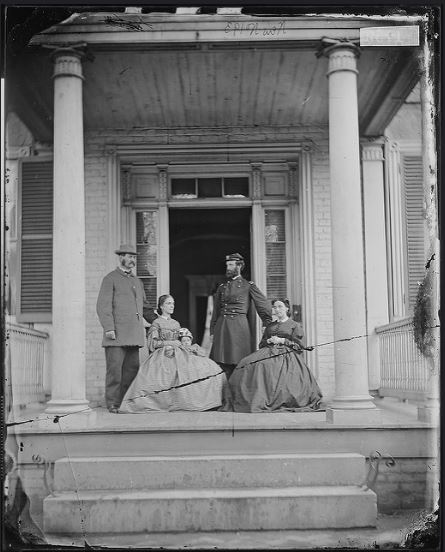


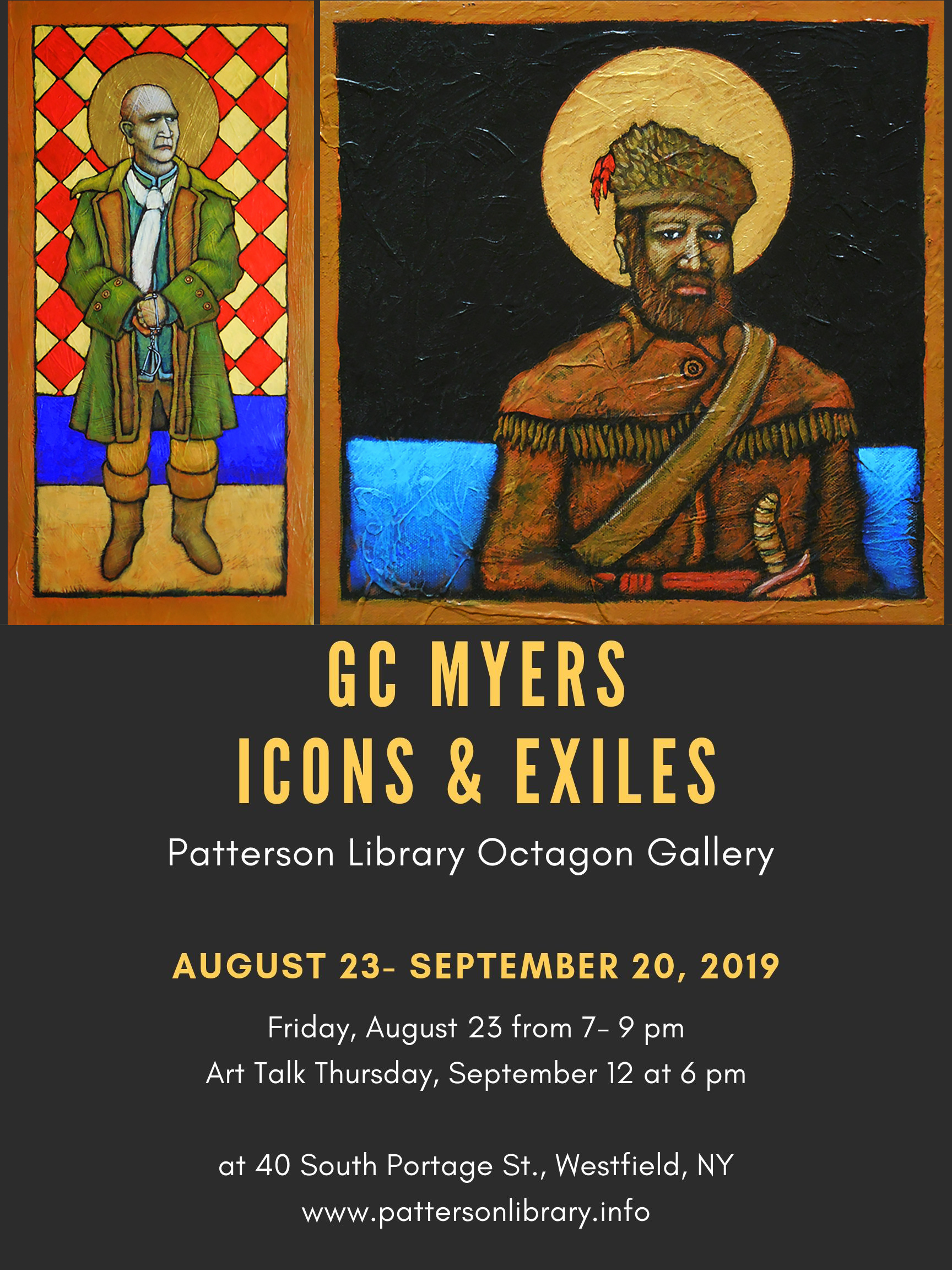


 The more I read about this ancestor,the latest entry in my Icon series, the more interesting I find her. Her maiden name was Tacy Cooper and she is my 10th great-grandmother, born around 1609 in England. Little is known of her parentage or when exactly she came to America but she is known to have lived in Dorchester, near Boston in the Massachusetts Bay Colony in the early 1630’s.
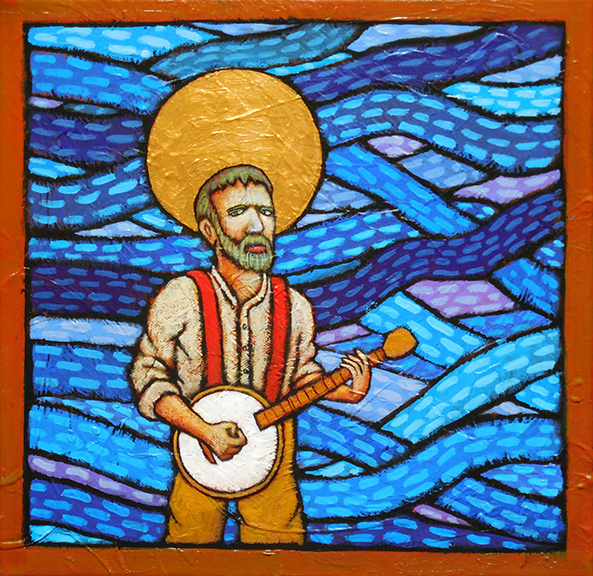 Here’s my latest entry into the Icon series, a 12″ by 12″ canvas piece that is titled Icon: Joe H. He is my 3rd great-grandfather and his name was Joseph Harris and he was born in the Lindley (the town named after our common ancestor, Eleazer Lindsley,who was among the first Icons) area south of Corning in 1833.
 My current Icon series has been a real pleasure for myself in that it’s refreshing to work on pieces that I realize are only for myself, not worrying if they strike a chord with anyone else. For me, it’s fulfilling to flesh out some of my ancestors and their stories, to give them an image that I an hold on to. As I’ve said these are meant as symbols– I’m not trying to recreate their actual appearance. In most cases, there is nothing to work with, nothing that would give me a clue as to how they might really look. So, this is how I see them in my mind.
 Redtree Times