Feeds:
Posts
Comments

Posts Tagged ‘James Baldwin’

Between Order and Chaos– At the Principle Gallery


Most people live in almost total darkness… people, millions of people whom you will never see, who don’t know you, never will know you, people who may try to kill you in the morning, live in a darkness which — if you have that funny terrible thing which every artist can recognize and no artist can define — you are responsible to those people to lighten, and it does not matter what happens to you. You are being used in the way a crab is useful, the way sand certainly has some function. It is impersonal. This force which you didn’t ask for, and this destiny which you must accept, is also your responsibility. And if you survive it, if you don’t cheat, if you don’t lie, it is not only, you know, your glory, your achievement, it is almost our only hope — because only an artist can tell, and only artists have told since we have heard of man, what it is like for anyone who gets to this planet to survive it. What it is like to die, or to have somebody die; what it is like to be glad. Hymns don’t do this, churches really cannot do it. The trouble is that although the artist can do it, the price that he has to pay himself and that you, the audience, must also pay, is a willingness to give up everything, to realize that although you spent twenty-seven years acquiring this house, this furniture, this position, although you spent forty years raising this child, these children, nothing, none of it belongs to you. You can only have it by letting it go. You can only take if you are prepared to give, and giving is not an investment. It is not a day at the bargain counter. It is a total risk of everything, of you and who you think you are, who you think you’d like to be, where you think you’d like to go — everything, and this forever, forever.

–James Baldwin, The Artist’s Struggle for Integrity talk, 1962


Yesterday’s post was about art enduring times of strife and repression. Today, I am offering a snippet from a 1962 talk author James Baldwin gave at the Community Church in NYC in which he spoke of the responsibility of art and artists to humanity, one in which they were required to reveal and share the truth of our common experience as humans. This would serve as a clarifying light that would diminish the darkness that surrounds us.

I will note here that Baldwin’s talk took place at the height of the Cold War, only weeks after the Cuban Missile Crisis. The war in Viet Nam was ramping up and the struggle for Civil Rights was at a bitter juncture at that same time. It was a dark and scary point in time.

In the here and now, I think we can relate to that feeling of impending darkness.

It is a time in which art– and by art, I include all forms of art: literature and poetry, visual arts, music, dance, theater, etc. — is a necessity. Not as diversion or distraction. But for its ability to reflect the truth and gravity of the moment and cast a bright light against the darkness.

It is a light that allows us to see we have not been alone in the dark as we had feared. It also lets us clearly see the struggle ahead that will require action and sacrifice. And knowing these things focuses our attention which has a calming, centering effect. 

It is then that blind fear is often replaced with clear-eyed courage.

Saul Bellow said a similar thing in a Paris Review interview:

Art has something to do with the achievement of stillness in the midst of chaos. A stillness which characterizes prayer, too, in the eye of the storm… Art has something to do with an arrest of attention in the midst of distraction.

Like Baldwin’s talk, Bellow’s interview took place in 1962 when the world was in crisis. It was a time that made clear that art was a necessity. It illuminated the issues and brought a focus that, in many ways, swayed public opinion that in many ways shaped the future.

It was a floodlight in the dark. 

Though it is a different time with different circumstances and a world much changed via technology, we’re at a similar point in history today. Art remains a necessity in bringing the light. 

Art will bring the light, people.

Let us make sure we focus so that we may see and hear what it is saying.


Read Full Post »

Solitude and Reverence


Perhaps the primary distinction of the artist is that he must actively cultivate that state which most men, necessarily, must avoid: the state of being alone. That all men are, when the chips are down, alone, is a banality — a banality because it is very frequently stated, but very rarely, on the evidence, believed. Most of us are not compelled to linger with the knowledge of our aloneness, for it is a knowledge that can paralyze all action in this world. There are, forever, swamps to be drained, cities to be created, mines to be exploited, children to be fed. None of these things can be done alone. But the conquest of the physical world is not man’s only duty. He is also enjoined to conquer the great wilderness of himself. The precise role of the artist, then, is to illuminate that darkness, blaze roads through that vast forest, so that we will not, in all our doing, lose sight of its purpose, which is, after all, to make the world a more human dwelling place.

–James Baldwin, The Creative Process (1962)


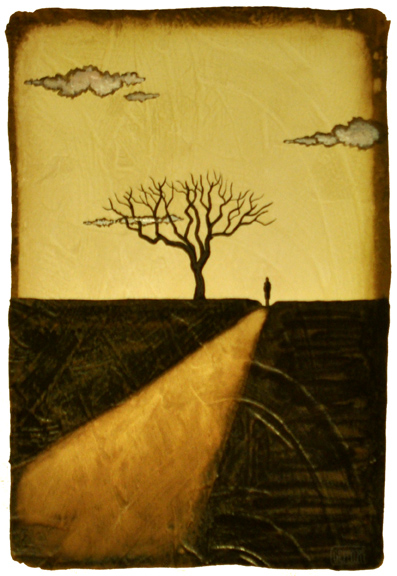
I’ve been looking quite often recently at the painting at the top which is here with me in the studio. It’s from about ten years ago and is titled Solitude and Reverence. It was an instant favorite for me when I finished back in 2015 so when it returned to me after its tours of the galleries, while I was surprised it had come back, I was pleased to have it back with me. I believe it’s a piece that says a lot about me and my work and the role solitude has played in it.

This morning, coming across an image of this painting used on the blog several years ago reminded me of a couple of things that I have shared over the years on the role of solitude and being alone for the artist. One is the passage at the top from a 1962 essay from James Baldwin and the other is below, from an early (2008!) blogpost where I wrote about advice I gave to young wannabe artists. I thought both worked well with this painting. At the bottom I am adding a song from Billie Holiday, at the peak of her powers, on the same subject. The song is Solitude from her 1952 album of the same name. Just a beautiful recording.


I’m showing the picture to the right to illustrate a bit of advice I often give when speaking with students or aspiring painters. This is my first studio which is located up a slight hill behind our home, nestled in among a mixed forest of hardwoods and white pine. This photo was from last February [2007]. It was a fine little space although it lacked certain amenities such as running water, bathrooms and truly sufficient heat. However, it served me very well for about a decade.

The advice that I give to aspiring artists is this:  Learn to be alone.

The time spent in solitude may be the greatest challenge that many artists face. I have talked to many over the years and it is a common concern. Some never fully commit to their art for just this reason. To be alone with your own thoughts without the feedback or interaction of others can be scary especially for those used to being immersed in people and conversation.

I like to think that I have been prepared for this aspect of this career since I was a child. For much of my youth we lived in the country, in houses that were isolated from neighbors. I had a sister and brother, 8 and 7 years my senior, and they were often my companions at times. But as they came into their middle teens, I spent more and more time alone. This is not a complaint in any sense. Actually, it was kind of idyllic. I lived a fairly independent life as a kid, pretty much coming and going as I pleased. I explored the hills and woods around us, going down old trails to the railroad tracks and old cove that ran alongside the Chemung River. I studied the headstones at an old cemetery tucked in the edge of the woods overlooking what was then a thick glen, filled with the family who resided at a late 1700’s homesite that had stood across the road from our home. All that remained of that place was a stacked stone chimney which served as a great prop for playing cowboy.

In the woods there were immense downed trees that served as magnificent pirate ships. There were large hemlocks with thick horizontal branches that were practically ladders, easy to climb and sit above the forest floor to watch and dream.

My life– and my work– would be very different without this time alone. Sure, maybe I’d be a bit more sociable and comfortable with groups of people, something which is sometimes a hindrance. But it prepared me for the time I spend alone and allowed me to create my own inner world that I occupied then and now. The same world that appears in my work, the same world that is my work.

This is only a short post on a subject I could drone on about for pages and pages. But, to aspiring artists, I say learn to love your time alone. Realize what a luxury and an asset it can be to you as an artist. It is gift that is available to us all if we only recognize and accept it as such. Learning to be alone will make your work grow and distinguish itself in ways you can’t yet see.


Read Full Post »

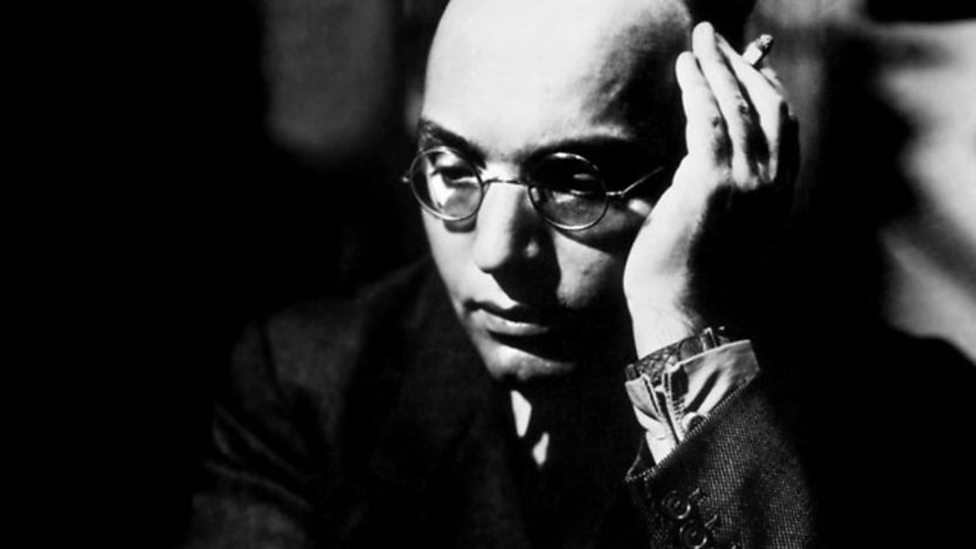
Kurt Weill. Who Wrote “September Song” with Maxwell Anderson


The summer ended. Day by day, and taking its time, the summer ended. The noises in the street began to change, diminish, voices became fewer, the music sparse. Daily, blocks and blocks of children were spirited away. Grownups retreated from the streets, into the houses. Adolescents moved from the sidewalk to the stoop to the hallway to the stairs, and rooftops were abandoned. Such trees as there were allowed their leaves to fall – they fell unnoticed – seeming to promise, not without bitterness, to endure another year. At night, from a distance, the parks and playgrounds seemed inhabited by fireflies, and the night came sooner, inched in closer, fell with a greater weight. The sound of the alarm clock conquered the sound of the tambourine, the houses put on their winter faces. The houses stared down a bitter landscape, seeming, not without bitterness, to have resolved to endure another year.”

― James Baldwin, Just Above My Head


In this strangest of years, September has crept in without barely any notice for me. Much in the way August departed. I barely noticed the comings and goings, even though time seems to drag in these days of waiting for what might come next.

In doing so, I have neglected playing what might be my favorite song as I do every year at this time. The son is September Song, written by Kurt Weill and Maxwell Anderson for the 1938 Broadway show Knickerbocker Holiday. It was written in just a few hours after the show’s star, Walter Huston, requested that he have a solo  song in the show.

Of course, in doing so, the composers had to account for Huston’s limited vocal range. The result though is a song that has become one of the great standards, covered by an incredibly wide range of artists. I have played versions from Willie Nelson, Bryan Ferry and Lou Reed along with the more well known jazz vocalists.

The song is just lovely in a most wistful way and these days we can all use something lovely and even wistful. Here’s such a version from the great Sarah Vaughan.

Have a good day.

Read Full Post »


“The Americans have no sense of doom, none whatever. They do not recognize doom when they see it.”

James Baldwin, Giovanni’s Room


At the bottom of the moods swings that occupy my waking days and dreaming nights as of late. In the studio at 5:30 this morning, a Tom Waits song playing with huge clunking beats and his coarse, smoke burnt voice yelling over it all, And the earth died screaming/While I lay dreaming

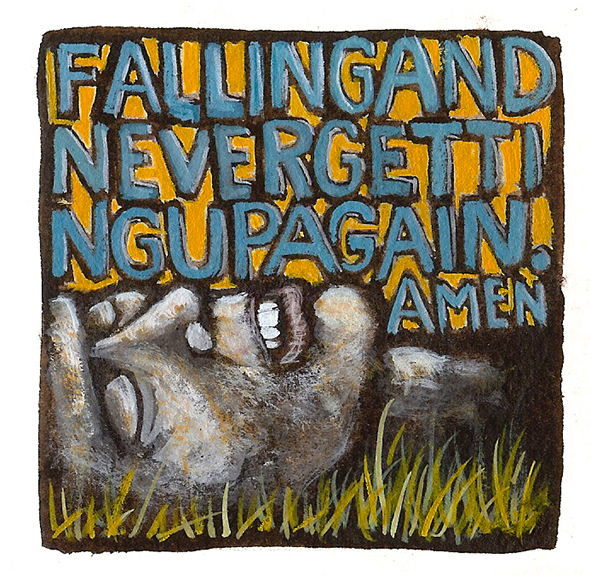
Shuffling through things, trying to find something to hold on to and I come across this little painting, one that I quickly did years ago for my eyes only. Never meant to be shared, just a private reminder to myself of those days when the dark crows of doom have flown around my door. Meant to keep me aware of the signs that appear when these crows are coming back, to remind me of the immense fatigue and sense of doom they bring with them so that I might be able to stay clear of them this time.

To avoid hopelessness.

But sometimes hopelessness cannot be avoided.

If you have been at this point, you know there are only two outcomes:  to succumb to the doom or fight. You realize that hope, at that point, has become your enemy, a distraction that weakens your resolve and keeps you from being fully engaged in the battle.

Hope is a tool used by agents of doom, to tyrants and despots who tie themselves to religions that keep the masses passive with promises in lives after this one on earth. Hope makes you look forward when you need to be only in the here and now. Hope makes you sloppy and inattentive, willing to surrender to nearly the same terms and conditions that have brought you to this point.

Hope is a promise unfulfilled, a wish without action.

No, in times of doom, hopelessness is your greatest ally.

Hopelessness demands action.

Hopelessness is the greatest agent of change.

Hopelessness is fearless, with nothing left to lose.

I wasn’t planning on writing this this morning. God, I want to be cheery and optimistic and, dare I say, hopeful. I have always preached hope on this blog but that was in times when I thought the future was still a bright sky, not a dark and foreboding one like the one I see now, where the storm clouds have been amassing for the last four years. I’ve watched them gather but hope made me think it would somehow resolve without me engaging, that the sky would brighten of its own accord.

But I was wrong to trust hope. I can’t turn to hope this morning.

No, I am looking to hopelessness as my savior. I’ve have sometimes visited that abject blackness down where hopelessness dwells and it has always sent me back upwards. It has invariably set me in action and stiffened my resolve. It has made me realize that this life is a precious thing that is worth fighting for, against all hope.

Against all hope. I never thought about that term before, though I have used it on more than one occasion. I think we are at that point, where we must struggle against all hope with hopelessness as our great ally.

So, for the time being, I am setting hope aside. Oh, I’ll hope you’re doing well and staying safe because I want us all to have a brighter future at some point soon. But I will not depend on hope or trust that it will bring that desired future.

Only hopelessness can do that.

Read Full Post »

The Need for Solitude

The artist must actively cultivate
that state which most people avoid:
the state of being alone.
-James Baldwin

**********************

I spoke with a drawing class from a local college yesterday.  I always feel like I could have done a much better job with these things and yesterday was no different.  I left thinking that I hadn’t fully expressed fully all the advice or warnings I might have wanted to offer.  I had sped over the idea of taking a  mindset for their work that makes it apparent that they view their work as important.  The idea here is that if you don’t take your work seriously, how can you expect others to  do the same?  I don’t think I got that fully across.

The one thing I did stay on was the value and need for solitiude in their work, how they must embrace being alone with their thoughts and work in order to take their work to its fullest potential.  They should be honest with themselves and if they are uneasy about being and working alone, this is not a path they should follow.  I told them that the solitude was actually the big attraction for me and that, even as I spoke with them, I was wishing I was back in the studio.  Alone.

Creation is most often done in solitude.  There have been successful artistic collaborations through the years but they seldom have the impact and power of the singular voice and vision.  And this is most often forged in solitude.

Maybe I’m biased towards this idea because of my cultivated  affinity for being alone.  I don’t know nor do I really care.  As the glorious Garbo said, ” I just want to be alone.”


Read Full Post »