The sole art that suits me is that which, rising from unrest, tends toward serenity.
–André Gide, journal entry, November 23, 1940
The journal entry above from Nobel Prize-winning author André Gide very much speaks to me. Though it serves many purposes for me, I tend to view my work as a means of absorbing and acknowledging the anxieties and pressures that this world often presses upon us, dampening their effects, and then moving, to use Gide’s term, toward serenity.
The darker aspects of the world are still there, an underlying presence that creates a contrasting tension, a counterpoint that serves as a starting point from which serenity and other aspects of light can build.
I am talking about the emotional tone of the work here, but it also roughly describes my actual painting process. Much of my work starts with a dark surface on which light and brightness is built.
Even my work with transparent inks that is more watercolor-ish in nature employs a process where a darker layer of ink is first applied. almost as a dark puddle on a light– usually white and prepped with layers of gesso– surface. This layer, this puddle of ink, is then little by little removed, each deduction revealing more and more light from the underlying surface.
From darkness comes light…
Let’s have a tune this morning. The song is I See a Darkness. It’s one I have played a couple of times over the years, once by Will Oldham (aka Bonnie “Prince” Billy) who wrote and originally recorded it and the other as covered by Johnny Cash, from the American Recordingsperiod late in his life. His work from this time, when his scarred voice carried his age and emotion so eloquently, is potent stuff.
Light coming from darkness…
I think this part of its chorus fittingly applies to today’s post and to life in general:
Oh, no, I see a darkness. Did you know how much I love you? Is a hope that somehow you, Can save me from this darkness.
We cast a shadow on something wherever we stand, and it is no good moving from place to place to save things; because the shadow always follows. Choose a place where you won’t do harm – yes, choose a place where you won’t do very much harm, and stand in it for all you are worth, facing the sunshine.
–E.M. Forster, A Room With a View
Choose a place where you won’t do harm…
Man, that sounds like advice coming to us from a distant time and place. So much so that it seems almost quaint, almost to the point where many of us do exactly the opposite, choosing places where we can do nothing but harm.
I know this is nothing new. There has always been a streak of malice and vindictiveness within our character. We would often rather sacrifice to harm others rather than to help them.
That’s part of the dark shadow that follows us, obscuring what little remains of our empathy. Not sure why I am writing this this morning, outside of the utter disappointment I sometimes feel in the choice many make to turn away from the sunshine of compassion and live in the deep shadows that are devoid of it.
Actually, this all started when I came across an old blog post that had a Johnny Cash performance of a Loudon Wainwright song, The Man Who Couldn’t Cry. Simply put, it’s a song about a man who lived a life without feeling. This performance is from a time when Johnny Cash was just beginning to reinvent himself, having become irrelevant, seen as a relic of country music’s past. He couldn’t get airplay for his music. He decided to make music that was out of the box.
It is written that though he was a legendary performer, he was terrified for this show as it was one of the first times he had played alone on stage without a backing band. Just a man and his guitar. I like that story, that this man who headlined around the world and had throngs of adoring fans felt the need to move ahead with deeply personal work that was meaningful and often raw. That it meant so much to him that he felt exposed, that he was nervous and afraid.
He chose a place where he wouldn’t do very much harm, and stood in it for all he was worth, facing the sunshine.
It was that hour that turns seafarers’ longings homeward- the hour that makes their hearts grow tender upon the day they bid sweet friends farewell…
― Dante Alighieri, Purgatorio
Dante had it right– dusk is that hour of recollection, some warm and some less so. As I age, I see this more clearly, most likely as a result of simply having more to look back on than look forward to at this stage in my life.
Don’t jump too hardly on that last line. I feel there is still a tremendous amount of living ahead for me and others my age or older. It’s just math– the ratio of time lived to the expected or hoped for time left in one’s life– says that the greater part of our life is behind us for people of my age and older.
And I believe dusk does often remind us of this fact. It’s a time when we sometimes pause to look back on the day, to reckon what we have done and not done during that time and to measure what lies ahead for the next day.
And sometimes this recollection extends back further than the day that just passed due to the moment in which it takes place. Maybe it’s the warmth and color of the sunset. Maybe it’s the way the landscape around us changes in the setting light, as colors deepen and contrast to the narrowing light. Whatever it might be in that moment, something triggers flashes of distant memories.
Words spoken and unspoken. Maybe just a glance from a face you remember or the most innocuous detail from some moment that didn’t seem important when you saw it so long ago.
Sometimes these moments are full and make sense. Sometimes they are fragments that seem insignificant. Yet they remain in place in our memory.
And as that moment of recollection passes and we move to settling in for the night and looking ahead to the coming day, these recalled moments dissolve, much like the setting sunlight melts into darkness.
There’s a wealth of recollections to pull from as one ages and maybe I see that in the depth and richness of the colors here. Maybe every stroke of color in that sky is a fleeting and flashing moment from my memory. I don’t know.
It makes me think of when my dad was in his final years suffering from dementia. His memory was spotty at best and often large segments of it were absent. I remember one instance when he was disturbed and asked me with great seriousness to tell him who his mother was. I went to a photo of her from her college yearbook (Potsdam 1918!) that was on a bulletin board we had put up in his room. I pointed her out and explained in great detail her history. He listened to me more intently than any other time I can remember in my life, like he needed to know this and wanted to inscribe it deep into memory.
Looking back on that moment now, I can only imagine him as the Red Tree looking back and, instead of the richness of individual colors in that sky of memory, he is seeing a hazy grayness with occasional peeks of color. A recognizable tree or hillside whose color has faded to a duller shade, almost gray. And the distant deeply colored mountain that might have been his mother was not even visible.
Makes me appreciate every moment, every fleck of color, every drop of light, every insignificant recollection that remains with the hope that my dusk never fully dissolves.
This post ran a few years back. I came across the image of the painting at the top, And Dusk Dissolves, and remembered that this painting was still at the West End Gallery. I had forgotten that it was there. It’s a very large piece, 30″ by 48″, so it is often difficult to find space for it on the gallery walls. But it remains a favorite of mine. Seeing it and reading the post reminded me of my parents, who I have been thinking about in recent weeks.
Here’s a song about looking back, a version of a favorite Beatles song, In My Life, from 1965‘s Rubber Soul album. Hard to believe this song is almost 60 years old. This version is from the American recordings of Johnny Cash, done in the final months of his life. n a long and storied career, I’ve always felt it was among his most impactful work. His age and ailments changed his delivery and imbued the songs with real heart-felt emotion and purity. A powerful group of music. This version of the Beatles’ song is not so different stylistically, but it it is filled with his own personal meaning which, n a way, makes it his own.
Freedom’s just another word for nothing left to lose Nothing don’t mean nothing honey if it ain’t free
Things have been a bit hectic and I failed to mention the death of Kris Kristofferson this week at the age of 88. The line above from his song Me and Bobby McGee, has echoed in my mind since I was a kid. So much so that when a high school English teacher asked our class how we would define freedom, I quoted that line as my answer. He took off his shoe and threw it at me.
The following paragraphs are taken from a post from a few years back, on his 85th birthday.
Kris Kristofferson was many things in his life, as the bio on his website points out:
He was an Oxford scholar, a defensive back, a bartender, a Golden Gloves boxer, a gandy dancer, a forest-fighter, a road crew member, and an Army Ranger who flew helicopters. He was a peacenik, a revolutionary, an actor, a superstar, a Casanova, and a family man. He was almost a teacher at West Point, though he gave that up to become a Nashville songwriting bum.
Definitely one of the more interesting people of our time. And a helluva songwriter.
As I mentioned, Me and Bobby McGee is burned into my brain, especially the version from Janis Joplin. He also dated Janis for a while, which adds to his interest factor. There are plenty of other songs to mention– Help Me Make It Through the Night, Why Me, For the Good Times, etc.–but for me, my mind always goes to either Bobby McGee or to Sunday Morning Coming Down, whose big hit for Johnny Cash remains a favorite of mine.
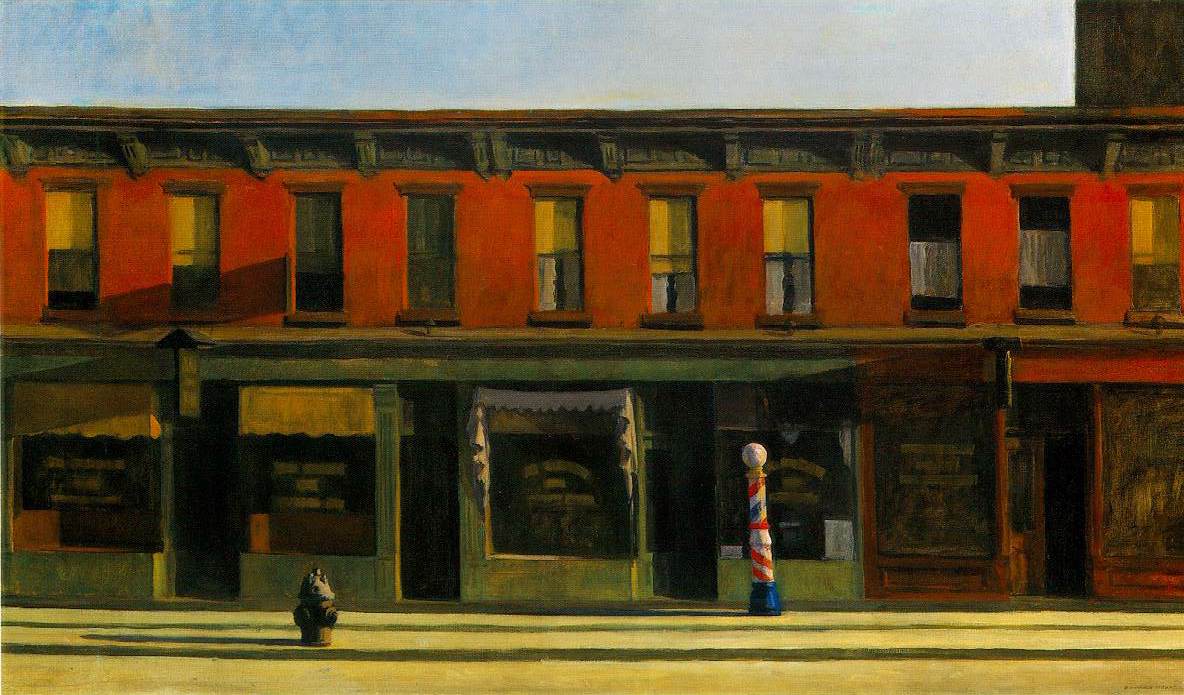
The feel of Sunday Morning Coming Down is unmistakable and for someone who grew up when the Blue Laws were still in effect and Sundays were, for the most part, shut down affairs, it rings true. The Edward Hopper painting at the top, a favorite among many other Hopper favorites, captures that same feeling for me.
The angle of the sunlight creates an unflinching glare on the storefronts that feels like it is burning off the sins of the night before. It has that stillness that comes after long Saturday nights spent knowing that the following day was there for recuperating.
And it brings up the memory of the weekly Sunday dinner from that time. Ours was often a roast chicken meal, if we weren’t going to another relative’s home for the meal.
The song opens up floodgates of memory and feeling. Though the world is now 24/7 all systems go-go, this song takes me back to those slow-moving Sundays of my childhood. There were many Sunday mornings and throughout my life that had that same quality of sunlight and stillness. That surge of personal memory makes this song so memorable for me.
Anyway, here’s the late Kris Kristofferson and Johnny Cash performing his Sunday Morning Coming Down. Thanks for the music and good travels to you, Kris.
“The difference between a path and a road is not only the obvious one. A path is little more than a habit that comes with knowledge of a place. It is a sort of ritual of familiarity. As a form, it is a form of contact with a known landscape. It is not destructive. It is the perfect adaptation, through experience and familiarity, of movement to place; it obeys the natural contours; such obstacles as it meets it goes around.”
― Wendell Berry, The Art of the Commonplace: The Agrarian Essays
**************************
I am a bit distracted this morning so I will make this short. Lots of moving parts this morning with much to do and lots of thoughts running through my mind. Some are small and trivial and some more momentous. Kind of like the difference between a road and a path. The path is the smaller, more familiar one, the comfortable one we walk each day as part of our everyday world. The road, on the other hand, denotes greater distance and further destinations.
My thoughts are of both paths and roads this morning. But none of it is really anything I wish to share now.
Maybe some other time. Maybe. Maybe not.
Instead, I am just going to share a song. It’s one of Johnny Cash‘s late recordings, this one made in the final months of his life. I have commented here before that I believe the work from late in his life was as raw and powerfully deep as anything in his long and illustrious career. This is his cover of a Bruce Springsteen song, Further On Up the Road.
We’re moving into a new decade in a few days and I though I would play some music this Sunday morning that reflected that fact. My personal opinion is that this could be a momentous year with ramifications that could echo down through whatever history we have left here. You can interpret that however you wish, be it with cheery optimism or dark pessimism. It could go either way at this point.
You might get a hint of my own view from the song selection: the Johnny Cash classic, Ring of Fire, written by June Carter. However, this is a different take on the song. Where the original is uptempo with a mariachi guitar band feel, this version from former Animals lead singer Eric Burdon in 1974 has a driving military march feel.
I first came across this version many, many years ago when I found the Eric Burdon album it was from, Sun Secrets, in a bargain bin of 8-track tapes at the old J.J. Newberry five and dime store in Elmira, which, if I am not mistaken, has been closed for decades now. I think I paid a quarter for the tape, which appealed to me had versions of many of Burdon’s earlier Animals’ hits such as It’s My Life and When I Was Young.
Hey, it was a quarter and our car at the time still rocked a player for the massive 8-track cartridges. I was always afraid that if I slammed on the brakes too hard that one of them might fly up and crush my skull.
It turned that some of that album was meh but some of the songs, especially the reworked versions of older songs, really worked. I especially liked this version of Ring of Fire even though the Cash version is perfect as it is. I just like to hear new interpretations, I guess. Give a listen and see for yourself.
The painting above is titled, of course, Ring of Fire. It’s from artist Gina Pfleegor, who also exhibits her work at the West End Gallery. I am proud to have this piece hanging in my studio.
Gina has been a tremendously talented painter of realism for a number of years but has really blossomed in recent years, moving to new levels with a series of metaphorical paintings with female figures as their central focus, many using her daughter as the model. These pieces have a unique quality that make them really sparkle on the wall and engage the imagination of viewers, myself included.
Just plain good stuff. So, take a look her Ring of Fire, give a listen to Eric Burdon’s version of Ring of Fire then brace yourself for whatever 2020 might bring.
“One of the saddest lessons of history is this: If we’ve been bamboozled long enough, we tend to reject any evidence of the bamboozle. We’re no longer interested in finding out the truth. The bamboozle has captured us. It’s simply too painful to acknowledge, even to ourselves, that we’ve been taken. Once you give a charlatan power over you, you almost never get it back.”
― Carl Sagan, The Demon-Haunted World: Science as a Candle in the Dark, 1995
********************************
Earlier this year, I used another passage from this same book by Carl Sagan that decried the dumbing down of America and the celebration of ignorance that he was witnessing at that time, in 1995. As most of us have noticed, if things have changed at all, this celebration of ignorance has only grown.
The passage at the top is an understandable explanation of those who still somehow, beyond all explanation, defend the behavior of trump- the unending lying, the blatant corruption, the sheer amorality, the rampant criminality and the traitorous disloyalty to the office and the nation.
They just don’t want to admit they were bamboozled.
They still believe there is some sort of redemption ahead, some move by trump that will miraculously explain the vast array of lies and corrupt actions that have rained down on us nearly every day for the past three years. Personally, I can’t point to any single moment, any words or actions, any evidence of any kind that has me asking myself if maybe this guy is being somehow unjustly persecuted.
No, he is getting what his actions warrant. That is, if the pillars of our democracy hold.
The bamboozle isn’t over yet. The charlatan is still at work.
For this Sunday morning music, I am presenting a different sort of bamboozlement. There are two videos below from Puddles, the 6′ 8′ clown with the Pagliacci manner and a beautiful baritone voice, and his Puddles Pity Party. He has taken two songs, Johnny Cash’s Folsom Prison Blues and the Who’s Pinball Wizard and mashed them together, switching the lyrics from one to the music from the other.
Both are terrific. It’s like two of my favorite musical artists had weird but fun children. This should be the only sort of acceptable bamboozling.
Give a listen, hopefully enjoy and have a good Sunday.
Over the last couple of weeks, I watched the documentary series, Country Music, from documentary filmmaker Ken Burns. As is the case with most of Burns’ work, it is extremely well done and deeply researched. I can’t say I learned a lot of new info from it but it was fun to again see many of the old films from the early legends.
Every documentary takes a position and holds its own perspective on its subject in telling its story. This one certainly did and I imagine a lot of fans of the current country music scene, which to my ear is more akin to the pop/rock music of the 1970’s and 80’s, were disappointed that Burns didn’t focus on their contemporary heroes. But Burns showed the continuum of country music, which carries that expression of authenticity that marked country music in its truest earlier form, moving into the genre we today call Americana. As a fan of that raw expressive quality found in the real traditional country music of years ago, I was glad to see this observation from Burns.
One of the lessons I learned from this series is that if a majority of people in the country music industry tell you to not do something, you must really be on to something big. Two of the primary artists they focused on, Johnny Cash and Willie Nelson, both fell into this category. I’ve talked about my affection for Cash many times here, including his amazing late in life work that was the result of working with Rick Rubin, a rap/hard rock producer who encouraged Cash to be true to his authentic self in these late recordings. Cash’s family and many in the country music field warned him not to work with Rubin but Cash went ahead and made several successful, both commercially and artistically, albums. I believe they are as close to real art as you will find in country music and they remain an incredible final testament to his life.
A great songwriter with an unusual vocal delivery, Willie Nelson was always a poor fit with the country music industry in Nashville. In the 50’s and 60’s, he tried to conform but it just never came out right. He was the perfect round peg in square hole world. He wrote a number of songs that became hits for others but he himself released a series of mediocre, standard country albums that did not sell well or open any eyes anywhere.
So he retreated to Texas and just began to be Willie, recording and performing in a completely natural manner without any thought as to how he should look or sound compared to others. His work from that time on had that authentic feel that’s the defining quality of real country music.
I’ve been a fan since The Red Headed Stranger, sparse concept album that, with its cinematic feel, tells the story of a cowboy who kills his wife and her lover then goes on the run in a search for redemption. It came out in 1975 and there wasn’t anything that was like it in any way. His songwriting and choice of material was pitch perfect and he harnessed that unusual voice in a way that perfectly captured feeling and emotion of the songs.
Since that time he has continued to make great music, even now in his mid 80’s. He’s worked with a wide variety of artists from many different genres of music and has released a number of great albums including one of my favorites, Teatro, from 1998.
This is really just a long excuse for me to play one of my faves from that album, Darkness On the Face of the Earth. Oh, what the heck, let me throw in Can I Sleep In Your Armsfrom The Red Headed Stranger. I can just shut up now and, if you like, you can give a listen. If you get a chance, take a look at Ken Burns’ documentary on the PBS site. Have a great day.
Another Gallery Talk in the rearview mirror, this one at the Principle Gallery. Many, many thanks to the many folks who came out yesterday to spend an hour with me on perfect end of summer day in the Capital District. It was wonderful to see new faces along with the more familiar faces of the many older friends there who I was able to spend a few minutes catching up with.
This was my 17th Gallery talk there and while it is somewhat easier after all those times, it still is a daunting thing to stand in front of a crowd and talk off the cuff. I wasn’t as smooth yesterday as I had wished and didn’t hit all my intended points. I always fret a bit in the aftermath of these talks about things I have said, worrying that I wasn’t clear or spoke with the wrong attitude for what I was trying to get across.
Or just said something plain dopey.
But I also worry about those things left unsaid. Sometimes there are little anecdotes I mean to tell that get lost in the the brain while I am standing there in front of the group.You would think that in 17 hours of yammering on in these talks over the years, everything would have been said, that everything would have found it way out by now. But I know that’s not the case, that there are still a lot of stories yet to be told and potential secrets to be revealed. I guess I’ll have to start now on getting these things into next year’s Talk which I am aiming to make the best yet.
But this year’s talk ended up as a pretty good talk, even with my own critical take on it. It certainly ended on a high note.
Again, my eternal gratitude to those who came out and especially to the whole staff at the Principle Gallery– my good friends Michele, Clint, Owen, Leigh, Pierre and Josh— for the very hard work done in making it possible. They had a large opening the night before, hosting the 14th annual exhibit of the International Guild of Realism with artists coming from around the country to attend. To turn around in a little over 12 hours and host this event is quite remarkable. I am filled with appreciation and affection for these folks.
So, like I said, mark it down now. Next September– best Gallery Talk ever. Promise.
Here’s this Sunday’s music. I thought I’d show one more piece that went down to the talk yesterday, Eyes of Night, shown above. This song lines up nicely with this piece for me. It’s Field of Diamonds, one of Johnny Cash‘s works from his final years. It was period of great expression and artfulness at the end of his time here on earth. It’s an interesting chapter for an artist with a very long and memorable career.
He saw his career in the future rather than in the past. Wished I had said that yesterday.
Climbed onto the interwebs this morning and made my way to the YouTube. Needed to find something to play for this Sunday morning and wasn’t sure where to turn. Something deep and ponderous? Retro blast from the past? Cool jazz cats?
I didn’t know what would turn up or where I’d find myself.
Oddly, this morning I didn’t have to go far. It was waiting for me on my YouTube homepage.
It was new, just released in mid-July. It was light. It was seasonal. It had a goofy video. It seemed like a nice respite from watching the news and wringing hands.
Well, alright, let’s go with it. It’s a little ditty called Blueberry Jam from Bonnie ‘Prince’ Billy, aka Will Oldham. He’s been a unique voice on the American music scene for a number of years and I’ve featured his music here a couple of times, once with him performing his I Am Goodbye and another with the epic cover of his song I See a Darknessfrom Johnny Cash.
Give a listen and grab a blueberry for yourself this morning.





 Redtree Times