Feeds:
Posts
Comments

Posts Tagged ‘Lord Byron’

Betwixt and Between— At Principle Gallery, June 2025


Between two worlds life hovers like a star,
‘Twixt night and morn, upon the horizon’s verge.
How little do we know that which we are!
How less what we may be! The eternal surge
Of time and tide rolls on, and bears afar
Our bubbles; as the old burst, new emerge,
Lash’d from the foam of ages; while the graves
Of Empires heave but like some passing waves.

Lord Byron, Don Juan (1819)


I’ve had these lines from Lord Byron in my holster for a long time, waiting for the time when they would mesh with one of my paintings. Today seems like as good a time as any to unleash it.

The painting is Betwixt and Between, a smallish 10″ by 10″ canvas that is included in my upcoming show at the Principle Gallery. It’s easy to see by its sky that it is a prime example of the title for this year’s show, Entanglement.  But it also presents an image of our temporal existence between this physical world and that of the ethereal and raises the question: To which do we truly belong?

Maybe we belong to both, real life examples of Schrodinger’s Cat, existing simultaneously in paradoxical states of being. Or maybe not. Who knows for sure?

These lines from Byron also point out that so much that we exult– money, power, fame, etc.–is meaningless in the grand scheme of things. Like the message of the poem Ozymandias from his good friend P.B. Shelley, Byron says that all empires one day fall and are lost to time and tide, exposing the folly of believing that we can attain an immortality of some sort in this world.

We might write our names on the slate of this world, but that slate is eventually and always wiped clean.

As for the painting itself, I am pleased with its look and feel. It speaks easily and simply to me. For me that’s always a good thing. Stark simplicity was a goal for much of the work in this show. I wanted clarity and didn’t want feeling to get lost in detail. This piece very much reaches that goal, at least in the way I see it. I think there’s a lot to see, feel, and think about in this small painting.

Maybe you will see that as well. Maybe not. Who knows?


Entanglement opens Friday, June 13 at the Principle Gallery with an Opening Reception from 6-8:30 PM. I will be in attendance to chat and answer any questions you might have so long as they don’t pertain to advanced mathematics or botany.

I will also be giving a Painting Demonstration at the gallery on the following day, Saturday, June 14, from 11 AM until 1 PM. I will also be in attendance at this event, in case you were wondering.

Read Full Post »

********************

“There is a pleasure in the pathless woods,

There is a rapture on the lonely shore,

There is society, where none intrudes,

By the deep sea, and music in its roar:

I love not man the less, but Nature more”

Lord Byron, Childe Harold’s Pilgrimage

********************

This another new painting, coming in at 24″ by 24″ on canvas, that is headed to the Principle Gallery for my annual solo show there. The show,my 20th solo effort at the Alexandria gallery, is titled Redtree: New Growth and opens on June 7. This painting is titled Solitude’s Rapture.

I don’t know if solitude is for everybody. Some people might look at this painting with a little discomfort, seeing in it isolation and loneliness. But for myself, it represents a total freedom of the self, one that allows one’s absolute truth to emerge. A freedom that allows one to experience clear glimpses of our connection with all being.

The lines above from Byron’s Childe Harold’s Pilgrimage express this feeling well. Alone on a shore, one can begin to hear and converse with nature. The lap and roar of the sea becomes language as does the light of the sun and moon as it sifts through clouds above. It is in these conversations that we come to better understand that we are both small and large, insignificant yet integral.

Of  course, this is not a practical matter for most of us. I have my own little island of solitude here in my studio but I am not isolated. My regular life has me out in the world, interacting with people on a regular basis. But knowing that I will soon be back on my island where the only conversation taking place is in myself.

Hermann Hesse put it well in the excerpt below from his book, Reflections. He mentions it as being a way of bitter suffering. I suppose initially, for those who have been always in the society of others and seldom alone, this may be the case when faced with solitude. But, as he points out, when you get past that discomfort, the rewards of solitude are rapturous.

*********************

“We must become so alone, so utterly alone, that we withdraw into our innermost self. It is a way of bitter suffering. But then our solitude is overcome, we are no longer alone, for we find that our innermost self is the spirit, that it is God, the indivisible. And suddenly we find ourselves in the midst of the world, yet undisturbed by its multiplicity, for our innermost soul we know ourselves to be one with all being.”

Hermann Hesse, Reflections

**********************

Read Full Post »

Dare to Know

+++++++++++++++++++++

Prejudice may be trusted to guard the outworks for a short space of time, while Reason slumbers in the citadel; but if the latter sink into a lethargy, the former will quickly erect a standard for herself. Philosophy, wisdom, and liberty support each other; he, who will not reason, is a bigot; he, who cannot, is a fool; and he, who dares not, is a slave.

William Drummond, 1805

+++++++++++++++++++++

The last line of this quote [ he, who will not reason, is a bigot…] from Scottish philosopher William Drummond is often mistakenly attributed to Lord Byron. Whether it was Drummond or Lord Byron doesn’t really concern my use of it. But its words ring true in these times where those who know better refuse to reason sensibly, where those without  an ability to reason follow those who play to their foolishness, and those that dare not to step forward to speak against fools and bigots is forever enslaved to these same fools and bigots.

Dare to reason. Dare to know. Dare to speak up.

+++++++++++++++

The painting at the top is a piece from last year that remains a favorite of mine. It is titled Dare to Know.

Read Full Post »

GC Myers- Jumping Off PointBetween two worlds life hovers like a star,
‘Twixt night and morn, upon the horizon’s verge.
How little do we know that which we are!
How less what we may be! The eternal surge
Of time and tide rolls on, and bears afar
Our bubbles; as the old burst, new emerge,
Lash’d from the foam of ages; while the graves
Of Empires heave but like some passing waves.

Lord Byron, Don Juan

***************

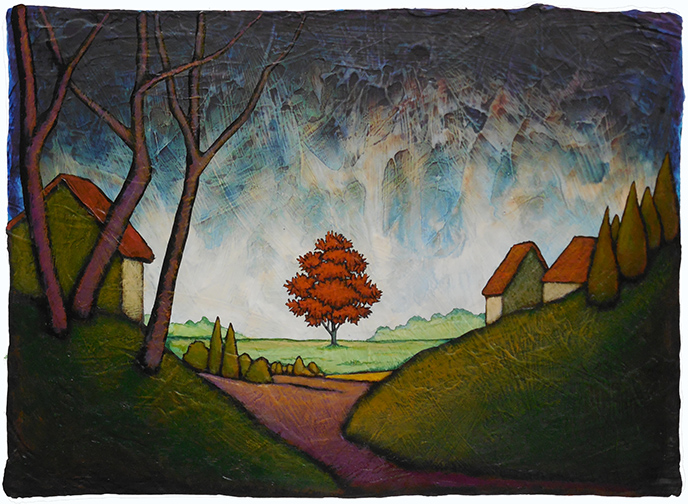
I chose the stanza above from Lord Byron’s Don Juan to kind of describe this new painting because it seemed to fit so well what I was seeing in this piece.

When I look at it the Red Tree seems to be an intermediary between differing worlds–  between the solid ground of earth and the airiness of the heavens, between the closer living of the settlement of houses and the wide open spaces of the fields and hills beyond, between the now and eternity, between the visible and the invisible.

Standing with one foot in either world, it becomes a moment of contemplation on the temporary nature of our existence.  Standing there before the suddenly visible and unrelenting power of nature and the universe– the eternal surge of tide and time— the Red Tree recognizes its own smallness and insignificance–How less what we may be!

This idea of  insignificant beings living but for a short time may seem like a dismal prospect to some.  But I don’t see it that way.  If anything, I see this as a celebration of just having the opportunity to bear witness to the grand spectacle of life set before us each day, to have a chance to play a part, albeit small, in the machinations of the universe.

Maybe this is too much for a simple painting such as this to bear.  Maybe you will not see it in the same way, only seeing a tree on a mound overlooking a group of houses with a patterned sky.  That’s fine because in its simplest terms that is what it is.

But even the simplest moments and images can have greater depth and meaning if we only choose to look more closely, to choose to perceive our place in the world in a different manner.

Well. that’s what I think anyway…

—Oh, this painting is 18″ by 18″ on canvas and I am calling it Jumping Off Point.

Read Full Post »

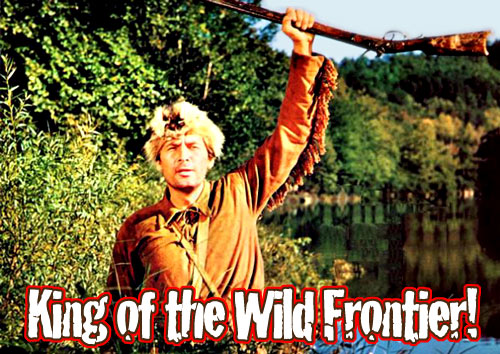
Fess Parker died last month.  He probably isn’t too well known to the younger generations but for anyone who grew up in the 50’s and 60’s, he was a big deal.  Portraying Davy Crockett in the movies and Daniel Boone on television, Parker was one of the biggest stars for kids of that time.  He became the personification of the mythical American frontiersman, the civilization shunning, wise old man of the mountains who lived off the land and gloried in his personal liberty.

Elbow room! cried Daniel Boone.

Popular myth has long glorified the lives of Boone and Crockett.  In the 1780’s, Boone exploits entered popular culture in a book that was more myth than fact.  It became a huge hit here and abroad, creating a legend that took on a life of its own, even influencing Lord Byron to make mention of Boone’s tales in his Don Juan.  He was portrayed as an Indian-fighting man of action who continually fled the reach of an ever impinging civilization.  A man who lived by his own rules without any concern for government.  Davy Crockett, in popular legend, was seen in much the same terms.  This mythic image of both has found its way into our collective psyche where it still dwells today, influencing our very definition of American liberty and the relationship of the common man to our government.  The Tea Party movement is filled with folks who grew up with these myths and surely believe that they can live a life like Daniel Boone or Davy Crockett, if only they could break the shackles of  government.

Unfortunately, many of the myths surrounding both men are unfounded and their real lives run counter to those who hold up their mythic images as a rallying flag.  Both were men were land-owners and served the government, Boone serving as a legislator and sheriff and Crockett as a congressman.  Both were leading citizens of their communities and basically enacted governance wherever they lived, prospering in civilization.  Boone’s biggest gripe with government came when he lost several land claims in a legal dispute about the same time he lost a government bid to another bidder for a contract to widen the Wilderness Road to aid in the westward expansion of the country.

I don’t really know why I’m mentioning this today.  Maybe it’s frustration at the rhetoric of some of the anti-government groups that have been filling the air recently.  Their usurping of American myth to fit their own selfish aims reminds me of evangelists who pull verses from the scriptures and throw them around out of context to prove their own selfish point.  Maybe that’s what I’m looking for here- context.

And an end to living a life based on unfounded myths such as the rugged individualist.

Read Full Post »