I don’t have much to say today. Oh, I have plenty to say but I am going to spare you having to hear it. I just want to get to work this morning seeing as it’s March 1 which translates to me as march forward as I prep for my annual shows. It’s total immersion time.
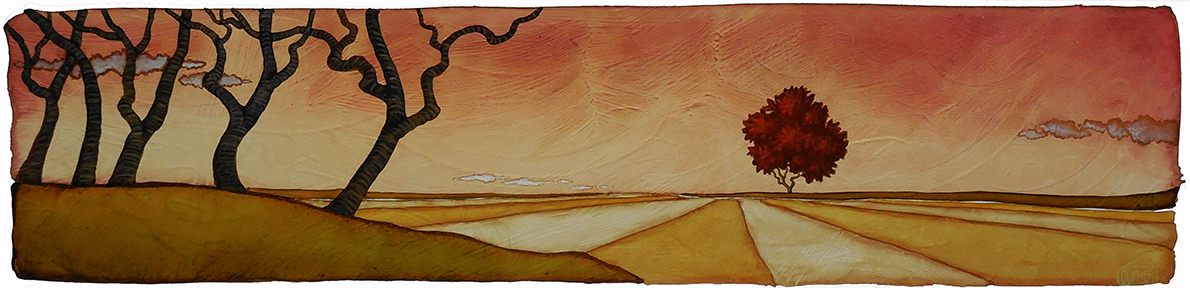
So, let’s keep it short today. I want to show a coupling of a song and a painting which I think works well together. The painting is above and is titled Blaze. It’s one of those pieces that have somehow found their way back to me and this one always confounds me. It felt so right and easy– graceful–off the hand. Even now, I always stop and look at this piece for the longest times, wondering why it is here. I guess it just hasn’t met its rightful partner yet.
The song that I matched up with Blaze is Wild Is the Windfrom Nina Simone. It was originally recorded by Johnny Mathis for a movie of same title in the 1950’s. It’s a little overproduced for my taste but the song is undeniably strong. Nina Simone took it and made it into a spare and special song. It was used as the title track for her 1966 album which is considered one of the greatest albums of the 1960’s, remarkable in a decade filled with legendary albums. David Bowie also is noted for performing this song, which was done as a tribute to Simone.
Joni Mitchell- The Mountain Loves the Sea- watercolor 1971
Over the years, I have often been asked about influences on my work and I often list several artists that I feel pushed me in certain directions. Then I also point out that there have been influences that fall outside of the painter mode. For example, literature, poetry and film come immediately to mind. Then there’s pop culture such as cartoons and comics, television and so much more. I’ve mentioned that there was a Coca Cola tv ad back in the 80’s that featured saturated colors– reds and golds– that stuck in my mind for years before I began painting.
There are so many contributing sources of inspiration.
I mention this today because as I was looking for a piece of music to play this morning, I came across the old Joni Mitchell album from 1974, Court and Spark. It was a great album, one that I loved even as a teenage boy. I had not listened to it in years but each of the songs was imprinted in me by this time.
I also hadn’t looked closely at its album cover for many, many years though it was a beautiful cover, cream colored with a small watercolor painting, The Mountain Loves the Sea, that Joni Mitchell had painted a few years before, tastefully in its center. It had a simple elegance that I recognized, again even as a teenage boy. But it was just one of those things that, because I had seen it so many times before, I didn’t look with any attention at all.
But I looked closer today at the painting in the cover’s center and was surprised at how much my own work sometimes held echoes of this little painting. I would never thought of Joni Mitchell as an influence beyond her music but looking at this little image made me rethink that.
Maybe it was just one of those little things that push you without your knowledge in one direction or another. Influences that you internalize and can’t recognize or name until you come face to face with them. We all have them, those small things we take in and blend together to make us who we are.
I am glad this was one of those things for me. So, let’s give a listen to the title track from Court and Spark.
The writer operates at a peculiar crossroads where time and place and eternity somehow meet. His problem is to find that location.
–Flannery O’Connor
**********************
I think you could probably substitute artist in for writer in the words above from author Flannery O’Connor (1925-1964) without changing the gist of the thought too much. All art, and literature certainly falls into that category, is about transforming the now of the creation– the time and place— into something beyond that moment, into something timeless–the eternity to which O’Connor refers.
Finding that intersection where those two things come together is, as she points out, not such as easy thing to accomplish. And almost every instance the artist will never know if they have come to those crossroads that moves their work into the realm of the eternal.
I guess the finding is immaterial without the seeking. And seeking without any assurance of finding something that will ever reveal itself to you is an act of faith, a belief that there something eternal worth seeking.
I don’t know what else to call it. You keep trying. You think it is near sometimes but when you finally come to it, you’re not sure enough of what you’re experiencing to stop seeking.
Does one ever know when they have come to that crossroads?
That being said, here’s this week’s Sunday morning music from a longtime favorite of mine, Tracy Chapman. I think her body of work sometimes get overlooked in the deluge of the new but every time I come back to her, I wonder how I have let her slip out of mind. Here’s a song that fits the subject here, Crossroads, to accompany the painting at the top, Beyond the Crossroads, from back in 2004.
Have things to do so I am going to be short with this this morning. It’s that time of year and I have to get out of the lazy funk that has hung on me for the last few months and get back to doing some real work.
It’s funny how you can drift away from the thing that makes you feel best. But coming back to it is like coming home.
And that’s where I am headed.
So this morning, for this week’s musical choice, I am going with Tuba Skinny, a group out of New Orleans and their street performance of Going Back Home. Just feels right this morning.
Give a listen. Dance around a bit. Have a good week.
“No matter how corrupt, greedy, and heartless our government, our corporations, our media, and our religious & charitable institutions may become, the music will still be wonderful.”
― Kurt Vonnegut, A Man Without a Country
***************************
It’s obvious that the removal trial coming before the Senate is being rigged by the GOP leadership to have no witnesses, no press coverage and as little evidence as possible. It is a travesty that mocks the entire concept of law and justice. It is a slap in the face of all citizens.
It’s infuriating. But I didn’t want to write about that today. So, I won’t.
However, I did come across a great quote from the late Kurt Vonnegut that allows me to use it to somewhat comment while moving on to something else. Vonnegut reminds us that while the coming days may mark the end of the Great American experiment as we know it, we have made some great music. Hopefully, that part of us will not change.
It reminded me of a post from several years back that I am running again today:
**********************
Last week I wrote about going through some old work and coming across work that had been lost in my memory, work that I seemed to recognize but couldn’t quite remember the how or why of it. Didn’t have that recollection of the moment that I usually have with my work where I can recall the emotion of that time, recall the instant it excited me and came to life for me. You know it’s your own work but it remains an enigma, a question. This is another that I came across last week. It was marked as being from 1994 and was titled American Music across the bottom.
I have looked at this piece a number of times over the year and know that it came from a time when I was experimenting on an almost constant basis, trying to capture that thing in my mind that I couldn’t quite identify but knew instinctively was there. All kinds of things poured out, most eventually set aside like this one. And through the years, looking at this piece always makes me question why I wrote American Music across the bottom of the sheet it was painted on. I don’t know if I saw some rhythm in this that reminded me of a generic American music or if I had been listening to some old music. The Blasters, fronted by Phil Alvin, had a song of that name in the early 80’s that I always liked so maybe that played a part.
But the fact is that I just don’t know. And there’s something interesting in that, that I get to look at a piece and try to figure out what the artist was thinking without really being sure. It’s not too often that you get to do that with your own work. And I think that’s why I gravitate to this piece whenever I go through my old stuff.
An enigma wrapped in a riddle wrapped in paint.
Maybe you can figure it out. Here are The Blasters with the original version of their song,American Music.
I wrote an entire entry just now for this blog and, after reading it over, I decided to chuck the whole thing. Just didn’t hit the mark, didn’t feel right.
Sometimes it’s better to just go back to square one than try to cobble together something that is rickety from the start. Or just do something altogether different.
So, this morning I am just going to say ‘To hell with it’ and play a song that soothes me in some small way.
It’s a Lou Reed song, Sunday Morning, from his days with the Velvet Underground in the 1960’s. The late model/singer Nico, best known for Andy Warhol transforming her into a Pop Art icon, does the vocals here but you can hear Lou’s voice in her vocals.
It has that familiar Velvet’s drone that I think gives it that soothing quality I am looking for this morning. Plus, this is kind of a neat video.
The Australian wildfires are still raging. Sheer devastation. Well over 18 millions acres (think about it as every single inch of Vermont, New Hampshire and Massachusetts being burnt to the ground) up in flames along with dozens of lives, thousands of homes and a staggering amount of wildlife. The current estimate that the number of animals and birds is that well over a billion creatures have perished. Those that survive face a grim future with an environment that will take years to rebound.
That is, if it ever can.
It’s heartbreaking. No, it’s more than that. Heartbreaking seems almost too trivial a word for the holocaust taking place. It’s more like a jagged rip in the very fiber of our souls. As helpless as we feel here on the other side of the globe, as hopeless as it seems from such a distance, we must not turn away.
Their horror may well be the future for many of us.
We have been warned for decades that this time was fast approaching but hubris and greed made us ignore and even scoff at the suggestion that we were destroying the environment that had once been so hospitable to us.
I don’t know what the answers are for climate change or even how to properly help our animal and human friends in Australia. But I know I can’t ignore the problem, can’t just shrug and say that my time here is short now that I am well into middle age and that it’s a problem for those younger than me. It’s that sort of ignorance and carelessness that allowed this to happen in the first place.
I am looking for answers, even if they are small. I can’t save Australia with my small donation but maybe it can help one small displaced creature, plant a tree or two or do anything to alleviate the pain caused by our treatment of this earth.
I hope you will look for answers as well.
This Sunday morning music is a song from the great Dinah Washington from back in 1960 called This Bitter Earth. I am also including a version of the song that combines her original vocals with a musical piece from contemporary composer Max Richter, On the Nature of Daylight, which is a piece of music that I have played here before. The two combine to create a powerful statement that is fitting for this subject and this time.
I hope you’ll listen to both. And don’t turn away. Do even one small thing to help someone on this bitter earth.
I was going back through some old things on this site and came across this piece of music that I shared here several years ago. Listening to it took my mind far way from the subject I had intended to write about this morning.
So far, in fact, that I can’t even recall that original thought stream. It must not have been too important.
So, forget what I was going to say and, if you’re so inclined, give a listen to that piece of music. It’s called Miss Sarah off the album Blues Twilightfrom jazz trumpeter Richard Boulger.
Maybe it will distract you from something you intended on doing, as well.
PS: The painting at the top is a fave of mine, Pause in the Moonlight, which is at the West End Gallery.
All is quiet on New Year’s Day A world in white gets underway I want to be with you Be with you, night and day Nothing changes on New Year’s Day On New Year’s Day
—U2, New Year’s Day
****************
Found myself beginning the new year this morning walking to the studio through the woods in the dark before 6 AM.
Like the song says: Nothing changes on New Year’s Day.
I always think of this song on New Year’s morning because there is always a preternatural quiet on these mornings.
Today was no different.
It’s an absolute stillness free of all noise. Even the deer whose eyes glow green in the light of my headlamp as I scan the forest, make no sound. They are motionless and when they finally move there is no snort of alarm, no crunch of leaves, no breaking of branches.
Just a stealthy movement of shadows against an empty void of blackness. It makes me stop for a moment just to listen, trying to absorb as much of that quietude as I can with the hope that I can recall this glorious absence of sound when I need it at some point later.
It makes me think of the old Elvis song If Every Day Was Like Christmas with its lyrics that ask: why can’t every day be like Christmas? I think a more appropriate question would be why can’t every day be like New Year’s Day?
The pressure of the holidays is past. No concerns about gift giving. It’s a fresh start, with the old and worn last year fading into the grainy grayness of the past and the new year stepping in, all shiny bright and full of potential. Even the most pessimistic and jaded of us most likely feels at least small glimmers of hope on this day.
And why not? It’s a clean slate, a tabula rasa, on which anything can written. It is a time, a moment, that assures us that there are no limits on what we can do in the coming year and the coming decade.
Of course, the pragmatic part of me knows that it is just as the song says: Nothing changes on New Year’s Day.
But this morning, at least for a while, I will try to hang on to the belief that there is change coming in this shiny new year. For the better, I hope.
Here’s the song New Year’s Day from U2 from way back in 1983. Time flies so enjoy this quiet morning.
We’re moving into a new decade in a few days and I though I would play some music this Sunday morning that reflected that fact. My personal opinion is that this could be a momentous year with ramifications that could echo down through whatever history we have left here. You can interpret that however you wish, be it with cheery optimism or dark pessimism. It could go either way at this point.
You might get a hint of my own view from the song selection: the Johnny Cash classic, Ring of Fire, written by June Carter. However, this is a different take on the song. Where the original is uptempo with a mariachi guitar band feel, this version from former Animals lead singer Eric Burdon in 1974 has a driving military march feel.
I first came across this version many, many years ago when I found the Eric Burdon album it was from, Sun Secrets, in a bargain bin of 8-track tapes at the old J.J. Newberry five and dime store in Elmira, which, if I am not mistaken, has been closed for decades now. I think I paid a quarter for the tape, which appealed to me had versions of many of Burdon’s earlier Animals’ hits such as It’s My Life and When I Was Young.
Hey, it was a quarter and our car at the time still rocked a player for the massive 8-track cartridges. I was always afraid that if I slammed on the brakes too hard that one of them might fly up and crush my skull.
It turned that some of that album was meh but some of the songs, especially the reworked versions of older songs, really worked. I especially liked this version of Ring of Fire even though the Cash version is perfect as it is. I just like to hear new interpretations, I guess. Give a listen and see for yourself.
The painting above is titled, of course, Ring of Fire. It’s from artist Gina Pfleegor, who also exhibits her work at the West End Gallery. I am proud to have this piece hanging in my studio.
Gina has been a tremendously talented painter of realism for a number of years but has really blossomed in recent years, moving to new levels with a series of metaphorical paintings with female figures as their central focus, many using her daughter as the model. These pieces have a unique quality that make them really sparkle on the wall and engage the imagination of viewers, myself included.
Just plain good stuff. So, take a look her Ring of Fire, give a listen to Eric Burdon’s version of Ring of Fire then brace yourself for whatever 2020 might bring.