Feeds:
Posts
Comments

Posts Tagged ‘Pablo Picasso’

GC Myers- Time Patterns 2024

Time Patterns– At West End Gallery


I can hardly understand the importance given to the word research in connection with modern painting. In my opinion to search means nothing in painting. To find is the thing. Nobody is interested in following a man who, with his eyes fixed on the ground, spends his life looking for the purse that fortune should put in his path. The one who finds something no matter what it might be, even if his intention were not to search for it, at least arouses our curiosity, if not our admiration.

Pablo Picasso, “Picasso Speaks,” 1923


To find is the thing…

I often write here about searching for something with my work. It’s usually something I can’t describe in any way that helps myself or the reader. It’s just something that pulls me forward.

Well, that’s what I thought, for the most part.

Reading the passage above from Picasso recently set me thinking that perhaps it was not a search at all, at least not in the way I had portrayed it.

Perhaps I was driven onward because I had found something and felt the need to express and share it. Or perhaps to keep that feeling of discovery, that eureka! moment, alive within myself– and within others who sensed whatever I had found for themselves when they viewed the work.

I can’t say for sure. I am still wrangling with this. But it makes some sense to me. A painting begins as an exploration, a search, but as it progresses it moves toward a revelation of some sort. The search is in the process, not in the resulting work.

At least, for the artist. It may differ for the viewer. They may see it as a way toward something they need and seek. Something they may not even realize is needed or sought. Perhaps they will find that same thing in the final work that that I had found, that same thing that seems to somehow answer vague, unasked questions.

Who knows for sure? But this idea that the work in not so much a search as it is a revealing of what has been found satisfies something in me.

Maybe that what was I was looking for in the first place?

Or maybe this is all one of those dreams where everything you wonder about suddenly seems to make perfect sense and there is that momentary feeling of elation that is then suddenly and completely gone once your eyes open.

Could it be that?

I don’t know but here’s an old song from Todd Rundgren that came to mind while I was finishing up. I haven’t heard this tune in many years and Todd Rundgren is one of those artists who was very popular in the 70’s but has faded somewhat from the front of the public mind the in the decades that followed, though he still is actively recording and performing. Just on a smaller stage as the musical outlets    became narrower and more niched. This is I Saw the Light.


Read Full Post »

9921076 To the Limit sm

To the Limit“- Part of the upcoming West End Gallery show


The purpose of life is to discover your gift.
The work of life is to develop it.
The meaning of life is to give your gift away.

— Dr. David Viscott


I wasn’t going to write about this today but I came across a tweet yesterday from a well known law professor who I highly respect using the quote above. Well, he used the shorter version– The meaning of life is to find your gift. The purpose of life is to give it away— which cuts out the developmental stage in the middle.

All fine and dandy. However, he attributed it to Pablo Picasso. Things immediately stirred my interest because I like Picasso and he has actually said some very noteworthy things that end up as oft used quotations. But this just didn’t sound right.

So, off to Quote Investigator and, sure enough, there it was. No evidence of Picasso ever saying this nor Billy Shakespeare — I can call him that as we go way back– who is also often given credit for this quip.

No, it turns out that the first evidence in print came from a radio/TV psychiatrist who was very popular in the 1980’s and early 90’s, Dr. David Viscott. He died in 1996 at the age of 58. I don’t really remember him but he was pretty well known  for his fast diagnoses of callers problems and his in depth discussions on the required pharmacology. He even entered popular culture with his voice being the inspiration for the cartoon psychiatrist Dr. Marvin Monroe, who appeared regularly on the first seven seasons of The Simpsons

The earliest mention of the same sort of sentiment but in different, more specific words comes from an 1843 essay titled Gifts from Ralph Waldo Emerson:

Rings and jewels are not gifts, but apologies for gifts. The only gift is a portion of thyself. Thou must bleed for me. Therefore the poet brings his poem; the shepherd, his lamb; the farmer, corn; the miner, a stone; the painter, his picture; the girl, a handkerchief of her own sewing.

Perhaps Emerson was the David Viscott or Dr. Marvin Monroe of his era? His advice is very much the same though it is a bit dated with females, half the population, being relegated to sewing handkerchiefs. Thankfully, today females populate every field of endeavor and can do much more than sew hankies. I don’t want to offend any hankie sewers out there but how many hankies do we really need?

But the idea of giving of yourself, to share what you do best with those you love as well as the rest of the world, is the idea here. The idea that thought, effort, and time have went into a gift make them all the more precious. Even now, as I sit here, I have several gifts within sight that have been given to me over the years. Each is precious to me for just those reasons.

The tragedy is that so many of us never find that gift or overlook it when it is right in front us. Or even more tragically, that for whatever reasons, we never try to follow the hints to our gift that we do recognize. 

So, now that we’ve cleared up the origins of the advice at the top, get out there and do something that you love and share it with friends or family or the rest of the world.

It’ll make your day as well as that of someone else.


The painting at the top, To the Limit, is a new piece that is included in my upcoming show, Through the Trees, that opens next Friday, July 16th, at the West End Gallery in Corning. I used this painting for this post because the blowing tree often represents for me self-sacrifice and the giving of all to an effort. I guess that would make for a splendid gift.

Read Full Post »

******************

I was checking YouTube yesterday to see if the videos from last week’s Virtual Gallery Talk from the West End Gallery were being viewed. As I came to my page I saw a strange looking entry among my suggested videos. It was my name as a title appearing to overlay what I could see was my work underneath.

There was lettering above my name that appeared to me to be Korean. Clicking on it, I saw that it was a compilation of my work set to three pieces of music with photos of me along with what appeared to be biographical info, all gleaned from the internet.

It’s a strange sensation to see your work in this way, compiled and used by someone else. I am sure there are those of you out there who feel I should be upset over the unauthorized use of my imagery in this way and maybe you’re right. But I knew that once I began putting my work online as I do, it would possibly be subject to this sort of thing. I felt it was worth the risk in order to get my work out there.

I sometimes at gallery talks tell the story of the great photographer Brassai asking his best known subject and friend Pablo Picasso for advice on selling some drawings he had created. For how much should he sell them, for example. Picasso, who liked the Brassai drawings, told him to put a very low price on them because he needed them to get out into the world where they could be known and be seen. Where they could establish a name and achieve a noteworthiness that might one day make all his work valuable. Picasso claimed that had been his route.

It’s advice I still give young artists.

And that’s how I view this– a result of putting my work out into the world.

Actually, I am happy and flattered that my work has reached across the world and translates well into other cultures. You go into this hoping your work speaks to all people and to get a small bit of proof that it might doing that is gratifying.

There are worst things in this world.

Take a look, if you so desire. I could do without the photos of myself but I like the musical accompaniment’s different moods. Have a good day.

Read Full Post »

Autobiography

Three-Musicians-By-Pablo-Picasso*****************

For those who know how to read, I have painted my autobiography. 

-Pablo Picasso

***************

The image and quote above ran here several years ago with just a few words from me. I am going to run it that way today as well. It’s a simple statement that I agree with so why muddy the waters with unnecessary verbiage?

Now, I have to get to work on the next chapter of my autobiography so have a good day, okay?

Read Full Post »

*****************

Artists who live and work with spiritual values cannot and should not remain indifferent to a conflict in which the highest values of humanity and civilization are at stake.

–Pablo Picasso

******************

I always worry about alienating people who come to this blog to read about art and are greeted with my opinions and beliefs on the world. But reading the words above from Pablo Picasso this morning reminds me that my art is a product of all that I am and all that I witness in this world. I like to think that the work is about the human spirit and emotion. As such, I can’t remain indifferent or ignore those things that set off my emotional alarms nor those that eat away at what I see as the collective human spirit that we all share.

Thinking this made me look for another blog entry that I wrote just a couple of years back that featured some other words from Picasso as well the painting above, his masterpiece Guernica.

Here it is:

***************

Art is a lie that makes us realize the truth.

Pablo Picasso

****************

Many of my favorite artists worked and produced their greatest works in times where the world was under great stress. Two World Wars only decades apart and– in the case of Picasso– the Spanish Civil War in between. Here, we had the Great Depression. Times of social transformation and spiritual upheaval. Even when the work didn’t overtly deal with the events of the day, much of the work reflected on the collective consciousness of that time.

I think that is so because art is, just as Picasso so succinctly states, a lie that makes us realize the truth.

Artists fabricate, often creating work that is on its surface pure fantasy with little relation to the world as others might observe it. But their fabrication is made up from everything that impacts them– their knowledge, their observations, their opinions and emotions. Artists take in the world and create something that seems like a pure fabrication.

A lie.

But what seems the lie often proves to be built of ultimate truths, just constructed in a manner that allows others to see this truth clearly.

I don’t know that we artists always succeed. I certainly don’t feel that I do as often as I would  like. But when a piece succeeds and shows us something far beyond what its surface represents, it is a true revelation.

Believing that, so long as we feel deeply and continue to create our lies, we will at some point reveal a truth.

Got to get to work now…

Read Full Post »

+++++++++++++

How often have I found that wanting to use blue,

I didn’t have it so I used a red instead of the blue.


–Pablo Picasso

++++++++++++++++

This year’s edition of the Genius series begins this coming Tuesday on the National Geographic Channel. This well done series premiered last year with a season dramatizing the life of Albert Einstein. This year it focuses on the life of Pablo Picasso, with Antonio Banderas portraying the artist. Given Picasso’s knack for pushing boundaries and stirring the pot, it could be an entertaining series.

He is probably the most quoted of artists, though many things are mistakenly attributed to him. It’s a case that if it sounds interesting and you’re not sure who might have said it, you credit him or Shakespeare or Lincoln or some other iconic figure.

But I have a feeling that the quote I chose here today is actually his. I can’t see Lincoln saying it.

I certainly know the circumstance to which he refers.

Been there, done that.

In a pinch, you just make do with what you have because you can’t always wait until you have perfect conditions, all the materials you desire and a moment of inspiration are in complete alignment. Sometimes inspiration is there and you don’t have what you would ideally want to use but you still want to make that mark.

A number of years back, I was having some real back problems. I had to that point always painted in a standing position but the pain forced me to sit. I found that there were points where I would reach for a color that I would normally use in certain instances and find it out of reach, across the room. Instead of straining out of my seat and limping to get it, I would take whatever was within my reach and try to either replicate the color or completely substitute another color.

In many ways, it was a good experience. Where I had used reds before, there were blues or greens. Turquoise tended to turn to purples and maroons.

Because my work doesn’t depend on accuracy in depicting natural color, it actually stretched the work a bit more and reinforced that idea that one must make do with what one has at hand. It’s something I have often tried to impress on young artists, that they should never use not having everything they think they need to start as an excuse to not start.

If they have a real creative urge, then they will make do, they will find a way.

The results may exceed what their mind had imagined.


Read Full Post »

Art is a lie that makes us realize the truth.

Pablo Picasso

****************

Many of my favorite artists worked and produced their greatest works in times where the world was under great stress. World wars and– in the case of Picasso’s painting, Guernica, shown above– Civil Wars. The Great Depression. Times of social transformation. Even when the work didn’t overtly deal with the events of the day, much of the work reflected on the collective consciousness of that time.

I think that is so because art is, just as Picasso so succinctly states, a lie that makes us realize the truth.

Artists fabricate, often creating work that is on its surface pure fantasy with little relation to the world as others might observe it. But their fabrication is made up from everything that impacts them– their knowledge, their observations, their opinions and emotions. Artists take in the world and create something that seems like a pure fabrication.

A lie.

But what seems the lie often proves to be built of ultimate truths, just constructed in a manner that allows others to see this truth clearly.

I don’t know that we artists always succeed. I certainly don’t feel that I do as often as I would  like. But so long as we feel deeply and create our lies, we will at some point reveal a truth.

Got to get to work now…


Read Full Post »

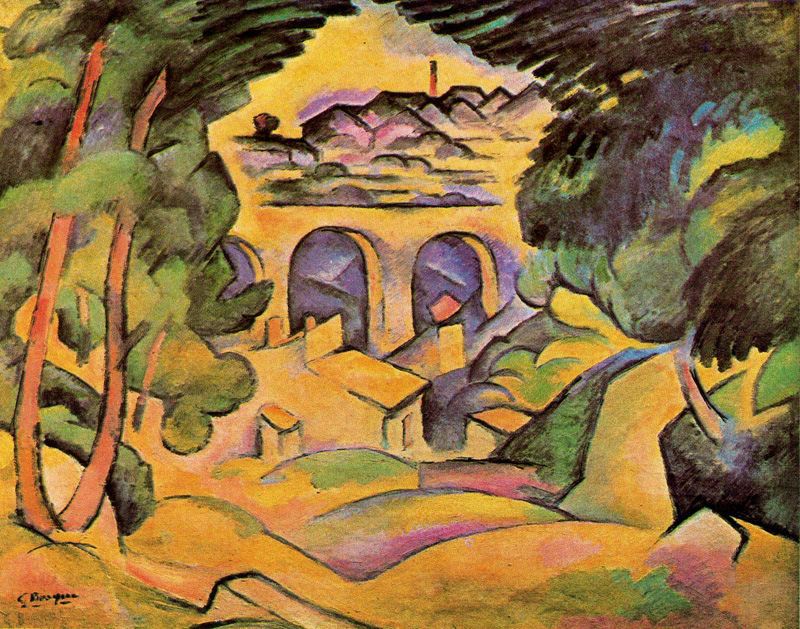
“There is only one valuable thing in art: the thing you cannot explain.”

 — Georges Braque

*******************************


This is a quote from artist Georges Braque that I used on the first artist statement I ever wrote many years back. It still pops up in my mind on a regular basis, especially at times when I find myself looking at a just finished painting, wondering what is there that is triggering my emotional response to it.  These words from Braque reminds me that what I am trying to capture is not the subject matter, not a mere representation of reality.  I am trying to capture an indefinable feeling or spirit that is not calculable or even visible.

Definitely beyond the reach of my words.

It is the sum of color and light.

And texture and line.

And the spaces in between.

It is of the spirit and the life force.   When it is there, it is obvious and undeniable. And though I can’t explain it, I can see the purpose and value of that work.

And that is a good day…

***********

I have never really focused here on the work of George Braque (1882-1963) who is mainly known as one of the major artists, along with Picasso, of the Cubist movement. His work, through all the differing phases of his long career, is always impressive. I thought I’d share the video slideshow below of his work. It’s set to Mozart’s Piano Concerto No. 21, better known as the Elvira Madigan concerto, which makes it a most pleasant and calming thing to spend a few minutes with on the first cool morning of November.


Read Full Post »

Yesterday I wrote about how the truth, particularly as it applies to the news, has become a subjective item.  It seems to be more about how we feel about something rather than what the facts provide. This in turn allows falsehoods to become accepted as truth in the eyes of some despite all evidence to the contrary.  It’s an unfortunate scenario that may have already affected us  and may create awful consequences at some point in the all too near future.

But you can’t judge the facts like you’re judging a piece of art.  The facts should not be affected by how you feel about them or whether you like or dislike them.  They stand as they are.  Can you imagine being innocent and on trial?  All of the evidence and testimony proves your innocence but you are convicted because the jury felt that you were nonetheless found guilty.  The jury just didn’t like something about you.

Unfortunately, that’s not that far-fetched an analogy.  

I thought I’d run the post below from a few years back that talks about how the emotional subjectivity is appropriate in art, where your feeling is as important as the facts.

Painting is a blind man’s profession.  He paints not what he sees, but what he feels, what he tells himself about what he has seen.

–Pablo Picasso

********************

I love this quote from Picasso.  I think that is what all art really is– an expression of  feeling.  Emotion.  I know my best work, or at least the work that I feel is most directly connected to who I truly am as a human being, is always focused on expressing emotion rather than depicting any one place or person or thing.  At its best, the  piece as a whole becomes a vehicle for expression and the subject is merely a focal point in this expression.  The subject matter becomes irrelevant beyond that.  It could be a the most innocuous object,  a chair or a tree in my case.  It doesn’t  really matter because the painting’s emotion is carried by the painting as a whole-  the colors, the texture, the linework, the brushstrokes, etc.

In other words, it’s not what you see but what you feel.

I think many of  Vincent Van Gogh‘s works are amazing example of this.  They are so filled with emotion that you often don’t even realize how mundane the subject matter really is until you step back to analyze it for a moment.  I’ve described here before what an incredible feeling it was to see one of his paintings  for the first time, how it seemed to vibrate with feeling, seeming almost alive on the wall.

It was a vase of irises.

A few flowers in a pot. A floral arrangement.  How many hundreds of thousands of such paintings have been created just like that?  But this Van Gogh painting resonates not because of the subject matter, not because of precise depiction of the flowers or the vase.  No, it was a deep expression of his emotion, his wonder at the world he inhabited, inside and out.

I also see this in a lot of music.  It’s not the subject but the way the song is expressed.  How many times have we heard overwrought , schmaltzy ballads that try to create overt emotion but never seem to pull it off?  Then you hear someone interpret a simple song with deep and direct emotion  and the song soars powerfully.  I often use Johnny Cash‘s last recordings, in the last years  and months before his death, as evidence of this.  Many were his  interpretations of well known songs and his voice had, by that time, lost much of the power of his earlier days.  But the emotion, the wonder, in his delivery was palpable.  Moving.

Likewise, here’s Chet Baker from just a few months before his death.  He, too, had lost the power and grace of youth due to a life scarred by the hardship of drug abuse and violence.  But the expression is raw and real.  It makes this interpretation of  Little Girl Blue stand out for me.

Read Full Post »

Three-Musicians-By-Pablo-PicassoFor those who know how to read, I have painted my autobiography. 

-Pablo Picasso

***************

True.  Enough said.

Read Full Post »

Older Posts »