Feeds:
Posts
Comments

Posts Tagged ‘Painting’

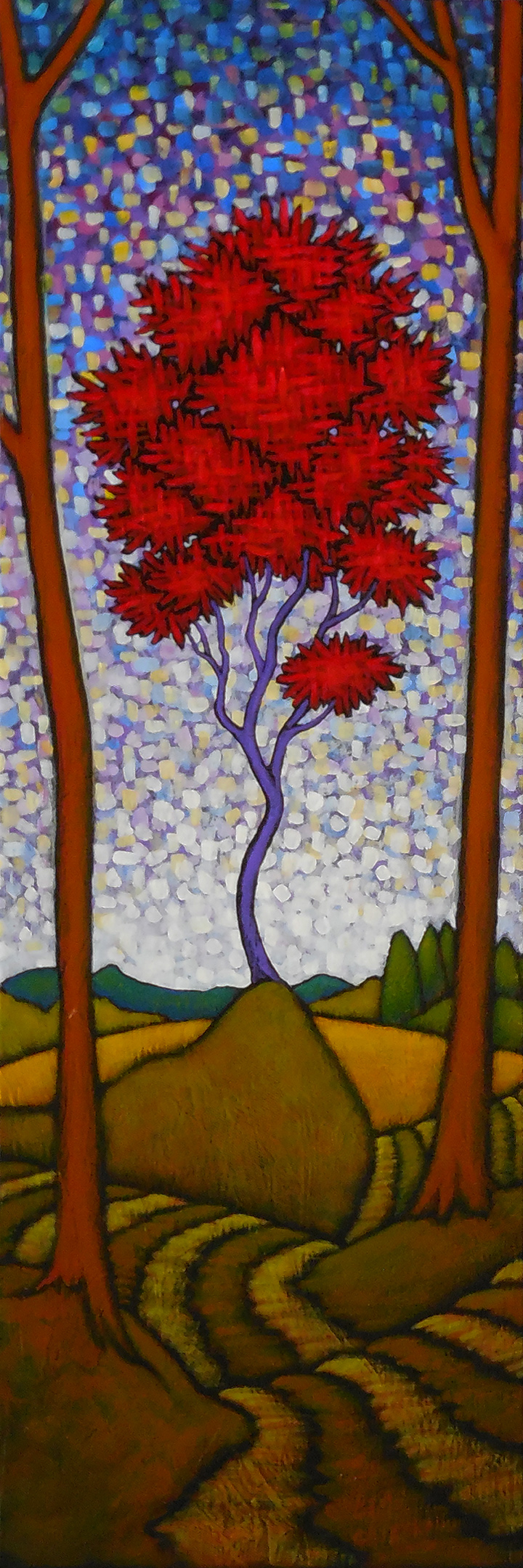
GC Myers- Biding Time 2007

Biding Time, 2007


Waiting for the end, boys, waiting for the end.
What is there to be or do?
What’s become of me or you?
Are we kind or are we true?
Sitting two and two, boys, waiting for the end.

–William Empson, Just a Smack at Auden


I feel like we are in a period of waiting right now. I don’t know what exactly, but it feels like we are kind of frozen in place as we wait for something to happen that will put everything into motion, for better or worse. Like we are waiting for someone to push over that first teetering domino.

Maybe it’s just me in feeling this way. Maybe it’s just the time of the year as we enter the holiday season and I am reminded of the intolerable waiting for Christmas’ arrival when I was a kid.  I am not quite so eager for whatever surprise is in store for us to arrive as I was then.

But whatever it is or isn’t, we– or maybe just me– remain somewhat frozen in place, biding our time. Finding a way to get through this waiting period is all we– or I– can do.

That brings me to the painting at the top, an older piece from 2007 that is titled Biding Time. I used to periodically paint pieces like this that were extremely simple and quiet. I viewed them then and now as meditations, as a means to finding stillness amidst the surrounding chaos. I haven’t painted one in quite some time for reasons I can’t determine which is odd because I always found most of them quietly effective., remaining in my mind for long periods of time.

This particular piece has not been shown publicly in many years and I thought it was time for it to make an appearance once again. The time seems right. It is headed to the West End Gallery tomorrow, in time for their annual Deck the Walls holiday show.

FYI– The verse at the top is from William Empson, a friend and colleague of poet W.H. Auden. In the poem Empson both pays homage and pokes a bit of fun at Auden while capturing the anxiety of post-WW II Europe that was struggling to gain its bearings amidst the nuclear threat that had risen.

Let’s have a song to go with such waiting.  Here’s a favorite, Waitin’ Around to Die from the late Townes Van Zandt.  This is from the 1976 documentary Heartworn Highways, a film that captured the beginnings of the alt-country movement of that time.  This clip features Townes singing to his girlfriend and his neighbor Uncle Seymour Washington, a retired blacksmith born to ex-slaves.


Read Full Post »

Be Careful What You Wish For- GC Myers 1996

Be Careful What You Wish For — 1996


In this world there are only two tragedies. One is not getting what one wants, and the other is getting it. The last is much the worst, the last is the real tragedy.

—Oscar Wilde, Lady Windemere’s Fan (1892)


This is a little piece that I did many years ago, that I call Be Careful What You Wish For. It never made it out of the studio except for a brief showing at a public exhibit of my Exiles pieces a few years back. It was never meant to be shown, actually. It was done solely for me.  I can’t say that it’s a great piece of work or even good. But that doesn’t matter because it’s one of my personal favorites. It’s after the old adage: Be careful what you wish because you may just get it. which is pretty much in line with the oft-quoted line above from Oscar Wilde. George Bernard Shaw is sometimes credited for this passage, having employed this same sentiment in his Man and Superman a decade after Wilde.

To be honest, I don’t care who wrote it first. Whoever wrote, it’s a thought I always bear in mind that every desire, every decision comes with a responsibility, a price to be paid that may not be evident on its surface.

 There are always unconsidered consequences we often fail to ponder when making wishes and decisions.

That’s what this small inconsequential painting from 28 years back is about for me. It’s tells a story much like  Pandora’s Box, where Pandora, the first woman created by order of Zeus, is given a box (or jar, in some versions of the tale) by the god Zeus with the instructions to not open it under any circumstance. Of course, she does. Immediately, all the evils in the world are released and, in her panic, she slams the lid back down, trapping Hope in the box.

Part of me wants to editorialize here about the Pandora’s Box that has been opened in the recent election, about the unintended consequences that those who chose to open the box will soon realize. Unfortunately, these darker consequences, the price that must be paid, will be felt by all. That’s all I will say on that this morning.

Just felt that it was an appropriate image for this particular moment. Now let’s get on to this week’s Sunday Morning Music. This is a version of the Bruce Springsteen song, The Price You Pay, from Emmylou Harris. There’s a verse and chorus in there that goes:

Now they’d come so far and they’d waited so longJust to end up caught in a dream where everything goes wrongWhere the dark of night holds back the light of the dayAnd you’ve gotta stand and fight for the price you pay
 
Woah, the price you pay, oh, the price you payNow you can’t walk away from the price you pay

Seems about right…


Read Full Post »


GC Myers-- Follow the River sm

Follow the River— At Principle Gallery

‘I cannot imagine what information could be more terrifying than your hints and warnings,’ exclaimed Frodo. ‘I knew that danger lay ahead, of course; but I did not expect to meet it in our own Shire. Can’t a hobbit walk from the Water to the River in peace?’

‘But it is not your own Shire,’ said Gildor. ‘Others dwelt here before hobbits were; and others will dwell here again when hobbits are no more. The wide world is all about you; you can fence yourselves in, but you cannot forever fence it out.’

—J. R. R. Tolkien, The Lord of the Rings: The Fellowship of the Ring


Yeah, I know. Another Tolkien passage in less than a week. I don’t think I’ve ever shared another passage from his books in the 16 years of this blog and now two show up in one week.  Guess that’s the way the Hobbit bounces.

I thought conversation between the hesitant hero Hobbit, Frodo, and the Elf, Gildor, fit with this painting, Follow the River, that’s at the Principle Gallery. The painting has an appealingly safe appearance with its blanket of green and its meandering tranquil river that, with the hills rising from it, feels safely walled in from the outside world. It has the insular warmth and security that I am sure the Hobbits felt in the Shire.

But there is darkness ahead. Part of me wants to see the rising moon in the blackened sky as light against the darkness while another part of me sees it as an ominous eye that surveils our every move.

Maybe it’s a bit of both. I can’t quite tell yet. Time will tell. But the message in this passage–the wide world is all about you; you can fence yourselves in, but you cannot forever fence it outresonates in this moment. Blissful ignorance will not insulate one from the evils of the world.

Go ask Frodo. He’ll tell you.

Here’s a favorite song from Joni Mitchell that I’ve played a number of times in the past. It has the right vibe for this morning. Here’s her River.


Read Full Post »

1995-V1 The Day of Great Confusion sm

The Day of Great Confusion–1995, At West End Gallery


It was a murky confusion — here and there blotted with a color like the color of the smoke from damp fuel — of flying clouds tossed up into most remarkable heaps, suggesting greater heights in the clouds than there were depths below them to the bottom of the deepest hollows in the earth, through which the wild moon seemed to plunge headlong, as if, in a dread disturbance of the laws of nature, she had lost her way and were frightened.

–Charles Dickens, David Copperfield


I was looking at some older work for the West End Gallery, pieces that had been with me for decades and had never been shown for a variety of reasons. Some just were never meant to be shared with the public, work not complete in one way or another. Some were drab and dull.

And some just didn’t completely click with me at the time. They didn’t hit whatever mark I had established for my work at the time they were painted. I don’t know if the criteria on which I was basing my judgement was that much different from what it is now or if it has shifted subtly over time due to time and circumstance. Whatever the reason, my appreciation for some of these unshown early pieces grew over the intervening years. 

Such is the case for the painting at the top of this page. It was painted in 1995 and, for reasons I can’t determine now, never made a journey outside my studio. Maybe it was that its colors were a bit different than my normal range of color in that time. Maybe I felt that the spew lines from where the watercolors broke free from the body of painting were too sloppy and distracting. Maybe it was the title I had jotted at the bottom of the sheet on which it was painted back in 1995, The Day of Great Confusion. Trying to determine why I applied that title always taxes my memory. 

I still don’t know why it didn’t quite hit the mark for me in 1995. 

However, looking at it at various times over the years, this painting greatly grew on me, showing me qualities I hadn’t recognized earlier. Those things I thought might have caused me to withhold now seemed like strengths. And in the past decade the title took on great significance as our country undertook an unnerving political transformation that still causes confusion and bewilderment within me.

Maybe that was the reason? I don’t know for sure, but I think there are other factors at play, as well. I think, even though it slightly differs from other pieces of that time, that it is a fine example of my early work in most every way. It’s one of those pieces that made me always pause in appreciation when coming across it in past years.

You might not see it that way and that’s okay. I just felt that if there was ever a time for a painting with that title to be shared, this was that time. It has put in its time with me and deserves to be seen.

Here’s song that kind of sums up the moment. Well, at least for me. It’s I Don’t Get It from the Cowboy Junkies. It’s from their fine 1988 album, The Trinity Session. It has bluesy vibe and lyrics that bite into the here and now.


Read Full Post »


Do I contradict myself?
Very well then I contradict myself,
(I am large, I contain multitudes.)

–Walt Whitman, Song of Myself, 1855


GC Myers- Niche  2024

Niche— At Principle Gallery, Alexandria

I use the word favorite quite a bit on this blog. I list many songs, movies, poems, quotes, people, etc. as being favorites of mine. There are probably a thousand songs or more that I could list as favorites, songs that always jump out at me. These are songs that raise very distinct feelings on hearing them. It might not be the same feeling for any of them. In fact, it certainly is not. Just something unique in each that excites me in a very specific way.

It’s that way with my work, as well. I am almost always asked at shows which painting is my favorite. It’s a question I can never answer as nearly every piece has something unique in it that speaks to me. Each affects me in its own way.

Some make me happy. Some make me think on darker things. Some make me look back and some forward.

Some make me feel large and powerful while others make me feel small and insignificant. I number many of both of these among my favorites.

Some make me cry. The painting shown here is one such painting. Even now, seeing it only on the screen, makes me emotional. As I wrote in an earlier post about this painting, Niche, they are not sad nor are they happy tears. They are tears of recognition and acknowledgment of the human condition. Tears of catharsis on clearly recognizing a large part of myself in it.

How could I not see this as a favorite?

It might seem improbable that one should have so many favorites but that’s the way it is. How could I place one above another? And why would I want to?

They say life is a banquet. Or maybe they should say life is an endless buffet of favorite things.

Anway, here’s a favorite song from a favorite artist. This is Favorite from Neko Case. How could this not be a favorite of mine?


Read Full Post »

GC Myers- And the River Flows 2024

And the River Flows– At the West End Gallery


That time
we all heard it,
cool and clear,
cutting across the hot grit of the day.
The major Voice.
The adult Voice
forgoing Rolling River,
forgoing tearful tale of bale and barge
and other symptoms of an old despond.
Warning, in music-words
devout and large,
that we are each other’s
harvest:
we are each other’s
business:
we are each other’s
magnitude and bond.

–Gwendolyn Brooks, Paul Robeson


I had come across part of the poem above from Gwendolyn Brooks before, those last three lines: …we are each other’s harvest: we are each other’s business: we are each other’s magnitude and bond. These are strong lines, sentiments that always speak loudly to me, ones that I hope will more people would realize and take to heart.

Unfortunately, I hadn’t taken the time to search out where it had come from in her work.  I was pleased when I finally came across the whole poem and found that it was titled Paul Robeson, about someone who I consider one of the most fascinating people of the last century.

Paul Robeson (1898-1976) was a star athlete, a lead actor and headlining singer– the bright light in any sky in which his star appeared. He was also a scholar– valedictorian for the 1919 class at Rutgers where he was the only black student. He went on to graduate from Columbia Law School and worked for a time as lawyer. But his performing talents were undeniable and they brought him worldwide acclaim. But beyond all this, Robeson was throughout his life a ceaseless champion of the labor and civil rights movements, here and abroad. If you don’t know much about Robeson, please look him up.

He is best known to most folks for his performance of Old Man River in the musical Showboat. I thought the song would be a fitting companion to the painting at the top, And the River Flows. It’s a piece that keeps drawing me back to look a little deeper. I feel there’s something beyond the surface, a message or story in the river rolling by or in a lit room in one of those buildings that overlook it. I might never know that message or hear those stories but just knowing that the river keeps rolling it good enough this morning.

All I need to know…


Read Full Post »

9924132 Passing Through Blue sm

Passing Through Blue– At West End Gallery


Sweet moonlight, shining full and clear,
Why do you light my torture here?
How often have you seen me toil,
Burning last drops of midnight oil.
On books and papers as I read,
My friend, your mournful light you shed.
If only I could flee this den
And walk the mountain-tops again,
Through moonlit meadows make my way,
In mountain caves with spirits play –
Released from learning’s musty cell,
Your healing dew would make me well!

― Johann Wolfgang von Goethe, Faust


Maybe there is something to that line: Your healing dew would make me well! The moon last night (and this early morning, for that matter) was full and bright in the clear night sky. A glorious supermoon.

Though the full moon is often associated with madness– lunatics and lunacy, for example– there is also a great calming effect in standing under it.

Maybe it’s the polarity of it making you feel both insignificant and significant. You feel small compared to the magnitude of a universe where the gigantic moon that looms over us is miniscule by comparison. Yet in the bright moonlight, you are illuminated and made to feel larger as you cast a long shadow on the ground.

Or maybe it is just the moon’s symbolic nature, still and steady as it serves an essential service to humanity in the way it reflects the hidden sunlight into our dark nights.

Not a bad example to emulate– quietly steady and bringing light to others…

Here’s a classic from Frank Sinatra, Fly Me to the Moon. I never actually wanted to go the moon, never ached to travel in space, but I have often wanted to be transported there in the way this song describes. And fortunately, I’ve made that journey many times.


Read Full Post »

gc-myers-early-figure


What are we when we are alone? Some, when they are alone, cease to exist.

Eric Hoffer


I’ve spent a tremendous amount of time alone in my studio over the years. Literally, tens and tens of thousands of hours in solitude. It has been time that has allowed me to close myself off in a certain way from the outer world and create the inner world that I show in my work. But occasionally the outer world breaks through and my simple solitude is shaken. I find myself caught between the outer world and my inner creation, my inner being.  

It’s a frustrating time and it becomes hard to focus in order to find that inner world. It’s been that way recently but I keep pushing for it and know that it will return soon. I am reminded of the post below from a few years ago that deals with being alone.


I was recently contacted by author for use of one of my images for inclusion in his upcoming book. It was an old image, one that I still possessed and had used on this blog, so I began to go through my files to find it. Shuffling through the old work, many from before I began exhibiting publicly, brought a number of surprises. There were pieces, like this one here on the right, that had slipped my mind and seeing them rekindled instant recognition and memory, like stumbling upon an old acquaintance who you had not thought of in ages. But there were others that had been lost in my memory and seeing them still only vaguely brought traces of their origin, as though you were again coming across someone who knew you, but you couldn’t quite remember them even though there was something familiar in them, something that told you that you once knew them.

Looking at these old pieces made me think of all the time spent alone with these images. The quote above from Eric Hoffer came to mind. What are we when we are alone? Is that the real you? Or is the real you that person that interacts with all the outside world?  Looking at these pieces, I began to think that the person I was when I was alone had evolved slowly over the years, becoming closer to one entity. What I mean is that the person I was when I was alone, my inner voice, did not always jibe with my outer voice and over time, especially as I have found a true voice in my work, has come closer and closer to becoming one and the same.

I don’t know if I can explain that with any clarity. It’s a feel thing, one that instantly comes from holding one of these paintings and still seeing the division that once was in them and in myself.  It is not anything to do with quality or subject or process. It’s just a perceived feeling in the piece, an intangible that maybe only I can sense.  But it’s there and it makes me appreciate the journey and the work that brought these two voices closer together.

My alone time immersed in these pieces has seldom felt lonely and, going back to Hoffer’s quote, never did I feel that I ceased to exist in my oneness. I know people who are like that, that need constant connection and interaction in order to feel alive and vital, but for me it has often felt almost the opposite. That probably is a result of that division of my inner and outer voices that I have been trying to describe. When I was alone, I was always comfortable with my inner voice and the work that resulted from it served in the forms of companions.

I definitely exist in my solitude and my work, my constant companion, is my proof.

I am going to stop now. Enough confession for one morning.  I have new companions on the easel to which I must attend.


This was a replay of a replay from back in 2017. Its message hasn’t changed a bit in the intervening years. Maybe I am just using it as pretense to play a song, The Inside Man. that I played here a few years back. I have no idea about its title’s meaning but for today it refers to the inner being. It’s a piece I came across awhile back, a piece of dance music from a Croatian DJ/ musician, Funky Destination. There’s something in it that always both focuses me and stirs me up– at least that inner part of me. The inside man…


Read Full Post »


He [Cézanne] reproduced himself with so much humble objectivity, with the unquestioning, matter of fact interest of a dog who sees himself in a mirror and thinks: there’s another dog.

–Rainer Maria Rilke, Letter to his wife, from Rilke’s Letters on Cézanne


After Paul Cezanne died in 1906, during the next year there was a retrospective exhibit of his work at a Paris gallery. Throughout the autumn of 1907, the poet Rainer Maria Rilke went to that gallery nearly every day to take in the Cezanne paintings. He would then write long letters to his wife describing the work and what he saw in it. These letters were later assembled in a book that expresses the joy and wonder that Rilke found in Cezanne’s paintings.

I came across the passage above about Cezanne’s habit of revisiting subjects again and again. He painted over 30 self-portraits (a handful are above) in his lifetime as well as over 80 versions of Mont Sainte-Victoire. His still life paintings were often new examinations of the same subject matter.

Rilke’s description of Cezanne as being like a dog gazing into a mirror and thinking that it was another dog made me laugh. But it also made me think about how many other artists often revisit the same themes and subjects repeatedly.

For me, it is in my landscapes and the ubiquitous Red Tree. When I think about it, every time I am in the midst of a new painting and it shows itself as Red Tree landscape, I seldom, if ever, think of it as a revisitation of a past painting. No, it always feels like it is something new, something fresh. It may be familiar to me, may spark a feeling of recognition but it seems new to me in that moment.

Another dog in the mirror.

One might wonder why that is so. I can’t say for sure, can only throw out theories based solely on my own glaring lack of knowledge in things such as art or psychology or most anything else. Just guesses really.

Maybe it is mere mental laziness? I might go with that but that is kind of insulting on a lot of levels. If that were the case, why even make the effort to talk or write about it?

Maybe one senses there is something more to be found in whatever that subject is but can’t quite determine what it might be. You need to come back to it again and again.

Kind of like a recurring dream, one that keeps showing up over time as the seemingly same dream but one that is slightly altered in some way that makes it feel somehow new to the dreamer. Certain aspects of the previous dreams remain but some are gone. Some elements that might have been mere background in former dreams suddenly take on greater significance. As a result, though it might have the same overall imagery and scenario the tone and feel of the dream is entirely different.

I could see this being the case with my painting. There is often a repetitive quality, but similar paintings never feel quite the same. There are often subtle (and not so subtle) changes in color, texture, emotion, depth, perspective, and on and on. There are refinements and progressions to the previous incarnations as well as regressions.

Like the recurring dream, some parts move forward to the new dream and some do not.

That dog in the mirror looks familiar but I don’t know it. Yet.

Here’s a tune that has nothing to do with this post other than the fact that it has dog in its title. Maybe that’s more than enough. Anyway, this is Sundog Serenade from the new album, The Southwind, from Grammy-winning guitarist Bill Mize. As mentioned here before, the album cover features one of my Archaeology paintings. That doesn’t matter– this is just a lovely tune for this morning.


Read Full Post »

Jamie Wyeth The-Sea-Watched_2009

Jamie Wyeth- The Sea, Watched


Painting to me is addictive. These are moments when it is inspiring, but they are few and far between. I keep my tools sharpened for the moment when things do start clicking, but that doesn’t happen a lot. I really have to push myself sometimes. Painting is a profession in which it is very easy to be lazy, particularly if you have any degree of success.

–Jamie Wyeth


I am in the same time period as the post below from 2018, in the weeks after my last major obligation of the current year and next year’s shows in the distance.  It’s a time to catch up on things unrelated to painting, things like maintenance projects on my home and studio, before the winter weather begins. I have found that while it feels like lazy time that takes me away from painting, it is actually a time of germination. Seeds of new images and colors grow during this period until they get to the point that break through the surface when I finally get back to painting in earnest.

I thought this was a good piece to share today. Its sentiment remains constant and serves as a reminder to not become too lazy, to get back to it as soon as possible. One difference might be that I could possibly have to adjust the amount of productive time as an artist I have left in my life. This morning, 30 years seems like a major stretch. But who knows, right? It remains something to shoot for, at least.


The painting above is The Sea, Watched from artist Jamie Wyeth. son of Andrew Wyeth and grandson of NC Wyeth. I came across the quote from Wyeth that is below the image, and it really struck a nerve with me, especially in the moment.

Being back in the studio after the Gallery Talk at the Principle Gallery [2018], I am conflicted by two desires. One is to just be bone lazy and do nothing, to simply enjoy the good feelings generated by the talk and my own sense of my work at the moment. The other is to dig back in with even greater fervor, to move the goalposts ahead and begin the next step towards reaching those goals. What exactly those goals are is yet to be determined but I do know they are there.

I do feel that I do have to move forward, to not be lazy and rest on the work that is out there at this point. Part of that comes from doing these talks and getting real feedback on what I have done. I don’t want to come before these folks next year and have nothing new, no advancement in the body of the work, to point to.

That is the one of the addictive parts of this painting thing– a fear of falling short.

But sometimes the lazy part is appealing. I look at the work so far and I feel good about it. I tell myself to take it easy. Relax. Coast for a while. That would certainly be easy to do.

But part of me knows that’s the wrong way to go. If for some reason my career ended today, I can’t say I would be satisfied with what I have done. I don’t feel that my story is completely told yet, that the work hasn’t yet revealed all that it has to yield.

So, I dig back in.

I was asked after the talk the other day if I planned to retire and I laughed. First, I said I couldn’t because all of the paintings I have given away at these talks represented my retirement funds. But I then said I couldn’t imagine not doing this to the day I either die or become incapacitated in a way that would prevent me from picking up a brush and making a mark.

Realistically, I figure I have a good twenty-five years in which to be productive. And if I am fortunate and take care of myself, maybe thirty. I notice more and more older artists working into their 90’s and beyond, producing new work that are exclamation points on long careers.

That would be good. But it won’t happen if one lets laziness creep too much into the equation. Fortunately for me, the credo, “Live to work, work to live,” is not a scary or depressing idea.

So, that being said, I’ve got a lot of work to do. Have a great day.

Read Full Post »

« Newer Posts - Older Posts »