Feeds:
Posts
Comments

Posts Tagged ‘Philosophy’

Phronesis Podcast Art


“Phronesis is a creative act, especially when navigating the unknown…It’s not just what happens when we’re faced with dilemmas, paradoxes, and crucible moments. Of course, that’s where our strength of character shines and guides our action choices, which is why we mark it as an act of practical wisdom.”

— Dr. Elena Antonacopoulou


I’ve known Scott Allen for some time now. Actually, I knew of him long before I met him when his wife asked if I could paint a small painting for him that she could give to him on completing his doctorate. In the years after, we have stayed in touch and have met a couple of times. Always an enjoyable experience as Scott is a great guy, very well-rounded with a wide range of interest and plenty of insights.

But more than that, Scott is really good at what he does. Here’s a bit from his website:

Dr. Scott J. Allen is a speaker, academic, author, and podcaster who empowers people and organizations to build stellar leaders.

Scott J. Allen, Ph.D., is an award-winning educator passionate about working with people at all levels and across industries. He serves as an instructor in SMU’s Cox School of Business Executive Education and spent more than 17 years as a professor of management. He also serves as a leadership consultant with Winding River Consulting. His areas of expertise include leader development, the future of work, and executive communication.

Scott has published more than 60 peer-reviewed articles and book chapters. He is the co-author of The Little Book of Leadership Development: 50 Ways to Bring Out the Leader in Every Employee, Emotionally Intelligent Leadership: A Guide for College Students, and the textbook Discovering Leadership: Designing Your Success (2023). Scott’s most recent publication is Captovation: Online Presentations by Design.

Beyond those impressive credentials, Scott also has a popular podcast that deals with leadership titled Phronesis, which is in the top 2.5% of all podcasts worldwide. Phronesis is a term describing how knowledge and wisdom is put into practical use. It goes all the way back to Aristotle who described it as such:

Phronesis… involves not only the ability to decide how to achieve a certain end, but also the ability to reflect upon and determine good ends consistent with the aim of living well overall.

Coincidentally, I used this quote and the word phronesis for a painting many years ago.

A couple of months back, Scott asked me to be interviewed for his Phronesis podcast. I wasn’t sure why since I don’t consider myself a leader in any way, especially from a business or organizational perspective. It’s easy to be a leader when you’re a one-man show.

In fact, I was a little apprehensive. It’s that impostor syndrome thing, where I will somehow finally reveal how unworthy and addle-brained I am. I often feel that when standing in front of group at gallery talk where I look out and know that I am most likely the least educated person there. I sometimes wonder how I tricked all those folks into sitting there listening to my blathering and if this will be the day when I finally show my inadequacy.

Of course, I agreed to do the interview with Scott. One of the great advantages of not being well educated is that I don’t know what to fear. It’s almost a form of courage. You might call it stupid courage. I’ve employed it a lot in my life. Sometimes it works out and sometimes it doesn’t.

Scott was a pleasure to work with– knowledgeable, well-prepared, gracious, and forgiving. A real pro. He said he could edit out my occasional stumbles and the uhs and umms that sometimes fell out my mouth. I left feeling a little apprehensive, of course. I don’t think I’ve ever done an interview when I didn’t come away feeling like a moron in some way.

But even so, it came out better than I had expected, to be honest with you.  Scott did a masterful job of making me seem reasonably coherent. Of course, I might be wrong there. But I think it touches on a lot of different things some of which I will discuss here over the coming days.

If you so inclined, you can listen here below or can go to Scott’s Phronesis site where you can listen to this episode or some of the many other interesting interviews he has conducted with a wide range of people. You can also subscribe to his podcast there. Lots of good stuff!

Thank you, Scott, for doing such a fine job with this and for your support and friendship through the years. It is very much appreciated. All good things to you and your family!


 

Read Full Post »

Ad Marginem C 1930 Painting by Paul Klee; Ad Marginem C 1930 Art Print for sale

Paul Klee– Ad Marginem, ca 1930


First, he does not attach such intense importance to natural form as do so many realist critics, because, for him, these final forms are not the real stuff of the process of natural creation. For he places more value on the powers which do the forming than on the final forms themselves.

He is, perhaps unintentionally, a philosopher, and if he does not, with the optimists, hold this world to be the best of all possible worlds, nor to be so bad that it is unfit to serve as a model, yet he says:

‘In its present shape it is not the only possible world.’

Thus he surveys with penetrating eye the finished forms which nature places before him.

The deeper he looks, the more readily he can extend his view from the present to the past, the more deeply he is impressed by the one essential image of creation itself, as Genesis, rather than by the image of nature, the finished product.

— Paul Klee, On Modern Art


This excerpt from On Modern Art, the 1924 treatise from the great Swiss artist Paul Klee.

For me, he was a big influence not only for his distinctive works but for his attitude and his views on art that he expressed so well in his writings. His use of color also influenced me. I always think of his work in terms of the color– sometimes muted yet intense and always having a melodic harmony to it.

It always feels like music to me. Like Klee, I often equate the visual with music.

I like his idea that the world is in the process of creation, of Genesis, and that it is not a final form. It allows for visionary work, for imagining other present worlds that extend beyond our perception because, as he writes, In its present shape it is not the only possible world.

And to me, that is an exciting proposition.


This is a reworked version of a post that originally ran in 2015. I needed a little kick of Klee this morning.


Paul_Klee,_Swiss_-_Fish_Magic_ 2

Paul Klee- Fish Magic 1925


blossoms-in-the-night-paul-klee

Paul Klee,, Blossoms in the Night

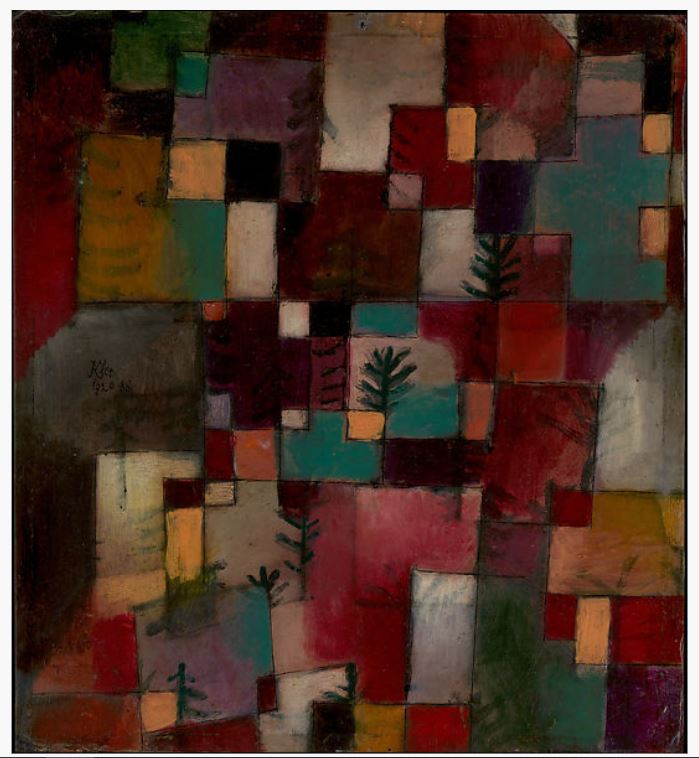
Paul Klee- Redgreen and Violets-Yellow Rhythms 1920

Paul Klee- Redgreen and Violets-Yellow Rhythms 1920

Paul Klee Bird Garden 1924

Paul Klee Bird Garden 1924

klee_southern-gardens

Southern Gardens- Paul Klee

Read Full Post »

GC Myers- Imitatio

Imitatio– At  West End Gallery, Corning NY


The opposite of love is not hate, it’s indifference. The opposite of art is not ugliness, it’s indifference. The opposite of faith is not heresy, it’s indifference. And the opposite of life is not death, it’s indifference.

-Elie Wiesel


With a presidential election only three weeks away, I am concerned with those who are indifferent to the potential consequences, many dark in nature by their very design, that might soon be upon us all. Maybe these folks believe they don’t have to engage because we have become so encapsulated in our own little bubbles that we believe that nothing can pierce these seemingly safe little spaces. They think that by staying disengaged they will be safe and can’t be held responsible in any way.

Unfortunately, the world doesn’t work that way. Indifference is like being asleep at the wheel. It enables all manner of bad behavior, from minor abuses to the deadliest crimes against humanity. We need to be engaged, to stop and examine what is happening in the moment.

I thought this would be a good time to replay a post that has appeared here every several years. I apologize for using my insignificant experience as any sort of comparison to the indifference to which Mr. Wiesel referred. I do try to explain below.


I’ve been sitting here for quite some time now, staring at the quote above from Elie Wiesel, the late Nobel Laureate and peace activist. I had planned on writing about how my work evolved as a response to the indifference of others but now, looking at those words and putting them into the context of Wiesel’s experience, I feel a bit foolish. Wiesel, who had survived the Holocaust and spent his life crusading so that it might never happen again, was eyewitness to indifference on a grand scale. It was indifference that ranged from those who were complicit or those who did not raise their voices in protest even though they knew what was happening to the personal indifference shown by his Nazi guards, as they turned a blind eye to the suffering and inhumanity directly before them on a daily basis, treating their innocent captives as though they were subhuman, nothing at all in their eyes.

The indifference of which he speaks is that which looks past you without any regard for your humanity. Or your mere existence, for that matter. It is this failure to engage, this failure to allow our empathy to take hold and guide us, that grants permission for the great suffering that takes place throughout our world.

So, you can see where writing about showing a picture as a symbolic battle against indifference might seem a bit trivial. It certainly does to me. But I do see in it a microcosm of the wider implications. We all want our humanity, our existence, recognized and for me this was a small way of raising my voice to be heard.

When I first started showing my work I was coming off of a period where I was at my lowest point for quite some time. I felt absolutely voiceless and barely visible in the world, dispossessed in many ways. In art I found a way to finally express an inner voice, my real humanity, that others could see and feel a reaction.

With this in mind, when my first opportunity to display my work came, at the West End Gallery in 1995, I went to the show with great trepidation.

For some, it was just a show of some nice paintings by some nice folks. For me, it was a test of my existence.

It was interesting as I stood off to the side, watching as people walked about the space. It was elating when someone stopped and looked at my small pieces. But that feeling of momentary glee was overwhelmed by the indifference shown by those who walked by with barely a glance, if that. It was as though my work wasn’t even there.

Those moments crushed me. I would have rather they had stopped and spit at my work on the wall than merely walk by dismissively. That, at least, would have made me feel heard.

Don’t get me wrong here. Some people walking by a painting that doesn’t move them are not Nazis nor are they bad folks in any way. I held no ill will toward them, even at that moment. I knew that I was the one who had placed so much importance on this moment, not them. They had no idea that they were playing part to an existential crisis. Now, I am even a bit grateful for their indifference that night because it made me vow that I would paint bolder, that I would make my voice be heard. Without that indifference I might have settled and not continued forward on my path.

But in this case, I knew that it was up to me to overcome their indifference.

Again, please excuse my use of Mr. Wiesel’s quote here. My little anecdote has little to do with the experience of those who suffered at the hands of evil people who were enabled by the indifference of those who might have stopped them. The point is that we all want to be heard, to be recognized on the most basic level for our own existence, our own individual selves. But too often, we all show indifference that takes that away from others, including those that we love. We all need to listen and hear, to look and see, to express our empathy with those we encounter.

We need to care.

Maybe in that small ways the greater effects of indifference of which Elie Wiesel spoke can be somehow avoided.

We can hope.

Read Full Post »

GC Myers- Between Order and Chaos

Between Order and Chaos– Coming to Principle Gallery


In all chaos there is a cosmos, in all disorder a secret order.

–Carl Jung


I am busy getting ready this morning for the Gallery Talk I will be presenting this coming Saturday, September 28, at the Principle Gallery, beginning at 1 PM. Part of this preparation is finishing new work and packing up that work as well as the painting that will be given away in a free drawing for those at the talk, along with a few other surprises. You have to come to the talk to know what those will be.

GC Myers- Point of Contact 2016

Point of Contact — You Could Win It!

Along with the new work, I am also bringing four favorites of mine from the past decade. One is the painting above, Between Order and Chaos, shown above. It is a piece that jumped out at me in many ways since it was first painted. The post below from a couple of years back explains one of those aspects.


There is a philosophical concept called Unus Mundus— Latin for One World. Its premise is basically that behind the evident chaos of this world and the universe there is a unifying realm of absolute knowledge on which all existence is based.

It has been around for ages, going back in some form to the ancient Greeks. In the last century, Carl Jung became the biggest advocate of this theory, using it to explain the similarity in the content and construct of the myths and stories of the cultures and their belief systems. Each represents the discovery of some small bit of the order or pattern contained in chaos surrounding this world and becomes a recurring symbol, forming what Jung termed as an archetype. 

I describe an archetype as being how there are universal reactions and interpretations to certain images. One of the main reasons I use the Red Tree and the Red Roof, the Red Chair, and the ball in the sky that serves as the sun/moon is that each translates seamlessly across cultures. You don’t need specific cultural knowledge to understand the reality they symbolize. Each carries universal meaning.

This theory, the Unus Mundus, is what I see as the force behind the new painting at the top, Between Order and Chaos. It’s about how we struggle to create order in the face of constant chaos (represented in the sky’s slashing marks) with the orderliness of the flower beds representing this attempt.

The round flower bed caught in the curve of the path echoes the sun above. I see it somewhat as a symbol of synchronicity, another term coined by Jung. He uses it to explain some coincidences that seem to have some sort of meaning though there is no explanation for this feeling.

A coincidence might be just that or it might be that we have unwittingly come in contact with a strand of the Unus Mundus.

I sometimes feel as I have had fleeting moments of synchronicity but I can’t be sure of that.

How does one really know such a thing?

And I can’t say that we will ever learn more about or understand the Unus Mundus or the meaning of synchronicity, even though it might be for the betterment of us all as a species.

Perhaps we have become too comfortable living in this slice of the universe between order and chaos?

I don’t know. But for now, it’s all we have.

Read Full Post »


“They are all in the same category, both those who are afflicted with fickleness, boredom and a ceaseless change of purpose, and who always yearn for what they left behind, and those who just yawn from apathy. There are those too who toss around like insomniacs, and keep changing their position until they find rest through sheer weariness. They keep altering the condition of their lives, and eventually stick to that one in which they are trapped not by weariness with further change but by old age which is too sluggish for novelty. There are those too who suffer not from moral steadfastness but from inertia, and so lack the fickleness to live as they wish, and just live as they have begun. In fact there are innumerable characteristics of the malady, but one effect – dissatisfaction with oneself. This arises from mental instability and from fearful and unfulfilled desires, when men do not dare or do not achieve all they long for, and all they grasp at is hope: they are always unbalanced and fickle, an inevitable consequence of living in suspense. They struggle to gain their prayers by every path, and they teach and force themselves to do dishonourable and difficult things; and when their efforts are unrewarded the fruitless disgrace tortures them, and they regret not the wickedness but the frustration of their desires. Then they are gripped by repentance for their attempt and fear of trying again, and they are undermined by the restlessness of a mind that can discover no outlet, because they can neither control nor obey their desires, by the dithering of life that cannot see its way ahead, and by the lethargy of a soul stagnating amid its abandoned hopes.”

― Seneca, On the Shortness of Life


I was reading an article that referenced the essay De Brevitate Vitae ( On the Shortness of Life) from the Stoic philosopher Seneca that written sometime around 49 AD. The passage above really struck me because it seemed to describe the dissatisfaction so many people have with their lives and the actions that result from this.

I can’t quite put my finger on it but it feels like the underlying current of what we’re seeing take place these days in this country. I have tried to discern what the desired outcome for the insurrectionists is or what drove them to act as a violent mob and I keep coming up with blanks.

What do they want?

They are not the downtrodden nor poor. They are not voiceless or without political power. There’s a high probability that most of them have livelihoods and assets that place them well above that of the average American. They are not trying to gain rights for themselves or others that have been denied. They are not fighting injustice.

And if they succeed, they have no plans for a future. Certainly not a future that will be in any way better.

All they have is anger and dissatisfaction with their lot in life. As entitled and privileged as they are, their lives lack purpose, lack meaning. It is a spoiled and bored existence, devoid of real consequences for bad behavior and fortified by the highs and unreality of video games and action flicks combined with conspiratorial bravado and cosplay costuming.

And that’s a recipe for disaster. 

This is just an observation this morning. Like I said, I am not sure I have a finger on what really is behind it. I am just trying to understand it so that I can begin to make sense of what I am seeing.

Still not there.

Here’s a topical song, Unsatisfied, a favorite of mine from The Replacements and their great 1984 album Let It Be.

Be careful out there and have a good day.


Read Full Post »


“To those human beings who are of any concern to me I wish suffering, desolation, sickness, ill-treatment, indignities—I wish that they should not remain unfamiliar with profound self-contempt, the torture of self-mistrust, the wretchedness of the vanquished: I have no pity for them, because I wish them the only thing that can prove today whether one is worth anything or not—that one endures.”

Friedrich Nietzsche, The Will to Power


I paused a little bit before using this quote from Nietzsche this morning. The use of anything from a philosopher whose work, and the book from which this excerpt has been taken, had been appropriated and distorted to justify their own ends , by the Nazis is a little risky, especially in this time of rising authoritarianism here and around the world. For many of us, just the title, The Will to Power, immediately conjures up imagery of invading Nazis goose-stepping through conquered cities in their quest for more and more power.

People naturally assume that that the power to which he is referring is ultimate power, ruling power to be  exercised over others. That is how the Hitler and his ilk interpreted it. But Nietzsche was talking about two separate forms of power which are expressed in German as the words Kraft and Macht. Kraft refers to brute force, both physical and mental, while Macht refers to true power. Kraft is the animal force, that primal element that is possessed in all of us. Macht, on the other hand, is the power to control one’s own kraft and use it in positive ways.

Macht is the overcoming and controlling of the kraft within us.

And that’s where we are now. We have two elements within this nation, one who see the power of this nation as pure animal power, and another who recognizes our power– our kraft— but understands that it cannot solely guide our actions and future. It is unsustainable. History shows that clearly. 

So, the question is how do we emerge from this? Do we have the fortitude to endure this tug of war between these two concepts?

Though I have my doubts on some days, in the long run I think we do have the ability to endure, actually.

And as Nietzsche expresses above, perhaps this struggle is just what we need to really move forward. Maybe we need some real hardship and suffering to understand the responsibility of our power. Maybe we need it to finally recognize that we must at some point sacrifice something of ourselves to a greater good, that our bounty does not come without a price.

Many of us have never had real hardship. I am not talking about normal loss and suffering that comes with being a human being. I am talking about widespread hurt that runs through the nation and touches most every citizen. Most of us have never had to sacrifice much for anyone.

Maybe we need the hurt and the humbling. While nobody wants to willingly take on great suffering, there are lessons to be learned from it. Perhaps that one can overcome and endure great hardship is the greatest of these. That and allowing more of us to develop a greater sense of empathy with those who continue to suffer around us.

Maybe we need to simply learn that we can endure.

Maybe then we can cross the divide between us and work together for some greater good.

Let’s hope, okay? 

Hey, here’s some old Canned Heat from about 50 years back with a fitting message for any time. It’s Let’s Work Together. Now, have a good day.


Read Full Post »

GC Myers--Phronesis Phronesis… involves not only the ability to decide how to achieve a certain end, but also the ability to reflect upon and determine good ends consistent with the aim of living well overall.

— Aristotle

*************************************************************

This is a new painting, 8″ by 14″ on paper, that I am calling Phronesis.   It’s a Greek word that the philosopher Aristotle used to differentiate practical wisdom from theoretical philosophy.  Phronesis involves putting gained wisdom into rational, measured action, not merely reflecting upon it.  It is the ability to determine where one wants to be– physically, mentally and spiritually– at a future point and how to achieve that goal.  Phronesis employs  theoretical wisdom  and puts it into rational action.

That’s the five cent version of the concept.  And that’s what I see here.   In a calm fashion, the Red Tree has determined its course, which is to be in unity with a greater universal power or spirit, represented here by the breaking sun and the layers of color in the sky.  It has already recognized the universal truths and is now trying to enact them, trying to become closer to the central truth.

It sounds much more complicated than it might really be. ‘Live lightly’ might just as easily get across what I struggle to say here.  That would probably fit the simple composition of this painting, that  spare elegance which draws me to this piece.  In itself, there is a sort of phronesis taking place, as its painting is an action that takes what little wisdom I have gained and allows me to move a step closer to that same goal shown in it.  Peace and light, really.

Well, enough said.

Read Full Post »

« Newer Posts