Feeds:
Posts
Comments

Posts Tagged ‘Photography’

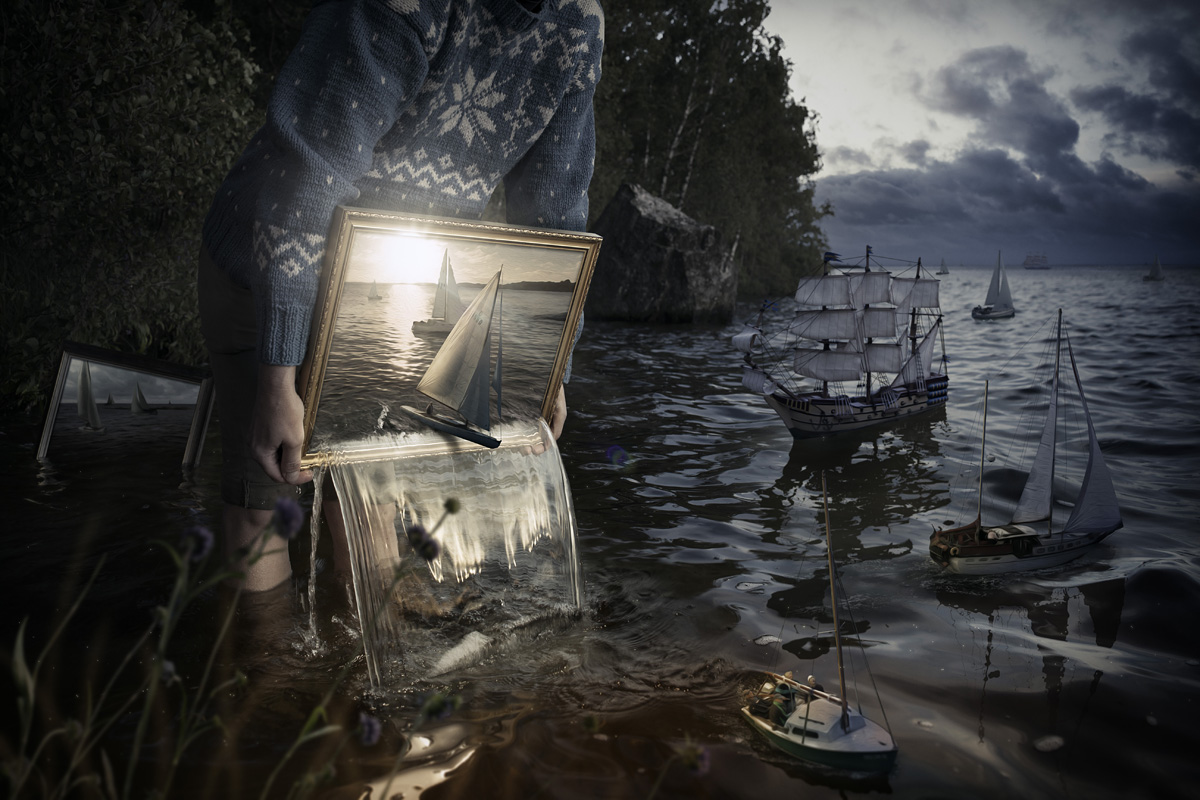
Erik Johansson Cut and FoldErik Johansson is a Swedish photographer working out of Berlin who has made quite a name for himself by taking the ordinary moment and inserting a twist in its perception through a very skilled manipulation of the photos, creating a new and surreal reality.  Johansson can look upon  a very mundane scene and see all sorts of other potentials. In his manipulated reality  there are row boats plowing through fields, a driver is faced with with a giant chrome ball that blocks his way and a biker comes upon a road that is cut like a piece of paper, its ends splayed high in the air above him.  Real life houses appear like those from an MC Escher drawing.  And that is just a small sample.

Erik Johansson ReverberateIt is an incredible combination of imaginative vision, skill and technology.  You can see more of his work at his website by clicking here.  There is also a wonderful blog on his site that gives a real inside look at his process, including a number of videos. Here at the bottom, there is one of these videos that shows in great depth the many layers of editing and manipulation that take place in composing  his photo, Cut and Fold, shown at the top of this page.  If you’ve ever used photo editing software such as Photoshop, you will appreciate his great skill.

If you don’t care how he came to his final product, it may take a way a bit of the mystery.  Or not.  I don’t know.

Anyway, it’s great fun so take a moment and let your mind wander into a different reality.

Erik Johansson The Architect Erik Johansson Rowboat Erik Johansson Set Them Free Erik Johansson Intersecting Planes Erik Johansson Greenfall Erik Johansson Nightmare Perspective

Read Full Post »

Foreign Affairs mar Apr Cover 2015I have mentioned my niece, Sarah Foster, here in the past for her exploits as a talented dancer and choreographer in NYC. But she has another form of her talent that showed itself recently in her day job with Foreign Affairs magazine. That is that of a video editor.  The coming March/April issue of the prestigious magazine deals with the issue of race and has images of  the faces from a group of people from all races all set against backdrops that match their skin tones.

Sarah produced  a very fine video for the magazine explaining the backstory behind these images, which is the work of  Brazilian photographer Angélica Dass.  She  an ongoing and open-ended project called Humanae which has her photographing people of all races from around the globe.   So far over 2500 subjects on five continents have participated.

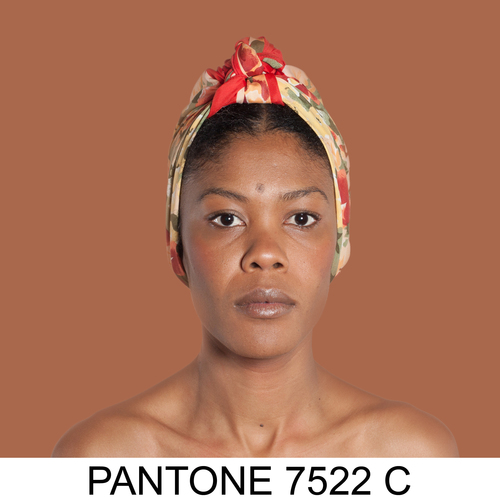
All are photographed in exactly the same circumstances– the same distance, the same light and exposure.  She then matches the color from their nose to the Pantone color system, an international standard for color matching, and makes the backdrop that color.   She then labels each with the Pantone code and number.   The result is a wonderful and powerful examination of how we define race by colors that really don’t exist.

Humanae Image of Angelica DassThe video feature a telephone interview with Dass ( shown here on the left–she’s Pantone 7522 C) who explains her project.  The video is a great accompaniment to it, giving you a taste of many images.

Great work.  Well done, Sarah!!

For more info on Angélica Dass and the Humanae Project click here.

Read Full Post »

roller skating house theboatlullabiesOne of my favorite things to do online is to browse through some of the sites that feature found photographs, images that have been lost or abandoned by their original owners and picked up by others at flea markets, yard sales, etc.  Almost all are by amateurs and feature many day-to-day scenes of friends and families, some remarkable and some not so much.  Some a little bit too personal.  But there is something quite beautiful in the sum of them, an artfulness that is naturally gained and not thought out, much of it unintended.

I find a lot of inspiration in going through these images.  There is often a tangible sense of emotion in these images, something that makes me wonder how something that obviously meant something to someone at some point could be just set adrift.   How many of my own family’s photos are out there like these, lost ancestors floating around in some flea market bin?

Some, like the one shown here, which I call the Roller Skating House (obviously a house in the midst of being moved), are just neat images that pique my interest and imagination.  I found this at The Boat Lullabies which is a great site ran by the person behind Square America, a site that is now down but was an amazing collection of vernacular photography.  You can still find Square America on Facebook— a great page to follow.  Another great collection of found images is at FoundPhotographs.com.

Check out some of these sites.  They are fun and often thought provoking.


Read Full Post »

Photo by Joe Capra- Scientifantastic   Greenland Ice

Photo by Joe Capra- Scientifantastic Greenland Ice

I was browsing through a few websites that I haven’t been able to keep up with lately and came across this video shot in Iceland and Greenland by photographer Joe Capra aka Scientifantastic.  Capra specializes in ultra  high definition time-lapse photography, cinematography and still photography and has traveled the world for his assignments for clients such as the National Geographic, the Discovery Channel and Animal Planet.  It’s beautifully shot and lushly colored work that has earned Capra a reputation as one of the finest in his field.

This particular film was shot in Iceland and Greenland over the course of ten days as Capra sought to film the Aurora Borealis.  I found it very striking and found much in it that reminded me of some of my own work, particularly the shots that highlighted the starkness of the landscape and those where the color of the scene was transformed by the Northern Lights into odd shades and combinations.  Just a lovely short film with beautiful imagery, one in which I can find lots of inspiration.

For more info on Joe Capra and his work, click here.

Two Lands – Greenland | Iceland from SCIENTIFANTASTIC on Vimeo.

Read Full Post »

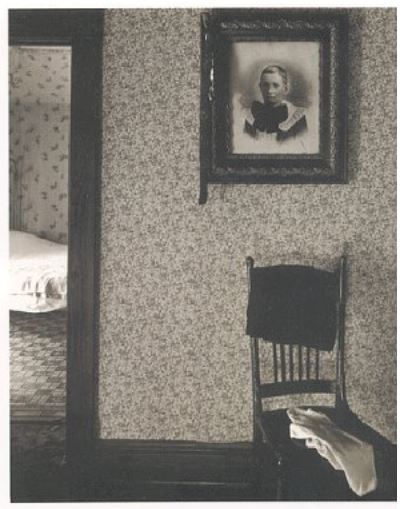
Writght Morris- Straightback Chair, The Home Place

Writght Morris- Straightback Chair, The Home Place

One of the most common questions I am asked at gallery openings or talks is about the meaning behind the Red Chair in my paintings.  I always struggle to answer.  Maybe because the answer is always changing for me.  I don’t really know.  I do know that I use it in my work because the chair is such an identifiable image that is known to anyone in nearly any culture and has an inherent meaning in its form.  A place to sit and rest. Or eat. Or converse. Or any number of things.  It is simply an icon of human existence.

But looking through some photo sites I came across the work of Nebraska-born photographer/writer Wright Morris (1910-1998).  His stark and striking images of the Plains will seem very familiar to anyone who saw last year’s Alexander Payne film, Nebraska.  I don’t know but would not be surprised if Morris’ imagery was a big influence on the visual look of the black and white film.

Wright Morris- Chair, The Home Place

Wright Morris- Chair, The Home Place

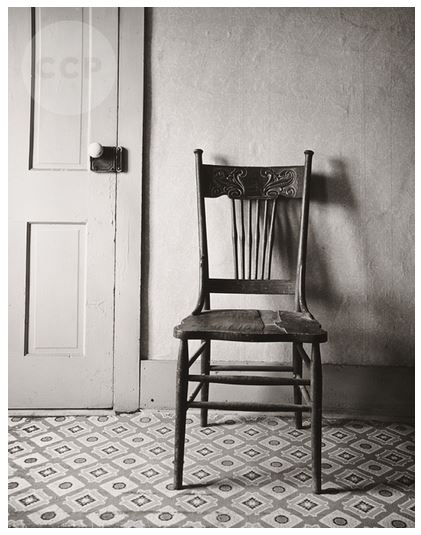
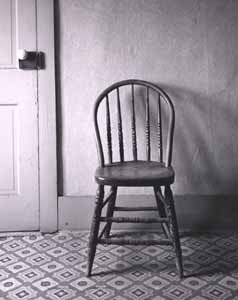
But while looking at some of these photos I came across a few images of chairs in a farmhouse.  They were from a book of his titled The Home Place, a photo-novel telling the story of a man’s one-day visit to where he had spent his childhood in Nebraska, the home place.  The images were very evocative and looking at them, it dawned on me that the meaning of the Red Chair was the same.  It was so obvious– it was the Home Place.  The place where you have a chair in which to sit, accepted as a part of that place.

It is simple yet powerful, like Wright Morris’ photos.

It’s good to have an answer to give now when someone asks…

Wright Morris Picture of Boy- The Home Place

Read Full Post »

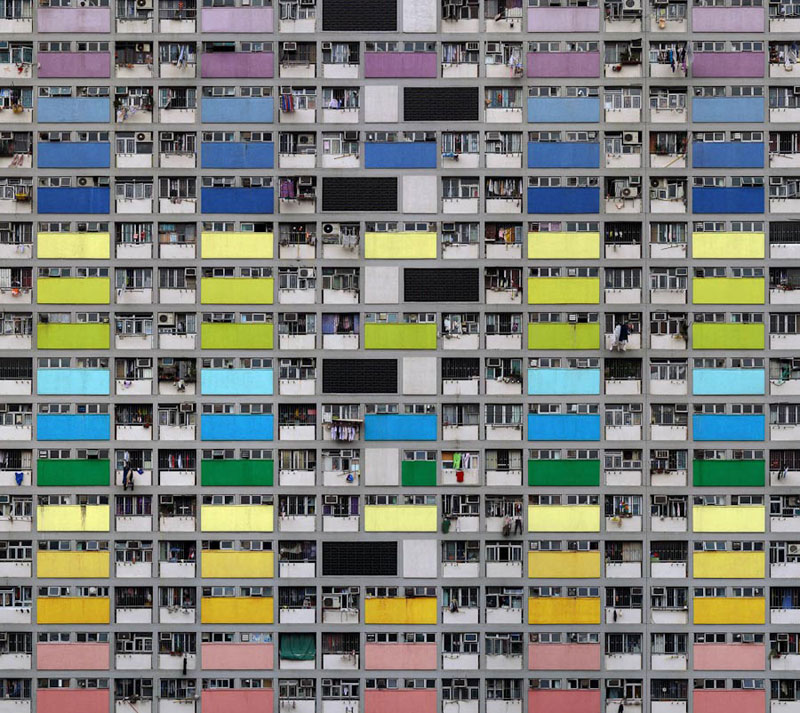
architectural-density-in-hong-kong-michael-wolf-8A friend sent me a link the other day to an article on TwistedSifter, a site that collects the most interesting visual images from the web on a daily basis.  While I enjoyed the article to which I was directed, about a French artist who makes creative use of the negative space in the photos he takes (I will feature his work here because it’s much more interesting than that), it was another image on the same page that really caught my eye.  It was a photo of several apartments towers in Hong Kong, the terraces filling the frame, shown here on the right.  It is a fascinating shot, with so much visual data that was both overwhelming and captivating with its abstraction and relentless chaos.

The photo is from the award-winning photographer Michael Wolf, who is German born but now resides in Hong Kong.  He has made a career out of capturing the imagery of the urban landscape.    This image is from his series and book, Architecture of Density, in which he takes away any glimpse of the sky or horizon, giving the viewer a claustrophobic feeling, as though there is no escape from the never-ending  sprawl.  It’s a bit scary but fascinating, nonetheless.

You can see more of Michael Wolf’s work at his site, photomichaelwolf.com.

architectural-density-in-hong-kong-michael-wolf-5 architectural-density-in-hong-kong-michael-wolf-3

Read Full Post »

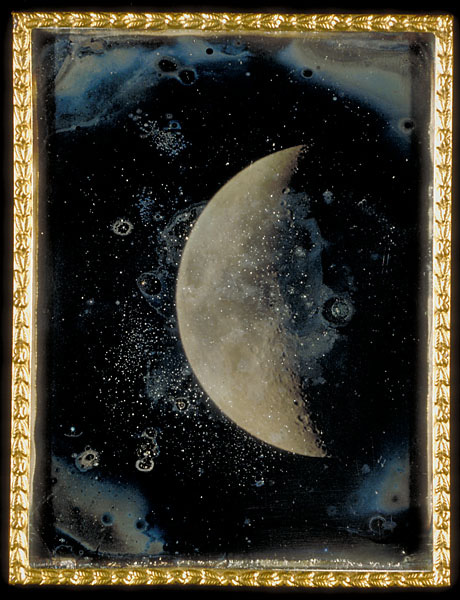
John Adams Whipple- The Moon 1851

John Adams Whipple- The Moon 1851

We live in an age where we are able to see, with the help of NASA’s Hubble Telescope and Cassini-Huygens spacecraft, truly amazing images of the far flung regions of our universe on a daily basis.   I often think that, as a result, we tend to simply stop looking up in the night sky and wondering at the moon and stars and planets that move above us in plain sight.  I know that one of my great pleasures was coming out of my studio to head home through the woods and looking up in the night sky to find those familiar landmarks.  Jupiter‘s strong glow as Castor and Pollux look on from a short distance away.   The constellation Orion‘s belt and brightest star, Rigel.  And of course, the large and calming presence of the moon in all its phases.

They become like friends after a while, true and  everpresent.  Well, when the winter sky isn’t filled with clouds.

John Adams Whipple- View of the Moon 1852

John Adams Whipple- View of the Moon 1852

All of this went through my mind in a flash when I came across the early photo shown above,  an 1851 daguerreotype of the moon, and this one here on the right, another moon image from 1852, from John Adams Whipple (1822-1891), a Boston area photographer who was a pioneer in early astronomical and night photography.  He took some of the earliest photos of the moon and stars using the Harvard 15-inch telescope which was one of the largest in the world at the time.

I like the idea that this image in its little precious case was perhaps carried and periodically looked upon  a century and a half ago, as one might look upon a photo of a friend or family member.  It makes me think that whoever carried this had similar feelings when they looked up into the night sky, a unity with something so much larger than that which is within our reach.  A nodding acquaintance with the eternal.

Seeing these images from Whipple makes me want to get out and look up into the sky.  Hopefully, the clouds will clear and I can see my old friends once more.

Read Full Post »

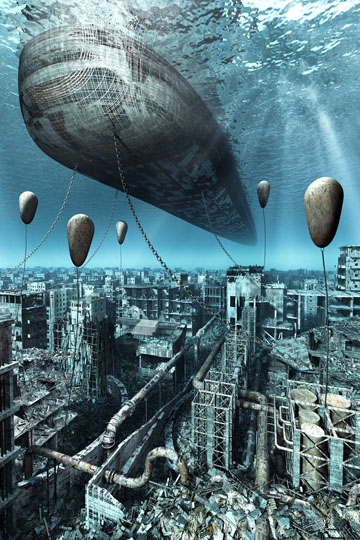
Giacomo Costa- Post Natural

Giacomo Costa- Post Natural

The last post, Brighter Days Ahead, featured a painting that dealt with the anticipation of the future.  The perspective of that painting had a somewhat optimistic and hopeful vision of what might be ahead.  There are, of course, grimmer visions of the future out there.  I  was reminded of this early this morning when I came across the photos of Italian photographer/artist Giacomo Costa.

Giacomo Costa- The Chronicles of Time   book coverCosta uses digital manipulation and , from what I can deduce, extensive architectural research to create large scale images that portray fantastic futuristic structures and cityscapes in various stages of decay.  They are very cinematic, easily fitting in any big budget sci-fi thriller,  yet stand on their own as pure, thought provoking imagery.  It was the cover of his book,  The Chronicles of Time, shown here on the right, that caught my eye.  I wasn’t aware of Costa’s work and thought this was a real building, one so fantastic and amorphous  that I couldn’t believe I had never seen it before this.

It may be a grimmer future, albeit one that may be a  millennium or two or more away, than we want to imagine but there is something beautiful in the recapture of the natural space by trees and oceans.  Perhaps, we may not be anymore at some point but nature will prevail in some form.  And that is, in some strange way, comforting, especially if you believe that we humans are not remote as a species but are entwined on a particle level with all natural life and will have some form of consciousness, even among the ruins of a human civilization.

It may not be the future we wish for but it is a future.  Check out the work of Giacomo Costa at his website.  It will make you think about the future and, hopefully, the present.

Giacomo Costa - Ground 1 2013 Giacomo Costa - Atto 9 2007 Giacomo Costa-  Aqua n 3 2007 Giacomo Costa

Read Full Post »

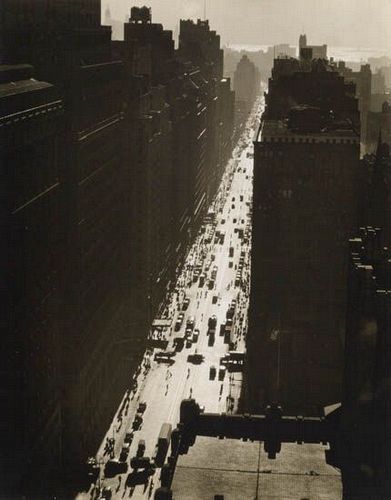
Berenice Abbott Seventh Avenue Looking South from 35th Street 1935New York City has long been a boon for photographers, with its constantly changing landscape of dramatic architecture and melting pot of cultures.  There is always an interesting juxtaposition of the old and the new which makes for fascinating viewing.  I am often drawn to photos which play on this contrast and some of the best are the photos of the late photographer Berenice Abbott.

Abbott was born in Ohio in 1898  and made her way via NYC to the post-war Paris of 1920.  She studied sculpture there but came to photography when she was hired as a studio assistant to avant-garde artist/photography Man Ray.  He chose Abbott because she had no experience at all with photography so would therefore do just as said.  That decision changed her life as she took immediately to photography and never looked back.

Berenice Abbott -Exchange PlaceWhile visiting NY in the late 20’s, Abbott became  enchanted with the photographic possibilities of the fast evolution of the city and began work on a project of shooting the landscape of the city that lasted for several years.  The result was a book, Changing New York, published in 1939.  The images of the city shown  here are from this time.

Abbott had a long and productive career as a photographer, dying in Maine in 1991 at the age of 93.

I was really taken with her photos of NY, particularly the image at the top right, Seventh Avenue Looking South from 35th Street.  She captures the beautiful contrast of light and shadow that takes place among the tall buildings and long avenues in the late afternoon.  There is a hardness in the edges and angularity of the buildings that plays off the softness of the light.  Just a wonderful shot, as is this shot here on the left of Exchange Place.  Its unusual proportions with the the walls of the buildings closing in give it a claustrophobic feel while the ant-like people on the streets below accentuate the vast space.  It’s a great contrast that really makes the image sing.

If you like images of the changing urban landscape, especially in those fast evolving years of the early 20th century, do yourself a favor and Google Image the work/photos of Berenice Abbott.  Just plain good stuff from a name that you probably do not know.

Berenice Abbott- Nightview_ New York 1934Berenice-Abbott-Flatiron-Building,-Manhattan

Read Full Post »

Lumqua, Hong Kong painter- John Thomson

I have come across this photo a number of times and have always lingered over it.  Maybe it’s just  professional curiosity, wondering how painters in other times and places worked in their studios.  But while I had seen this photo I had never really examined who the artist was.  It turns out he was named Lumqua and he was active in Hong Kong in the middle part of the 19th century.

This photo was taken in the early 1870’s by John Thomson and published in an 1873 book of photos and descriptions of the Chinese people.  Below is an excerpt that describes Lumqua.  The part that I find interesting is Thomson’s description of the groups of painters that would scour the Hong Kong docks trying to sell the sailors a finished painting that reproduced a photo they might possess so that they might have a larger, color image of their loved one to take home as a souvenir.  They offered a 24 hour tunaround.  Thomson’s description of how they divided the work on these pieces so that they could quickly and ably finish this task foreshadows the current businesses that turn out cheap paintings in the thousands to be sold around the country in  local Holiday Inns at so-called  Starving Artist sales.

This is the description that Thomson attached to this photo:

Lumqua was a Chinese pupil of Chinnery, a noted foreign artist, who died at Macao in 1852. Lumqua produced a number of excellent works in oil, which are still copied by the painters in Hong-Kong and Canton. Had he lived in any other country he would have been the founder of a school of painting. In China his followers have failed to grasp the spirit of his art. They drudge with imitative servile toil, copying Lumqua’s or Chinnery’s pieces, or anything, no matter what, just because it has been finished and paid for within a given time, and at so much a square foot. There are a number of painters established in Hong-Kong, but they all do the same class of work, and have about the same tariff of prices, regulated according to the dimensions of the canvas. The occupation of these limners consists mainly of making enlarged copies of photographs. Each house employs a touter, who scours the shipping in the harbour with samples of the work, and finds many ready customers among the foreign sailors. These bargain to have Mary or Susan painted on as large a scale and at as small a price as possible, the work to be delivered framed and ready for sea probably within twenty-four hours. The painters divide their labour on the following plan. The apprentice confines himself to bodies and hands, while the master executes the physiognomy, and thus the work is got through with wonderful speed. Attractive colours are freely used; so that Jack’s fair ideal appears at times in a sky-blue dress, over which a massive gold chain and other articles of jewellery are liberally hung. These pictures would be fair works of art were the drawing good, and the brilliant colours properly arranged; but all the distortions of the badly taken photographs are faithfully reproduced on an enlarged scale. The best works these painters do are pictures of native and foreign ships, which are wonderfully drawn. To enlarge a picture they draw squares over their canvas corresponding to the smaller squares into which they divide the picture to be copied. The miniature painters in Hong-Kong and Canton do some work on ivory that is as fine as the best ivory painting to be found among the natives of India, and fit to bear comparison with the old miniature painting of our own country, which photography has, now-a-days, in great measure superseded.

So I know a little more about this photo.  I still have questions about he worked, wondering if his studio was really as organized as this photo.  My studio is never so tidy.  Oh, well…

Read Full Post »

« Newer Posts - Older Posts »