Feeds:
Posts
Comments

Posts Tagged ‘Photography’

The tools I create and work with are pinhole cameras. With pinhole photography, the same air that touches my subject can pass through the pinhole and touch the photo emulsion on the film. There’s no barrier between the two. There are no lenses changing and manipulating light. There are no chips converting light to binary code. With pinhole what you get is an unmanipulated true representation of a segment of light and time, a pure reflection of what is at that moment. With some exposure times getting close to 2 hours, it’s an unsegmented movie from a movie camera with only one frame.

–Wayne Martin Belger

*****************
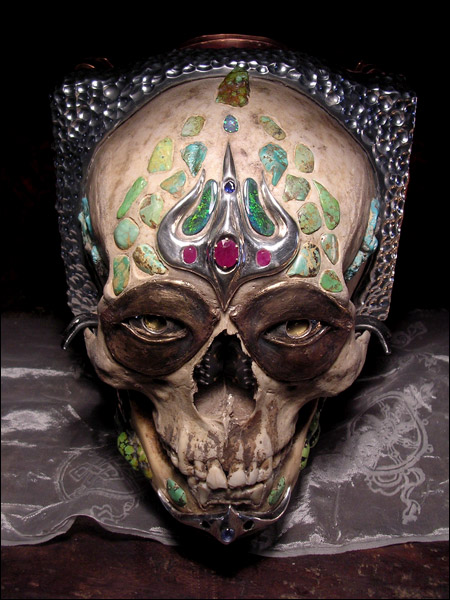
Wayne Martin Belger-Yama Pinhole Camera

Wayne Martin Belger-Yama Pinhole Camera

I recently came across the very intriguing work of Wayne Martin Belger, a contemporary artist/photographer working out of the Los Angeles area.  He makes pinhole cameras from found and unusual materials and uses the cameras to photograph scenes related to the theme of the camera.  Pinhole cameras are very simple in their nature but Belger’s creations are nothing like the shoebox or milkcarton cameras from one’s childhood.  They are elegant and strange, often elaborate in their construction.  The images he pulls from these cameras are often just as elegant and strange.  For example , Belger has a camera called Roadside Altar which , of course, he uses to photograph  the altars that are erected at the sight of fatal road accidents.   His website,  Boy of Blue Industries, tells this story  as well as give complete backgrounds on all of his cameras and Belger himself.  Fascinating stuff which I encourage you to investigate further.

Wayne Martin Belger-Wood Camera

Wayne Martin Belger-Wood Camera

One of my favorites, among many here, is the Wood Camera, which Belger describes as being designed to study distance.  He writes on his site:  The Wood Camera is made from Wood, Aluminum, Copper, Steel, Acrylic, and Insects. Most of the camera parts were found in Death Valley, CA. The camera has an interchangeable front plate used to float objects in front of the pinhole. With pinhole photography the focus is infinite. Objects which are a quarter-inch in front of the pinhole are just as in focus as objects 20 miles away.

He floats small objects in front of the pinhole to create great juxtapositions as both the object and the scene in the far distance remain in focus.  It made me realize that I often paint as though I were a pinhole camera.

Wayne Martin Belger-Wood Camera Photo

Wayne Martin Belger-Wood Camera Photo

Wayne Martin Belger-Wood Camera Photo 2

Wayne Martin Belger-Wood Camera Photo 2

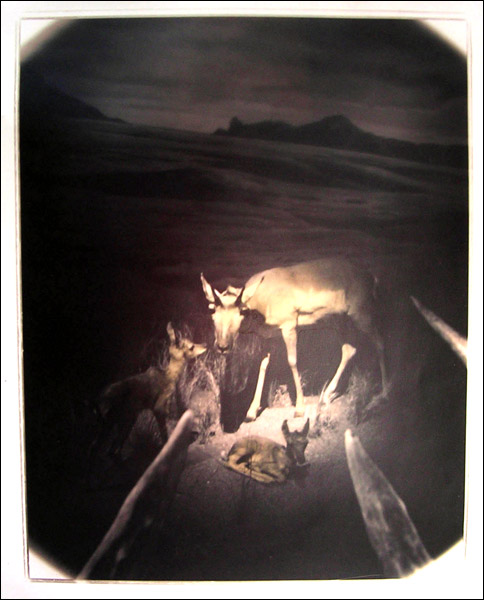
Here is the Deer Camera which is used to take photos of deer, of course.  Again, for more info on this work, check out his site.

Wayne Martin Belger-Deer Pinhole Camera Front View Wayne Martin Belger-Antilocapraamericana (Mother & Babies)

Read Full Post »

Julia Margaret Cameron- Whisper of the Muse-Portrait of GF WattsI came across this photo from Julia Margaret Cameron, a Victorian era  British photographer whose work I find tremendously interesting and forward leaning.  I have featured her work here before, with photos titled Sadness and Iago.  This photo from 1865 is titled Whisper of the Muse/Portrait of GF Watts  once again shows off the painterly eye that marks Cameron’s work as she portrays the renowned painter of the time amid two young girls.

I liked the image and it piqued my interest as to GF Watts‘ work.  I had heard the name but couldn’t recall his work so I decided to give a quick look.  An interesting guy, one who fell from favor at one point after his death and has found renewed interest.  Some of his work is Pre-Raphaelite in its appearance, very appealing and beautiful but falling into the genre to the point it became hard to distinguish it from other painters working in the same time.

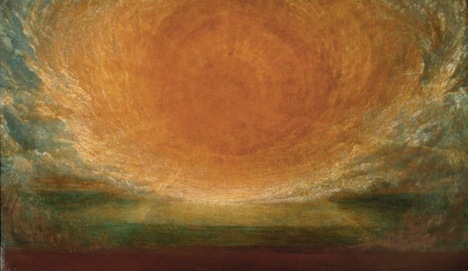
But there was a piece that really captured my eye.  Titled After the Deluge (The Forty-First Day) it is an almost abstract depiction of the world after the biblical flood, the sun dominating in bursts of warm tones .  It was such an anomalous and powerful piece, more Van Gogh and modern in feel than Pre-raphaelite.  It evokes Mark Rothko, to bring it even further into the future. I found it just amazing.  It was on display at the National Galleries of Scotland last year in an exhibit titled Van Gogh to Kandinsky/ Symbolist Landscape in Europe 1880-1910.  This is how they described Watts’ work:

George Frederic Watts took his role as an artist to a high calling, stating: ‘I paint ideas, not things’. For him, landscape provided elements which he could transform to project profound meaning via natural grandeur, as in his large, imposing painting After the Deluge: The Forty-First Day. This simple image – a vast sun hanging over an expanse of calm, unbroken water – is far from a mere sunset; it evokes the cosmic energy of a star.

I love the quote– I paint ideas, not things.  Something to hold to.  Here’s the painting in question:

george_frederic_watts_after_the_deluge

Read Full Post »

Teun Hocks PrairieI came across these photos by Dutch artist Teun Hocks  (b. 1947) which reminded me very much of the work of Robert and Shana ParkeHarrison, which I have featured here twice before.  Actually, it was on this same day last year that I last featured them– perhaps I am looking for an alternate reality on this date as opposed to trying to relive in some way that morning twelve years ago.  The ParkeHarrisons create elaborate but real backdrops against which they photograph their Everyman in allegorical scenes– there is no digital manipulation.  It is more like the worlds created in the earliest days of cinema when what was seen had to made real in some way, even the most fantastic scenes.

Teun Hooks Untitled- Man on IceTeun Hocks works in very much the same vein except that he creates a painted backdrop against which he photographs himself as the sometimes comical but deadpan Everyman.   Think Buster Keaton here.  He then creates oversize  gelatin silver prints on which he paints in oils, treating his original photo as an underpainting.  The result is a beautiful image with a painterly feel that is  imbued with both humor and pathos.  You can’t but help feel some sort of connection with Hooks’ character as he faces a sometimes puzzling reality.  Don’t we all?

I’m showing just a handful of the work of this prolific artist here as well as a YouTube video showing a larger group.  Hope you’ll enjoy this on this day.

Teun Hocks

Teun Hocks Baggage

Teun Hocks Untitled-Man Sleeping with Weight

Teun Hocks Crossroads

Teun Hocks Music

Read Full Post »

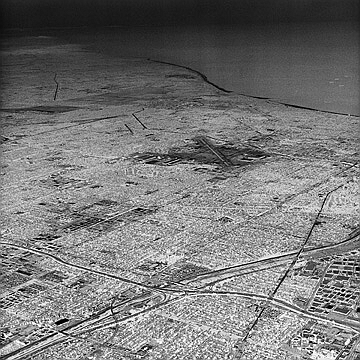
David Maisel Oblivion 1382-52nI really don’t have the time to really get into the work of photographer David Maisel but wanted to at least pass on a few of his images as well as a link to his website.  Initially, I came across some of his black and white views of Los Angeles taken from great altitudes, transforming the landscape into an abstract form that feels darkly uneasy and machine-like, the urban sprawl constantly self-replicating.  I am drawn to aerial imagery and these pulled me in at once.

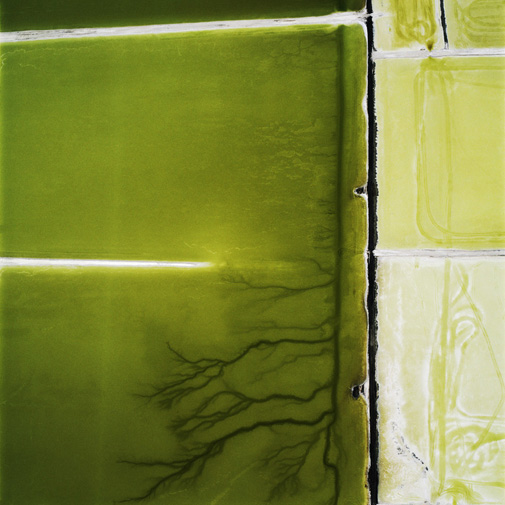
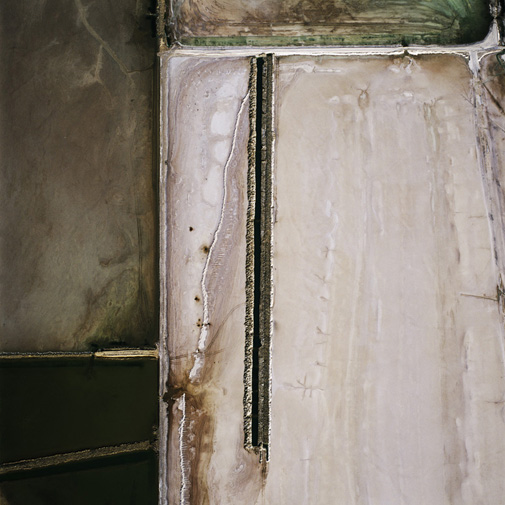
David Maisel  Terminal Mirage 22But going to his site, I was hit with a wide spectrum of images that knocked me out.  Color filled views of geometric beauty shot over the Great Salt Lake. Creepy shots of clear-cut forest zones in Maine with massive piles of logs splayed out like toothpicks.  Images that capture what he calls the apocalyptic sublime in the aftermath of Mount Saint Helens.  Images in black and white and in colors that come off as shocking of mining sites.  It was stunning work that captured the environmental impact of the continual push of humans into all spaces– beautiful and terrifying at once.

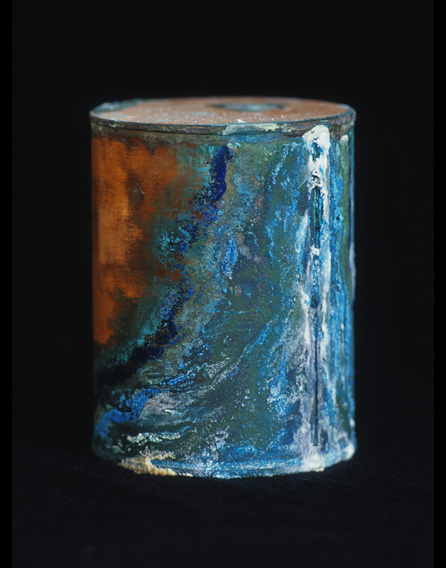
David Maisel Library of Dust 1165Even the parts of his body of work that seem to stray from his aerial assault on our perceptions were fascinating.  X-rays of antiquities.  A series called Library of Dust that shows the degradation of copper canisters containing the cremated remains of patients of an Oregon Insane Asylum who died there between the 1883 and the 1970’s, all unclaimed by family and forever resting anonymously in a decaying building.  Thousands of these sealed copper cans lining simple shelves while time works its magic.

It’s all remarkable and thought provoking work.  As I said, beautiful and terrifying.  I could see myself getting lost in any of his projects.  I encourage you to check out his site and see for yourself.

David Maisel  Terminal Mirage 19 David Maisel  Terminal Mirage 18 David Maisel  Terminal Mirage 8 David Maisel Oblivion 1381-41n David Maisel Oblivion 1380-45n David Maisel  Terminal Mirage 20 David Maisel Untitled [Library of Dust]

Read Full Post »

BOATS UNDER SAIL---Image of japanese Junks ca 1898 T. EnamiThis is an image of two junks that was taken in the late 1890’s by the great Japanese photographer T. Enami .  It was produced in the period as hand tinted  slide to be viewed in the popular stereopticons of the time.  The image was forwarded as a black and white photo to the National Geographic  magazine in the the 1920’s along with other photos of Japan from Enami.  They didn’t use the photo at the time, instead opting for the more traditional images of Japanese farmers and Geishas in a story on the island nation.  However, in the 1980’s the magazine took another look at the image and it really struck a chord with them.  The artistic beauty of the image was evident to them and they ultimately named this image as one of the best photos from their holdings of over 100 years.  It was used on the covers of one of their books and a catalog for a show of their best photography.

T. Enami - Japanese Boys in a Lively Quarrel stereopticon slide 1905I was immediately taken with this photo when I saw it.  It’s just such a beautiful composition and the harmony of the color and atmosphere make it sing.  I decide I should look at some other images from this T. Enami who was born Enami Nobukuni in Tokyo ( actually Edo at the time) in 1859 and died in 1929.  There were many images of Japan from the time, all beautifully captured with a sublime eye.  Some were surprising such as this 1905  image of 3 boys scuffling, an image that was sold in a series of slides by Sears.

But for me his images of  Mt. Fuji were the highlights.  They captured the dramatic presence that the mountain holds and are just incredible compositions, powerful and serene.  There are several of my favorites below.  T. Enami is probably not as well known here as his work deserves.  There is a site,  T-Enami.org, devoted to his work that is worth a look if only to take in more of his wonderful work.

T. Enami Mt Fuji and the Boatmen of Kashibara ca 1900 T. Enami- Mt. Fuji's Summit T. Enami- FOUR_MEN_ON_A_BRIDGE_AT_TAGONOURA_in_OLD_JAPAN.224130134_std T. Enami MOUNT_FUJI_SEEN_FROM_THE_MARSHES_OF_KASHIWABARA.  ca 1892

Read Full Post »

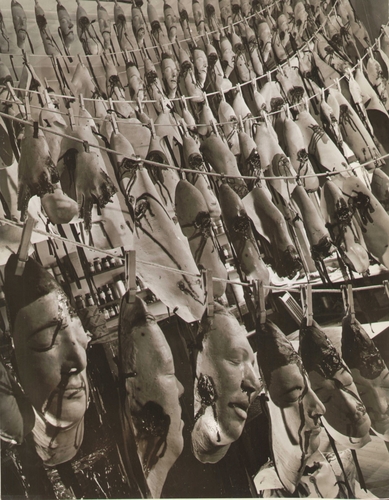
Carol Eyerman-  A Surreal Study of Latex Masks 1950There is something about a mask that captures the imagination.  Hiding our true selves behind a shield often allows us to act in ways that are often in direct opposition to who we really are or to, at least for a short time, take on a persona we would never dare exhibit as our own.  I think we all often wear masks of a sort in our dealings with people, showing only the face we choose to show at any given moment.  We seldom fully take off our masks and show our full and true self.  I think that is a reason I often feature masks in the artifacts of my Archaeology series.

So when I came across this photo it  immediately caught my attention.  It is a wonderful abstraction of latex masks hanging from lines as they dry.  I can find no story behind this 1950 photo or even much about the photographer,  Carol Eyerman , who died in 1996 at the age of 85 and was a Life and Sunset magazine photographer best known for landscape photos.  To me, it is either a shop that makes masks for Halloween or theatrical or movie productions.  I’m thinking Halloween just by the sheer number.

But beyond the facts behind the photo, it’s a terrific image with the looping lines that hold the gruesome faces and  bloodied hands rising up and away.  Like a factory of pain and torture, an image torn from a nightmare. Just a great shot.

Cherry and Richard Kearton - Wildlife Photography Pioneers 1900As an aside, while I was jumping around online trying to find more about Carol Eyerman, I came across this photo of a man standing on another man’s shoulders while taking a photo on a camera atop an extraordinarily tall tripod.  It was such a neat image that I had to stop to discover that the two men were Cherry and Richard Kearton who were brothers and pioneers in wildlife photography.  This photo was taken in 1900.  I always seem to find the most interesting things while searching for other things, as thought the initial search is actually only a starting point.  In this case, it may not be as interesting as the masks but it’s a great image in itself.

Read Full Post »


paul strand ny 1916No matter what lens you use, no matter what speed the film, no matter how you develop it, no matter how you print it, you cannot say more than you can see.

–Paul Strand

************************

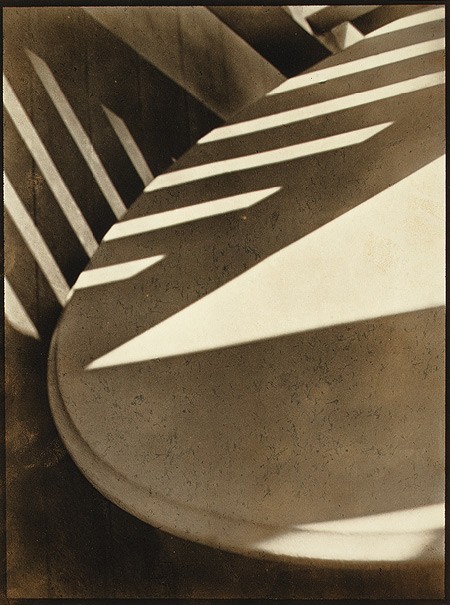
I have featured the photography of Paul Strand here before, writing about his groundbreaking work in the early decades of the 20th century.  There is something about his work and his eye that is unmistakable, something that jumps from the surface.  When I saw this photo of a park in NY, here on the right, I knew immediately that it was Strand’s work.

I love this image, with the abstraction of the forms with the sidewalk forming a flowing diagonal through the picture plane.  The single figure in the lower third of the photo, cutting across the park in full stride,  becomes the focus for me, the soul of the picture.  He becomes the singular voice in a busy anonymous world.

Paul-Strand-The-Court-New-York-1924I think  the way in which he applies abstraction to the common forms in his work is wonderful and inspiring as an artist, something too many of us forget in our own work.  We become too concerned with simply capturing subject and not the emotion created in how that subject fits into its environment.  His best work speaks purely of emotion to me and he was able to find it everywhere.  As he said:  The artist’s world is limitless. It can be found anywhere, far from where he lives or a few feet away. It is always on his doorstep.

I think those are words to live by for any artist.

Paul Strand Abstraction Connecticut 1916


Read Full Post »

Abraham Lincoln Tintype Medallion  1860I’m always intrigued whenever I come across images of Abraham Lincoln.  There aren’t many I haven’t seen  as his image has remained in the public eye on a regular basis throughout my life.  Growing up, in our family photos there was a small image of Lincoln that was mixed in with a handful of early photos from my great-grandmother.  I didn’t yet understand the place that Lincoln held in the heart of the American people   and wondered why it was there.  I actually felt more related to his image in that I at least recognized who he was which was something I couldn’t say for some of the folks in those old photos of people standing in front of what appears to be 1920’s automobiles in some totally unfamiliar rural farm setting .  Maybe that’s why I am drawn to his image even now.

So when I come across an image that doesn’t seem familiar, I take notice.  It’s part of trying to capture another part of the prism of the man, to fill him out as a human rather than as the icon he has become.  The token shown above, obviously a souvenir from the 1860 campaign, is new to me.  Lincoln is still youngish in appearance, not yet showing effects that the ravages of the weight of a nation at war would  appear  in later photos.

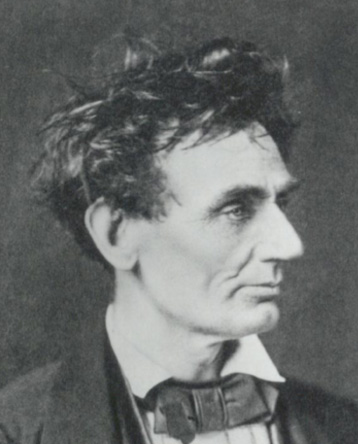
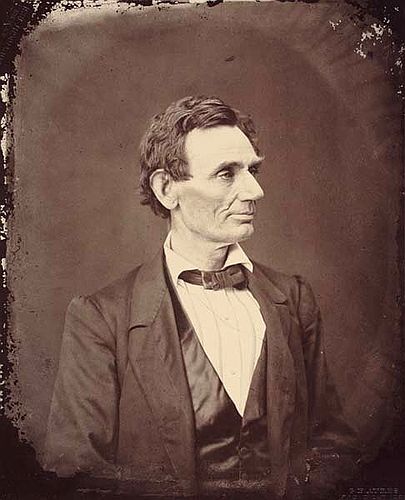
Abraham Lincoln- Early with Wild hairThis photo on the right brings up questions.  Why was his hair so wild?  Would he not have been aware of that when he agreed to sit for the photo?  It’s not like there was a paparazzi at that point snapping candid shots at every turn or a White House photographer documenting every moment.  You had to more or less pose for most photos.  But I like it.  Again, it fills out the man.  And it makes me feel a little better about my own crazy professor hair as I sit here.

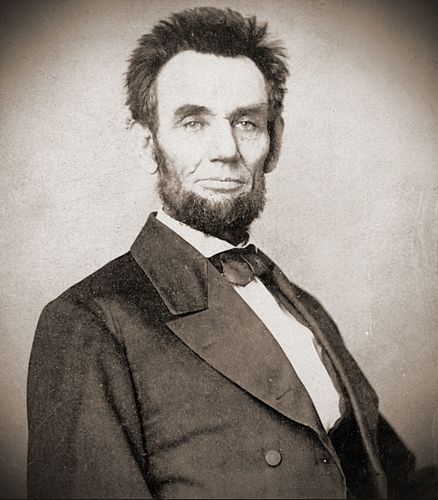
There are a few more images below and some of them are a bit more familiar.  The first one seems to be a shot from the same sitting as the wild-haired one above.  Maybe the photographer noticed and offered up a comb.  I don’t know.  The second is from the War years and he has began to age.  But it’s a noble and strong image with that steely look of determination staring directly into the camera. The last is an earlier image when he is obviously not as consumed by the tasks before him.   But all are interesting in their own way and give us more insight into this most compelling character.

Abraham Lincoln George Ayres 1861

Abraham Lincoln- Alexander Gardner 1860s

Abraham  Lincoln-attributed to Nicholas H Shepherd

Read Full Post »

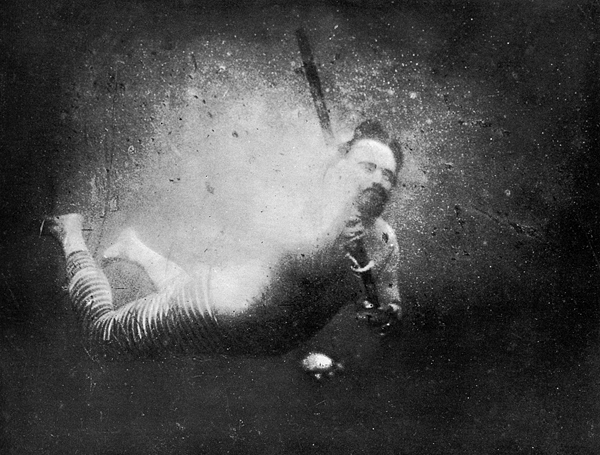
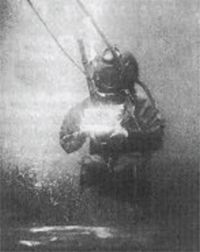
Louis Boutan- Underwater Photo ExperimentA friend of mine had a picture on Facebook yesterday that was taken underwater.  It was bright, clear and detailed, full of the color of the sea.  The fact that anyone can easily take such sharp underwater photos made me wonder about how underwater photography had evolved.  Doing a little research I came across the photo shown here on the left that really caught my eye.  It has a real magical quality to it with the light burst at the center and the diver appearing like some odd creature in mid-birth.  It was by a French marine biologist, Louis Boutan, from the early 1890’s and is one of the earliest surviving underwater photos.

There had been an earlier photo,  from 1856 by William Thompson in the waters of Dorset in the UK.  It was taken by a camera attached to a pole and showed the underwater plant growth of the shallow sea bottom. The photo has been lost  however which  and it takes almost forty years into the future before Boutan takes up the quest for documenting what he was seeing under the sea as a marine biologist.  You have to realize the difficulties he faced in achieving this goal.  First, diving and photography were in their early stages and the equipment for both was large and cumbersome.  It would be decades before scuba gear was introduced and cameras were large boxes with long exposures and flash systems that consisted of burning magnesium.  You couldn’t just whip out your iPhone and snap some pix.

Louis Boutan in his Diving SuitBut Boutan persevered and with the aid of his engineer brother devised systems, that would be enormous by today’s standards, allowed him enough mobility to move them to the sea bottom and photograph.  His experiments included shallow shoots such as the one featuring the diver above and, ultimately, dives that descended to 164 feet beneath the sea in a diving suit.  The image to the right is one of these first deep images.  As I said, the exposure were long, up to 30 minutes for the film of the time at such low light, and Boutan would sometimes suffer nitrogen narcosis– the rapture of the deep.  It was a dangerous effort to document the world he loved.

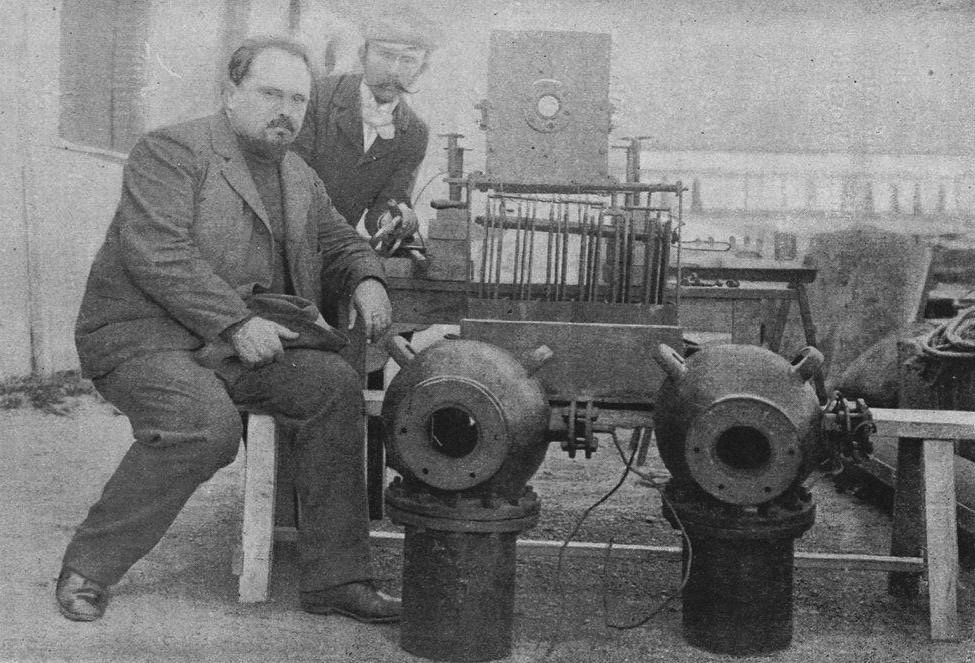
Louis Boutan on left with his Dual Carbon LampsThis a photo of Boutan (on the left)  and his equipment at one of the later stages of his 1890’s experimentation.  Even though it looks huge to us, this was pretty compact for the time.  The two steel orbs in the forefront are carbon arc lamps that he developed to replace the earlier system which was a huge wooden barrel with a large glass globe affixed to the top that encased a ribbon of burning magnesium.  Portability was not its big strength.

I like this photo of Boutan and his equipment because there is a feeling of the past and the future in it.  He appears so modern in contrast with his appearance, with his sport coat and haircut when compared to his assistant standing behind him who is obviously a product of his age with handlebar moustache, necktie and cap.  Boutan could walk into the room today and be contemporary.  I think that speaks to his drive to evolve his process.  He would not be tied to the static present and the lingering past.

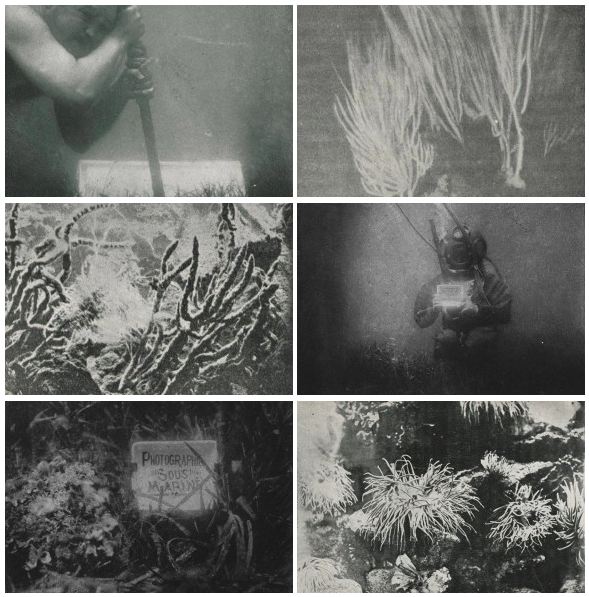
Boutan also published a book in the 90’s that featured many of his images and documented his work.  Below is a group of these images.  So, when you pull out your compact camera the next time and dive into the water to snap a shot of the kids or some colorful fish, remember Louis Boutan.  He set the whole thing in motion.

Louis Boutan Group of Photos from his 1890s Book

Read Full Post »

“Not I, nor anyone else can travel that road for you,
You must travel it for yourself.

It is not far, It is within reach,
Perhaps you have been on it since you were born, and did not know,
Perhaps it is every where on water and land.”

–Walt Whitman- Part of Song of Myself from Leaves of Grass. 1855

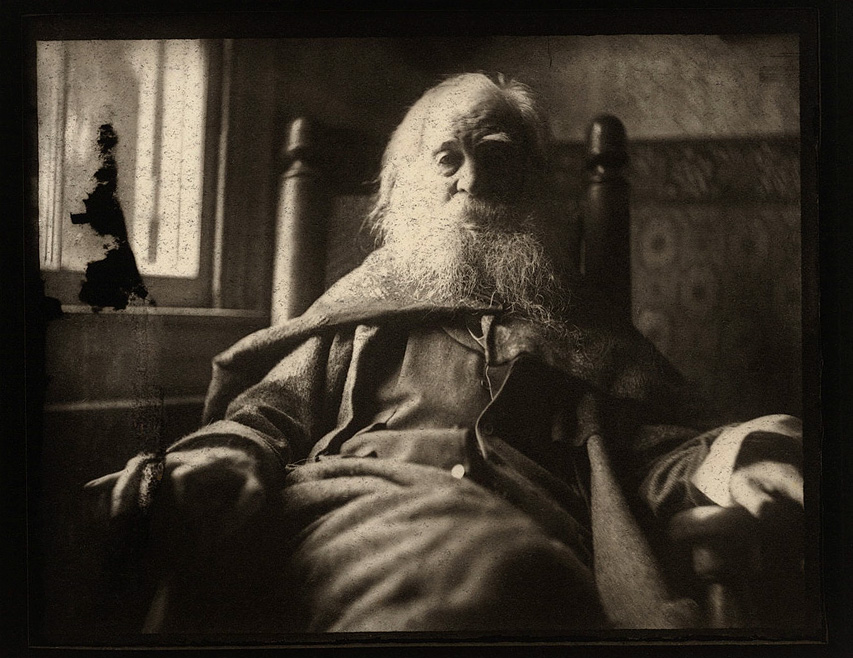
Walt Whitman-  Thomas Eakins 1891

I’m in a bit of a hurry but really wanted to show this great photo of Walt Whitman.  I don’t think I’ve ever seen a photo of him that wasn’t interesting but this one is special.  It’s taken by the great American painter Thomas Eakins in 1891, a year before Whitman’s death in 1892.  Eakins was also a pioneer in the use of photography in the art studio and an innovator in motion studies with film, among many other things.  I plan on writing more about his remarkable career in the future.  But for now, I just wanted to show this simple elegant photo of America’s voice.  At least to my ears.

Read Full Post »

« Newer Posts - Older Posts »