Feeds:
Posts
Comments

Posts Tagged ‘Principle Gallery’

This week I’ve been heavily focusing here on new work from my next show which opens at the Principle Gallery on June 10th.  I was going to move to something other today but as I sat here contemplating what to write about, this piece just completely swallowed my attention, making me forget about anything else.  I suppose that’s as strong a sign of validation for a piece of work as anything.

This painting has a feeling of total contentment for me.  Nirvana.  In fact, I call this piece,  a 14″ by 24″ image on illustration board,  Serene One.   

There’s a wondeful golden glow to this piece, a radiance in the surface that I often hope for in my work but seldom feel  is completely attained.  It’s not something that I can produce at will.  It just shows itself periodically, a tantalizer, a glimpse of where the work might take me if only I put myself- mind and spirit- completely into it. 

This search for this  radiance is not unlike the quest and desire for the actual serenity it represents.  That may be the greatest benefit of my job as a painter, the fact that it allows me to search for this contentment in my work, the same sort that I seek in myself. 

I could say much more about this painting but I think what I’ve said is enough.  This piece is well beyond my words.

Read Full Post »

Origins

Origins is the title that came forward in my mind for this new  painting from the Principle Gallery show, which opens June 10th.  It’s a  small piece, 5″ by 7″ on paper, that recalls some of my earlier Archaeology series pieces, particularly the ones that focused more on the strata rather than the artifacts. 

Origins is primarily painted in shades of sepia with some grays and blacks.  It is highlighted with a thin greenish tone in the grass and a deep orangish sun above, touches that push out well from the sepia background, giving a pop to the piece.

The title, as I see it, refers to the relationship between the sun and the grass, as well as the tree which connects them in the scene.  The very beginnings of life, the start of yet another cycle of existence.  The layers below the surface represent the generations and ages that have come and gone before, now buried together out of sight.  The surface is the present,  for the living, unfettered by the past.   The tree, and its limbs that move in many directions, represents the potential of youth.  The freedom of the now.

The grass at the base of the tree symbolizes an urgency of existence, being pulled upward by the feeding sun, feeling fresh and vibrant while knowing its time is limited here. The pale tint of the larger grassy area is a pulse to me, faint but becoming stronger.

As I’ve stated many times before, these are what I see after the fact.  When I’m painting, these things are not in mind at all.  At that point, it is all about balance and rightness and rhythm.  The outcome, the what-wiil-be, is undefined.  It’s like being a reader of tea leaves- before I can read the leaves the tea must be made.

That may not make sense to anyone but I think I know what I’m trying to say.  And for the moment, that will have to be enough.

Read Full Post »


When he reached the ferry, the boat was just ready, and the same
ferryman who had once transported the young Samana across the river,
stood in the boat, Siddhartha recognised him, he had also aged very
much.

“Would you like to ferry me over?” he asked.

The ferryman, being astonished to see such an elegant man walking along
and on foot, took him into his boat and pushed it off the bank.

“It’s a beautiful life you have chosen for yourself,” the passenger
spoke. “It must be beautiful to live by this water every day and to
cruise on it.”

With a smile, the man at the oar moved from side to side: “It is
beautiful, sir, it is as you say. But isn’t every life, isn’t every
work beautiful?”

——-Herman Hesse, From “Siddhartha

****************************

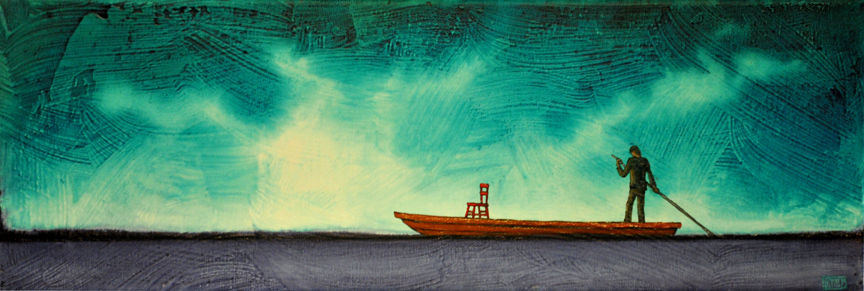
This is is a new piece, also from the upcoming Principle Gallery show.  It’s a small piece, 6″ by 18″ on canvas, that I call simply Ferryman.  I have used the image of the ferryman through the years, usually in very simple, quiet compositions.  It would be easy to associate the image with that of Charon, the boatman of Greek mythology who carries recently deceased souls across the river Styx in Hades.  There is that feel about this image,  especially with the red chair sitting empty in the boat, an image I have often associated with the dead and memory of the past.

 But I see this particular ferryman in a different way, more like the philosophic ferryman of Hesse’s Siddhartha above.  The passage with this ferryman is  more about transformation than transportation, a spiritual crossing from existence, one state of being,  to another.  The brightness of the light breaking through in the sky seems more attuned to this reading of the image as well, as though the passage is taking one across to a state of higher enlightenment.  There’s still a somber quality but it is different than that which is often attached to death.  It’s more the feeling of knowing that you are being transformed on this voyage and the past you is no more.  Gone forever.

As always, this is just how I read it.  You may see more, you may see less.  All views are equally valid.

Read Full Post »

I’ve been showing a number of the pieces here that are part of my Principle Gallery show that opens on June 10, focusing recently on the more monchromatic work, those pieces in shade of gray and sepia with less color.  I thought this painting would be a nice return to the color of my normal work.  Called Dusky Dance, it’s a 7″ by 15″ image that rests in a 14″ by 22″ mat and frame.

This image features the intertwined trees that I have sometimes painted over the years, their trunks and limbs rhythmically coming together which brings about the dance of the title.  There’s a great moodiness here in the misty orange atmosphere with the sun  softly finding  its way through. 

The landforms are kept low and simple, their compositional impact intentionally kept to a minimum.  The piece is really about the feel from the sky with its dusky oranges and yellows,  and the the way the trees twist together.  As though the the two trees are existing in only the rare atmosphere of that moment which I think is reflected in the extreme focus of this piece.  It’s simply put together but intense in its feeling, both aspirations I normally maintain for my work.  This  makes this a very prototypical piece, one that expresses much of what I feel for my work.

Read Full Post »

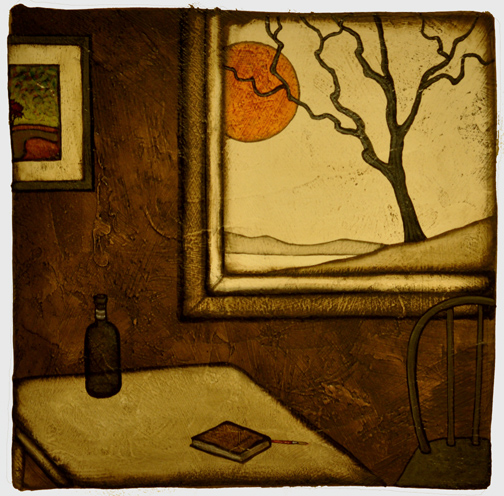
I try to have a few pieces in every show that are a bit out of my normal range, pieces that still carry the same momentum as the other work in the show but have a different look from my typical work.  This is one such piece from my next show, Now and Then, which opens at the Principle Gallery on June 10th.  This is an 11″ by 11″ painting on paper and is limited in its color with shades of brown and gray and bits of more vibrant colors.

I do these interior scenes once in a great while, usually employing a window or door as part of the composition.  I enjoy the contrast between the sharp angular geometry of the interior space and the more rolling curves and arcs of the outer landscape.  The window also provides a contrast in darkness and light for this piece, the darker tones of the interior making the lighter exterior scene pop in this composition.

Like my landscapes, I still try to keep details to a minimum.  The interior scene provides more opportunities to embellish, to add more points of interest such as the few things on the table, but I want the larger forms to be the expression in this piece.  I want the piece to still read easily from a distance.  This is similar to the way I felt about my earlier Archaeology series.  There was an area of great detail but I wanted that to be secondary to the whole scene, preferring that the viewer be drawn to the overall feel of the piece first then noticing the detail after.  Also like some of the Archaeology pieces, I’ve added bit of self reference here in the form of the painting on the wal, a small red tree. 

I always like these pieces if only for the difference they display from my other work and the fact that they feel more personal to me, as though the outer scene here is the one I regularly share with the larger world and the interior scene is the part that I don’t show, that part of the self I keep in reserve, hidden from the outer world.   Maybe that is the meaning here.  As for any other message,  I don’t know what they say to others. don’t know if that really matters in the case of these pieces.  Perhaps they are simply what they are, shades of brown and gray and bits of color…

Read Full Post »

Symphony

I wrote yesterday about how my upcoming show at the Principle Gallery was beginning to take shape in the studio.  I’ve been thinking about this and thought I might add a few points, maybe clarify things a bit.  Or muddy up the thought process even more.  There’s no telling  at this point.

I view the show not as a group of individual paintings but as a cohesive collection with common threads that run through them, emotional connections that create a unity of feeling across the group.  This is a hard thing to explain and goes beyond subject matter or style and technique when I’m trying to take in the group as a whole.  It comes down to a gut sensation, that feeling of rightness that I’ve struggled to describe before.  For instance, there are a few pieces that I could show with this group but , while they are strong and fully alive, their emotional resonance is slightly out of line with the rest of the work.  I don’t even know where to start in defining this emotional resonance that I’m talking about here.  It’s as though each piece is emitting a tone or a note and I’m trying to choose those pieces that harmonize with one another.

Maybe it’s like a composer putting together a symphonic piece, trying to unite all these disparate instrument and sounds into one united voice.  You can pick out the different themes and tones of the individual instruments but it is the power of the whole that draws you in.

Maybe I shouldn’t view the work for my shows in this manner, should not worry  how the work is assembled as a group.  I mean, it may not even be noticeable to anyone but me.  But I do recognize it when I look at the shows as whole entities and that me feel there is something in it , something that makes the work come together to create something more powerful than the individual elements.  And this unity ultimately enhances each piece.

I don’t think I can really explain this, it being a pretty nebulous concept.  But it does occupy my thoughts for these weeks leading up to a show.  Hopefully, this will be evident in the show.

By the way, the triptych at the top is part of this show, part of the symphony.  It is a work on paper that frames out at 16″ by 34″.  There’s great warmth in this painting, a great sense of security for me.  But the title is still evading me at this time so if you have any suggestions, I would gladly listen.

Read Full Post »

I’m in the final days of painting for my upcoming show at the Principle Gallery in Alexandria.  I’ve titled this show Now and Then and it opens June 10th.  This past weekend really was extremely productive in the studio, with several pieces finally finished and the overall feel of the show taking  shape.  I had struggled for some time to find real definition for this show, that key factor that hopefully makes  each show distinct.  The past few days has me thinking that this show has found its distinction.

I think that it is defined by a fairly large group of works on paper such as the one shown above,Call to Waking.  This is an 11″ by 11″ image that is a mix of black inks and a sort of sepiatone that is actually a mix of many colors.  As I have described before, my process involves putting a lot of paint on the surface then pulling much of it off, soaking it up with brushes then squeezing them out.  In my old studio, I often found myself squeezing this paint on to the floor which left a huge blackish stain on the flooring there.  I try to be a bit more careful in my newer studio and have made a habit of collecting this paint, which often results in the creation of a color like the sepia of this piece. 

 There are a number of pieces in this show that have either this sepia or black/gray as the base color.  I have shown a few at a time in the past but this will be a substantial group and will provide an interesting juxtaposition between this work and my prototypical work. filled as it is with strong colors.  Seeing the two differing styles side by side in the studio has really shown this contrast.

Many of these pieces have bits of color in them, a faintly red tree or an orangish sun/moon  that pops from the gray/sepia background, but this piece is devoid of color.  I felt that the sepiatone had a warmth in itself and the contrast of the light breaking through the sky provided its own pop.  I felt that  any more color, say with  red roofs, would actually be a distraction here, altering the ample mood that has been created.  I think it works well as it is.

Well, although I could say more, I have work to get to.

Read Full Post »

I’m on the road today, taking a group of work to the Principle Gallery in Alexandria.  So, I thought I’d play a song that ties together several different elements.  It’s a song that I referenced in yesterday’s post on Harry Nilsson, Don’t Forget Me.  It’s performed by one of my favorites, Neko Case, who has been featured here a number of times.  She covers this song on her most recent album but this is from Elvis Costello’s Spectacle television series.  She also hails from Alexandria.

So, give a listen and, like the songs says in such a wistful way, come on, get happy

Read Full Post »

A few weeks ago, at the gallery talk at the Principle Gallery, I was trying to explain my process and how my work comes around to being what it is and why there is often a repetition of form and subject.  It’s a difficult thing to describe and has always evaded the limit of my words.  In doing so that day I used an example of an apt description that I had seen once on televison and had written of in this blog.

It was from a segment on PBS’ Masterpiece Mystery series called Wallander: Sidetracked starring Kenneth Branagh as a Swedish police detective involved in solving a series of murders.  There is a point at the end where he is forced to shoot and kill the killer who is a disturbed and abused young man.  Wallander (Branagh) is deeply affected by this and goes to see his father, played by the great British character actor David Warner (I’ll always remember him best as Evil in the film Time Bandits from  Terry Gilliam) who is shown above.  He is a painter of landscapes and is struggling with the onset of Alzheimer’s.

While trying to find a way to comfort his distraught son, the father reminds him of the times when Wallander as a child would ask why he painted what he did, why they were always the same.  He gives an answer that struck me deeply when I first heard it because it was so near to the heart of what I do as a painter.

 I used this example that day and as I describing the scene to the folks there at the talk, I was wishing I could just show them the scene to better illustrate what I had meant.  Anyway, I was able to find the scene which is definitely enhanced by camerawork and background music. I hope it gets the point across as well as I think it does.

Read Full Post »

Old Stuff

At the gallery talk I gave a few weeks back at the Principle Gallery, I referenced my early work, before the Red Tree emerged in my work and the landscapes were less centered on a central figure.  Whenever I talk about how the work evolved over the years I always turn and look at the paintings of mine that are hanging and try to find something that has some sort of equivalency and never really see anything there that fits the bill. 

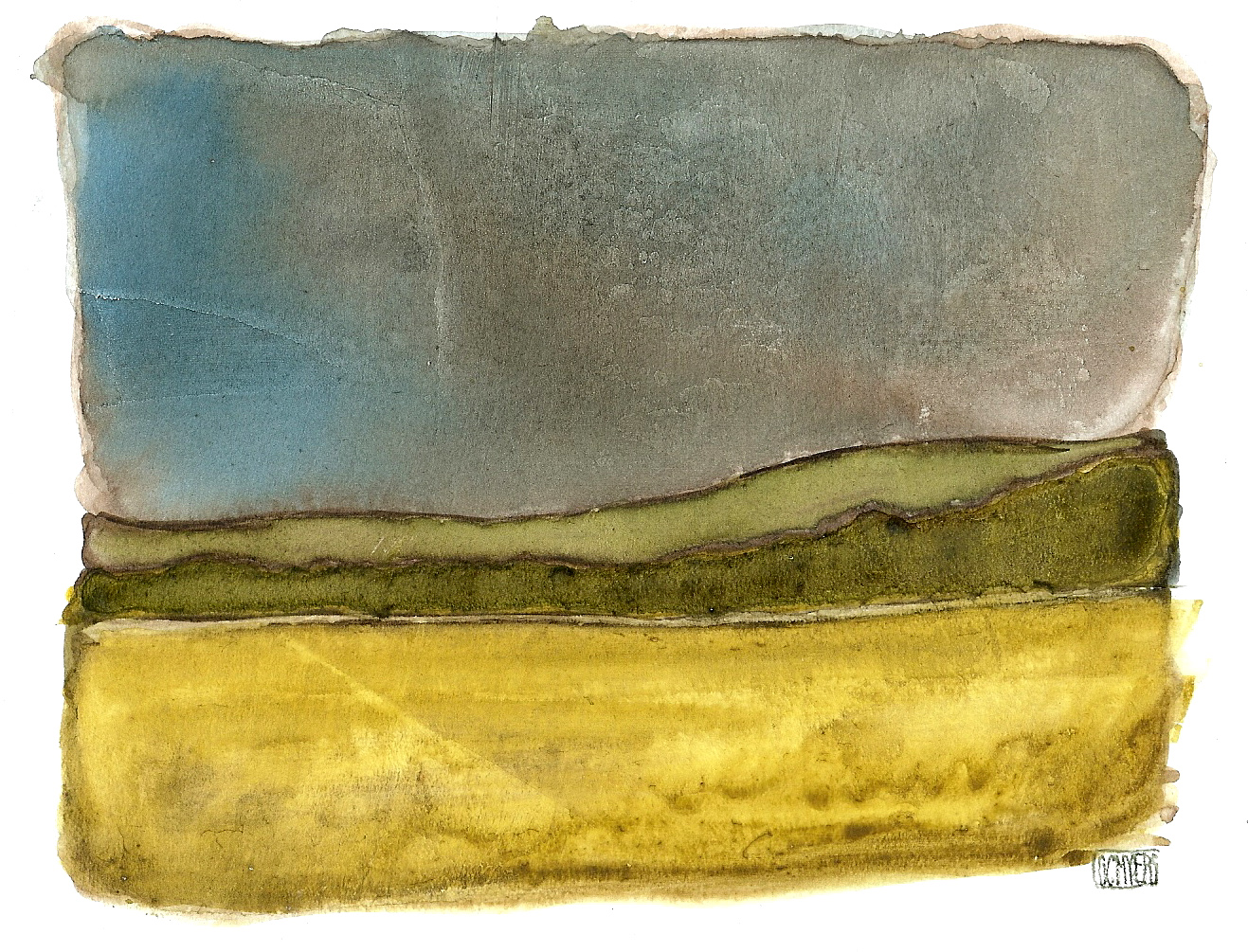
I was reminded of this yesterday when I was going through some old work on the computer and came across this scan of a small piece from about 15 years back.  It’s about 4″ by 5″  on a piece of illustration board and is very emblematic of the work I was trying to produce at the time.  It was all about blocks of color and their relationship to one another and how atmosphere and feeling  was created by them.  They were extremely quiet, almost mute.  Stoic.

There is always a part of me that wonders, when seeing examples of this early work, what my work would be now if I had chosen to stay in that mode of expression, if I had not been sparked by the energy of the red tree.  Would the work have grown in a different way, with a different feel and appearance? 

 Perhaps it’s not wise to ask such questions.  I suppose we are what we are at this point in time and to reflect back with such questions serves no purpose. 

But looking at this work, I can see the beginnings of what has become my work.  I see the point where I was at that time in the progression of how I mix colors and how the paint is applied.  I can see the things in this piece that would spark other pieces which would contribute to the work’s evolution.  That’s one of the aspects of painting I seldom talk about – how work begets work, how each piece is a step forward in the evolution of a body of work.  It’s a process of constant change and adjustment, always moving hopefully ahead.

Maybe that’s the purpose in looking back on earlier work- to see if one has truly changed or grown.

I don’t know…

Read Full Post »

« Newer Posts - Older Posts »