You’ll get mixed up, of course, as you already know. You’ll get mixed up with many strange birds as you go. So be sure when you step. Step with care and great tact and remember that Life’s a Great Balancing Act. Just never forget to be dexterous and deft. And never mix up your right foot with your left.
-Dr. Seuss, Oh, the Places You’ll Go!
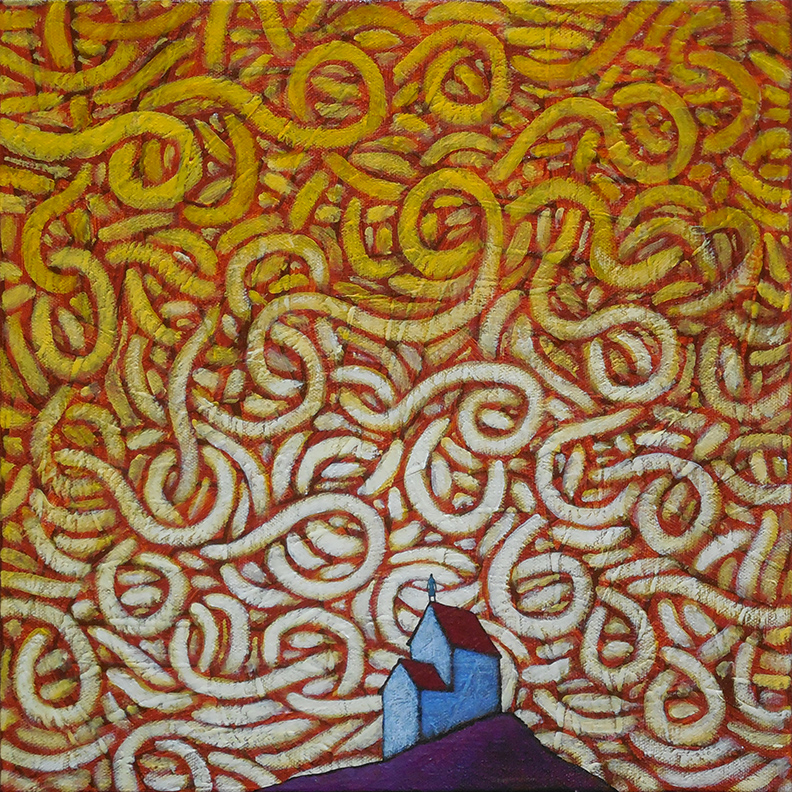
This is one of the smaller pieces from my Entanglementshow that opens June 13th at the Principle Gallery. It’s 6″ by 8″ on canvas and I call it Balancing Act. Not quite sure if the balancing act refers to this person to staying upright on the small peak or in life in general, as Dr. Seuss reminds us with his Life’s a Great Balancing Act.
Or does it refer to the act of living as we do between planes of existence, one physical and one ethereal as the tangles of energy in the sky here suggest?
Or might it be the balancing act between reality and perception?
Hmm. More to think about here than I first thought. I guess it all comes down to how someone is feeling at any given moment or how they see things as a whole.
I have to think on this a little more so let us have a little Sunday Morning Music. This song seems like a good fit and a fine way to jumpstart your day. This is Over Under Sideways Down by the Yardbirds (with Jeff Beck on guitar) from back in 1966. Sounds like a great way to describe the sky in this painting.
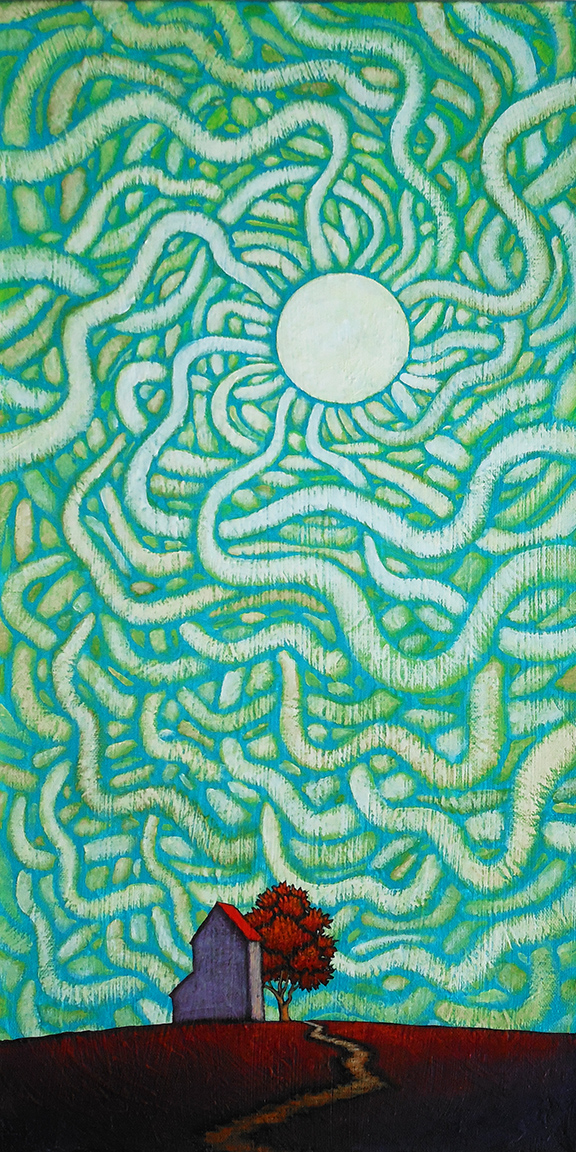
The Answering Light At Principle Gallery, June 2025
Who am I? This or the other? Am I one person today, and tomorrow another? Am I both at once? A hypocrite before others, and before myself a contemptibly woebegone weakling? Or is something within me still like a beaten army, fleeing in disorder from a victory already achieved?
—Who Am I?, Dietrich Bonhoeffer, Letters & Papers from Prison
It is said that the true character of a person is revealed in times of adversity.
It is also said that true character is revealed with the attainment of power but I’m not going to talk about that this morning since having great power is much rarer than the many forms of adversity that can us common folk. Besides, that adage is definitively proven by the soulless creature now brandishing power here in this country.
But most of us face adversity of some sort at some point in our lives, a time when we are forced to make decisions that show just who we are and what is contained within our character. At such times we must decide whether to dither or take action. To speak out or be silent. To fight or take flight. To accept and succumb to our fear or to resist and overcome it.
This all comes to mind for me in this new painting, The Answering Light, from my upcoming Principle Gallery show, Entanglement. On one hand it is a quiet and somewhat placid piece, almost meditative in its nature. On the other hand, I see the house here as representing one of those critical points in time when such a decision must be made. It is still quiet but more brooding than meditative as an answer is sought.
I see the swirling tangle of energy in the sky as providing an answer which is to do that which is right, that which is not in disharmony with the energy of the universe. It is also a reminder that this is a point in which there is the opportunity to mold and alter the character that has been formed throughout one’s life. A time to overcome those mistakes of judgement from our past, to reestablish our strength of character– to find redemption of a sort.
The light and energy of the sky cautions that whatever you decide will define your character because you will do what you will do because that is what and who you are.
This same question of who we are and what that will us do is contained in a poem written in a German prison during World War II by theologian and anti-Nazi dissident Dietrich Bonhoeffer. I have written about Bonhoeffer a number of times here and the post on his essay, On Stupidity, has been by far the most popular post on this blog over the past several years.
Dietrich Bonhoeffer was a German pastor and theological writer who stood in direct opposition to the Nazi regime and spoke out against its programs of euthanasia and genocide. He had an opportunity to stay in the US in the late 1930’s, safe from the reach of the Nazis, but he insisted on returning, believing that if he were to rebuild the German church in the war’s aftermath he must endure it with its people.
He was imprisoned in a German prison in 1943 and later transferred to a concentration camp. He was implicated in a plot to assassinate Hitler and was hanged in the waning days of the war, in April of 1945.
In this poem, Who Am I?, Bonhoeffer poses many of same questions and concerns that I see in this painting, They are the same questions and concerns that I have for my own character. I think it is a fine companion for this painting.
That’s a lot to say here this morning and I am not sure that I’ve said it clearly or with any sense at all. I write these things as first drafts each morning so sometimes they are not always all I want them to be. Some things are missed or said in a clunky way. Kind of reflective of my own character. Below is the whole poem from Bonhoeffer.
The Answering Light, 24″ by 12″ on canvas, is included in my exhibit of new work, Entanglement, that opens Friday, June 13 at the Principle Gallery with an Opening Reception from 6-8:30 PM. I will also be giving a Painting Demonstration at the gallery on the following day, Saturday, June 14, from 11 AM until 1 PM.
Who am I? They often tell me I would step from my cell’s confinement calmly, cheerfully, firmly, like a squire from his country-house.
Who am I? They often tell me I would talk to my warders freely and friendly and clearly, as though it were mine to command.
Who am I? They also tell me I would bear the days of misfortune equably, smilingly, proudly, like one accustomed to win.
Am I then really all that which other men tell of? Or am I only what I know of myself, restless and longing and sick, like a bird in a cage, struggling for breath, as though hands were compressing my throat, yearning for colours, for flowers, for the voices of birds, thirsting for words of kindness, for neighbourliness, trembling with anger at despotism and petty humiliation, tossing in expectation of great events, powerlessly trembling for friends at an infinite distance, weary and empty at praying, at thinking, at making, faint, and ready to say farewell to it all?
Who am I? This or the other? Am I one person today, and tomorrow another? Am I both at once? A hypocrite before others, and before myself a contemptibly woebegone weakling? Or is something within me still like a beaten army, fleeing in disorder from a victory already achieved?
Who am I? They mock me, these lonely questions of mine. Whoever I am, thou knowest, O God, I am thine.
–Dietrich Bonhoeffer, Letters & Papers from Prison
Setting Course— Headed to Principle Gallery, June 2025
Gravity is so strong that space is bent round onto itself, making it rather like the surface of the earth. If one keeps traveling in a certain direction on the surface of the earth, one never comes up against an impassable barrier or falls over the edge, but eventually comes back to where one started.
–Stephen Hawking, A Brief History of Time
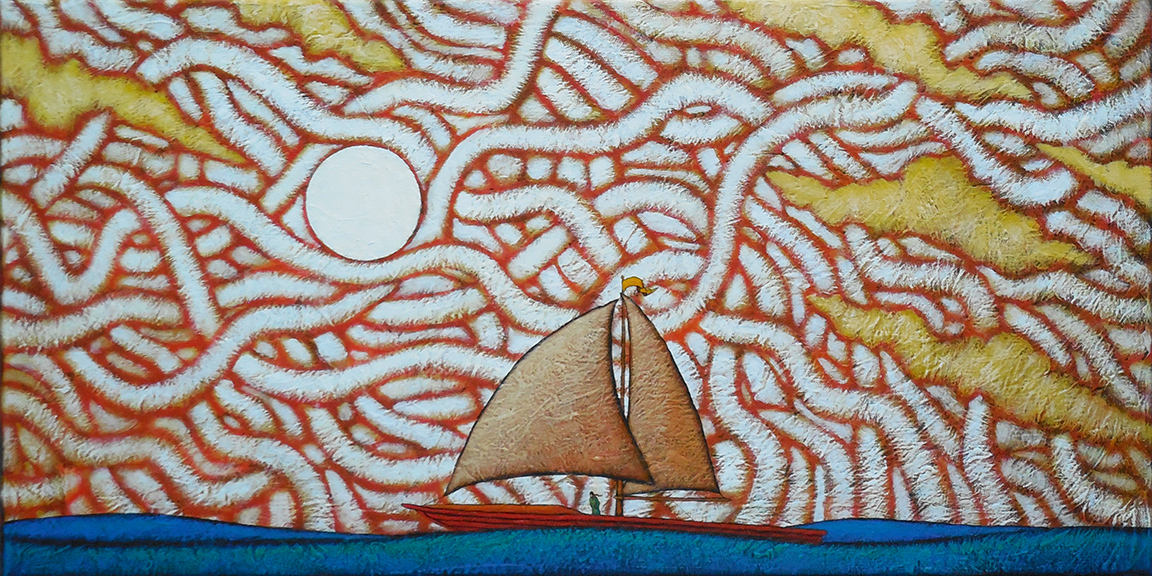
I am not sure that the passage above from Stephen Hawking is perfect for what I am seeing in this new painting but for this morning it will do just fine. The painting, headed to the Principle Gallery for my June show there, is titled Setting Course and is 24″ by 24″ on canvas.
Though from its outward appearance the sailboat here seems to imply setting a course to some distant destination, that is not necessarily how I read it for myself. As it is with much of my work, I see all journeying and searching not as being outward but rather inward.
The answers we think can only be found by seeking outside ourselves are often contained within. Often it is the contrasting and gained experience we find on the outward journey that provides the clarity to recognize the answers within. We find that we didn’t know what we thought we knew, didn’t want what we thought we wanted, weren’t what we thought we were, and so on.
We may voyage around the world but it usually ends, as Hawking points out, with us coming back to where we started– the destination within ourselves.
I see this painting and its interwoven nature of the inward and outward as another form of the Entanglement that is the theme for this year’s exhibit. We are contained in everything and, as a result, become the destination for our every journey.
Every course we set leads back to us.
Okay, my head hurts a little now. Maybe I should have just said that I like this painting simply because I deeply feel its colors and forms and that the boat here makes me think of living a conscious life of self-reliance and self-determination.
Maybe even that is too much to say.
How about I just say that there’s something speaks to me, and I hope it says something to you as well?
Kind of a long journey to get back to that, right?
Like the boat here, I am moving on this morning. Here’s a favorite song whose mood and title feels right for this painting. Plus it feels like perfect fit for a cool, rainy May morning with lots of those same blues and greens outside the window here in the studio. This is Blue in Green from Miles Davis.
Setting Course is included in my exhibit of new work, Entanglement, that opens Friday, June 13 at the Principle Gallery with an Opening Reception from 6-8:30 PM. I will also be giving a Painting Demonstration at the gallery on the following day, Saturday, June 14, from 11 AM until 1 PM.
Betwixt and Between— At Principle Gallery, June 2025
Between two worlds life hovers like a star, ‘Twixt night and morn, upon the horizon’s verge. How little do we know that which we are! How less what we may be! The eternal surge Of time and tide rolls on, and bears afar Our bubbles; as the old burst, new emerge, Lash’d from the foam of ages; while the graves Of Empires heave but like some passing waves.
—Lord Byron, Don Juan (1819)
I’ve had these lines from Lord Byron in my holster for a long time, waiting for the time when they would mesh with one of my paintings. Today seems like as good a time as any to unleash it.
The painting is Betwixt and Between, a smallish 10″ by 10″ canvas that is included in my upcoming show at the Principle Gallery. It’s easy to see by its sky that it is a prime example of the title for this year’s show, Entanglement. But it also presents an image of our temporal existence between this physical world and that of the ethereal and raises the question: To which do we truly belong?
Maybe we belong to both, real life examples of Schrodinger’s Cat, existing simultaneously in paradoxical states of being. Or maybe not. Who knows for sure?
These lines from Byron also point out that so much that we exult– money, power, fame, etc.–is meaningless in the grand scheme of things. Like the message of the poem Ozymandias from his good friend P.B. Shelley, Byron says that all empires one day fall and are lost to time and tide, exposing the folly of believing that we can attain an immortality of some sort in this world.
We might write our names on the slate of this world, but that slate is eventually and always wiped clean.
As for the painting itself, I am pleased with its look and feel. It speaks easily and simply to me. For me that’s always a good thing. Stark simplicity was a goal for much of the work in this show. I wanted clarity and didn’t want feeling to get lost in detail. This piece very much reaches that goal, at least in the way I see it. I think there’s a lot to see, feel, and think about in this small painting.
Maybe you will see that as well. Maybe not. Who knows?
Entanglement opens Friday, June 13 at the Principle Gallery with an Opening Reception from 6-8:30 PM. I will be in attendance to chat and answer any questions you might have so long as they don’t pertain to advanced mathematics or botany.
I will also be giving a Painting Demonstration at the gallery on the following day, Saturday, June 14, from 11 AM until 1 PM. I will also be in attendance at this event, in case you were wondering.
All birth means separation from the All, the confinement within limitation, the separation from God, the pangs of being born ever anew. The return into the All, the dissolution of painful individuation, the reunion with God means the expansion of the soul until it is able once more to embrace the All.
–Hermann Hesse, Steppenwolf (1927)
The expansion of the soul until it is able once more to embrace the All…
The title, Reunion, for this new 36″ x 12″ painting from my June show at the Principle Gallery came long before I was reminded of the passage above from Hesse’s Steppenwolf. But the message comes pretty close to that of both this painting and the Entanglement exhibit as a whole, as I have attempted to describe in recent posts here.
I say attempted because I really don’t know, so my words are often lacking. It is still a mystery to me, one that will remain so until the energy that animates the physical form I temporarily inhabit reunites with the all-encompassing energy of the universe, the Alldescribed by Hesse.
It is the mystery of this whole thing that I am trying to capture with much of the work from this upcoming show. The landscapes in these paintings are spare, often small islands or sailboats on the seas or lone trees or houses on wide plains. As in this piece, they are set low in the picture plane in a way that, for me, symbolizes the smallness or insignificance of the ephemeral nature of our existence in relation to the vast and seemingly eternal energy represented by the sky.
My desire was to have the skies, with the rhythm of their patterns and twists and turns, be the focus of these paintings. The idea is to represent a form of energy that seems chaotic from afar yet has motion and rhythm that hopefully becomes apparent to the viewer who takes the time to dwell in these pictures.
I know I have found this work most rewarding. It is a theme that has shown itself in my work over the past decade. In 2016 I did a group of similar work that remains close to my heart. I moved away from it but every time I reviewed that particular work, I found myself asking why. It moves me as much now as when it first emerged. I think these new takes on that theme takes it further and deepens the meaning of it.
Being a mysterious thing, there are certainly questions raised. That’s a good thing, in my opinion. Are there answers to be found? That’s not for me to say. As with most things, the answer is in the individual and where they are in their way through this temporary bit of time and space.
That is, if there are answers at all. Maybe just asking the question is all we need. Maybe it’s the first step in aligning our energy to that great Entanglement with which we will one day be reunited.
Until that time, it shall remain a mystery.
Entanglement opens Friday, June 13 at the Principle Gallery with an Opening Reception from 6-8:30 PM. I will also be giving a Painting Demonstration at the gallery on the following day, Saturday, June 14, from 11 AM until 1 PM.
I wasn’t going to add a song to this post but as I was finishing up a song came to mind that made me laugh. It felt a little goofy and out of place for a fairly serious post but then I thought, why not? The title alone works for me with this painting. Plus, I haven’t shared a lot of Elvis here in recent times. This is Return to Sender.
Wherever the Wind Takes Me – At Principle Gallery, June 2025
It’s hard to tell the difference between sea and sky, between voyager and sea. Between reality and the workings of the heart.
–Haruki Murakami, Kafka on the Shore
This was one of the first pieces completed for my upcoming Principle Gallery exhibit. It pretty much sent me in the direction that had me deciding to focus on the unity and interconnectedness of all energy and things as the theme for the show. It was the painting that spawned the idea of Entanglement as the show’s title. It’s been a favorite for me here in the studio over the seven months or so since it emerged.
It’s called Wherever the Wind Takes Me and is 15″ by 30″ on canvas. The title implies a journey or voyage of some sort and that’s true for the most part. My take on it is that there are all sorts of journeys, some that take you outward to distant shores and some that take you inward to equally distant shores within yourself. Both offer the potential for adventure and discovery of something new and perhaps life-altering.
The other thing that comes to mind for me from this painting, even in its title, is that we often go on such journeys without knowing what it is that we seek. And that is just as it should be because we often can’t recognize what it is that we most need. We think we know but we are often mistaken, especially when our conscious mind has not yet opened and melded with the greater entanglements that surround us.
It is then, when we journey– inward or outward without expectation of answers or discovery–that we may learn what it is that we need most.
It is then that the Entanglement will guide us– in the form of the wind in this painting– to what it is that we unknowingly seek.
In this case, the wind knows just what that is.
That might not make sense to you. It often doesn’t make sense to me. That makes me think I might be on the right track. The wind will let me know…
Here’s a tune that has been in my mind since I woke up this morning and it kind of fits. Kind of. The song is from The Byrds, their cover of Dylan’s You Ain’t Goin’ Nowhere.
Entanglement opens Friday, June 13 at the Principle Gallery with an Opening Reception from 6-8:30 PM. I will also be giving a Painting Demonstration at the gallery on the following day, Saturday, June 14, from 11 AM until 1 PM.
I have never started a poem yet whose end I knew. Writing a poem is discovering.
–Robert Frost, The New York Times (Nov. 7, 1955)
I am at that point in preparing for my annual solo show at the Principle Gallery where fear and panic set in. I begin to doubt every movement or decision made in producing the work. It’s a common occurrence with any of my exhibits at this juncture in the proceedings. You would think after nearly 70 such solo shows that these doubts would subside, that one would maintain absolute trust in their work and the processes they employ in producing it. But they never do.
This feeling of angst made writing a blog post about my new work difficult this morning so I am once again running one of my most popular blogposts with hardly a day going by when it doesn’t get at least a handful of views. It is about a well-known essay from poet Robert Frost that describes in a poetic way how his work emerges. I write about the many parallels to the way I paint that I see in Frost’s methodology.
Much of it certainly applies to the work from this show, which seemed to guide me rather than be guided by me.
A little bit of that was on display at the demonstration I gave recently at the West End Gallery. I will be doing another such demonstration at the Principle Gallery in Alexandria on Saturday, June 14, the day after the opening of my show, Entanglement, on Friday, June 13.
The poet Robert Frost wrote a wonderful preface to the 1939 edition of his collected poems. It was titled The Figure a Poem Makes and it described how he viewed his process of unveiling the true nature of his work. Reading it, I was struck by the similarities between his development of a poem and how I view my process for a painting.
For example, the following paragraph-I have highlighted individual lines that jumped out at me. I probably could have highlighted them all:
It should be of the pleasure of a poem itself to tell how it can. The figure a poem makes. It begins in delight and ends in wisdom. The figure is the same as for love. No one can really hold that the ecstasy should be static and stand still in one place. It begins in delight, it inclines to the impulse, it assumes direction with the first line laid down, it runs a course of lucky events, and ends in a clarification of life–not necessarily a great clarification, such as sects and cults are founded on, but in a momentary stay against confusion. It has denouement. It has an outcome that though unforeseen was predestined from the first image of the original mood-and indeed from the very mood. It is but a trick poem and no poem at all if the best of it was thought of first and saved for the last. It finds its own name as it goes and discovers the best waiting for it in some final phrase at once wise and sad-the happy-sad blend of the drinking song.
A painting often begins in delight, assuming direction, as Frost put it, with the first line laid down. A certain tone of color, the shape of a form, the way a line bends, the manner in which a brushstroke reveals the paint or in how the contrast of light and dark excites the eye. The delights pull you in and keep you engaged and it is not until you have finished that you are able to understand the sum of these elements, to detect the wisdom, the meaning, behind it all. It is only then that you know what you have uncovered and how it should be named.
The work itself, if left to its own means, knows what it is and will tell you.
Then there is this gem of a paragraph:
No tears in the writer, no tears in the reader. No surprise for the writer, no surprise for the reader. For me the initial delight is in the surprise of remembering something I didn’t know I knew. I am in a place, in a situation, as if I had materialized from cloud or risen out of the ground. There is a glad recognition of the long lost and the rest follows. Step by step the wonder of unexpected supply keeps growing. The impressions most useful to my purpose seem always those I was unaware of and so made no note of at the time when taken, and the conclusion is come to that like giants we are always hurling experience ahead of us to pave the future with against the day when we may want to strike a line of purpose across it for somewhere. The line will have the more charm for not being mechanically straight. We enjoy the straight crookedness of a good walking stick.
I have often spoke of the need to have my emotions near the surface when I work, to always need to feel excited and surprised by what I am working on. To recognize new things I never knew as being part of me. If I am not moved by the thing I am working on at any given time, how can I expect others to be moved by it? This paragraph speaks clearly to my experience as an artist.
Then there is the final sentences of the essay:
Like a piece of ice on a hot stove the poem must ride on its own melting. A poem may be worked over once it is in being, but may not be worried into being. Its most precious quality will remain its having run itself and carried away the poet with it. Read it a hundred times: it will forever keep its freshness as a petal keeps its fragrance. It can never lose its sense of a meaning that once unfolded by surprise as it went.
My translation of this, as a painter, is that the work must be free to move and grow of its own volition. It tells you where it wants to go and, if you don’t constrain it and try to push it to a place to which it was not intended, will reveal its truth to you. If you can do that, it remains always fresh, always in the present and always filled the excitement and surprise that it contained in that burst when it was created.
And that, to feel always fresh and in the present, is the goal of all art, be it painting, poetry, music, or dance.
I don’t want to bore you too much. It’s a great essay and is a valuable read for anyone who makes art in any form. You can see the whole book, The Collected Poems of Robert Frost, and read this essay in full by clicking here. The link takes you to one of my favorite sites on the whole interwebs, the Internet Archive, which has a huge library of available books that you can view in book form online. With its great search engine, it is a super reference tool.
Finis Terrae (Land’s End)— Coming to Principle Gallery, June 2025
Nothing is secure but life, transition, the energizing spirit.
–Ralph Waldo Emerson, Circles (1841)
There is a lot to discuss from the 1841 Emerson essay, Circles, from which the words above are taken, much of which is applicable to the new painting above them. But that will have to wait for another day. Today we’ll focus on just this small part of his essay.
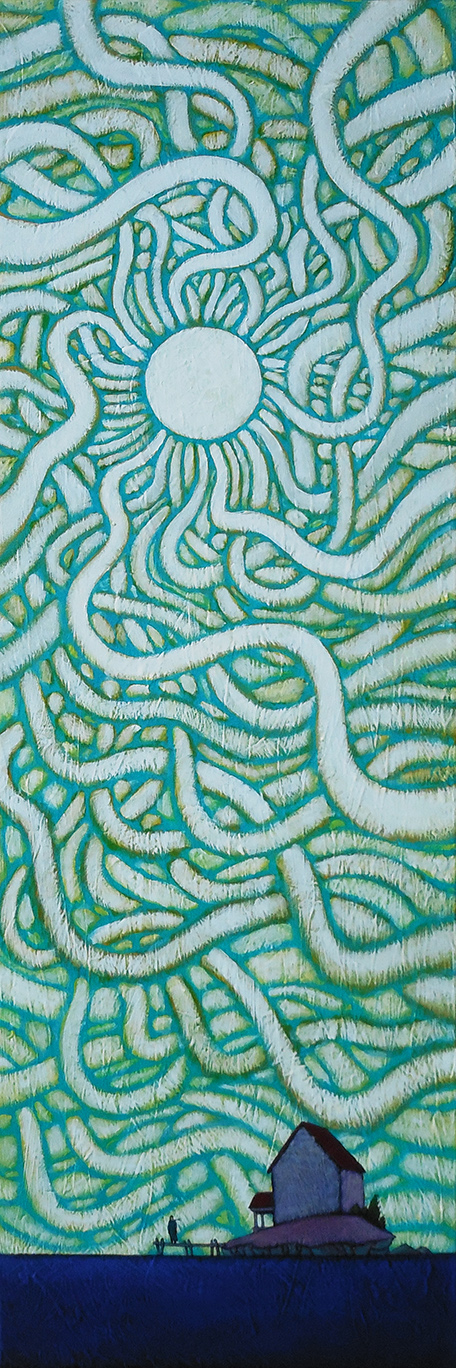
This new painting is 15″ by 30″ 0n canvas and is included in my upcoming solo show, Entanglement, opening June 15th at the Principle Gallery. I chose its title, Finis Terrae (Land’s End), because the term Land’s End,in whatever local language is spoken, is employed in a variety of locales around the world to signify the furthest point one can venture in a particular direction before reaching the sea. I saw that small rocky island with its blue house as being such a place, an endpoint, a place where one has reached the end of one realm and can only proceed by venturing into a different and unknown realm.
A transition point from one state of being into another.
I often think of those first ocean voyagers who left the Land’s End of their countries and proceeded out into the ocean without knowing where they might end up or what might lie in store for them. Theirs was a venture into the unknown and in order to survive and continue their journey, they had to make the transition from a life bound by soil and stone, forests and fields, a land with its own rhythms and cycles, to a watery life ruled by the wave and the wind, one under the unrelenting gaze of the sun and the moon.
Much of what they knew from their prior life on land now meant little in the new world in which they traveled. They lived by different rhythms now with different parameters and concerns. In order to survive, they truly underwent a transition from one state of being to another.
I see a similar kind of transition here. It’s not necessarily about departing land on a sea voyage. No, it’s a different sort of voyage, more of a spiritual quest that seeks a sense of unity with the greater powers of the universe, which is the basis for much of the work in this show.
For some, there comes a time when they recognize–though they will never fully understand it–the endless power and chaos of the universe and realize that they and everything they see and know are products of that churning tangle of energy. They come to know that at some point they will depart this realm to rejoin with that greater power.
They will leave this Land’s End and head out into the unknown for a reunion, a homecoming, of sorts.
A transition from one state of being to another.
And that’s what I see in this painting. It is neither sad nor happy. It just is as it is. It has a shifting sense of what it is, one that reflects back to me my own mood at any time. And I like that reflective quality. That may be the source of the vast appeal this piece holds for me.
As with Emerson’s essay, there’s a lot more that could be said. For now, let’s leave it here with a song from English folk singer June Tabor, whose songs I have shared here in the past. This song is called, of course, Finisterre. It is a beautiful tune and concerns a departure from a port called Santander, in Land’s End, Finisterre, Spain. Wonderful atmosphere in this song. Thought it paired well with this painting.
The Calming Flow— Coming to Principle Gallery, June 2025
In my youth the heart of dawn was in my heart, and the songs of April were in my ears. But my soul was sad unto death, and I knew not why. Even unto this day I know not why I was sad. But now, though I am with eventide, my heart is still veiling dawn, And though I am with autumn, my ears still echo the songs of spring. But my sadness has turned into awe, and I stand in the presence of life and life’s daily miracles.
—Youth and Age, Kahlil Gibran (1926)
I recently came across the opening portion above from the poem Youth and Age from poet/philosopher Kahlil Gibran (1883 –1931) and felt that it spoke deeply to both what I have been feeling in my recent work and in my own life. I suppose that makes sense since my work very much reflects the experience and feeling of my life. I
I think that anyone who is into the autumn or winter of their life can identify with the message of these lines. The face in the mirror shows the wear of the years and the body often aches and groans but the heart and spirit still feel youthful. As Gibran puts it, my ears still echo the songs of spring.
But it is a youthfulness that comes with much more understanding and acceptance than when one was actually the age felt. I think this is put best in a passage from later in this poem:
And in my youth I would gaze upon the sun of the day and the stars of the night, saying in my secret, “How small am I, and how small a circle my dream makes.” But today when I stand before the sun or the stars I cry, “The sun is close to me, and the stars are upon me;” for all the distances of my youth have turned into the nearness of age; And the great aloneness which knows not what is far and what is near, nor what is small nor great, has turned into a vision that weighs not nor does it measure.
The extremes of smallness and largeness of self that one sometimes felt in their youth has mellowed with the knowledge that while we are but small and seemingly insignificant bits of whatever you want to call this swirling, chaotic mass that is our existence and the universe, we occupy a place in it.
Born of a singularity, we are of it.
And with that knowledge, as Gibran puts it so well, my sadness has turned into awe, and I stand in the presence of life and life’s daily miracles.
I think this thought is an apt description for what I see in this new painting, The Calming Flow, an 18″ by 18″ canvas that is part of my upcoming solo exhibit, Entanglement, at the Principle Gallery. I recognize that same sense of acceptance and realization that I read in Gibran’s verse. It is one of the calmness and patience that comes with age for some.
The complete poem Youth and Ageis below.
Entanglement opens Friday, June 13 at the Principle Gallery with an Opening Reception from 6-8:30 PM. I will also be giving a Painting Demonstration at the gallery on the following day, Saturday, June 14, from 11 AM until 1 PM.
In my youth the heart of dawn was in my heart, and the songs of April were in my ears. But my soul was sad unto death, and I knew not why. Even unto this day I know not why I was sad. But now, though I am with eventide, my heart is still veiling dawn, And though I am with autumn, my ears still echo the songs of spring. But my sadness has turned into awe, and I stand in the presence of life and life’s daily miracles. The difference between my youth which was my spring, and these forty years, and they are my autumn, is the very difference that exists between flower and fruit. A flower is forever swayed with the wind and knows not why and wherefore. But the fruit overladen with the honey of summer, knows that it is one of life’s home-comings, as a poet when his song is sung knows sweet content, Though life has been bitter upon his lips. In my youth I longed for the unknown, and for the unknown I am still longing. But in the days of my youth longing embraced necessity that knows naught of patience. Today I long not less, but my longing is friendly with patience, and even waiting. And I know that all this desire that moves within me is one of those laws that turns universes around one another in quiet ecstasy, in swift passion which your eyes deem stillness, and your mind a mystery. And in my youth I loved beauty and abhorred ugliness, for beauty was to me a world separated from all other worlds. But now that the gracious years have lifted the veil of picking-and-choosing from over my eyes, I know that all I have deemed ugly in what I see and hear, is but a blinder upon my eyes, and wool in my ears; And that our senses, like our neighbors, hate what they do not understand. And in my youth I loved the fragrance of flowers and their color. Now I know that their thorns are their innocent protection, and if it were not for that innocence they would disappear forevermore. And in my youth, of all seasons I hated winter, for I said in my aloneness, “Winter is a thief who robs the earth of her sun-woven garment, and suffers her to stand naked in the wind.” But now I know that in winter there is re-birth and renewal, and that the wind tears the old raiment to cloak her with a new raiment woven by the spring. And in my youth I would gaze upon the sun of the day and the stars of the night, saying in my secret, “How small am I, and how small a circle my dream makes.” But today when I stand before the sun or the stars I cry, “The sun is close to me, and the stars are upon me;” for all the distances of my youth have turned into the nearness of age; And the great aloneness which knows not what is far and what is near, nor what is small nor great, has turned into a vision that weighs not nor does it measure. In my youth I was but the slave of the high tide and the ebb tide of the sea, and the prisoner of half moons and full moons. Today I stand at this shore and I rise not nor do I go down. Even my roots once every twenty-eight days would seek the heart of the earth. And on the twenty-ninth day they would rise toward the throne of the sky. And on that very day the rivers in my veins would stop for a moment, and then would run again to the sea. Yes, in my youth I was a thing, sad and yielding, and all the seasons played with me and laughed in their hearts. And life took a fancy to me and kissed my young lips, and slapped my cheeks. Today I play with the seasons. And I steal a kiss from life’s lips ere she kisses my lips. And I even hold her hands playfully that she may not strike my cheek. In my youth I was sad indeed, and all things seemed dark and distant. Today, all is radiant and near, and for this I would live my youth and the pain of my youth, again and yet again.
I conceive of the art of painting as the science of juxtaposing colours in such a way that their actual appearance disappears and lets a poetic image emerge. . . . There are no “subjects”, no “themes” in my painting. It is a matter of imagining images whose poetry restores to what is known that which is absolutely unknown and unknowable.
–Rene Magritte, 1967, In a letter two months prior to his death
I am getting ready for my annual solo exhibit at the Principle Gallery. This year’s edition, Entanglement, my 26th such show at the Alexandria, VA gallery, opens five weeks from today on Friday, June 13th. I will also be doing a Painting Demonstration at the gallery the following Saturday, June 14, from 11AM until 1 PM. There is still a ton of work to be done so I am simply sharing a reworked post from several years back.
The quote above from Belgian Surrealist Rene Magritte reminds me of an instance where I didn’t fully get across what I was trying to communicate in response to a question while speaking to a group. It occurred at a demonstration and talk I gave before a regional arts group consisting of enthusiastic painters, some amateurs and some professional.
While I was working, a question was brought up about the importance of subject. Magritte elegantly stated in his words what I was trying to say that evening, that the purpose of what I was doing was not in the actual portrayal of the object of the painting but in the way it was expressed through color and form and contrast. To me, the subject was not important except as a vehicle for carrying emotion.
Of course, I didn’t state it with any kind of coherence or clarity. Hearing me say that the subject wasn’t important visibly angered the man who was an art teacher and an accomplished lifelong painter of realistic landscapes. He said that the subject was most important in forming your painting. I fumbled around for a bit and don’t think I ever satisfied his question or got across a bit of what I was attempting to say.
I think he was still mad when he left which still bothers me because he was right, of course. Subject is certainly important. It is the artist’s relationship that with the subject and the emotional response it elicits that allows the artist to create this poetry of the unknown, as Magritte may have put it.
While I am not interested in depicting landscapes of specific areas, I am moved by the rolls of hills and fields and the stately personae of trees that populate my work. I believe it comes through in my painting. Yes, I can capture emotion in things that may not have any emotional attachment to me through the way I am painting them, which was part of what I was saying to that man that evening, but it will never be as fully realized as those pieces which consist of things and places in which I maintain a personal relationship. It is always easier to find the poetry of the unknown in those things which we know.
But there is a caveat: The subject is often not the tree or the landscape, as much as it may seem the case. Often, it is the vague poetry made from that tree, the sky, the landscape, or whatever is chosen to paint along with things not visibly apparent that makes up the atmosphere of the painting.





 Redtree Times