Feeds:
Posts
Comments

Posts Tagged ‘Quote of the Week’

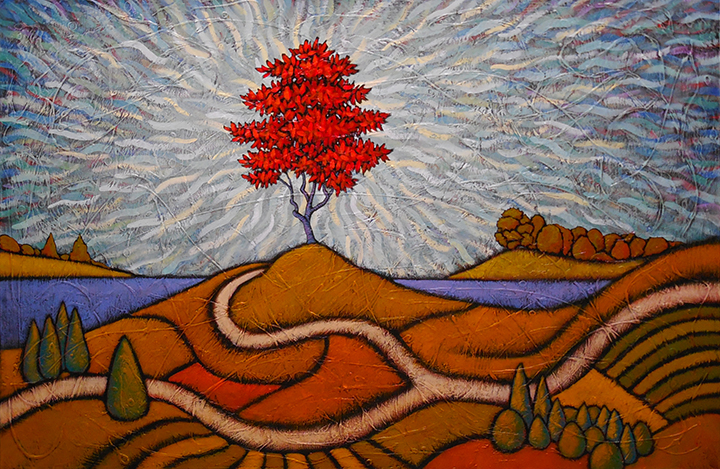
GC Myers-Transmitters smAll art is autobiographical; the pearl is the oyster’s autobiography.

Federico Fellini

*****************

I love this quote from legendary Italian filmmaker Federico Fellini and the image of us all having a pearl inside ourselves, just waiting to be revealed to the outer world.  It’s a pearl that is formed from the experiences and observations that make up our lives.

It fits well  with the theme for the Gallery Talk that takes place Saturday at the West End Gallery in Corning.  I plan on talking about  how art has transformed my life and how that transformation has made its way into my work.  In short, how my own simple pearl was formed and  brought to light.

An example of that might be in the painting at the top, a very new work that will be shown for the first time on Saturday called Transmitters which is 10″ by 20″ on canvas.  I see it as being about the need to communicate, about how we seek  and reach out to like-minded people throughout our lives.  For me this has been one of the biggest needs that  painting has fulfilled for me.  It has provided a platform for me to express thoughts and emotions that I would struggle to express in any other way.  In doing so it has created a path forward to reaching others who share similar thoughts and emotions.

So here the pearl is the Red Tree and it reaches across space to others who feel they have their own Red Tree within.  Hopefully, knowing that allows them to open their own shells and share it with the world.

Well, that might be part of what I’ll be talking about on Saturday.  Who knows what might come up?

Read Full Post »

David Hockney- Mulholland Drive 1980

David Hockney- Mulholland Drive 1980

It is very good advice to believe only what an artist does, rather than what he says about his work.

 –David Hockney
*************************
     When I first read this quote from artist David Hockney, a painter whose work I admire and find very interesting, I wanted to be offended.  After all, I am an artist who has said plenty about his work through the years– this blog and gallery talks being evidence of that– and have tried to be always transparent and forthcoming when talking about my work.  But even so, I nodded in agreement when I read his words.
     Part of my own desire to be honest and open about my work came from the frustration I felt in reading other artist’s writings that were filled with ArtSpeak, that way of seeming to say something important and meaningful without really saying anything at all.  The words danced around all form of meaning and never fully jibed with the images that accompanied the words, leaving me with a single word resonating in my mind.
     Bullshit.
     And I know bullshit.  I was a longtime bullshit artist.   I sold swimming pools and automobiles– yes, I was even a used car salesman!- to the public for quite some time.  I knew that you could sell by focusing on the strengths of the product and by dancing around questions about its drawbacks.  Fill any voids with words that sounded like they were filled with meaning but really made no commitment to anything.
     For me, there came a time when I was determined to not deal anymore in that manner of speaking and when I finally came to painting, I knew I didn’t want my work to fall into that pool of bullshit.  I wanted to tightly control how I represented my work and to be completely open about it.  It’s whole purpose for me was my own honest expression and I wanted people to be able to witness that without a filter of crap between them and the work.
     For the most part, I feel that I have been able to maintain that through these last several years.  Oh, occasionally I feel myself straying off the path but I simply remind myself that the product I am representing is the core of my self and once I cross that line I would be betraying everything art has provided for me.
    But these are just words and maybe you should take them with Hockney’s advice in mind.  If you want to judge for yourself, come to the Gallery Talk at the West End Gallery next Saturday, August 1, which begins at 1 PM.  Ask me anything and I promise you a straight answer.

Read Full Post »

GC Myers-Foundling smArt is interested in life at the moment when the ray of power is passing through it.

Boris Pasternak

******************

I think Pasternak (author of Doctor Zhivago) is really spot on with with this terse definition of art.  Art at its core is, for me, an attempt to affirm our existence and the existence of that life force within us.

I really like that term that Pasternak uses here– ray of power.  That description of the force that drives all living things jibes well with that animating force that I try to find in my own work, that indeterminate quality that makes a static thing seem to take on a life of its own.

How and if it comes through in the work is the interesting thing for me.  Sometimes, despite my extreme efforts, I cannot find that life force.  Maybe I should say because of my extreme efforts instead of despite.  Sometimes it seems as though trying to consciously find that thing prevents it from being found. It often finally appears when I don’t focus on that aspect and lose myself in the process of actually painting– the colors, lines and forms before me.

It’s as though you don’t find it.  It finds you.

I chose the painting at the top, Foundling, to illustrate this post before I wrote that last line but it fits so well with the idea of that ray of power as well as the idea of it finding you.  This painting, a 24″ by 36″ canvas, is, of course, from my upcoming show, Home+Land, opening July 17 at the West End Gallery.

Read Full Post »

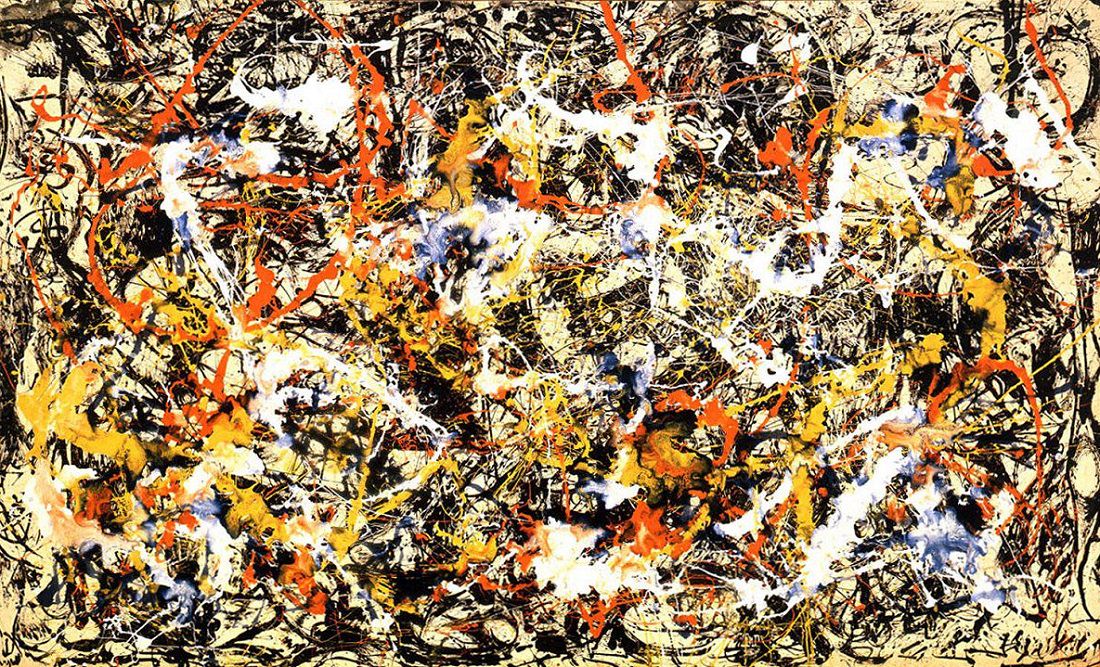
Jackson Pollock -Convergence 1952Painting is a state of being…Painting is self discovery.  Every good painter paints what he is.

–Jackson Pollock

*********************

In yesterday’s The Guardian, here was a review of a current exhibit at the Tate Liverpool of Jackson Pollock paintings.  Writer Jonathan Jones describes Pollock’s work around 1950, in the period when he was briefly liberated from his chronic alcoholism,  as being the pinnacle of his career. As he put it : Pollock was painting at this moment like his contemporary Charlie Parker played sax, in curling arabesques of liberating improvisation that magically end up making beautiful sense.

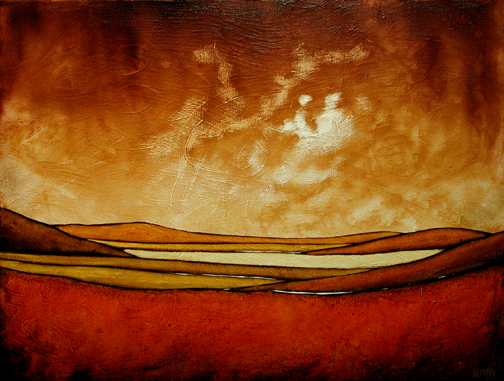
GC Myers-Under TextureThat sentence really lit me up, as did the words of Pollock at the top of the page.   In Pollock’s work I see that beautiful sense of which Jones writes. I see order and rhythm, a logic forming from the seemingly incomprehensible. The textures that make up the surfaces of my own paintings are often formed with Pollock’s paintings in mind, curling arabesques in many layers.  In fact, one of the themes of my work is that same sense of finding order from chaos.

 To some observers, however, Pollock’s work represented the very chaos that plagued the world then and now.  But true to his words, Pollock’s work was indeed a reflection of what he was– a man seeking grace and sense in a chaotic world.

Painting is, as Pollock says, self discovery and indeed every painter ultimately paints what they are.  I know that in the work of painters I personally know I clearly see characteristics of their personality, sometimes of their totality.

I believe that my work also reveals me in this way.  It shows everything– strengths and weaknesses, hopes and fears.  You might think that a painter would be clever enough to show only those positive attributes of his character, like the answers people give when asked to describe their own personality.  There are some that try but it comes off as contrivance. Real painting, real art, is in total revelation, showing the chaos and complexity of our true self and attempting to find order and beauty within it.

Read Full Post »

The_Torment_of_Saint_Anthony_(Michelangelo)A man paints with his brains and not his hands.

-Michaelangelo Buonarroti

***********************

I am a little intimidated in quoting the words of a man who is believed to have painted the piece shown above, The Torment of Saint Anthony, at the tender age of 12 or 13.  Pretty amazing.  It’s obvious from this and almost everything of his that came after that Michaelangelo had both brains and hands–craftsmanship of the highest degree and thought and feeling that brought his work to life.

But his words ring true for any painter.  Painting should not be mere craft, not formulaic process nor exact replication of the reality before them.  No, it is beyond  that.  It is how the artist imbues the work with their own thought and emotion, their own spirit, their own essence– an investment of the self— that elevates the work above craft.

Doing that is the trick.  At first glance, it seems both a tall task and a simple one.  But it comes down to simply feeling emotion in what you are doing and being willing to openly display it without reserve.

Now, maybe I am misinterpreting Michaelangelo’s words to fit my own subjective view of painting.  Perhaps in these ten words he was speaking about taking a more scientific or mathematical approach to painting and composition. That I don’t know.  But when I read it, it made sense to me because the differentiating quality I see in painting, from self-taught outsiders to the highest level of traditional representational painters, is how much of themselves a painter is willing to invest in their creations.

It is the thought process of the artist that makes the painting, not the mechanical process.

Read Full Post »

paul-gauguin-the-alyscamps-in-arlesDo not paint too much after nature. Art is an abstraction; derive this abstraction from nature while dreaming before it, and think more of the creation which will result than nature.

-Paul Gauguin

******************

Although I wouldn’t probably call Paul Gauguin one of my favorite artists, I do admire and respect much of his work.  More importantly, there are a lot of things I’ve taken from his work over the years, including the advice offered in the above quote.  The idea that the painter could paint the landscape not exactly as it were before them but, rather, in how they felt they saw it was a mind expanding thought.  It meant that the artist could take liberties with color, space and form to find their own expression of nature.

Another thing I culled from looking at Gauguin’s paintings was his use of multiple colors within his surfaces.  I remember seeing an exhibit quite a few years ago at the MFA in Boston.  Looking closely at some of his Tahitian scenes, I noticed that while one would say the overriding color of each piece might be green there were other colors among the greens of the tropical landscape, most noticeably large flecks of vermillion, that gave the overall color so much more depth and interest.  I knew that I needed to increase the complexity of my own colors.

I’ve also talked quite a bit about Native Voice, about painting in a way that was purely natural and distinct like a signature to the artist.  Gauguin’s work is to me a perfect example of this native voice.  His ease in being himself on his surfaces made it easier for me to be myself.  Whenever I get a chance to look closely at his work I take the opportunity because I almost always find something in it that helps me in my own work.

 It always has something to say and share.  And that in itself is an influence and a hope for my own work.

Paul Gauguin A Farm in Brittany

Read Full Post »

Vincent Van GoghWhy does one not hold on to what one has, like the doctors or engineers; once a thing is discovered or invented they retain the knowledge; in these wretched fine arts all is forgotten, and nothing is kept.

Vincent Van Gogh

Letter to his brother Theo 1888

*****************************

When I read this quote from Van Gogh, I flashed back to a conversation I had several years back with an artist friend who was urging me to begin filming my painting process.  He said that a deer could jump in front of my car going home from the gallery that night and nobody would ever know how my  paintings came about.  He  thought would be a loss.

That made me think but I still didn’t follow his advice and protected my process, except for small glimpses here and there, for years like an alchemist greedily withholding their found knowledge.  It was one of several reasons for my lack of enthusiasm for teaching.

But time normally changes all things.  I began to realize that it was a fool’s mission in keeping my process to myself.  The  process was tool for expression– it was not the expression.

An artist often has individual expression that transcends subject, material and technique.  For example, an artist painting exactly like me– same trees and process– would produce work that would be different than my own.  It would have a different soul, if it had one at all.  If this artist’s purpose was mere copying, it would not.  I can say this because I’ve seen this before.

So, after a bit, I came to understand that showing or teaching my process would not diminish my work in any way.  In fact, I began painting the way that I do because I initially wanted to see paintings that I wasn’t seeing anywhere else.  Wouldn’t it be great to spur that same thing in others?

To that end, as I announced earlier, I am teaching my first two day workshop,  September 17 & 18,  at the Arts Center of Yates County in Penn Yan, NY.  It’s a lovely town sitting at the end of scenic Keuka Lake, one of the Finger Lakes, famed for their beautiful vistas and multitude of wineries.

I am pretty excited about this and am starting to put together just how I want to teach this.  I don’t want to spend any more energy  hiding my process and I plan to fill each of the  two days with as much info as I can get across while still making it entertaining and educational.  So if you want to spend a couple of late summer days in a beautiful setting learning a form of expression that might spur other good things for you, contact the Arts Center of Yates County.

Hope to see you there.

Read Full Post »

GC Myers Time to Reflect  smIt is very dangerous to go into eternity with possibilities which one has oneself prevented from becoming realities.  A possibility is a hint from God.  One must follow it.  In every man there is latent the highest possibility, one must follow it.  If God does not wish it then let him prevent it, but one must not hinder oneself.  Trusting to God I have dared, but I was not successful; in that is to be found peace, calm and confidence in God.  I have not dared: that is a woeful thought, a torment in eternity.

–Søren Kierkegaard

*******************

There is nothing I can add, except to point out that the image at the top is another new painting, a smaller 9″ by 12″ canvas called Time to Reflect, that is part of my Native Voice exhibit which opens on June 5 at the Principle Gallery.

Read Full Post »

He knows all about art, but he doesn’t know what he likes.

–James Thurber

******************

James Thurber Cartoon Art CriticThis may not technically qualify as a quote but who cares?  The message in this cartoon from the great James Thurber is so simply put and true and that’s what I am looking for in a good quote.

 And art.

That’s what I like.

In the past I’ve talked about how many people are intimidated by the idea of art, feeling that they don’t know anything about art.  This leaves them not trusting their own eyes and their own reactions to any given piece of art.

And that is a pity because art is mainly about the reaction to it.  Art is a reactive agent, reaching out and stirring something in the viewer.  All of the knowledge in the world about a piece of art cannot make you like that piece of work if it doesn’t first strike that chord that raises some sort of emotional response within you.

And I think most of us know within a few moments whether a work of art speaks to us or leaves us cold.  The trick comes in recognizing this realization and feeling okay with it.

I’ll admit that there are many celebrated works of art out there that do absolutely nothing for me.  They may have historical importance or elements of beauty or great craftsmanship in them but they simply don’t raise any emotional response within me.

I might be able to appreciate them but the bottom line is that I don’t like them, plain and simple.  That doesn’t mean I’m right or wrong.  It just means I know what I like.

And I accept that criteria from anybody, even with my own work.  While it would be nice to think that it speaks to everyone, I know this is an impossibility.  I’ve had people tell me that they didn’t like my work– in polite and respectful terms, thankfully– and I’m okay with that.

They know what they like.  And that’s good enough for me.

Read Full Post »

GC Myers Eternally FreeAll of humanity’s problems stem from man’s inability to sit quietly in a room alone.

–Blaise Pascal, Pensées 

************************

This week’s quote continues the theme of silence that showed itself in yesterday’s post where poet Wendell Berry advised us to sit alone and to be quiet, to accept those things we might find in the silence.  This oft-quoted line from  French mathematician/philosopher Blaise Pascal from back around 1660 shows us that even in that world without smartphones and the constant crackle of 24/7 electronic and social media the idea of sitting in silence made most people anxious.

It’s an interesting thing to ponder.  As I sit here, a little before 7 AM in my quiet studio, I can hear the thump of a bass from someone’s car stereo probably almost a mile away as it goes down the road.  That is someone who obviously isn’t ready to embrace silence and believes that they are doing everyone else a favor by breaking it up so we won’t be bothered by it.

Hard as it is to admit, I was that guy at one point in  my life.   Noise was a way of making my presence, my existence, known.  

The lion’s roar.  The barbaric yawp.  

It was all an existential scream that tried to break through the ever-growing wall of sound from the outside world that threatened to obscure everything, melding all the noises into a huge suffocating drone of anonymity.

But my noise made no difference.  No single sound, no one angst-filled scream could break through and show that I was indeed alive, that I mattered.

No, existence was found sitting quietly in a room alone.

It wasn’t always easy.  In the silence there is nowhere to hide from every random thought, every fear, every diminishment of yourself. But silence provides the gift of acceptance after a time and every relived thought and moment, good or bad,  becomes equally part of the make-up of your self.  You come to realize that proof of your existence is in this acceptance and not in that barbarous scream that you once thought would scar the world as that proof.

It sounds too simple, I know.  But simplicity is sometimes very difficult and I still find myself struggling to stay in the silence, to not revert to screaming out.

But most days I find that it is worth the effort.

Read Full Post »

« Newer Posts - Older Posts »