Feeds:
Posts
Comments

Posts Tagged ‘Quote’

Kiefer Connections

++++++++++++++

What does the artist do? He draws connections. He ties the invisible threads between things. He dives into history, be it the history of mankind, the geological history of the Earth or the beginning and end of the manifest cosmos.

Anselm Kiefer
++++++++++++++
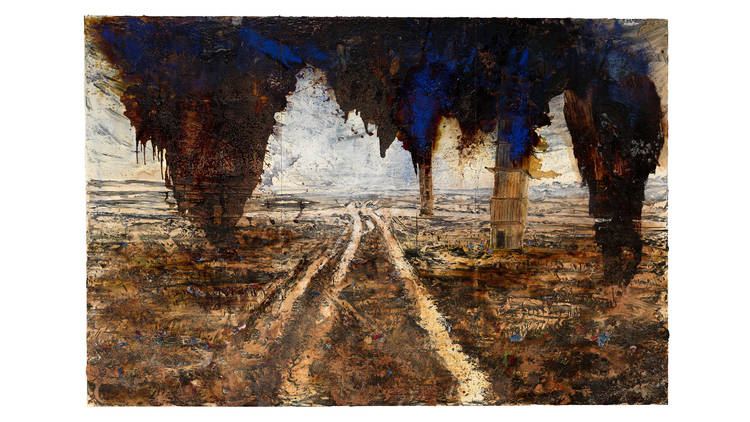
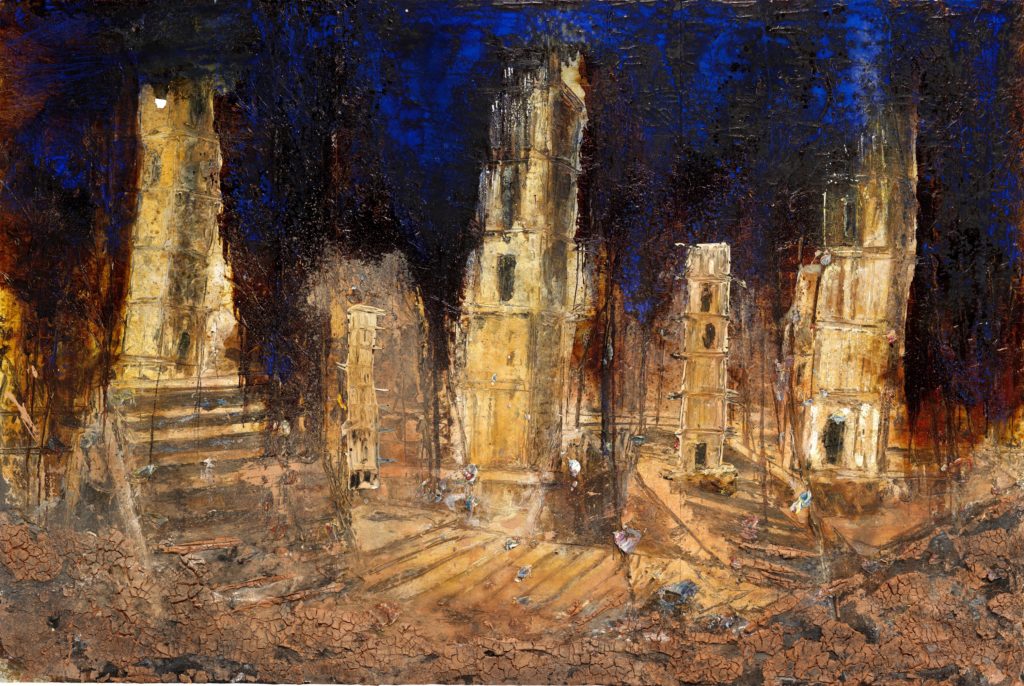
Anselm Kiefer (born 1945) is a contemporary German artist whose work is often epic in size and scale. You can see this in one of the photos below. Many of his more recent paintings use molten lead as a medium which creates these large ominous and heavy (obviously!) areas in the paintings. Over his long career he has been controversial, especially in confronting his German heritage and the events of the first half of the 20th century. But it is always interesting.
.
Several things he has written or said have really resonated with me, including one quote from which I stole a bit to use as the title of a painting, The Palace of My Memory. The quote summed up perfectly how I view the body of my work. I believe I am creating a place, a palace if you will, where my collected memory can be preserved and survive, hopefully, long after I am gone.
.
Here is that quote:
.
But I believe above all that I wanted to build the palace of my memory, because my memory is my only homeland.
.

Read Full Post »

+++++++++++++

I really just wanted to share one of my favorite Edward Hopper paintings but the message attached really speaks to my own thoughts on painting. The painting is his Early Sunday Morning from 1930.

I like that it seems so still, so static, yet it is filled–at least for me– with tensions and deep emotional content. That reaction is my own imagination reacting to the elements of the painting. Hopper created an armature, a framework, that gives shape to the emotional response of the viewer without filling out all of the details.

You look at it and there are guides in place that gently direct you to Hopper’s own emotional location. But it never spells it out in great detail, never tells you what you should feel. It relies on your imagination to fill in the voids, to fill it with details to which you can personally relate. You are no longer a mere viewer, you are an emotional participant.

That’s how I think a painting should work, as a sort of active terminus where the work of the artist and the imagination of the viewer meet.

Sometimes, it works that way. Sometimes, it doesn’t. I think this Hopper definitely works in this way.

Read Full Post »

+++++++++++++

Art has always been the raft onto which we climb to save our sanity. I don’t see a different purpose for it now.

Dorothea Tanning
+++++++++++++
.
Doing research for this blog, I run into so many artists that work well into their nineties and beyond that I begin to get hopeful for my own longevity. I try to see if there is some sort of common denominator among them, something that might be a key to their long careers and lives.
.
There seems to be among many, at least to my eye, a constant striving for growth and change in their work. There are often new subjects, new styles, new mediums and new processes. But a constant state of wonder.
.
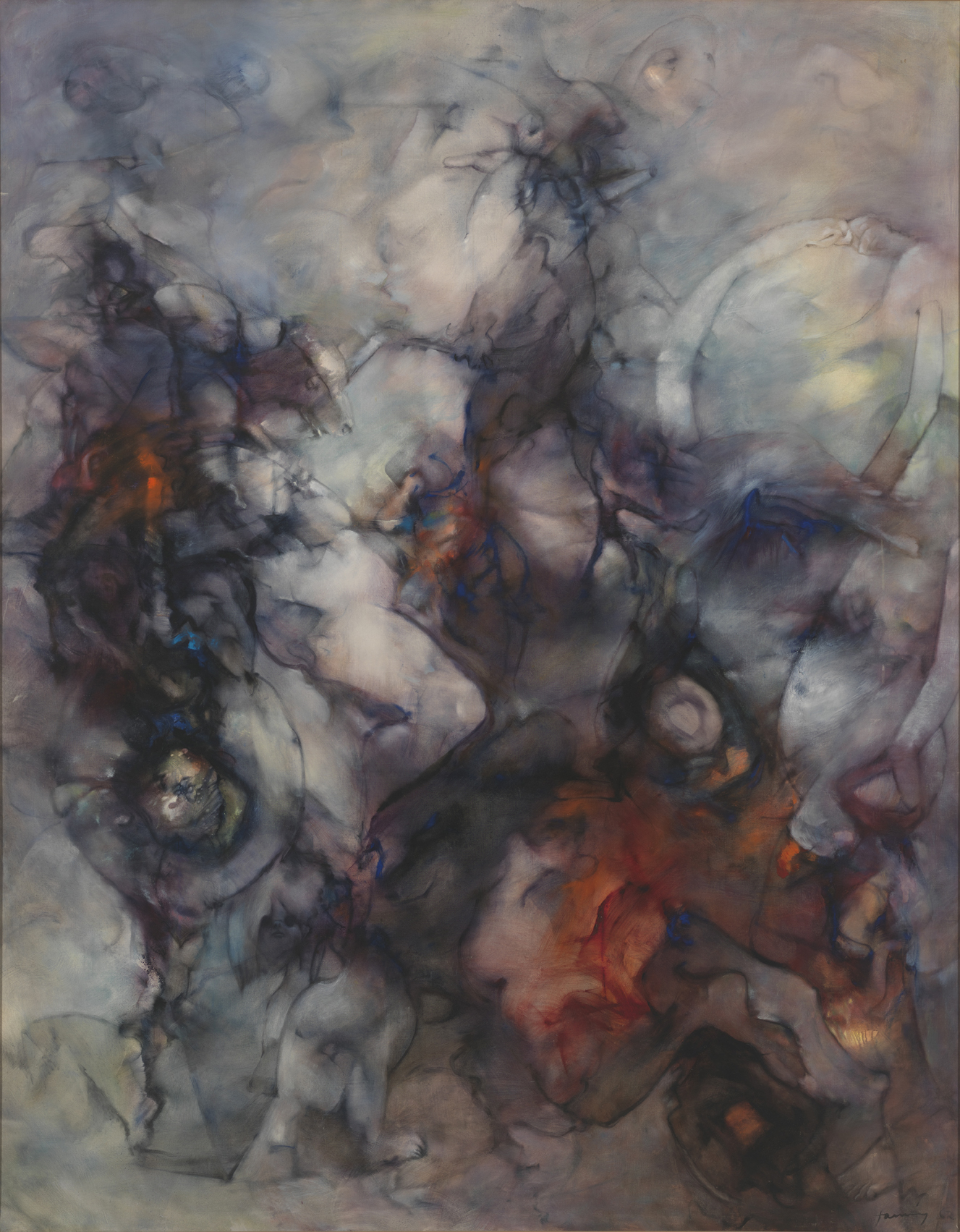
Dorothea Tanning is one such example. Born in 1910, she worked until late in her life and died at the age of 102 in 2012. Her work changed throughout her career, having multiple phases, but always remained her own. I am only showing a few of her pieces here, a few that immediately grabbed me this morning, along with a short video with a bit of an overview. Like many artists I show here, I don’t know a lot about her work but hope to use this as an introduction.
.
Hopefully, in forty years or so, I will still be following Ms. Tanning’s example. But most likely only if I try continue to attempt to grow. Because as Dorothea Tanning also said: It’s hard to be always the same person.

Tanning, Dorothea

Read Full Post »

++++++++++++++++

I perceive the world in fragments. It is somewhat like being on a very fast train and getting glimpses of things in strange scales as you pass by. A person can be very, very tiny. And a billboard can make a person very large. You see the corner of a house or you see a bird fly by, and it’s all fragmented. Somehow, in painting I try to make some logic out of the world that has been given to me in chaos. I have a very pretentious idea that I want to make life, I want to make sense out of it. The fact that I am doomed to failure – that doesn’t deter me in the least.

–Grace Hartigan
.
+++++++++++++++++
.
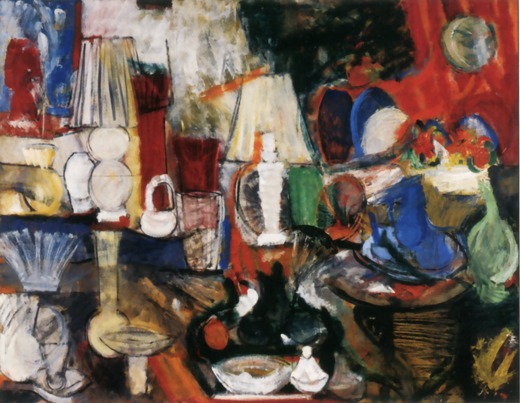
Grace Hartigan (1922-2008) was a painter based in NYC. She often called herself a second-generation Abstract Expressionist because she used the influence of the major artists of the genre as a jumping off point for her own distinct work.
.
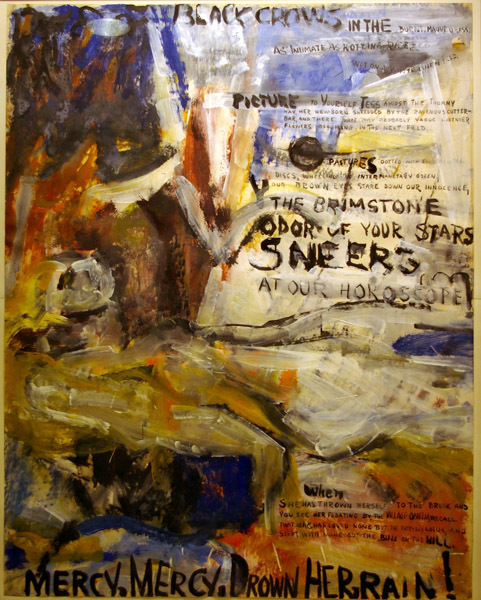
While we certainly work in different forms of expression, I admire the strength and vibrancy of much of her work. I also like her work, such as some below from her Oranges series, that incorporate the written word, in this case the poems of her close friend, poet Frank O’Hara. And I certainly understand her own words above, especially about perceiving the world in fragments and trying to put that chaos into some coherent form of logic. And the doomed to failure part, as well.
.
I think that sense of failure, that goal that always move out of reach, is the compelling part of painting. If you felt you reached that desired endpoint, there would be no point in continuing.
.
++++++++++++

Read Full Post »

+++++++++++++++++

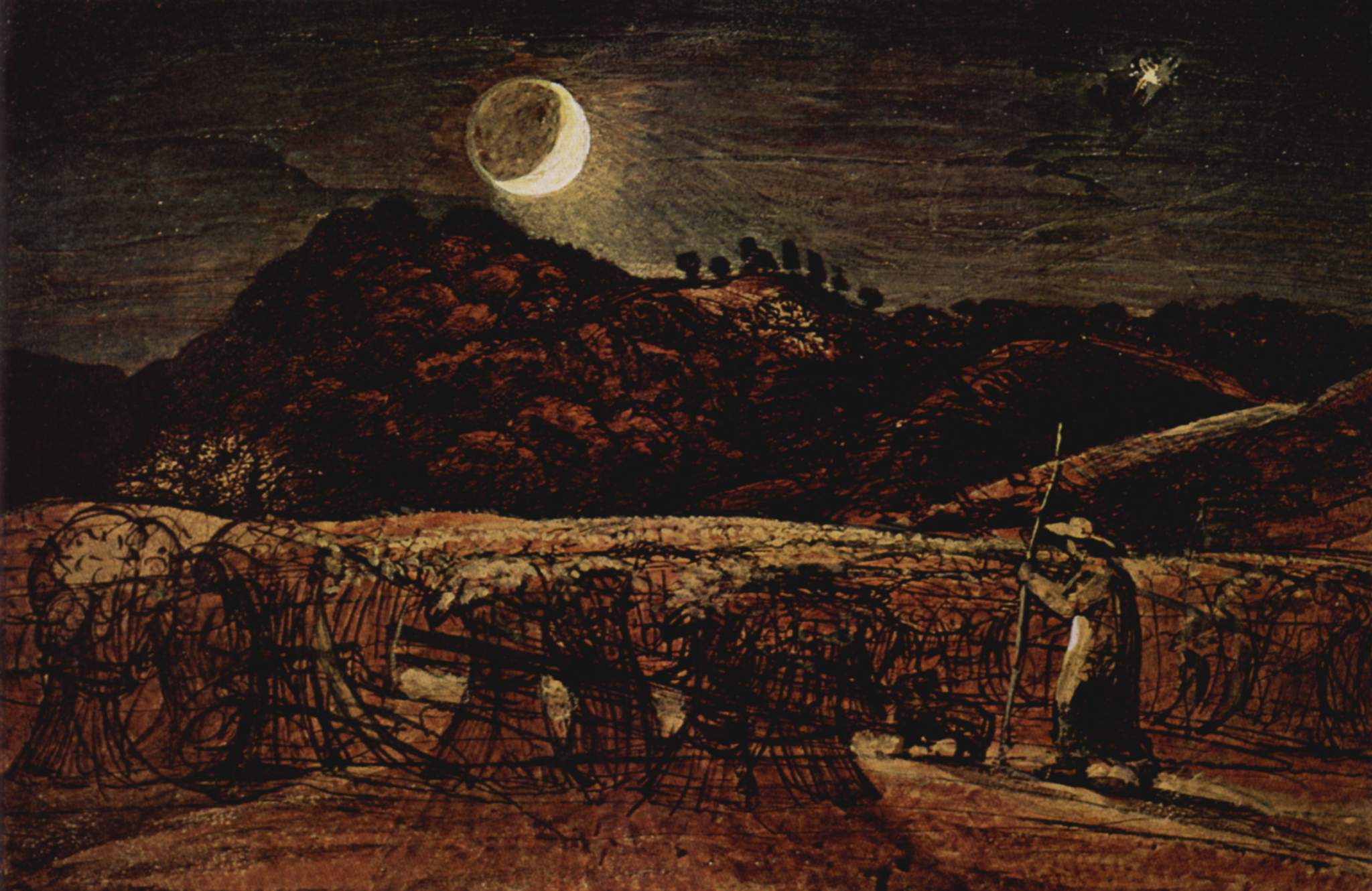
When less than four years old I was standing with my nurse, Mary Ward, watching the shadows on the wall from branches of an elm behind which the moon had risen. I have never forgot those shadows and am often trying to paint them.

-Samuel Palmer

+++++++++++++++++

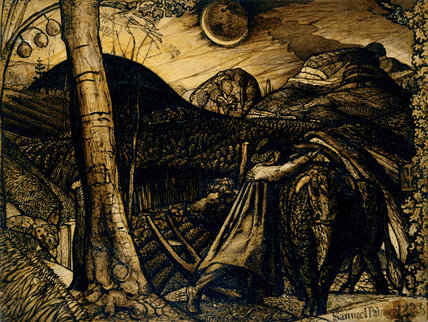
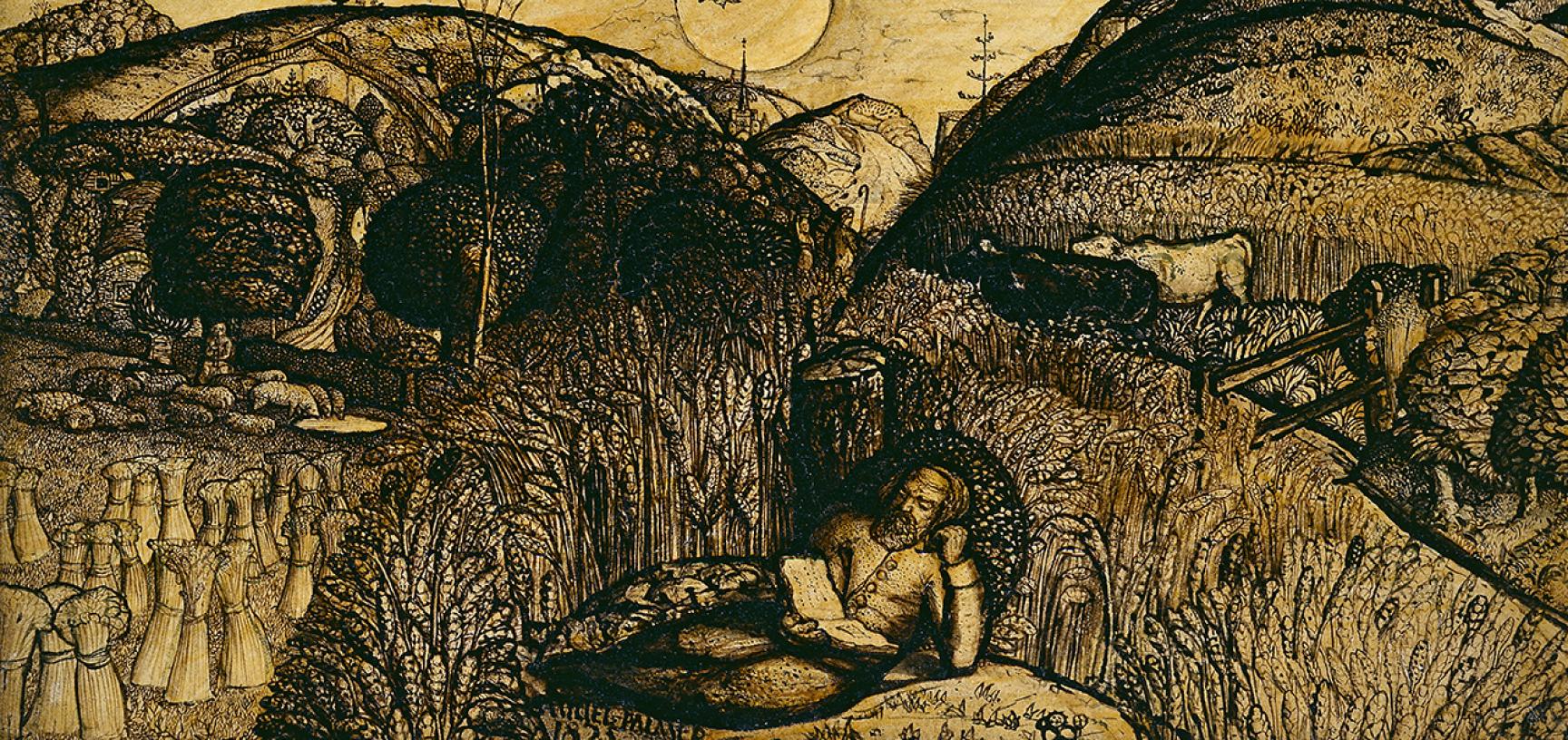
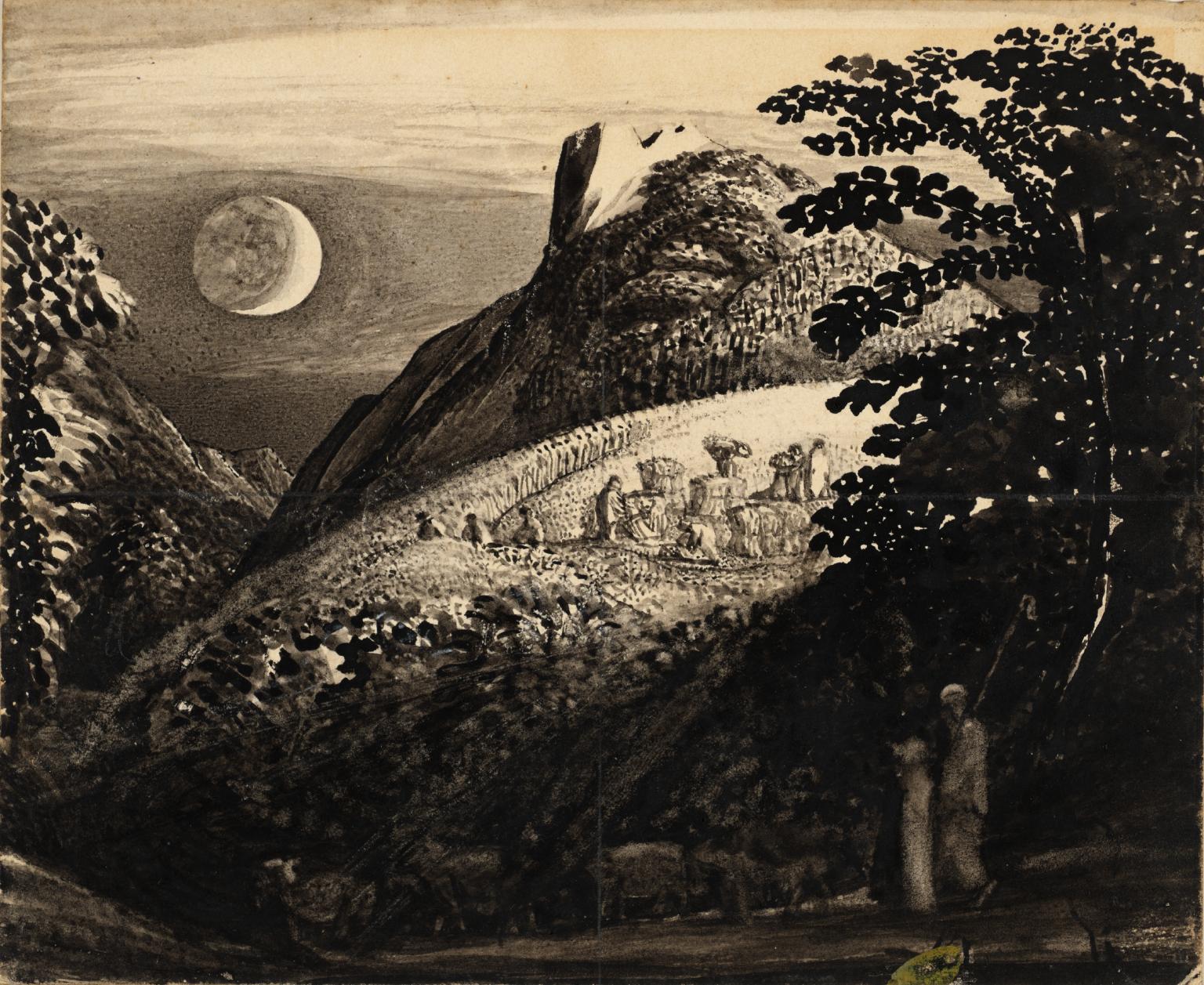
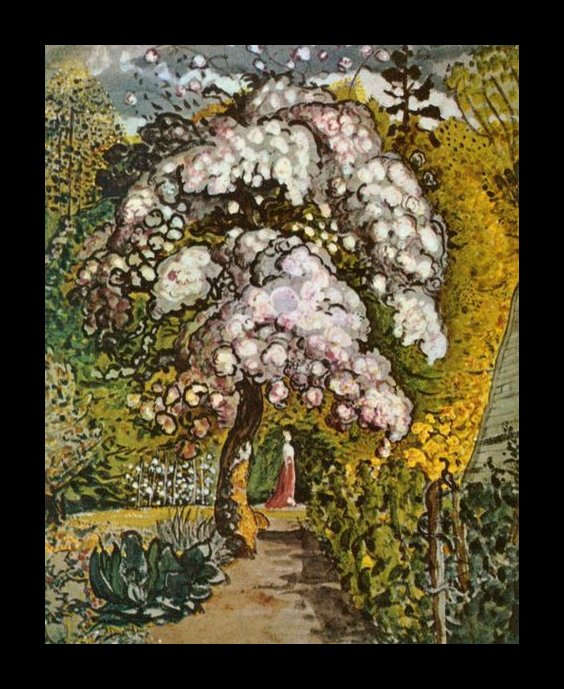
I have long admired the work of the British painter Samuel Palmer (1805-1881).  He is sometimes called the British Van Gogh even though he painted much of his work much of his work before Van Gogh was even born. There’s a wonderful darkness underlying much of his work that no doubt relates to the shadows from his childhood that he mentions in the quote above. Interesting how things from our childhood that might be easily overlooked or downplayed affect us throughout our lives.

His compositions have a very unique quality, one that strives to create a sense of fullness in the view he is revealing. It is very stylized and personal, more so than most artists of the first half of the 19th century. His often condensed compositions create an air of unreality but nevertheless make sense and translate easily in the journey from the eye to the brain. This really appeals to my own sense of composition and I find myself relating easily to his work, almost sensing how he was putting his pieces together.

Many of you have probably never heard of Samuel Palmer but he certainly has had my attention and respect for some time. Here’s a short video of his work and a few more of my favorite pieces.

The Harvest Moon: Drawing for ‘A Pastoral Scene’ c.1831-2 Samuel Palmer 1805-1881 Purchased 1922 http://www.tate.org.uk/art/work/N03699

Read Full Post »

Paul Klee/ Color


Read Full Post »

+++++++++++++

Art is the soul of a people.

Romare Bearden
+++++++++++++
.
Getting ready for tomorrow’s 1 PM Gallery Talk at the West End Gallery in Corning. There are a few new paintings that I am framing today to bring along  with me. I am also getting some other things together that will no doubt show up including the painting, Pipedream, that will be given away at the end of the talk.
.
I’ve also been running things through my mind that I want to discuss. One thing I will try to touch on is the purpose of art. That’s where the quote above from the late American painter Romare Bearden comes in. In a very concise manner, it sums up the importance of art.
.

Win This Painting! –“Pipedream”

Art, in all forms, is our soul, our collective spirit and memory. It is the expression of our values and beliefs. It completes our humanity.

.
Without art, we are less human. We are without our soul.
.
Okay, maybe that will be a subject. I never fully know until I am standing there, trying to look composed while my anxiety causes my mind to shoot off fireworks inside my skull. But I do know that we will talk about something and tell some stories. You know, it might very well be interesting, even fun. Plus, there are prizes! What’s not to like?
.
So, if you’re in Corning tomorrow around 1 PM, stop in at the West End Gallery and join in the conversation. Maybe you’ll take something home you were not expecting.

Read Full Post »

++++++++++++++++

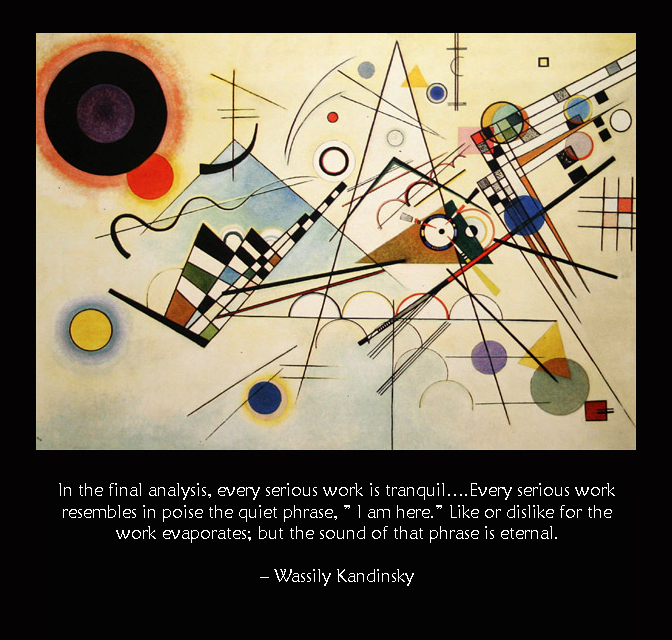
The above quote is from Wassily Kandinsky and concisely captures what might be the primary motive for my work. I think, for me, it was a matter of finding that thing, that outlet that gave me voice, that allowed me to honestly feel as though I had a place in this world. That I had worth. That I had thoughts deserving to be heard. That I was, indeed, here. 

That need to validate my existence is still the primary driver behind my work. It is that search for adequacy that gives my work its expression and differentiates it from others. I’ve never said this before but I think that is what many people who respond to my work see in the paintings- their own need to be heard. They see themselves as part of the work and they are saying, “I am here.” 

Hmmm…

++++++++++++++++

This was one of the early posts from this blog from back in 2008. It remains true to this day, nearly ten years later, as the idea of “I am here” still drives my work.

Maybe this will be one of the things we touch on this coming Saturday, August 4, at my Gallery Talk at the West End Gallery, starting at 1 PM.

Maybe. Or maybe we’ll just have a sing-along. Who knows? It’s a fluid thing.

Read Full Post »

+++++++++++++++

The artist has to transcend a subject, or he loses the battle. The subject wins.


Fritz Scholder
.
+++++++++++++++
Fritz Scholder (1937-2005) was an Native American painter. I wasn’t going to use the Native part because he had claimed at one point in his career that he was not an Indian painter nor would he ever paint Indians. Much of his work adhered to that idea but his work, in many cases, definitely reflected his experience as a Native American. His work followed the modern trails of painters like Francis Bacon and Willem de Kooning but certainly expressed his personal viewpoint and experience. It’s great work that I always enjoy taking in.
.
The subject matter in his work is strong but Scholder seems to have won the battle, to have transcended pure subject. His words above are important for artists in any genre to keep in mind. I know that that this act of transcendence is something I aspire to whenever I am before the easel.
.
Sometimes I win and sometimes I don’t.
++++++++++

Read Full Post »

+++++++++++++++++

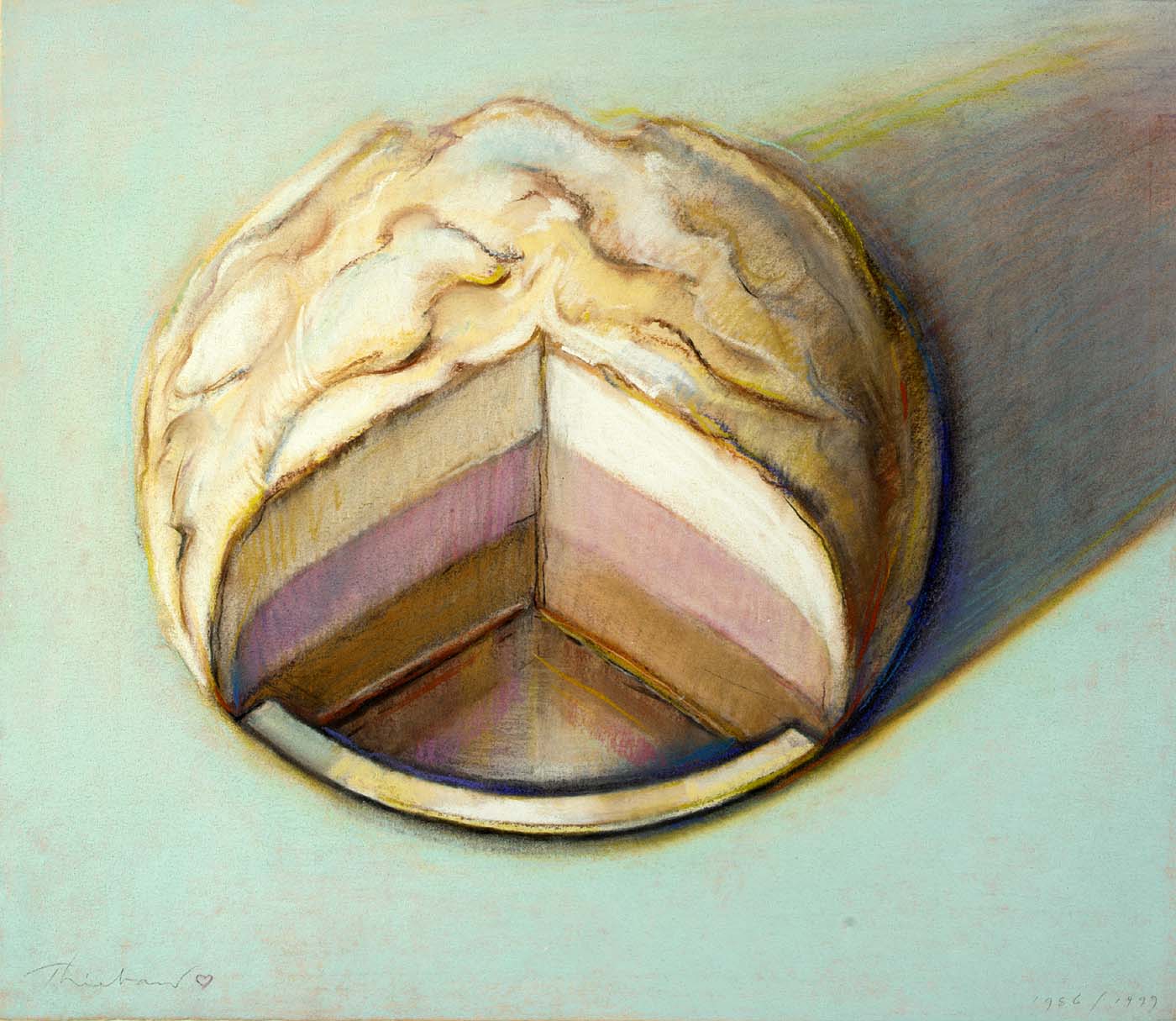
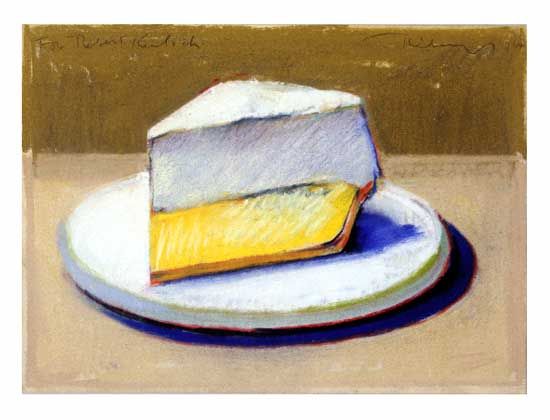
Commonplace objects are constantly changing… The pies, for example, we now see, are not going to be around forever. We are merely used to the idea that things do not change.

Wayne Thiebaud
+++++++++++++++++
I am not really hungry this morning but I felt like looking at some pies. Well, paintings of pies. And more specifically, those from Wayne Thiebaud, a favorite of mine. He’s going to turn 98 years old in November. I am not sure if he is still painting but I think he probably is. He was still painting two years ago when the following short film was produced by Christie’s auction house. If you have five minutes I urge you to take a look.

Read Full Post »

« Newer Posts - Older Posts »