Feeds:
Posts
Comments

Posts Tagged ‘Red Tree’

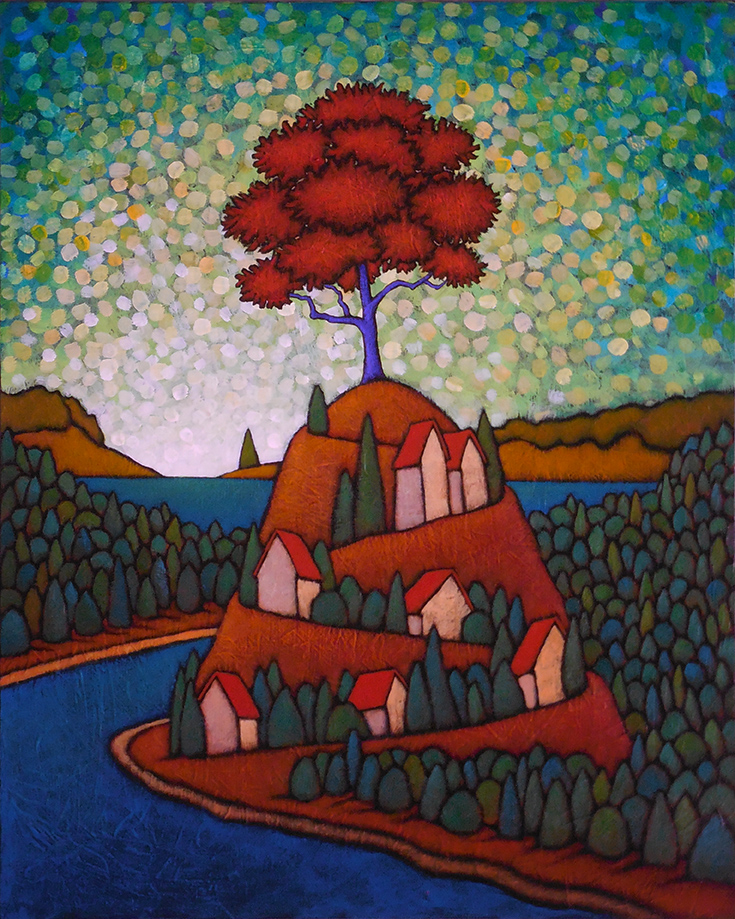
Anchor— At West End Gallery


It is a strange freedom to be adrift in the world of men without a sense of anchor anywhere. Always there is the need of mooring, the need for the firm grip on something that is rooted and will not give. The urge to be accountable to someone, to know that beyond the individual himself there is an answer that must be given, cannot be denied.

–Howard Thurman, The Inward Journey (1961)


I wrote a couple of weeks back about how part of my response to the veritable dismantling of this country that is taking place was a feeling of grief for something lost. I think that lost something could be defined as many things– a loss of belief, loss of security, loss of trust, loss of respect, loss of pride, loss of honor, loss of community, and on and on.

So much has seemingly– and perhaps irrevocably– been lost by so many that there may not be a single definition that covers our loss.

For me, I define my grief as being for the loss of bearings, of losing a sense of having an anchor that I could rely on at any given time, one that let me know who and where and what I was in relation the world at that given moment.

A sense of place. Of home.

It makes me ache to write about this feeling of loss. It is one of feeling unmoored and adrift in a fast-moving current. Looking back, I can catch a brief glimpse of that place, but it fades further into the distance with each successive glance.

Can I escape this current? Can we? And if I do and somehow find my way back to some of that same sense of home, will these feelings of loss subside?

Can it ever be the same anchor that I once thought it was?

I don’t think anyone really knows that answer. I sure as hell don’t. And I don’t think speculating on it matters. Because if we cannot escape that rushing current, the path back is gone forever.

I know this sounds too stark, too grim. Grief is like that. Even so, it not without hope.

Hope has not been completely lost.

I can still look back and see home, as I define it, in the distance. It’s there and, therefore, a way to it must exist.

We just got to get back to it, one way or another, because where we’re at now ain’t home.

Here’s a favorite song, one of many, from Talking Heads. This is This Must Be the Place (Naive Melody) from their great 1984 concert film Stop Making Sense.


FYI– Howard Thurman (1899-1981), who is quoted at the top, was an American author, philosopher, theologian, Christian mystic, educator, and civil rights leader. He was considered a mentor to MLK and other civil rights leaders.


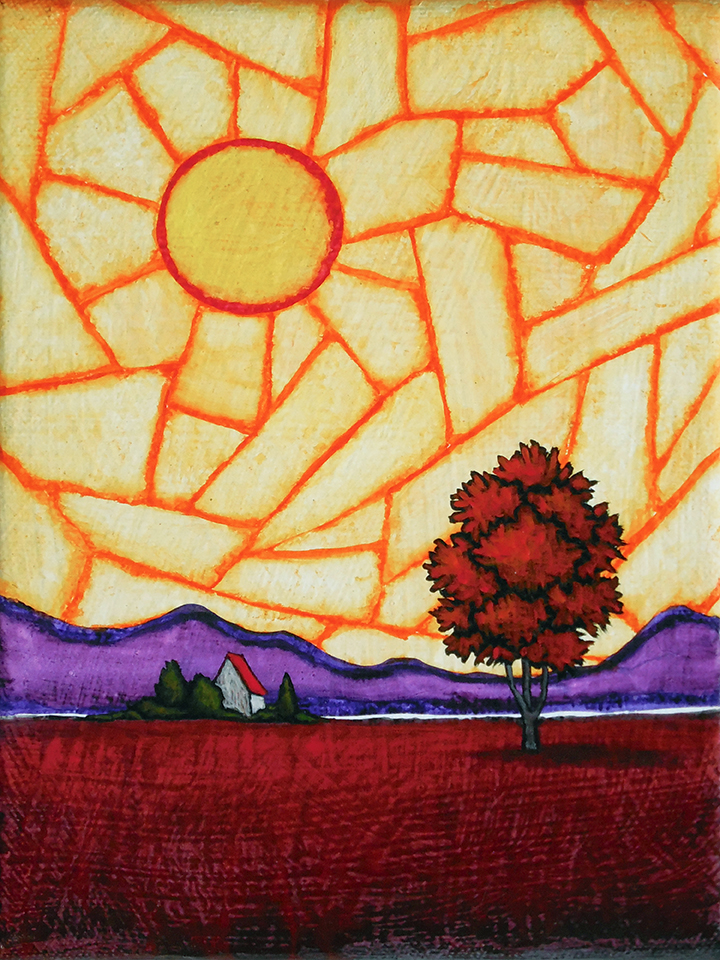
Read Full Post »


In Eminence— At Principle Gallery

The sole art that suits me is that which, rising from unrest, tends toward serenity.

–André Gide, journal entry, November 23, 1940


The journal entry above from Nobel Prize-winning author André Gide very much speaks to me. Though it serves many purposes for me, I tend to view my work as a means of absorbing and acknowledging the anxieties and pressures that this world often presses upon us, dampening their effects, and then moving, to use Gide’s term, toward serenity.

The darker aspects of the world are still there, an underlying presence that creates a contrasting tension, a counterpoint that serves as a starting point from which serenity and other aspects of light can build.

I am talking about the emotional tone of the work here, but it also roughly describes my actual painting process. Much of my work starts with a dark surface on which light and brightness is built.

Even my work with transparent inks that is more watercolor-ish in nature employs a process where a darker layer of ink is first applied. almost as a dark puddle on a light– usually white and prepped with layers of gesso– surface. This layer, this puddle of ink, is then little by little removed, each deduction revealing more and more light from the underlying surface.

From darkness comes light…

Let’s have a tune this morning. The song is I See a Darkness. It’s one I have played a couple of times over the years, once by Will Oldham (aka Bonnie “Prince” Billy) who wrote and originally recorded it and the other as covered by Johnny Cash, from the American Recordings period late in his life. His work from this time, when his scarred voice carried his age and emotion so eloquently, is potent stuff.

Light coming from darkness…

 I think this part of its chorus fittingly applies to today’s post and to life in general:

Oh, no, I see a darkness.
Did you know how much I love you?
Is a hope that somehow you,
Can save me from this darkness.


Read Full Post »

Island Getaway– At West End Gallery


The power of the good has taken refuge in the nature of the beautiful; for measure and proportion are everywhere identified with beauty and virtue.

— Plato, Philebus (ca. 350 BC)


Philebus is a fictional work presenting a conversation between Socrates and two young Athenians on the value of pleasure in relation to the highest level of Good. The two younger men see pleasure as being this Absolute Good.

As might be expected, Socrates, disagrees. He points out that there are different forms of pleasure. Some are of little value and some, such as pleasure for pleasure’s sake, are harmful to man and which should be avoided.

Just before the line at shown here at the top. Socrates points out the harm in such pleasure:

That any compound, however made, which lacks measure and proportion, must necessarily destroy its components and first of all itself; for it is in truth no compound, but an uncompounded jumble, and is always a misfortune to those who possess it.

This passage sure feels like it was written around 2500 years ago for such a moment such as we are experiencing here in this country. It seems to be an uncompounded jumble that is set on destroying itself and all of which it is comprised. It without measure, proportion, and reason. It has become a land governed by beings that appear to be soulless and artless, devoid of any measure of Beauty or Absolute Good.

When I read this, it made me think of the value and necessity of art as a refuge from this world. As Socrates pointed out, there is goodness and virtue in those things by which we define beauty. We are on the brink of an artless and ugly world. Engaging with art or creating art in times such as these serves a valuable purpose. It reminds us that these is and will always be goodness and virtue in that which appears beautiful to the human spirit.

Art is our refuge.

It comes in the literature and poetry we read. In the music we play and in the movement of our dances. In the films we watch, and in the statues and paintings that we experience.

As difficult as times may be in the near future, we must remember that Art is a both a refuge and a repository for Good, as well as a link, a path, to the world and future we desire.

Take refuge in your art.

Here’s song I last shared about four years ago. It fittingly titled Shelter and is from Lone Justice from back in the mid 1980’s. Led by vocalist Maria McKee, they were very hot for a few years but they couldn’t hold together long enough to reach the potential that so many saw in them. They disbanded in 1987 and Maria McKee went on to a solo career. I thought their two albums were very good and they were regulars on my turntable back in the day. The chorus from this song pops into my head every now and then. It was produced and cowritten with McKee by the multi-talented Steve Van Zandt, who was the subject recently of a wonderful documentary, Stevie Van Zandt: Disciple, that centered around his efforts that were instrumental in using his art to cast light on apartheid and end it.

Such is the power and refuge of art.


Read Full Post »

Completeness— At West End Gallery


We do not belong to those who only get their thought from books, or at the prompting of books, — it is our custom to think in the open air, walking, leaping, climbing, or dancing on lonesome mountains by preference, or close to the sea, where even the paths become thoughtful.

–Friedrich Nietzsche, The Gay Science (1882)


Below is a poem from the late Nobel Prize-winning Polish poetess Wislawa Szymborska (1923–2012) called Possibilities. I featured it here back in 2015 but it struck my fancy this morning and I thought I’d share it again and maybe add a bit to the original blogpost. It is basically a laundry list of her personal preferences. Some are small and some significant but all contribute mightily to her wholeness as a person. We are all the totality of our own laundry lists of preferences that define our character and personality just as our DNA determines our physical characteristics.

It’s a simple yet thought-provokingly complex poem that leave me wondering about my own preferences, my own possibilities. What are those small things that give you shape, make you who you are? Do we rely solely on these preferences in making the choices that we face in this life? Or do we sometimes make choices that do not align with our own preferences?

There are a lot of Symborska’s preferences that strike a chord with me. For instance:  I prefer myself liking people to myself loving mankind. That certainly has been my preference for most of my conscious life.

Then there’s: I prefer the absurdity of writing poems to the absurdity of not writing poems. Like writing poetry, painting can often seem like an absurd thing to do. I often find myself asking why I am alone in the woods smearing paint on surfaces. Is there a purpose or meaning in it?

But I have known the other side of that coin, living a life where I wasn’t painting, and that existence was far more absurd for me. Absurd to an unsustainable degree.

And that final line says it all: I prefer keeping in mind even the possibility that existence has its own reason for being. We may never know whether there is a reason for our being but that should not take away from the life we have here.

If this is all we get, live by the possibility of your own preferences and not those of any other.

Live as you are. As you want to be.

You might not agree with some of her preferences. That’s okay– they’re not yours to determine. She is simply giving us a loose outline of her individual nature, her humanity. And there’s poetry in that for any of us.

I am also including a song which was a favorite of Symborska, who requested that the version below from Ella Fitzgerald be played at her funeral. The song is Black Coffee and since being written in 1948 by Sonny Burke it has been covered by some of the great vocalists of our times– Sarah Vaughan, Peggy Lee, k.d. lang and so forth. You could pick any as your preference and they are all special. It’s that kind of song. But this version from the great and grand Ella Fitzgerald is extra special.


POSSIBILITIES

I prefer movies.
I prefer cats.
I prefer the oaks along the Warta.
I prefer Dickens to Dostoyevsky.
I prefer myself liking people
to myself loving mankind.
I prefer keeping a needle and thread on hand, just in case.
I prefer the color green.
I prefer not to maintain
that reason is to blame for everything.
I prefer exceptions.
I prefer to leave early.
I prefer talking to doctors about something else.
I prefer the old fine-lined illustrations.
I prefer the absurdity of writing poems
to the absurdity of not writing poems.
I prefer, where love’s concerned, nonspecific anniversaries
that can be celebrated every day.
I prefer moralists
who promise me nothing.
I prefer cunning kindness to the over-trustful kind.
I prefer the earth in civvies.
I prefer conquered to conquering countries.
I prefer having some reservations.
I prefer the hell of chaos to the hell of order.
I prefer Grimms’ fairy tales to the newspapers’ front pages.
I prefer leaves without flowers to flowers without leaves.
I prefer dogs with uncropped tails.
I prefer light eyes, since mine are dark.
I prefer desk drawers.
I prefer many things that I haven’t mentioned here
to many things I’ve also left unsaid.
I prefer zeroes on the loose
to those lined up behind a cipher.
I prefer the time of insects to the time of stars.
I prefer to knock on wood.
I prefer not to ask how much longer and when.
I prefer keeping in mind even the possibility
that existence has its own reason for being.

–Wislawa Szymborska


Read Full Post »

All of Time-At West End Gallery


My delight and thy delight
Walking, like two angels white,
In the gardens of the night:

My desire and thy desire
Twining to a tongue of fire,
Leaping live, and laughing higher:

Thro’ the everlasting strife
In the mystery of life.

Love, from whom the world begun,
Hath the secret of the sun.

Love can tell, and love alone,
Whence the million stars were strewn,
Why each atom knows its own,
How, in spite of woe and death,
Gay is life, and sweet is breath:

This he taught us, this we knew,
Happy in his science true,
Hand in hand as we stood
‘Neath the shadows of the wood,
Heart to heart as we lay
In the dawning of the day.

— Robert Bridges, My Delight and Thy Delight (1899)


I have things to attend to this morning, so I am sharing a simple trio that deals with something other than the state of the world or even the creative process. The trio today has more to do with love. I guess you could argue that love– or the lack of it– plays a vital part in both the state of the world and the creative process. So, maybe it is pertinent?

I don’t know. I just like this group and felt they all interwove well with each other, all dealing in a way with the theme of two angels. The poem above is from Robert Seymour Bridges (1844-1930) who was a British poet and the Poet Laureate of Britain from 1913 -1930. I was going to include just the first verse but the poem is not that long.

The song, Two Angels, is a longtime favorite from Peter Case. The painting at the top, All of Time, is at the West End Gallery. It’s one of those pieces that stick in my mind, maybe because its creation didn’t come easily. I began it then set it aside for a long time, often looking at what was there and wondering what the next step would be. It was a bit of an enigma. I was finally able to complete it so that it both pleased me deeply and found its own voice. That’s always satisfying.

The hard-fought ones often leave the deepest impressions—in painting as well in love and in life.


Read Full Post »

Passionata–Included in Little Gems at West End Gallery


There must be some other possibility than death or lifelong penance … some meeting, some intersection of lines; and some cowardly, hopeful geometer in my brain tells me it is the angle at which two lines prop each other up, the leaning-together from the vertical which produces the false arch. For lack of a keystone, the false arch may be as much as one can expect in this life. Only the very lucky discover the keystone.

― Wallace Stegner, Angle of Repose


Valentine’s Day in the year 2025. Though there is a lot that could be said about both the Valentine’s Day type of love and the year 2025, the two seem incompatible. At this place and time–2025– writing about romantic love seems almost trivial. And that might be a mistake as it may be only love, in its many facets, that sustains us going forward. So, for this Valentine’s Day in the year 2025, I am going back to a post from the good old days– 2022 (yikes!)– that deals with the sustaining power of love. The only difference is the painting at the top from the Little Gems show, which nonetheless serves as well as the painting shown in the original post.


The lines above from the 1972 Pulitzer Prize winning novel, Angle of Repose, from the late Wallace Stegner really jumped out at me this morning. To be honest, I haven’t read the book so can’t speak to its context but its concept of two vertical lines tipping together so that they meet and prop each other up to create a self-supporting false arch just seemed like the perfect imagery for today, Valentine’s Day.

Every lasting relationship depends on this arch. I hesitate to use the word “false” though I understand it is in reference to the distinction between “true” arches that have angled stones and a keystone at its apex that binds it all together and “false” arches that have the appearance and serve the same purpose but are constructed in a less sophisticated manner, sometimes haphazardly or by sheer accident.

Two trees falling against one another in the forest, for example.

Or maybe even two trees that grow together and eventually seem almost as one. a la the trees in my Baucis and Philemon based paintings.

I’ve been part of such a false arch for a very long time and as a result Valentine’s Day takes on a different look for me. Though it maintains a romantic aspect, it is more about a deeper recognition and appreciation of all the many aspects that make up that other vertical line that somehow fell my way all so many years ago to create our false arch.

And, as the Stegner lines above point out, this false arch might be as much as one can expect in this life. I certainly can’t ask for anything more.

Here’s one of my favorite Rickie Lee Jones songs, one that seems fit for this post. It’s a song that I never thought received the recognition it deserved. This is We Belong Together, from her classic 1981 album, Pirates, with its cover photo from Brassai of two Parisian lovers of the 1930’s.


Read Full Post »


Move On Up–At West End Gallery

We cast a shadow on something wherever we stand, and it is no good moving from place to place to save things; because the shadow always follows. Choose a place where you won’t do harm – yes, choose a place where you won’t do very much harm, and stand in it for all you are worth, facing the sunshine.

–E.M. Forster, A Room With a View


Choose a place where you won’t do harm…

Man, that sounds like advice coming to us from a distant time and place. So much so that it seems almost quaint, almost to the point where many of us do exactly the opposite, choosing places where we can do nothing but harm.

I know this is nothing new. There has always been a streak of malice and vindictiveness within our character. We would often rather sacrifice to harm others rather than to help them.

That’s part of the dark shadow that follows us, obscuring what little remains of our empathy. Not sure why I am writing this this morning, outside of the utter disappointment I sometimes feel in the choice many make to turn away from the sunshine of compassion and live in the deep shadows that are devoid of it.

Actually, this all started when I came across an old blog post that had a Johnny Cash performance of a Loudon Wainwright song, The Man Who Couldn’t Cry. Simply put, it’s a song about a man who lived a life without feeling. This performance is from a time when Johnny Cash was just beginning to reinvent himself, having become irrelevant, seen as a relic of country music’s past. He couldn’t get airplay for his music. He decided to make music that was out of the box.

It is written that though he was a legendary performer, he was terrified for this show as it was one of the first times he had played alone on stage without a backing band. Just a man and his guitar. I like that story, that this man who headlined around the world and had throngs of adoring fans felt the need to move ahead with deeply personal work that was meaningful and often raw. That it meant so much to him that he felt exposed, that he was nervous and afraid.

He chose a place where he wouldn’t do very much harm, and stood in it for all he was worth, facing the sunshine.

A good way to go.


Read Full Post »

Heart’s Fortress– At West End Gallery


Fortify yourself with contentment, for this is an impregnable fortress.

–Epictetus


Epictetus probably personally knew a thing or two about building a fortress out of contentment. He was a Greek Stoic philosopher born into slavery in the middle of the first century AD. In Rome, he served as a slave to a powerful and wealthy man who was secretary to Emperor Nero. His owner recognized that Epictetus, who also had a disability caused in his childhood which required him to use a crutch, possessed a passion for philosophy and allowed him to study under a Stoic master.

Eventually the owner released Epictetus from servitude, and he began teaching philosophy in Rome. Around 93 AD, Emperor Domitian banished all philosophers from Rome and Epictetus left for Greece where he established his school of philosophy which became well known and revered.

Having survived slavery, disability, and banishment, Epictetus was someone who knew hardship and loss. Even so, it seems as though he was able to find his own fortress of contentment that was beyond the reach– the influence, opinion, and injury– of the outside world.  

I think that idea applies to the new painting from the Little Gems show (opening today at the West End Gallery) shown at the top, Heart’s Fortress. I know that it is just an idealized condition, that no one can fully isolate from the world. But we all need a place of our own, even if it exists only for short periods of time in our inner landscape, where we can be free from the world. A safe island of quiet where we can examine all that we are and find some degree of satisfaction in that.

I try.

Occasionally, I succeed.

And sometimes the world comes in the form of tidal waves that crash on the cliffs of my fortress, shaking away much of my contentment.

Still, my fortress remains. Perhaps a little disheveled and in need of some maintenance. But it stands.

And in that alone, there is some satisfaction, some contentment. 

Heart’s Fortress is a small painting, 3″ by 4″ on paper that is now at the West End Gallery in Corning as part of the annual Little Gems show. There is an opening reception for the show today from 5-7 PM. Hope you can make it.

Here’s a lovely song that, while it may not be about the specific island of my heart’s fortress, is about the love of an island. This is Island in the Sun from the late great Harry Belafonte.


Read Full Post »


Height of Achievement– At West End Gallery


“All who are not lunatics are agreed about certain things. That it is better to be alive than dead, better to be adequately fed than starved, better to be free than a slave. Many people desire those things only for themselves and their friends; they are quite content that their enemies should suffer. These people can only be refuted by science: Humankind has become so much one family that we cannot ensure our own prosperity except by ensuring that of everyone else. If you wish to be happy yourself, you must resign yourself to seeing others also happy.”

— Bertrand Russell, The Science to Save Us from Science, NY Times (19 March 1950)


The final sentence above from Bertrand Russell from 75 years ago seems almost quaint in the selfish and cynical times in which we find ourselves. The idea of making others happy as a measure of our success or our satisfaction with our lives is not particularly popular these days.

It raises many questions for me.

How does anyone define success? Or happiness?

Can anyone be successful and happy while denying the same to others? 

That would be the old climb-to-the-top-and pull-up-the-ladder-behind-you trick that’s so popular these days. We have sadly come to believe that our own success and happiness is somehow diminished or devalued by the success and happiness of others. Many see it as some sort of reality show competition and not only pull the ladder up behind them but roll boulders down at those attempting to climb a bit higher.

This all came from thinking about what I was seeing in this new small painting, Height of Achievement, that is part of the Little Gems show now hanging at the West End Gallery. I see it as being about defining your success and happiness on your own terms, about claiming your own small pinnacle and laying a path that gives others the opportunity to climb as well. I see the Red Tree here as not a ruler over a domain but as an explorer or guide showing the way.

I also saw a slightly different interpretation, one where the Red Tree has climbed to the top, achieving the success it sought, and found it a lonely place. And happiness was in short supply, as well, since it was forever preoccupied about keeping its place up there. It never was able to enjoy the view or share it with others.

I guess both translations say much the same– strive for yourself but for others, as well.

That works for me this morning.

Here’s a song that is well-worn, both in airplay and on multiple film soundtracks, for good reason. Just a great song. This is the 1967 hit, Ain’t No Mountain High Enough, written by Ashford & Simpson and performed by Marvin Gaye and Tammi Terrell, who both died tragically young. Diana Ross did a great version of the song as well in 1970 but I thought I’d go with this one.


Read Full Post »


Twilight Time–AT West End Gallery

And even if you were in some prison the walls of which let none of the sounds of the world come to your senses—would you not then still have your childhood, that precious, kingly possession, that treasure-house of memories? Turn your attention thither. Try to raise the submerged sensations of that ample past; your personality will grow more firm, your solitude will expand and become a place where you can live in the twilight, where the noise of other people passes, far in the distance.

–Rainer Maria Rilke, Letters to a Young Poet


Little time this morning as I have some maintenance issues around here that demand immediate attention. Before I get to those issues, I thought I would share a triad of image, word, and song to serve as a reminder that the annual Little Gems exhibit of small works is now hanging at the West End Gallery and that the opening reception takes place this Friday, February 7, from 5-7 PM.

Above is a new painting, Twilight Time, 6″ by 12″ on canvas, that is included in the show. The words at the top are from the always relevant Letters to a Young Poet from Rainer Maria Rilke.  This passage is from a letter where he was instructing a struggling young poet to stop trying to satisfy the critics or publishers and focus on creating an inner world where his work can grow and prosper.  It then takes on its own life based on the poet’s unique self, instead of an imagined criteria set by other people. It then takes on a reality that others will recognize.

For the music, I am selecting the obvious song, Twilight Time. I probably should share the old beautiful Platters hit that most will recognize but I am going with a version from Willie Nelson. I enjoy his takes on the American songbook of standards. It always gives the work a somewhat different dimension, an easiness that is comforting to my ears. 

Okay, got to run. There are things to do that cannot wait.


Read Full Post »

« Newer Posts - Older Posts »