Feeds:
Posts
Comments

Posts Tagged ‘Walden’

Serene Gratitude— At West End Gallery


If you have built castles in the air, your work need not be lost; that is where they should be. Now put the foundations under them.
–Henry David Thoreau, Walden (1854)


I was going to write something else this morning but am feeling a bit foggy and tired. Instead, I thought I would share a post from a few years back and add the Don McLean song, Castles in the Air, at the bottom.


This is a well-known quote from Walden. Maybe the most well-known. It basically states, in my opinion, that we are meant to dream, to imagine better things and circumstances for ourselves. But there comes a time when we have to put the necessary work if these dreams are ever to become a reality.

Pretty sound stuff. The value of work and dreams is not lost on me. My life as it currently is, relatively simple and humble, was once a castle in the air. I was leafing through an old journal from when I was 16 or 17 years old and came across a list of goals for my future.

I had forgotten that I had made such a list and was surprised at how closely it matched the life I now live. Apparently, though I stumbled and fumbled around for too long a time, I somehow subconsciously made my way back to those castles I had built in the air with that list as a teenager.

I was pleased at first for it validated this idea that you somehow eventually reach destinations for which you set a course. Then I began to wonder what might have happened had I built my castles even further up in the sky.

Were the goals of an unexceptional and naive 16-year-old too restrained and self-limiting? Or did that 16-year-old know itself better than I currently think it did, that it already recognized its own core strengths and deficiencies? 

I don’t know the answer to that question. But I can say that I don’t regret placing the foundation under the castle that I first built in the air when I was young. It suits me.

My one wish is to have time enough to put other foundations under a few other castles that float in the air above me. We shall see.

As it is with most of the quotes I use here, I like to seek out the context in which they appear in their original form. I felt that the paragraphs that end with these words from Thoreau should be shared in full.

There’s still a lot of meat on this old bone from Mr. Thoreau:

I left the woods for as good a reason as I went there. Perhaps it seemed to me that I had several more lives to live and could not spare any more time for that one. It is remarkable how easily and insensibly we fall into a particular route and make a beaten track for ourselves. I had not lived there a week before my feet wore a path from my door to the pond-side; and though it is five or six years since I trod it, it is still quite distinct. It is true, I fear, that others may have fallen into it, and so helped to keep it open. The surface of the earth is soft and impressible by the feet of men; and so with the paths which the mind travels. How worn and dusty, then, must be the highways of the world, how deep the ruts of tradition and conformity! I did not wish to take a cabin passage, but rather to go before the mast and on the deck of the world, for there I could best see the moonlight amid the mountains. I do not wish to go below now.

I learned this, at least, by my experiment: that if one advances confidently in the direction of his dreams, and endeavors to live the life which he has imagined, he will meet with a success unexpected in common hours. He will put some things behind, will pass an invisible boundary; new, universal, and more liberal laws will begin to establish themselves around and within him; or the old laws be expanded, and interpreted in his favor in a more liberal sense, and he will live with the license of a higher order of beings. In proportion as he simplifies his life, the laws of the universe will appear less complex, and solitude will not be solitude, nor poverty poverty, nor weakness weakness. If you have built castles in the air, your work need not be lost; that is where they should be. Now put the foundations under them.


Read Full Post »

*******************

“I learned this, at least, by my experiment: that if one advances confidently in the direction of his dreams, and endeavors to live the life which he has imagined, he will meet with a success unexpected in common hours.”

― Henry David Thoreau, Walden: Or, Life in the Woods

*******************

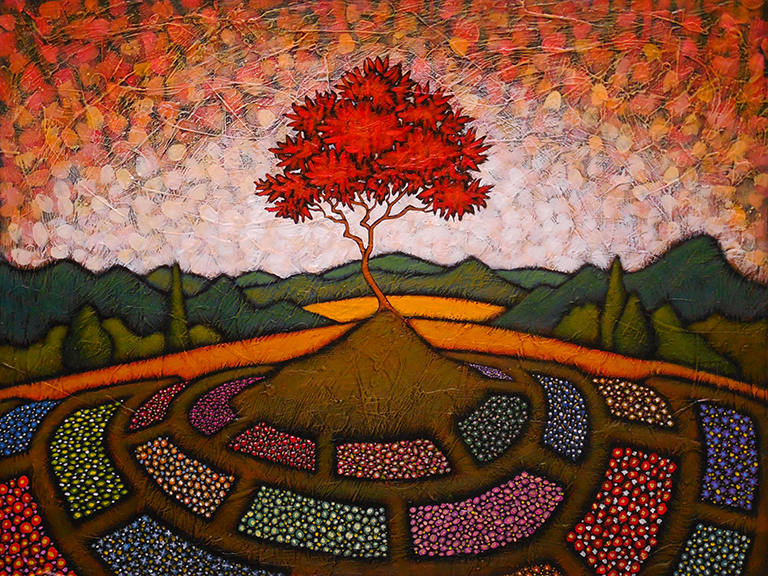
This is a new painting, 18″ by 24″ on panel, that is headed to the Principle Gallery for my upcoming show, Redtree: New Growth, that opens June 7. It’s been one of those pieces that keeps drawing my eye in its direction here in the studio. Maybe it’s the rings of colorful flowers– part of the New Growth from the show’s title–that encircle the Red Tree that attract my eye. They have a gem-like quality in the landscape.

I have mentioned in the past how I view many of my Red Tree paintings as being portraiture as much as they are landscapes, with the Red Tree and the foreground landscape often serving as the head and shoulders of a portrayed figure.  That certainly holds true for this piece, which I have titled  The Pharaoh’s Necklace.

In this piece, I see the Red Tree as a head held high with the colorful bands around the mound– the neck here– transforming from beds of flowers into a sort of necklace like those seen of the pharaohs of ancient Egypt. By the way, for your daily dose of useless facts, that type of necklace is called a usekh or wesekh.

Seeing this painting as a portrait, I see it as a portrayal of the strength and pride of someone who has, as Thoreau describes above, endeavored to live the life they have imagined in their dreams and have met with unexpected success.

More than that, it’s a painting of possibility, one that points out that we all have the potential to realize our hopes and aspirations, That is, if we can first formulate a dream. I sometimes get the feeling that many people have never given their dreams much thought.

As to those who have, I often wonder if many people actually maintain the dreams of their youth into their adulthood. If not, have they convinced themselves that these dreams were foolish and unattainable then finally ceased all pursuit? Or perhaps they had aspirations that didn’t match up with their actual strengths and abilities?

For example, I knew at an early age that my dream of being the ace of the St. Louis Cardinals pitching staff was off the table. And I never had the nerve to be a master thief. I knew my dreams had to focus on the few qualities I possessed and prized if they were ever going to come to fruition, if I was ever going to wear my own pharaoh’s necklace.

And, thankfully, there are some days when I do feel that I am sporting my own gem encrusted usekh. Those are the good days of this life and this painting is how those certain days feel to me.


Read Full Post »

GC myers-Sanctuary A couple of days ago I wrote about the theme behind my upcoming Home+Land show at the West End Gallery, briefly describing that feeling of feeling at home in a place.  This homing instinct has been noted by others including a passage in the book Desert Solitaire from late author/environmentalist Edward Abbey.

Written in 1968, the book tells of his time as seasonal park ranger at Utah’s Arches National Park in the 1950’s and has been compared to Thoreau‘s Walden for the philosophical ruminations that run alongside his stories of working the park.  I read it probably well over thirty years ago and had forgotten this short passage until running across it on another site.  It fit so well into the other day’s post that I thought I would share it:

Every man, every woman, carries in heart and mind the image of the ideal place, the right place, the one true home, known or unknown, actual or visionary.  A houseboat in Kashmir, a view down Atlantic Avenue in Brooklyn, a gray gothic  farmhouse two stories high at the end of a red dog road in the Allegheny Mountains, a cabin on the shore of a blue lake in spruce and fir country, a greasy alley near the Hoboken waterfront, or even, possibly, for those of a less demanding sensibility, the world to be seen from a comfortable apartment high in the tender, velvety smog of Manhattan, Chicago, Paris, Tokyo, Rio or Rome—there’s no limit to the human capacity for the homing sentiment. Theologians, sky pilots, astronauts have even felt the appeal of home calling to them from up above, in the cold black outback of interstellar space.

I know that this homing instinct, the need to be peacefully at ease in a place, has been a prime motivator in many parts of my life and it shows itself in my work on an a regular basis.  The example at the top very much reflects this sense of home and is called, fittingly, Sanctuary.  It is part of my show Native Voice which hangs now at the Principle Gallery and ends July 6.


Read Full Post »