Feeds:
Posts
Comments

Archive for March, 2010

Reign of Light

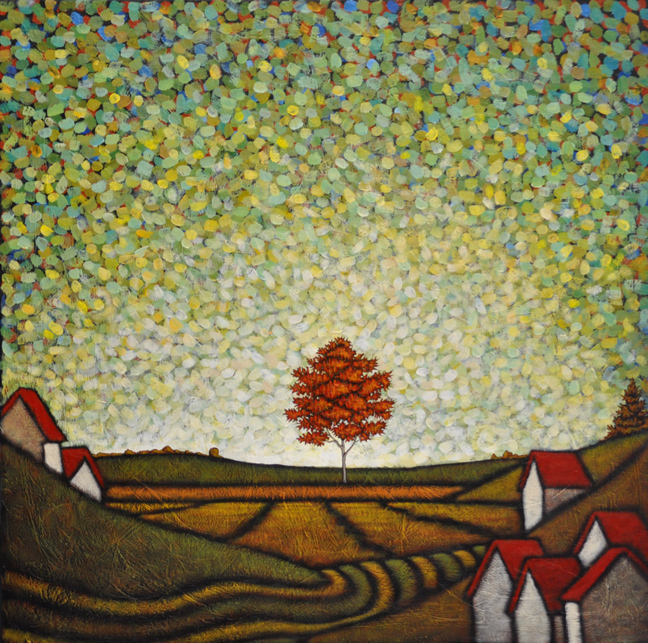
This is a new painting that I’m calling Reign of Light for the time being.  It’s a 30″ square canvas, a size that is large enough to give the piece real impact in a space.  I’m finding that it has a very commanding presence in the studio, one that immediately pulls the eye to it and holds it.

For me, there’s an ethereal quality in the sky, as though all the many strokes of color represent the deconstruction of time as we know it.  Time breaking apart into fragments of color and light of which we can see only a portion from our earthbound positions.  On one hand, I see the tree in this piece as the seeker, the dreamer.  The climber who is driven by a longing to find a new and higher position from which to see and better understand the world.

But another part of me thinks that maybe that’s too romantic a view for this piece because it seems also like a statement of power, as though the tree is holding court and the multitude of lights that gather above are at it beck and call.

An interesting pull between two separate viewpoints, one of strength and command and the other of wonderment.  Perhaps there is room for both viewpoints here in this painting.  Maybe it comes down to one seeking power from understanding the patterns and processes of the universe and passing that power on to others so that all can benefit.

But then again, maybe it’s just a painting of a tree out in some fields.  Nothing more.

Such is art.

Read Full Post »

In a recent New York Times article, columnist Matt Bai wrote about the current outrage in the American public against the influence of lobbyists is our halls of government.  He makes a case that perhaps the lobbyists themselves are not wholly to blame for the power they now wield but the current state of affairs is a result of a system that has made most politicians view any critical decision as being a matter of them either choosing  what is truly right for their constituents and the country or choosing what best protects and serves their own position.  It comes down to a matter of self-preservation, looking out for themselves, over looking out for the people they represent and supposedly serve.

As a result, we are left with a government designed and built with good intentions for all but operated by the few for their own often selfish ends.

It brings to mind director Frank Capra‘s classic film,  Mr. Smith Goes to Washington.  Everyman Jimmy Stewart plays Jefferson Smith who is chosen by the governor of some vague western state to replace a recently deceased senator.  Smith is chosen for his wholesome image in the state, as head of the Boy Rangers,and for a naivete that those in power feel will allow him to be easily manipulated.  In Washington, Smith is faced with corruption and graft from special interests and is soon the target of these groups as they attempt to destroy him when he finds out what he is up against and tries to do what is right.

Sounds familiar.

The film is a very simplified, maybe overly naive,  object lesson for our democracy.  But beneath this layer of naivete there is the simple truth that our government is based on those in power doing what is just and right for the people and when this power is usurped, our voices are ignored and the power of our democracy is diminished.  We lose something essential to our character as a people.

What’s the answer?

I’m not sure.   Perhaps we should change our system in a way that very much limits a person’s term in office, maybe one four year term so that there is no pressure for running a campaign while they are in office.  Do away with career politicians.  Fund all campaigns with public funds and return to a true citizen government.

Could such a system do much worse than the way things are currently done?  Some will say that we would be losing our best minds by having term limits but does the current system really encourage our best minds to serve in government at this point?

As it is, I am without a congressman of any sort at the moment.  I am unfortunately part of the congressional district  ( the 29th New York) represented until last night by Eric Massa, who is bailing on his constituency because of a recurrence of cancer and a sexual harassment scandal.  I am disappointed.  In the sheer stupidity of his actions.  In his quick, unceremonious exit.  In his unwillingness to finish his term and fight for the people that chose to vote him into office.  He claims he was at odds with the Democratic party over his refusal to toe the party line on health care but instead of staying in the game and trying to work out solutions, his choice was to try to punish the party by leaving the citizens of his district without a voice in Congress for several months until a special election can be held.

He was obviously not our Mr. Smith.  I don’t think Mr. Smith would give up so easily on the people of this country.

***************************************************

Addenda: As I was finishing the end of this, there was a local news report on the TV about a local longtime mayor who was being urged to seek Massa’s abandoned seat.  In a statement the mayor said that the environment in Washington was toxic and that they needed honor and dignity.  For that reason, he would not run.  It struck me as a very funny line.

Read Full Post »
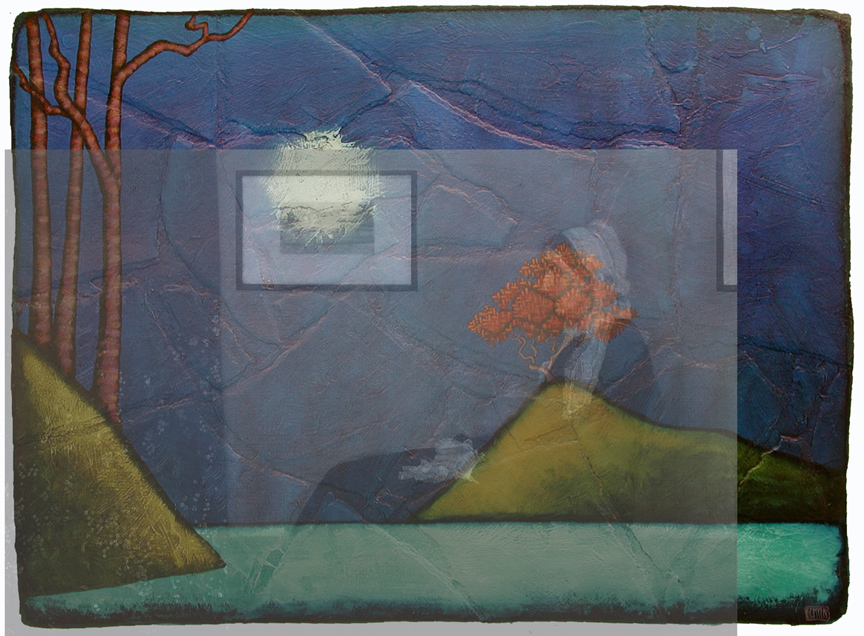
Yesterday I wrote about how I have often used in my own work the composition from the James McNeil Whistler painting popularly known as Whistler’s Mother.  I did so without illustrating the point so I thought I’d take quick moment to show how I might block in my own work with Whisyler’s composition.

Going into my archives, one of the first things I look at is a painting from a few years back, The Way of Light.  At first glimpse, this piece has nothing in common with the Whsitler piece.  First, it is not portraiture ( although I often view my trees as such) and it is a landscape.  It is obviously a different palette of color than that of Whistler and the elements are rendered in a less realistic fashion than you would see in Whistler’s work.

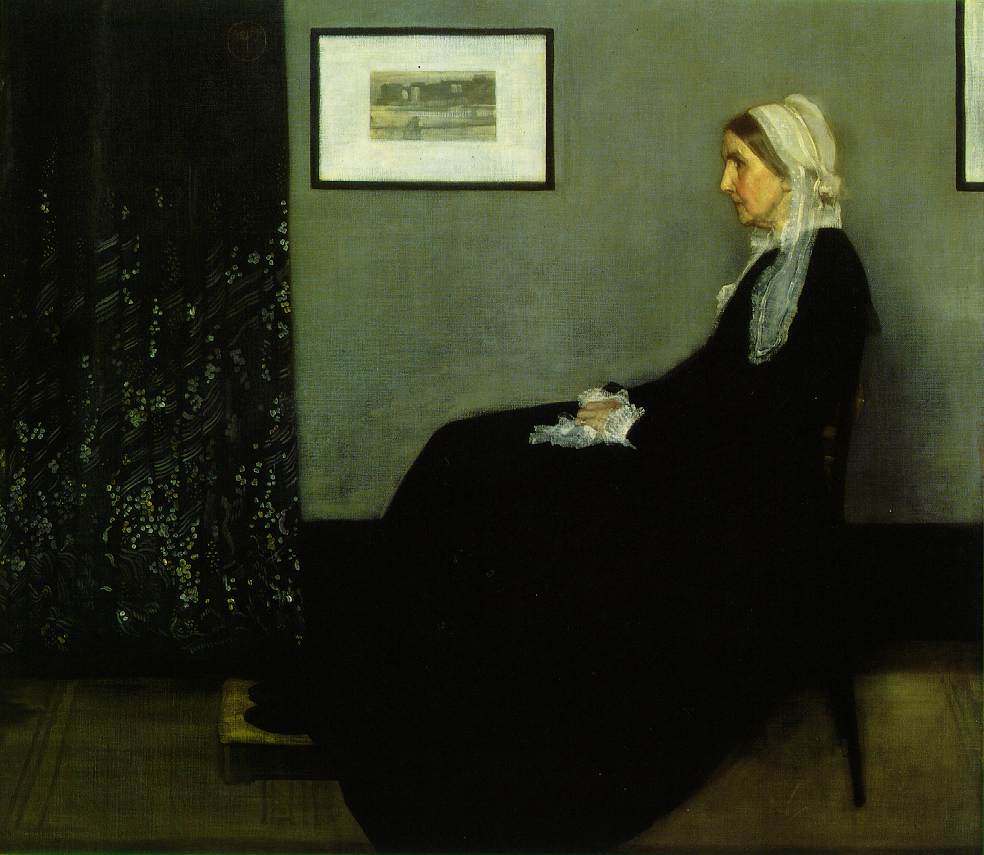
But if you put those differences aside and quickly take in the shape and form of each piece, you can begin to see the similarity.  The line of trees on the small mound of land in my piece take the place of Whistler’s dark curtain on the far left.  The water in mine becomes the floor of his. The body of his mother is replaced by my island and her head becomes my red tree.  The framed print is now my moon.

Here, I overlaid my piece with the Whistler piece to further illustrate the point.  Obviously, there are worlds of differences separating the two pieces, as I pointed out above.  But the composition and use of blocking and light help us each achieve a sense of mood that is the primary goal in both cases.  Like Whistler, I am often more concerned with the mood and emotion of a piece of work than the actual subject matter.  In this pursuit I have come to view much of my work as Whistler did his, as musical compositions rather than merely representative images.

In color and shape there is rhythm, tempo and tone.  The placement of the compositional elements of a piece are much like the placement of individual notes in music, each affecting and reacting with those around it.  All trying to evoke feeling, response.

Well, there’s my illustration of how Whsitler’s iconic piece fits in with what I try to do with my work.  Hope you can now see the connection…

Read Full Post »

This is James McNeil Whistler’s most famous piece, Arrangement in Grey and Black, No. 1:  Portrait of the Painter’s Mother.  It is, of course, better known as Whistler’s Mother.  It was a painting that I was casually familiar with as I grew up but it wasn’t until I looked more closely at it after I had started painting that I saw the brilliance of it’s composition.

Whistler always asserted that the painting was not about his mother but was more concerned with creating mood with color and composition, which the primary focus of almost all his work. This piece achieves it’s mood with beautiful diagonal lines formed by the woman’s form and contrasting verticals and horizontals that create great visual tension and energy.  The stark whiteness of the matted print on the wall behind shines like a full moon against the pale blue-gray sky that is the wall itself.  The head of the old woman seems to be almost lit by the light from the moon/print.

This is not a portrait of an old woman.  It’s a nocturnal landscape.  That’s what I saw when I looked at it as a painter trying to glean what I could from it for my own use.  This was a composition that had a geometry that just felt so right immediately.  It had such a sense of perfection in the way color and form combine with sheer simplicity that I knew I would have to use it for myself.

And I have, quite a few times over the years since I first really looked at it, sometimes with slight variations in the placement of the elements but still basically with the same compositional base.  And inevitably, they are pieces that great immediacy in their impact, pieces that carry great mood whatever their subject matter.

And for that I thank you, Mr. Whistler…

Read Full Post »

I’ve written quite a bit lately about the concept of home and the search that many of us go through in defining what home truly means.  It’s all part of a process of determining who we really are as individuals and what our place is in the grand scheme of things.  Home and family are the two fundamental building blocks upon which we build our own definitions of self.  Home is where we are and feel we belong in the present and family is where we have been in the past, the basic bloodlink that has carried us to this point in time.

I’ve written about my research into my family and that of my wife so it was with some interest that I watched a new program last night called Who Do You Think You Are? that traces the lineage of celebrities on a weekly basis.  I really couldn’t  care less about the celebrity part (in fact, this show might be more interesting if they randomly chose to trace the roots of some very everyday folks) but am always interested in seeing how a person is affected when finding a new depth and understanding of their distant past.  Such was the case with last night’s subject, Sarah Jessica Parker.

Parker, like many of us, knew little of her past and felt that her family was only on the fringe of the American experience, that they had little to do with the events of the past that shaped and made this country.  I knew that feeling well .  In her case, her past easily revealed itself with just a bit of research and she was able to find a great-grandfather who from several generations back who left home and family in Ohio and crossed the country via wagon train, questing for fortune for his family in the gold mines of California.  Part of the Gold Rush and staking a claim with partners, he worked the mine and died of illness within a year.  His story is emblematic of the American push into the west.

Going back further, she found her family in the center of the Salem witch trials of the 1690’s, with a great-grandmother who, as a young woman, was accused of witchcraft but was spared from the death by hanging that all other who had been previously accusedsuffered as the trials were halted before her case came before the court.   Without the stoppage of the trials, Parker’s very existence would be in doubt.  Again, she finds herself in the middle of events that shaped the narrative of our country.  Going further, I’m sure she will find her family in the midst of events that shaped history in the countries of her ancestors.

Such is the case with us all.  It was interesting to see her story and to see how she was moved by and connected with the stories of her ancestors, how she gained insight and appreciation for the journey that led to this very moment in time.  Her’s is a wonderful story but not a rare one.  All of us have a rich heritage if we only choose to look, a wealth of information that winds through and connects us with the annals (yes, annals) of history.  We all are more than we seem and all are alive as the result of  many amazing sets of circumstance.

I have often thought if we all comprehended what it took to get us as a people to this point, how those ancestors who came before us risked and sacrificed for home and family, then we might take more pride in who we are and take more personal responsibility for our future.

Read Full Post »

I was thinking of Dan Hicks and His Hot Licks the other day.  I’ve got a couple of  his albums from the early 70’s and periodically some of his songs pop into my mind.  It’s hard to categorize his music but their was always an eccentricity factor with it.  He’s been around for something like 40 years or more but probably achieved his greatest success with his early work and his appearances on popular TV variety shows of the time. 

 One such appearance was on The Flip Wilson Show in 1972 which I’m showing here.  I was going to show only this clip, given that it’s such a great snapshot of that time in popular culture,  but I thought it would be interesting to also show him a few years later to show the evolution.  Somewhat.

Anyway, here are a couple of Dan Hicks’ songs for your consideration.  The first is from 1972

The second is from around 1990 from the short-lived late night show Night Music with David Sanborn…

Read Full Post »

Spring Training!

As I worked in the studio yesterday, familiar sounds filled the space for the first time this year.

The slap of a ball on the leather of a glove.  The crack of the bat.  The muffled bellow of a called strike from the umpire.  The crowd roaring when a ball clears the outfield wall.  The familiar voices of the longtime announcers describing a pitch or giving a player’s stats as he strolls to the plate.

Baseball’s back.  Spring training is underway once more.

I feel as though my year is officially started and that I am once again engaged with the continuum of time.  Baseball is a symbol of the cyclical nature of time and the fallibility of man for me and feels almost ingrained.   The biggest stars, names that will resonate with fans for generations, fail on a regular basis, much more often than they succeed as their season goes on an almost daily basis through three seasons of the year.  The game is about patience and perseverance, continually slogging ahead day after day.  Putting aside setbacks and looking at each new day and the next game as a new start.  Grinding it out.

Doesn’t sound too appealing when put that way but the beauty comes from the moments of triumph that sprout during this long march through the year,  bursts of brilliance and sudden victory that overshadow the failures that came before.

Much like life. 

So again, pitchers throw, catchers catch and hitters swing .  Fielders kick the dirt of the infield and track flyballs across the lush green carpets of the outfield and once again, I feel as though I am back in the flow and rhythm of my year.  Play ball!

Read Full Post »

Keeping Hope

To be hopeful in bad times is not just foolishly romantic. It is based on the fact that human history is a history not only of cruelty, but also of compassion, sacrifice, courage, kindness.

What we choose to emphasize in this complex history will determine our lives. If we see only the worst, it destroys our capacity to do something. If we remember those times and places — and there are so many — where people have behaved magnificently, this gives us the energy to act, and at least the possibility of sending this spinning top of a world in a different direction.

And if we do act, in however small a way, we don’t have to wait for some grand utopian future. The future is an infinite succession of presents, and to live now as we think human beings should live, in defiance of all that is bad around us, is itself a marvelous victory.

——Howard Zinn

***************************************************************************

I failed a month or so back to mention the death of historian Howard Zinn, author of  A People’s History of the United States and many other books.  In much of his work, he sought to bring a sense of hope and a reason to believe to his readers even when chronicling the darkest times.

The last paragraph of this writing says it all…

Read Full Post »

This  is a new painting that I’ve just finished, tentatively called As Clouds Roll By.  It’s a 14″ by 18″ image painted on ragboard.  It’s a composition that I have visited on a number of occasions, this time at the request of a collector in Pennsylvania, and one that I always get great pleasure from painting.

Even though this is a very simple composition with few elements, the great satisfaction I feel after finishing a piece such as this is something I can’t fully explain.  Perhaps it’s the recognition of the things in this piece that fully jibe with what I want from my own paintings.  The simplicity of design. The quietude of vast open space.  The depth into the picture, even though it is a very simple composition.  The inviting warmth of the house and tree.  The languorous fashion in which the clouds roll by, in a way representing the slow and inevitable march of time.

It clicks a lot of my own buttons.

The clouds in this piece always take me back to the first time I painted clouds in that looked like these.  I was not yet a full-time painter and had obtained a large commisiion that would prove to be very important to me.  I was on a short deadline and was still painting in the dining area of our home at the time with large sheets of paper spread over folding tables.  I was working on a large triptych and was nearly finished when our late cat, Tinker, decided to explore the tables.  Bounding up, she stepped first in a damp part of my palette and ran across the three sheets, leaving perfect little paw prints in a watery blue tint in her wake.  As the echoes of my bellow faded, my mind raced as I looked at my now very unfinished work.

Start over?  No time.  Try to blend them in to the background?  Not with this particular style of painting.  I sat and looked, concentrating.  Wait a minute.  The prints only ran across the sky portion of all the sheets.  And they ran in lovely diagonal manner.

Quickly, I was at it with paint and within several minutes I had blocked in clouds where once there were paw prints.  It worked.  Tinker’s run across the sky fit the rhythm of the piece and the clouds actually gave a fullness to the composition that it had lacked.  It was actually quite an improvement.

So when I see clouds such as these, I always flash back to my initial panic and the subsequent discovery of good fortune in this happy accident.  Since that day, when what seems to be a disatrous event happens with one of my paintings I step back with a much calmer mind and eye with the knowledge that perhaps this is just a new opportunity to see things a new way.

Read Full Post »

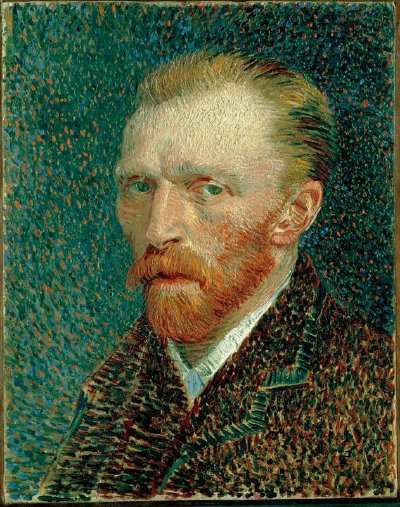
Last year I featured a video called Women In Art that featured portraits of women from over the past 500 years morphing one into another.  It was a really well done piece of work from Phillip Scott Johnson and was a YouTube sensation, having more than 10 million hits.  He has also given the self-portraits of Vincent Van Gogh the same treatment.

It’s a short piece and it’s interesting to see how the familiar views of Van Gogh relate to one another and how his appearance or, at least,  his perception of it, changed through the years.   His state of mind is evident in each piece, with some showing a vibrant, seemingly healthy man and others showing the more tortured Van Gogh that we have come to know.

It’s an interesting little piece, coming in at under a minute.  Give a look…

Read Full Post »

« Newer Posts