Feeds:
Posts
Comments

Archive for May, 2011

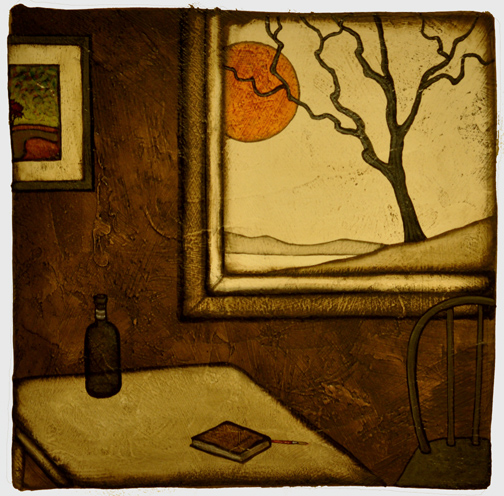
I try to have a few pieces in every show that are a bit out of my normal range, pieces that still carry the same momentum as the other work in the show but have a different look from my typical work.  This is one such piece from my next show, Now and Then, which opens at the Principle Gallery on June 10th.  This is an 11″ by 11″ painting on paper and is limited in its color with shades of brown and gray and bits of more vibrant colors.

I do these interior scenes once in a great while, usually employing a window or door as part of the composition.  I enjoy the contrast between the sharp angular geometry of the interior space and the more rolling curves and arcs of the outer landscape.  The window also provides a contrast in darkness and light for this piece, the darker tones of the interior making the lighter exterior scene pop in this composition.

Like my landscapes, I still try to keep details to a minimum.  The interior scene provides more opportunities to embellish, to add more points of interest such as the few things on the table, but I want the larger forms to be the expression in this piece.  I want the piece to still read easily from a distance.  This is similar to the way I felt about my earlier Archaeology series.  There was an area of great detail but I wanted that to be secondary to the whole scene, preferring that the viewer be drawn to the overall feel of the piece first then noticing the detail after.  Also like some of the Archaeology pieces, I’ve added bit of self reference here in the form of the painting on the wal, a small red tree. 

I always like these pieces if only for the difference they display from my other work and the fact that they feel more personal to me, as though the outer scene here is the one I regularly share with the larger world and the interior scene is the part that I don’t show, that part of the self I keep in reserve, hidden from the outer world.   Maybe that is the meaning here.  As for any other message,  I don’t know what they say to others. don’t know if that really matters in the case of these pieces.  Perhaps they are simply what they are, shades of brown and gray and bits of color…

Read Full Post »

Yesterday I was working in the basement of my studio which is set up to accomadate the matting and framing operations for my work.  It’s a finished space  that is decorated in a typical 1960’s fashion with woodtone paneling, a drop ceiling  and carpeting with a geometric pattern that has  brown mustard  as its main color.  It has a kind of shmaltzy feel and I always mean to overhaul the space but never find the time. 

I have a number of  long tables throughout the space as well as a couple of large drafting tables, covered  almost  always with something.  Sometimes they contain sheets of heavy watercolor paper as I apply layers of gesso.  Sometimes they are filled with frames in various stages as they are being finished or with canvasses that are being coated with their final protective varnish.  At one end there are heavy industrial shelf units that hold unfinished frames and canvasses and stretcher bars.  Along the walls there are several other shelfing units that hold bottle of gesso and varnish and  tape and all the little things that are needed  for framing.  Large rolls of brown and black kraft paper are hung on one wall.  There are several paintings of mine on the wall, a few older pieces that have somehow stayed with me over the years.

 There is also a painting that we bought many years ago from a PBS auction.  Shown above, it’s a folky piece of a black Lab sleeping on a checkerboard pattern surface.  There is no name but we have always called it Winston Churchill.  I can’t remember the reasoning but we both immediately latched onto that name.  It has bounced around with us for a long time and its plaster frame has began to show its age a bit, losing a few of the half  rounds that go around its outer edge.  It’s not a great painting but I have a lot of affection for it.

I mention all of this because yesterday as I was working down there, I had a moment.  I suddenly stopped at one end of the space and turned, looking down the length of it.  I had this odd feeling that I needed to take in the whole scene, register the details in my mind.  It was as thought I knew that somewhere down the line I would be remembering this moment, this view.  It might be in a dream or in a moment of deja vu, those moments where one seems to recognize the occurring instance as being from their past and are reliving it.   This felt pre-deja vu, as though I knew I would someday relive this moment and this feeling.

It was an odd moment and I took in as much as I could, looking from item to item as I stood there.  There seemd to be nothing profound in that instant when I turned from that mundane view back to the frames I was staining.  I wondered how this could possibly matter in the future, why my mind would want to someday recall this moment, this scene. 

I don’t know.  But, as I’ve learned from my painting, sometimes we don’t really know what we know.  We can’t question that moment, that feeling.  Just have to take it in and see where it takes us.

Read Full Post »

Calvin Black, Folk Artist 1903-1972

There’s another terrific website out there called folkstreams.net which is an archive of films that describes itself in its site’s header as “ A National Preserve of Documentary Films about American Roots Culture.”  It is a treasure chest of great fims about roots music (Cajun, Delta Blues, etc.), lost American crafts and folk or outsider art.   Most relate to things that are fading fast in our culture, a sort of  expressive ephemera.  I could spend a day just browsing this site, which makes all of its films available for viewing online.

 
One of the first films I came across was Possum Trot, made by documentarians Allie Light and Irving Saraf back in 1977, which shows the work of Calvin Black.  Black and his wife, Ruby,  ran a rock shop in the Mojave Desert and in 1954 he began to create life-size female dolls as an added attraction for his shop as well as an outlet for eslf expression.  He created more than 80 dolls each with distinct features, costumes and personalities.  Some were crudely animated and performed in his Birdcage Theatre there, singing in voices recorded by Black himself.
 
Black died in 1972 and Ruby maintained the attraction for several years but eventually Possum Trot was abandoned and no longer exists today.  The dolls have been dispersed into the folk art collections of the world, one recently fetching about $80,000 at auction. 
 
There something kind of haunting in seeing this created world that no longer exists but for photos and a little film, as haunting as the dolls themself.  The full 28 minute film is available to see here on the folkstreams.net site.  Here’s a short trailer that gives a great overhead shot of the place when the film was shot in 1977 and has the voice of Calvin Black singing in falsetto as one of his dolls.  Interesting stuff…


Read Full Post »

Symphony

I wrote yesterday about how my upcoming show at the Principle Gallery was beginning to take shape in the studio.  I’ve been thinking about this and thought I might add a few points, maybe clarify things a bit.  Or muddy up the thought process even more.  There’s no telling  at this point.

I view the show not as a group of individual paintings but as a cohesive collection with common threads that run through them, emotional connections that create a unity of feeling across the group.  This is a hard thing to explain and goes beyond subject matter or style and technique when I’m trying to take in the group as a whole.  It comes down to a gut sensation, that feeling of rightness that I’ve struggled to describe before.  For instance, there are a few pieces that I could show with this group but , while they are strong and fully alive, their emotional resonance is slightly out of line with the rest of the work.  I don’t even know where to start in defining this emotional resonance that I’m talking about here.  It’s as though each piece is emitting a tone or a note and I’m trying to choose those pieces that harmonize with one another.

Maybe it’s like a composer putting together a symphonic piece, trying to unite all these disparate instrument and sounds into one united voice.  You can pick out the different themes and tones of the individual instruments but it is the power of the whole that draws you in.

Maybe I shouldn’t view the work for my shows in this manner, should not worry  how the work is assembled as a group.  I mean, it may not even be noticeable to anyone but me.  But I do recognize it when I look at the shows as whole entities and that me feel there is something in it , something that makes the work come together to create something more powerful than the individual elements.  And this unity ultimately enhances each piece.

I don’t think I can really explain this, it being a pretty nebulous concept.  But it does occupy my thoughts for these weeks leading up to a show.  Hopefully, this will be evident in the show.

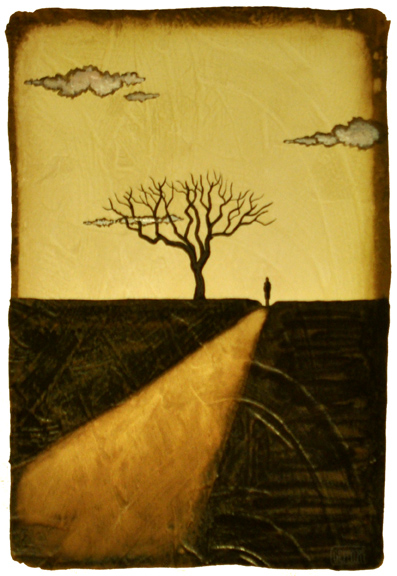
By the way, the triptych at the top is part of this show, part of the symphony.  It is a work on paper that frames out at 16″ by 34″.  There’s great warmth in this painting, a great sense of security for me.  But the title is still evading me at this time so if you have any suggestions, I would gladly listen.

Read Full Post »

I’m in the final days of painting for my upcoming show at the Principle Gallery in Alexandria.  I’ve titled this show Now and Then and it opens June 10th.  This past weekend really was extremely productive in the studio, with several pieces finally finished and the overall feel of the show taking  shape.  I had struggled for some time to find real definition for this show, that key factor that hopefully makes  each show distinct.  The past few days has me thinking that this show has found its distinction.

I think that it is defined by a fairly large group of works on paper such as the one shown above,Call to Waking.  This is an 11″ by 11″ image that is a mix of black inks and a sort of sepiatone that is actually a mix of many colors.  As I have described before, my process involves putting a lot of paint on the surface then pulling much of it off, soaking it up with brushes then squeezing them out.  In my old studio, I often found myself squeezing this paint on to the floor which left a huge blackish stain on the flooring there.  I try to be a bit more careful in my newer studio and have made a habit of collecting this paint, which often results in the creation of a color like the sepia of this piece. 

 There are a number of pieces in this show that have either this sepia or black/gray as the base color.  I have shown a few at a time in the past but this will be a substantial group and will provide an interesting juxtaposition between this work and my prototypical work. filled as it is with strong colors.  Seeing the two differing styles side by side in the studio has really shown this contrast.

Many of these pieces have bits of color in them, a faintly red tree or an orangish sun/moon  that pops from the gray/sepia background, but this piece is devoid of color.  I felt that the sepiatone had a warmth in itself and the contrast of the light breaking through the sky provided its own pop.  I felt that  any more color, say with  red roofs, would actually be a distraction here, altering the ample mood that has been created.  I think it works well as it is.

Well, although I could say more, I have work to get to.

Read Full Post »

I sometimes stumble upon things and don’t quite remember how or why I got to them in the first place.  Such is the case with this kind of neat photo that’s currently up for bid on eBay.  It’s a card promoting the 19th century circus strongman John Jennings, the Iron Jawed Man.  My jaw is sore just looking at this  and I finding myself wondering if it’s a real feat that he regularly performed in his act. 

I decided to try to find out a little more about this iron jawed man but there;s not a lot to be found with a quick search on the web.  The circus life of the the late 1800’s was not the most documented or stable aspects of the American landscape and I’m sure many of the performers and crews of these circuses were a little on the sketchy side.  I did however come across an interesting site, the Circus Historical Society, that has listings of circus people of that era, including one from a book titled Olympians of the Sawdust Circle.  This book had a short listing of Jennings alongside the likes of the The Albino Brothers, who were a gymnastic group,  and Admiral Dot,  aka the “California Dwarf”, and a slew of other intriguing figures.

Jennings lived from 1845 until his death in 1906.  It mentions that he was injured in a wreck of a circus train in Tyrone , PA and died in Harrisburg.  His last engagement was with Ringling Brothers.

I find this a curious world, this one filled with strongmen, trick horse riders and freaks that trekked all over our country back in the day.  I can only imagine some of the stories that could be told and I’m sure there are some that well beyond my imagination.  Most, I fear, are lost to memory.  But at least the Iron Jawed Man still is around, forever gripping that barrel with its two riders in the iron vice of his jaw.

Read Full Post »

Growing up, cigarette ads were commonplace in every form of advertising.   You couldn’t flip on the TV without seeing an ad for the smoothest, coolest smokes going at the time.  Camels were the cigarette of choice in our house, long before the coming of Joe Camel.  One uncle of mine smoked Lucky Strikes, another Newports although I might be confusing this one with a Parliament.  An aunt smoked Raleighs with their classy packages with an image of Sir Walter Raleigh and the coupons which she saved for years and years.

 I never knew why any of them made their specific choices, what might have spurred them to say that they felt that their Camel was superior to a Winston or a Kool.  It had to be the image they felt each brand projected rather than some difference in taste or quality.  So it’s always interesting to see early advertising to see how this perceived image came about.  The Marlboro Man is the classic example.  It was easy to see how one might identify with that image of the rugged individualist.  But the Camel? Or Sir Walter Raleigh?  What made them see themselves in that choice?

Maybe it was just a choice made on scientific data, as this ad from the earliest days of television points out.  To our slightly more wary eyes today this ad seems ridiculous but in the 50’s these outrageous claims made by the cigarette companies filled the airwaves.  In a curious way, I miss this blatant huckstering…

Read Full Post »

The Need for Solitude

The artist must actively cultivate
that state which most people avoid:
the state of being alone.
-James Baldwin

**********************

I spoke with a drawing class from a local college yesterday.  I always feel like I could have done a much better job with these things and yesterday was no different.  I left thinking that I hadn’t fully expressed fully all the advice or warnings I might have wanted to offer.  I had sped over the idea of taking a  mindset for their work that makes it apparent that they view their work as important.  The idea here is that if you don’t take your work seriously, how can you expect others to  do the same?  I don’t think I got that fully across.

The one thing I did stay on was the value and need for solitiude in their work, how they must embrace being alone with their thoughts and work in order to take their work to its fullest potential.  They should be honest with themselves and if they are uneasy about being and working alone, this is not a path they should follow.  I told them that the solitude was actually the big attraction for me and that, even as I spoke with them, I was wishing I was back in the studio.  Alone.

Creation is most often done in solitude.  There have been successful artistic collaborations through the years but they seldom have the impact and power of the singular voice and vision.  And this is most often forged in solitude.

Maybe I’m biased towards this idea because of my cultivated  affinity for being alone.  I don’t know nor do I really care.  As the glorious Garbo said, ” I just want to be alone.”


Read Full Post »

I’m off to talk with professor Dave Higgins’  drawing class this morning at a local coffeehouse, something I have done in the past.  It’s always a challenge speaking to students, much different than speaking to a gallery audience of people who somewhat know your work.  There’s a bit of a wall to knock down with some of the students and sometimes its not an easy thing to accomplish.  All I can hope is that I come out with at least one or two thoughts that might prove useful to some of these kids somewhere down the line, some little tidbit that they might hold on to for more than five minutes.

I will probably talk about the focus and choice I mentioned in a post last week.  Making a choice and giving a fully invested effort is essential, be it in art or some other field.  But it’s also important to recognize that this choice can be an evolving, changing thing.  Where they headed for may not be their final destination.  But if they make that first conscious decision to head in a single direction they will at least be on some sort of path forward, one of their own choice.

We’ll see.

Anyway, here’s a little musical interlude for this lovely Thursday morning.  It’s a video that mixes two of my favorite things, the singing of Neko Case and beautiful old film and photos of the last century.  I find myself always moved by this kind of imagery, as though it is exposing our commonality as a people, our interconnectedness with one another.  Whatever the case, it’s a beautiful song that meshes very well with the video here.  Enjoy.

Read Full Post »

A newer painting, this one an image of about 18″ by 26″ on paper.  The composition is intentionally simple in that  this piece is obviously very much centered on its color and texture.  The stringlike twirls of its texture create a real feel of motion and energy underneath the image, the hint of the hidden forces of nature  that exist just beyond our ability to recognize or comprehend them.  I don’t know if I would call these  purely physical forces or if they somehow become a spiritual force as well.  For this painting, let’s assume that they are both.

I see the Red Tree here as being enmeshed in both the visible world and in the world of these hidden forces.  While trying to find a way of describing this energy, these hidden forces of life, I came across the writings of Sri Aurobindo, anIndian philosopher/yogi who was very influential in the the first part of the last century.  Some of his writings describe the spiritual evolution of man into what he called the Supramental Being.  Here is how it is described in Wikipedia:

Sri Aurobindo’s vision of the future includes the appearance of what may be called a new species, the supramental being, a divine being which would be as different and superior to present humanity as humanity is to the animal. It would have a consciousness different in kind than the mind of the human, a different status and quality and functioning. Even the physical form of this being would be different, more luminous and flexible and adaptable, entirely conscious and harmonious. Between this supramental being and humanity, there would be transitional beings, who would be human in birth and form, but whose consciousness would approach that of the supramental being. These transitional beings would appear prior to that of the full supramental being, and would constitute an intermediate stage in the Earth’s evolution, through which the soul would pass in its growth towards its divine manifestation as the supramental being in the earth nature.

It is an interesting concept and one that I feel fits the imagery of this painting.  However,  I did think about how the concept was similar in nature to Nietzsche’s Superman  or Ubermensch  and the use of that idea by the Nazis,  how it could easily be diverted from its original meaning and twisted to rationalize behaviors far from the true nature of the concept.  It’s unfortunate that many ideas that are concerned  with the betterment of all people are often perversely used to divide and destroy people.  Here, I am thinking of this concept in the purest sense, of the elevation of the individual to a higher state of being, aware of and in harmony with all the forces of this world.

Or it’s just a tree blown by the wind…

Read Full Post »

« Newer Posts - Older Posts »