Feeds:
Posts
Comments

Archive for April, 2012

This a new painting that I am calling Pot Luck, a 10″ by 36″ piece on paper.  The pot part of the title is referring to the several pot lakes that surround the Red Tree, a slightly different way for me to represent water in my work.  But after using the term I began to think about how it might refer in a deeper sense to this scene and to our lives.  It now normally refers to a community meal where there is no specific menu and everyone brings a dish to share. It derived from the British Isles of centuries ago, when households might have only one pot in which to cook and a meal would often consist of whatever was available being thrown into the pot.  The resulting meal was called potluck.

 It’s this meaning that sparked my interest.  It made me think of how our lives are often very much like those potluck dinners where we make do with the ingredients at hand.  It may not always seem like the tastiest of dishes and we might sometimes cast an envious eye at those whose luck has blessed them with more ample pantries, wishing we were so fortunate.  But, hopefully in the end, we try to make the best of what is available to us and in the process become better chefs, making the most fulfilling  meals from the simple ingredients at hand. 

 I think that’s the takeaway here– to make the most of what we have in our lives.  To not bemoan that which we do not have but to instead celebrate and accentuate what we have.  We are what we are.  A simple stew can never be chateaubriand but, with care and attention,  can be tasty and quite satisfying in itself.  Maybe we should all give this same  proper care and attention to our own lives.

Meanings aside, the other thing that I really like in this piece are the way the clouds reflect the shape of the pot lakes, their elliptical silhoueettes making them look kind of flying-saucery in the sky.  It is an  afternote that doesn’t greatly alter the scene but adds a layer of depth to it.  An added layer of flavor to the stew, if you see it that way…


Read Full Post »

When you’re an artist, sometimes your work goes to distant places and is involved in interesting things of which  you may never know.  One such example is an event that took place at the US Embassy in Kathmandu in Nepal near the end of this past January.  It was an art gala, shown here in a photo, that was hosted by US Ambassador Scott DeLisi, which featured the works of Nepalese artists and the works of eight American artists that hang in the Embassy.  The idea was to promote the linking of cultures via the communicative powers of art.

As I had written  here in a post from last April, I had a piece, The Dark Blue Above,  that was chosen by Ambassador DeLisi to hang in the embassy as part of the US State Department’s Art in Embassies Program. It was one of the eight American pieces that were part of the evening.  I found out about this in an online article from The Kathmandu Post which covered the event. 

 I have to admit that I was a bit envious of  my painting that evening.  But, on the other hand,  I am so gratified that some piece of my work was involved in an event that was designed to bring people together and highlight our commonalities.  Too often we focus on our differences instead of realizing how alike and connected we truly are in our humanity.  One of my greatest hopes for my work is that it speaks across cultures, beyond language, race or nationality.  It’s difficult to  really know, as an artist, if this cross-cultural translation is accomplished in your own work but simply knowing that it is part of such an effort makes me feel hopeful that I am on the right track.

The Dark Blue Above- GC Myers

Read Full Post »

A young friend of mine posted this video online yesterday.  It’s a song that I haven’t heard in many years, Down in Mexico from The Coasters in 1956.  This was their first single and was a mild hit although ost people remember The Coasters for the string of hits that followed, all written , like Down in Mexico, by the legendary songwriting team of Lieber and Stoller.  Songs like Young Blood, Yakety Yak, Charlie Brown, Along Came Jones and Poison Ivy.  A virtual soundtrack for the young ears of the time and for a generation or so beyond. 

This made me think of my nephew and his wife who have been travelling in Mexico for last couple of months, climbing volcanos and surfing before heading further south.  I thought this would be a nice jolt to waken them and everyone else on a Sunday morning. Enjoy!

Read Full Post »

Feeling the Fish/ Redux

I had an interesting conversation at the opening a week or so back at the Kada Gallery in Erie. It was near the end of the night and John D’Angelo, the brother of Joe D’Angelo who owns the gallery along with wife Kathy, approached me. John is in his 80’s but it is not an old 80’s. He is vibrant and filled with energy. He is also a very talented man. After his retirement, John started carving full size carousel animals, copying the masters who crafted the beautiful creatures that adorned the merry-go-rounds of the late 1800’s and the early parts of the 1900’s. His beautiful beasts were the subject of a show at the gallery that drew huge crowds and raves.

We talked for a short while about the paintings then I asked him more about his carvings. He talked about how he just couldn’t sell them. Not because there was no demand. On the contrary, he described how many people were upset that he wouldn’t put a price on them, wouldn’t part with them at the show. He said he only gave them away to family members and held on to the rest. He talked about the joy of carving the animals and how, after he was done, he would run his hands over the large smooth carvings and be filled with wonder as to how he had done this. It seemed beyond him, more than he was capable of doing. He asked if I ever finsihed a painting then ran my hands over it with that same feeling.

I immediately knew the feeling he described. In fact, it brought back a memory of the piece shown above, Big Fish. It is a large wide painting that is over 60″ wide in its frame and now spends its days in a very prestigious office in DC. When it was still in my studio, I was part of a project for a book by photographer Barbara Hall Blumer where she would visit artists’ studios and chronicle them in their work environment. On the day she visited my old studio, which was infinitely more rustic than my current one, she had me show her around and talk about my process as she snapped away. At one point, I stood at one of my painting tables where this piece was resting, nearly complete. As we talked, I absentmindedly ran my hands over the surface of the heavily textured painting, feeling the coolness of the paint on my skin. Barbara noticed and commented as she took a shot of my hands on the painting, asking if that was something I did regularly.

I thought about it and said I guess I did.

Thinking about it now, I was indeed doing that very thing that John D’Angelo had described. I often look at my work after it is done and wonder where it came from, how something so graceful came from someone so often awkward. About how it seemed more than me, just as John had described. I needed to feel it if only to verify that it was real, that it indeed existed outside of my mind. It’s a strange feeling and one that I was pleased to share with John that night, comforted in knowing he knew that same feeling of surprise and wonder.

*************************

The post above ran originally in November of 2010.  I’ve been very busy lately and have been periodically running older posts that my favorites.

Read Full Post »

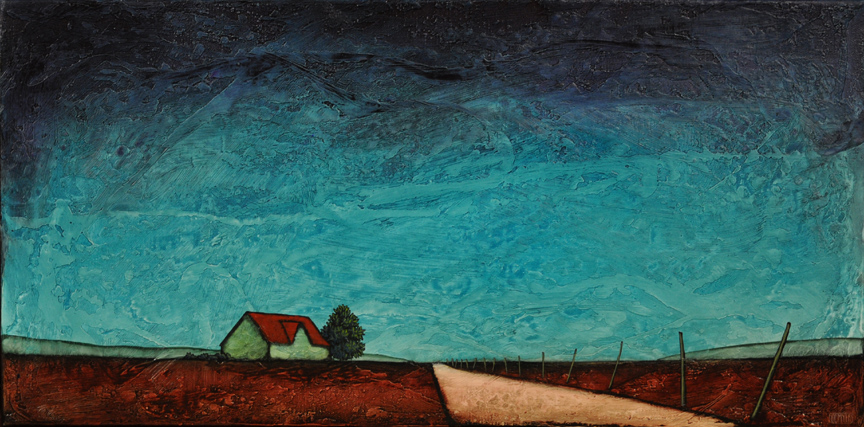
I’ve written here before about how I find the color blue an intoxicant.  When my nose is to the canvas and it is all that I can see, it has a way of making me feel that it is the only color in my world.  It’s a very satisfying and mollifying effect and, if I am not wary, I can find myself using blue tints to the exclusion of all others.  Because of this wariness, I try to only sporadically break out the blues.  But even with this watchful effort, I find the addictive pull of the color very strong in some pieces.  This new painting is such a case.

Called Blue Dance of Dawn, it’s a 10″ by 30″ canvas that employs two of my familiar icons, the Red Tree and the the Red Roofs.  They, however,  feel secondary to the predominance of the color blue here.  They serve as warmer counterpoints to the coolness of the blue and signify awakening  to me in this scene.  But the feel of this piece is dictated by the calm harmony of the blues.

I find this piece very placid with that  kind of satisfying effect that one sometimes has in the best dreams, that feeling of total understanding and acceptance of the universe.  That wonderful feeling that fades so quickly once you open your eyes and realize that it was only a dream, the details suddenly fuzzing over.  Maybe that’s what this painting represents– that idealized version of the world in those dreams just before we are awakened to the reality of the moment. That fleeting feeling of grace, seemingly within grasp then gone.

Let me think that over…


Read Full Post »

The man who insists upon seeing with perfect clearness before he decides, never decides. Accept life, and you must accept regret.

****************

One of the great things about the cyberworld is the ability to find the work, either in image or words, of those people that might easily go unnoticed in the past.  You can now come across a few words or images that intrigue  you and within moments have access to a world of information about the writer or artist.  Such was the case recently when I stumbled upon a few quotes from the writer of the words above and  shown in the portrait above, Henri-Frederic Amiel

Born in 1821, Amiel was a Swiss professor, poet and writer who died in 1881, leaving no major marks on the world before his death.  Although esteemed, his poetry was not celebrated and he made no major breakthroughs as a professor of moral philosophy in his time.  It was after his death that Amiel began to live on in the form of a personal journal that he kept from the 1840’s until the time of his death.  Called the Journal Intime, it is a wondeful inner exploration of the man, exposing a depth of thought apllied to universal truths.  His words, written over 150 years ago in many cases, seem as fresh and as true today as then, a fact that made the Journal Intime a timeless classic  in much the same manner as the essays of Ralph Waldo Emerson

However, despite its acclaim after it posthumous publishing, the book has faded from the modern consciousness  and may not grace the shelves of many libraries.  But thanks to the online world, it is a book that is now readily available to those wishing to read these thoughtful words.  It is available on most book sites and is available free at a number of sites including Project Gutenberg.

So many of the quotes that have been pulled from the Journal Intime ring true for today, including those that could be applied to subjects that are hotly debated in this country such as healthcare and taxation of the richest of us:

In health there is freedom. Health is the first of all liberties.
Sacrifice still exists everywhere, and everywhere the elect of each generation suffers for the salvation of the rest.

I was probably drawn to his words by two that said what I have said for some time.

The great artist is the simplifier.

Learn to… be what you are, and learn to resign with a good grace all that you are not.

The Journal itself is not an easy read.  It is a winding road through the life of one man and doesn’t always reveal its truths quickly.  So if you wish to quickly absorb some of Amiel’s aphorisms, I suggest checking out his pages at BrainyQuote or ThinkExist.

Good stuff…


Read Full Post »

A gem cannot be polished without friction, nor a man perfected without trials.

–Chinese Proverb

^^^^^^^^^^^^^^

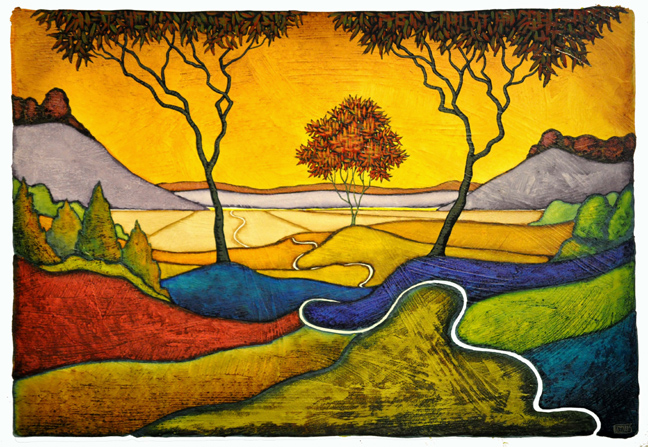
I call this new painting Gem.  It’s an 18″ by 26″ piece on paper.  The gem part came obviously from the deep and rich colors that run through and define  it.  It reminds me at first of a colorful bracelet or brooch dotted with bright gems.  Rubies and sapphires, emeralds and amethysts all set in a citrine yellow sky.  It definitely has a jewelry-like  appearance.  Bright and easy.  Almost a trifle.

But there seems to be a feeling in this piece that goes beyond the playful interplay of the surface colors, something that takes it far from being a trifle.  There is for me a feeling of self-realization in the central figure of the Red Tree, a sense of knowing and understanding one’s self.  It’s a sense that comes from knowing one’s strengths and weaknesses,  a realizing of all that one is and is not in an instant, a flash of insight.  And though it comes in as a sudden thought at a singular moment, it is formed through a lifetime of living, taking into account all successes and failures equally.  The trials that form  character, as the proverb above states.

Our lives are very much like a gem-studded bracelet, easy to see with all surfaces shining bright.  But the gems here have underwent eons of transformation through pressure and friction to reach that easy shine.  Maybe that’s what the white ribbon of the trail going through this painting signifies for me, a long and sometimes hard road to reach that final gemlike quality. 

Maybe.  All I really know is that this painting seems easy to take in at first but lingers on the way down.  And there is a great satisfaction in that discovery of something below the surface, an added depth that belies the shine of the gems.

Read Full Post »

Kinkade Dies

The death of Thomas Kinkade was announced yesterday.  The self=proclaimed  Painter of Light was only 54 and his death is attributed to natural causes with an autopsy upcoming to determine what actually caused his early demise. 

I am not really sure what to say here.  I was not a fan of his work but never really wanted to join those who openly jeered at his often saccharine paintings of thatched cottages with windows that looked like the inhabitants were reading by huge floodlights.  To rail against these paintings was to rail against those people who did connect with that sort of art, be it good or bad.  And that is not a good thing.

Art is a personal taste and can’t be dictated.  You like what you like.  And that is as it should be.

And, whether you liked Kinkade’s paintings or despised them, there were those who had a taste for them.  A great many of them.  His paintings obviously filled a niche.  He had legions of fans who bought his prints and paintings and books and mousepads and plates and figurines and on and on.  Even homes in communities based on his paintings.

Ubiquitous.

 To me, his gauzy paintings always reminded me of walking into our local Loblaw’s grocery store as a child where near the entrance they had inexpensive copies of  highly sentimental paintings, undistinguished for the most part,  printed on thick gray cardboard stapled into cheap wooden frames.  I believe that you could buy them for a few dollars with a certain amount of groceries purchased.  That was the artwork of my childhood, the sugary farmsteads and watery city street scenes that adorned seemingly every home I entered as a kid. 

 I had no judgment of them then but noticed them and their ubiquitity in my world.  They aroused no emotion in me.  Nothing.  I neither liked them nor disliked them.  They served a purpose for the folks who had them hanging on their walls and even the tritest piece of this work was preferable to not having anything on the walls of these lower middle- class homes.  When I think about Kinkade’s work, that is pretty much how it comes across to me– it arouses no emotion in me and I find myself having no feelings one way or the other.  It’s there to cover bare walls and that was okay to me.  His mass market approach to art, while a bit distasteful, didn’t offend me.  He was simply filling a niche.  He took a market that was once filled by my Loblaws supermarket and today is often littered with factory produced works  sold in starving artist sales in every Holiday Inn  across the country and made it his personal  kingdom.  He became the face and signature of mass produced work.

And that’s okay, for what it’s worth. 

Will it have lasting value to future generations?  Now that’s a different story.  It will, in the short run, over the next ten or twenty years, probably hold its appeal, and value,  for some people.  But as the next generations comes along, I have a feeling that Kinkade’s work will be little more than a footnote in the history of art.  It’s happened to the great mass artists of most every generation.  The popularity they held fades to anonymity over the generations.  I could be wrong here but I sincerely doubt it.

Unfortunately, I fear that the people who bought into Kinkade’s sales pitch and paid dearly for his mass produced pieces  thinking they would continue to grow in value will be forced to face this reality.  And that’s the distasteful part here.  Not the in the artistic merit of the work itself, but in the way it was marketed, manipulating people with Christian themes that never seemed to quite jibe with the reality of the artist’s life.  There is a marked lack of taste in this.

Oh, well.  I feel badly for the human tragedy of  his family’s loss.  There’s something sad in the premature death of anyone.  But I don’t feel the tragedy in not seeing what great works he might have someday produced.  His work is all here now.  For some, that is enough.  For others, too much.  For me, it’s just there, like those cardboard paintings at Loblaws.


Read Full Post »

Finding Joy/ Redux

I’m on the road today so I thought I would rerun a post and  painting from May of 2009:

Joy lies in the fight, in the attempt, in the suffering involved, not in the victory itself.

Mahatma Gandhi

How do you define joy? Is there such a thing as joy that is the same for every person or is finding joy strictly a personal preference? Are there people who live without any joy at all in their lives or are there moments in everyone’s lives where they experience something close to joy? Maybe it’s not a giddy kind of joy. Maybe joy for some is a feeling of contentment, an absence of fear, an absence of pain.

Maybe that’s it. Maybe joy is finding that which takes away our fears and pains.

I don’t know. I know that it doesn’t have to be sought. It’s just there or it’s not. For me, it might be as simple as laying in the grass and having my dog come over and lay against my chest. It might be in sipping a cup of tea or watching the deer graze laconically in the yard. It might be in laughing out loud at something I’ve seen a hundred times yet still find funny or in making my wife laugh. It can seem so simple yet I see people who seem joyless and I wonder where their joy might be.

Certainly, they must have something which brings them something akin to joy. At least contentment. But maybe it’s not for me to see or maybe they live a joyless existence. Who knows? Just something I wonder about on a sunny morning when the sun filtering through the trees, scattering patches of light on the thick grass beneath them, brings me joy.

By the way, the painting above is a new one, The Coming Together, that is part of the Principle Gallery show in June (2009). It features the entwined trees I sometimes use as well as the field rows. I really like the feel of this piece and love the texture and color in the surface.

Makes me happy.

Gives me joy…

Read Full Post »

I have a real soft spot in my heart for self-taught and outsider artists, the untrained artists who are driven to create by forces that no one truly understands.  There is something about their passionate need for expression that really fills in the voids of the work they do,  making their sometimes unsophisticated creations sing as a reflection of the artist.  Many of these artists have interesting stories or lives that have been overtaken by their need to create their work.  One of these is the late Lee Godie.

Godie (1908-1994) showed up on the steps of the of the Art Institute of Chicago in the late 60’s and for the better part of the next three decades was a fixture there, hawking her rolled canvas paintings to museum-goers and art students.  Her work was often made in ballpoint pen and watercolor and depicted mainly figurative work, often fashionably attired people in a style resembling fashion plates.  Over the years,  her work and her persona became almost legendary in the Chicago area and there was a career retrospective of her work at the Chicago Cultural Center in 1992,  just two years before her death.

I mentioned her persona, which may have been the biggest part of her work. While little is known of her life before her years as an itinerant artist on the steps of the museum, she was a big personality.  Although not French and with work that was not of the Impressionist school of art, she called herself a French Impressionist and often attached the title to her name on the back of the canvases she painted.  It was actually a nod to the inspiration she got from the Imprssionist paintings she saw in the museum.  As she said of her favorite artist , “Renoir was the greatest artist of all time. He always said he painted beauty. Now I always try to paint beauty, but some people say my paintings aren’t beautiful. Well, I have a beauty in my mind, but it isn’t always easy to make paintings beautiful.”  

Like many Outsiders, Godie lived a hard and homeless life, often sleeping in the bus terminal or, when sales were good, in flophouses.  But it didn’t deter her search for beauty.  One of the interesting things she did was to take advantage of the bus terminal photobooth, taking a series of photos over the years of her in different personas, often in heavy stage makeup.  She would often touch-up these photos with the colors with which she painted, creating photos that in themselves are as much works of art as her paintings.

I didn’t know much about Lee Godie before stumbling across her work but there is something quite special in her work, a childishly naive yet full view of her world that reaches out beyond the surface.  Knowing a bit more of her story makes that sensation even more profound.

Read Full Post »

« Newer Posts - Older Posts »