Feeds:
Posts
Comments

Archive for July, 2012

I check one of my favorite sites, Luminous Lint, periodically to see what is new .  It’s a treasure trove of great and historical photography and there is always something interesting in the new images that are seemingly added daily.

The photo shown here immediately caught my eye and made me chuckle.  It’s titled Portrait of Henri Groulx and a Rooster and is from a Parisian photo studio from around 1920.  In these all so politically correct times, it’s kind of refreshing to see this French kid with his cigarette dangling.  That world-weary look on his face and the confidence  of his stance as he sits with legs crossed say that he’s six years old and he’s seen it all.  Probably waiting for the next cockfight with his superchicken.

Another interesting photo is this one from 1847 taken by Boston area photographers Southworth and Hawes.  It documents an operation at Massachusetts General that features one of the earliest uses of ether as an anesthetic.  I’m not sure if the man credited with introducing ether as an anesthetic, William T.G. Morton, is in this photo but he was known to have demonstrated ether in this use in the Boston area at that time.  I just find this photo a remarkable historical image which makes me really appreciate modern medicine, especially modern anesthesia.

With that in mind, I must get to work.  My health insurance won’t pay for itself…
Read Full Post »

Of all our possessions, wisdom alone is immortal.

–Isocrates

***********************

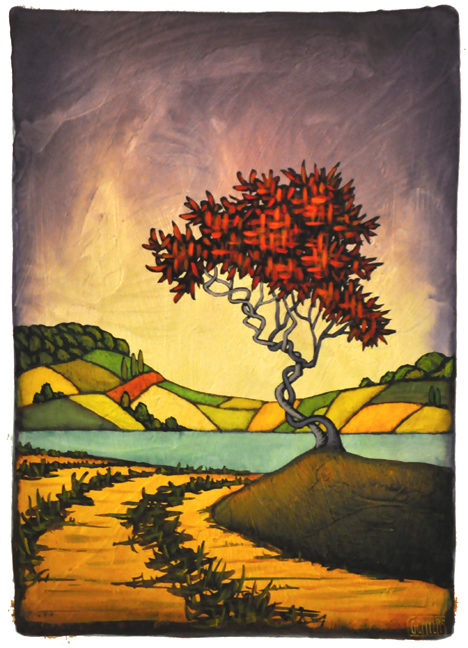
This is another new painting from my upcoming show, In Rhythm, at the West End Gallery that opens this coming Friday.  Titled All We Have, this 8″ by 12 ” painting on paper has numerous meanings for me,  mainly focusing on the only things we ever  truly possess — our love, wisdom, memory and the precious time we have on this earth.  I could easily give up all of my personal possessions but to lose any of these other things would stagger me  much more greatly as they are the things that give my life meaning and worth.

I see this represented in this painting, from the obvious symbolism of the intertwined trees for love to the field rows which act here as a symbol for the passing of time .  Even the colors of the sky have meaning in this piece for me, the purplish hues having a weightiness that reminds me of thought and wisdom.  Or. at least, what I take to be wisdom.

I’m not sure I’m really qualified to identify wisdom at this point.  Maybe some day.

But I do like this piece and what I see in it.  Perhaps, like the wisdom I desire, it is an aspiration for the only possessions that are truly worth the work…

Read Full Post »

Early Sunday morning.  The West End Gallery show is delivered and with the studio feeling almost empty now, I take a small breath of relief.  Outside, it’s dark and shadowy as a soft rain falls, bringing the parched earth that same breath of relief.  Kind of a hazy, unfocused morning.  I think I’ll take this time to relax just a bit before plunging back into the  new work that waits for me.

For a gray morning, here’s a song, Hey Joe,  that is best known for the version done by the inimitable Jimi Hendrix.  I thought I would try to take the morning in a brighter direction so I’ll show it as done in a more upbeat  bluegrassy fashion by Tim O’Brien.  He has a way of  giving songs a different twist that I find appealing.  His version of Bob Dylan’s  Subterranean Homesick Blues is a great example with it’s mandolin and hambone handslaps.  On Hey Joe, O’Brien is joined by Jerry Douglas, the  master of the dobro.  Together, they make a dark song seem less ominous.

Good way to start a dark Sunday.

Read Full Post »

I have completed my show, In Rhythm, for the West End Gallery and will deliver it today in advance of the opening next Friday.  While it’s a big relief to finish a show and have it in the gallery, there is always a pang of loss in seeing works that mean a lot to me personally move out into the wider world.  Some are paintings that resonated with me immediately, almost from the first lick of paint hit the surface.  Those are the instinctual, native pieces that just emerge without a struggle and seem to have their own perfectly natural rhythm.

Others are paintings that show their meaning long after they are completed  Such is this painting shown here, Ribbon and Memory, a 12″ by 16″ piece on paper.  When I was done with this and was searching for a title I wondered what it might mean.  It still seemed to be a mystery even though I liked it very much without knowing its meaning.

I knew that the Red Chair often represents memory for me so I felt that the title would have something to do with memory.  And the path that runs through the foreground seemed more like a ribbon than an actual road so I immediately tied the two words together for the title.  Done. Enough said.

But early this morning I looked again at this piece and I more fully saw a meaning in it for myself, one still rooted in the title words but with more depth.  I have a friend whose wife has early-onset Alzheimer’s and it has turned their lives upside down as they try to cope with the changes and stresses that it brings.  Their struggles are in my thoughts quite often.  So when I saw this painting this morning it suddenly seemed plainly obvious to me that this could represent their situation.  The Red Chair is the wife, the Red Tree is the husband and the Red Roofed House is early memory of home and family.  The path, the ribbon, is that remaining memory that still tenuously connects her with this past that has began to recede into the distance.

The Red Tree, the husband shown here in a heroic stance, is apart from her and everything else, alone in his struggle to stay connected with that ribbon and to oversee her welfare.  The Red Chair, the wife, is also alone, facing  a solo journey forward with little connection to her past, separated here by the water.

I have to reiterate that this is my personal meaning that I see in this piece.  You may see it in a completely different way with your own personal meaning.  As it should be.  But for me, seeing this painting this morning with this new perspective made it seem  deeper and more precious than just a day earlier.  One that gives that pang of loss that I spoke of above.

Read Full Post »

I have painted several pieces over the past few years based on the mythic tale of Baucis and Philemon, taken from the Metamorphoses from the Roman poet Ovid.  I have described the story here several times of the visit  to a village by Zeus and Mercury, disguised as beggars.  They are roughly tuned away from every door in the village until they come to the home of the poor elderly couple, Baucis and Philemon, where they are welcomed with warmth and gracious hospitality despite the  poverty of their household.  Sparing the couple as he destroys the village in his wrath, Zeus then grants them any wish they might desire.

They choose to be allowed to stay together for eternity.  When they pass away simultaneously years later, they are resurrected as two separate trees that grow from the same trunk, united forever.  It’s a lovely fable and one of my favorites.  I have always chose to depict this story simply, with two trees, one red and one green, intertwined together.

I call  this painted version The Gift of Zeus.  It is a n 18″ by 18″ canvas that is headed to the West End Gallery for my annual solo show there which opens next Friday, July 20.  There’s a crispness in this piece that I find very appealing as well as interesting contrasts and subtleties in the sky, which may not show up well in the photo here, that give this piece a dramatic edge that catches my eye each time I pass by it in the studio.

Read Full Post »

I call this new painting Viva!   It’s a 24″ by 24″ canvas that is part of my upcoming exhibition, In Rhythm, which opens on July 20  at the West End Gallery in Corning.  In Spanish, Viva! is Long Live! or simply Live!  Both definitions fit this piece well, especially when used in exclamation.  This is a piece that exclaims.

Not a piece for the timid.

It has a glowing presence in the studio as though it is alive, the vibrant reds and oranges seeming to have their own pulse.  There is a great intensity in the colors here, a quality that can sometimes get out of hand quickly.  But the harmony between the color intensities in this piece really holds it together and gives it a placid quality that belies the strength and heat of the colors.

The way I see this painting is that the Red Tree is reaching upward from its perch, connecting with the energy contained in that  sky, as though there is source of power, both physical and spiritual at once, swirling overhead.  It has a feeling of the joy in simply being alive in the now, as though  this single moment contains all eternity- past, present and future.  A celebration.  Fiesta.

Viva!

Read Full Post »

I thought I had mentioned the work of photographer Paul Strand here before but can’t seem to locate it.   Strand lived from 1890 until 1976 and was part of the Modernist era of the early 2oth century, using his camera to capture the urban landscape’s abstracted forms in a way that no photographer had to that time.  The image shown here, Wall Street, is perhaps one of his most famous.

His portraiture is also quite striking.  Doing a Google image search, the page is immediately filled with multiple fairly closely cropped images of  faces in black and white.  They’re shot in a way that might make you think it would be difficult to discern any particular photographer’s eye but seeing them altogether shows clearly how he saw his subjects and show the continuity in his work.  Strand was a student of the great Lewis Hine and carried on Hine’s use of the camera as a tool for social reform.  His photos of the inhabitants of the city streets are powerful and gritty.

One of his projects was a film, Manhatta,  with the great Modernist painter/photographer Charles Sheeler, another of my favorites.  It is a really interesting view of the bustling, swelling city from 1921 taken from Strand’s and Sheeler’s unique perspectives.  Just great imagery.

Read Full Post »

This is another new painting that is headed to the West End Gallery for my annual show which opens in a couple of weeks, on July 20.  I call this piece, a 24″ by 36″ canvas, Out of the Loop, a title that seems to fit this piece quite naturally.  Fits me, as well.  I’ve always felt a bit of the outsider,  sometimes despite my own desires but most often by my own choice.  Maybe it’s like Groucho Marx explained when he resigned from the Friars Club:  “I do not care to belong to a club that accepts people like me as members.”   Or maybe it’s a personal view that being in the loop sometimes feels a bit restraining, in the way a noose  restrains you from breathing.

In this painting, the houses with the Red Roofs really take on a sense of anonymity with their doorless and windowless sides giving them the feeling of faces without eyes or mouths.  They seem completely alien to the patterned  fields which rings them as well as to the Red Tree which stands just outside on the crest of the hill. Or the edge of the world, depending on how one views this.

I’m making this painting sound darker in nature than it actually seems to me.  I think it’s a very upbeat and hopeful painting, a celebration of the individual.  The sunlight breaking over the horizon is filled with the optimism of the future and the color and rhythm of the fields are like the petals of a flower with the houses of the inner loop as the centerpoint.

As you can see, I see this  piece in many different ways, which I like.  It’s always nice to have a piece give you something different with each view.  Hopefully, others will see it in this way as well.

Read Full Post »

It’s fitting that on this American holiday that we mark the passing of an actor who represented an idealized slice of Americana.  Andy Griffith, who died yesterday at the age of 86, was best known for his portrayal of Sheriff Andy Taylor on The Andy Griffith Show.  On the show he and his deputy, the immortally funny Barney Fife, prowled the mean streets of Mayberry, a gentle North Carolina that has come to symbolize  America’s rural past for many.  Andy administered an equally gentle brand of justice with folksy common sense  and patience.  Of course, no real town could live up to the idyllic nature of Mayberry where everyone got along and even Otis the town drunk was lovably comic but it didn’t matter.  It was a lovely comic fantasy that was easy to buy into.

I know that I did.  I can still watch the show and laugh out loud or be touched when Andy straightens out Opie with a folksy moral tale.  A pure slice of goodness.

The flipside of that goodness was exhibited in Griffith’s performance in the 1957 film from Elia Kazan, A Face in the Crowd.  It’s a dark satire that chronicles the rise of Griffith’s character Lonesome Rhodes from drifting drunkard to a national media star  with great influence over public opinion that he wields in a cynical fashion.  Lonesome Rhodes is a classic film character, a larger than life personality that is a little over the top  with a veneer of charm and charisma that hides a truly nasty inner core.  He’s a far cry from anyone ever seen in Mayberry.   A Face in the Crowd is a great, great film that still rings true today.  I periodically hear rumors of people wanting to remake it today and I always hope that they let it be as it is.  I don’t think you could have a better Lonesome Rhodes than Andy Griffith.

Have a great 4th of July.  Here’s a taste of Lonesome Rhodes:

Read Full Post »

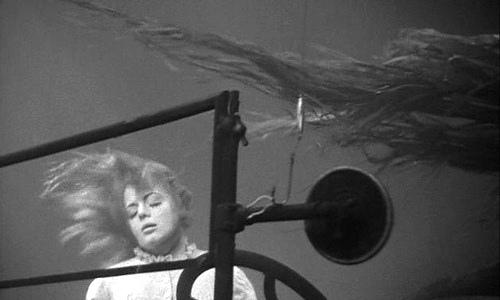
One of my favorite actors is the late Charles Laughton, the portly Englishman who is perhaps most famous for his portrayal of Captain Bligh in Mutiny on the Bounty from 1935.  His looks were not like those of a typical leading man but he was able to overcome this with his sheer acting abilities and a screen presence that enhanced everything in which he was cast.  He could pay both despicable villain or the comic hero with ease.  But one of his most amazing performances for me was that of  the director of the movie The Night of the Hunter from 1955.

His first attempt at directing for the big screen, the film  was a flop at the box office and was panned by critics causing Laughton to forever give up directing.  But over the years the film has grown in stature and Laughton’s beautiful treatment of the creepy tale has garnered accolades, making me wonder what other great films he might have made if he has found greater initial success with The Night of the Hunter.

I am really drawn to his use of stark black and white imagery, using the contrasts to really accentuate the struggle within the tale between good and evil.  Robert Mitchum’s evil preacher, Harry Powell, with tattoos reading LOVE and HATE on his knuckles is contrasted with the delicate strength of Lillian Gish’s character.  It seems as though every scene is composed like a beautiful black and white painting. with imagery that reinforces the tension of the tale.    Just a wonderful film to look at.

TCM is showing The Night of the Hunter on July 5 at 10 PM.

Here’s a great scene with Mitchum and Gish.

Read Full Post »

« Newer Posts - Older Posts »