Feeds:
Posts
Comments

Archive for April, 2013

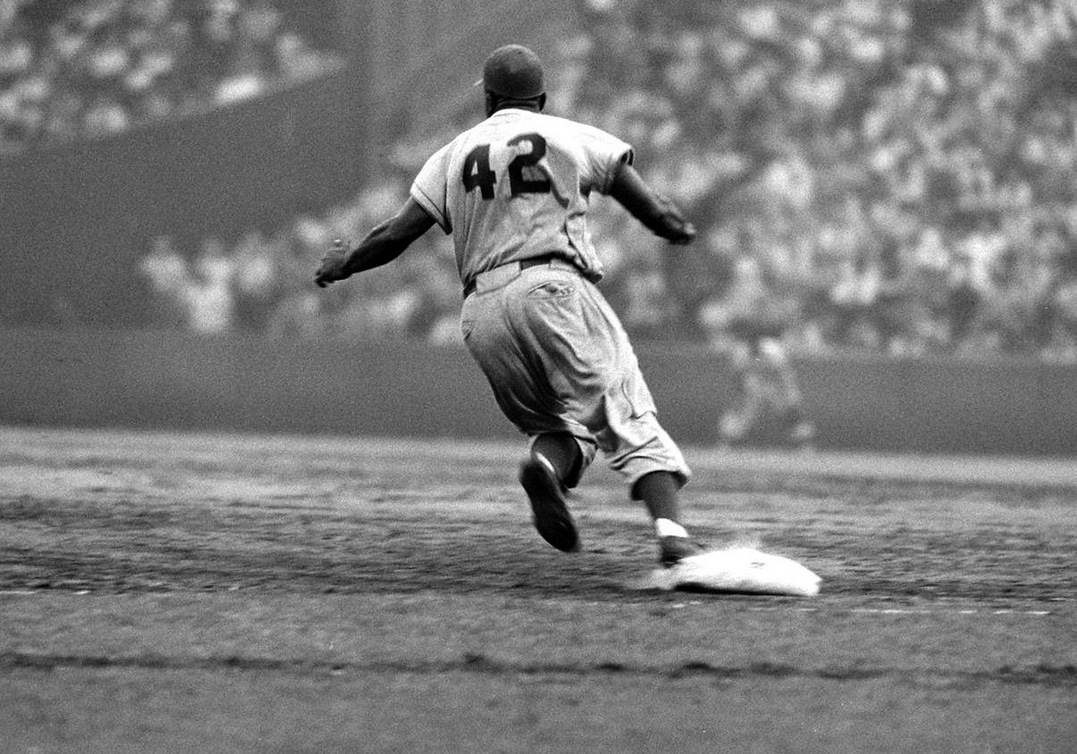
jackie-robinson-1956_April 15 means a couple of things to some people.  Of course, there is the unpleasant connotation of it as being Tax Day, the due date for income tax filing here in the USA.  But for the baseball fan, it is a date that marks the first day a black player took the field as a major leaguer, when a special player ran out to play first base for the Brooklyn Dodgers back in 1947.   This young black man was athletically gifted, smart and tough-minded.

That player was of course Jackie Robinson.

Major League Baseball now honors him on this day every year, Jackie Robinson Day, with every player on every team putting aside their own uniform numbers to wear his number 42, which is now retired throughout baseball. Currently, only Mariano Rivera wears the number 42 on his back  and after he retires at the end of this season, no player will ever wear the 42 on their back again outside of this day each year.

Retiring a number is a sacred thing in baseball.  A player’s number has an almost mystical connection with the fans.  Growing up, everyone knew that Babe Ruth was 3,  Lou Gehrig 4, Mickey Mantle 7, Willie Mays 24, Hank Aaron 44 and on an on.  Whenever I see the number 45 all I see is my hero Bob Gibson on the mound. And everyone , even Mariano Rivera fans like myself, knows that the 42 belongs to Jackie Robinson.

There is also a new movie out that bears that number and it tells the story of Robinson’s initial turbulent year with the Dodgers.  I haven’t seen it so I can’t really comment other than to say that it is a story that every child should know.  It is a remarkable story of self restraint and strength in the face of institutionalized hatred, one that made possible the  broader changes that took place in our country in the civil rights movement in the decades after Robinson’s first day on that field in 1947.

From what I have read, the biggest complaint is that the movie doesn’t really give a full accounting of Robinson’s life. Jackie was a legendary collegiate athlete at UCLA, lettering in four sports– football, basketball, track and baseball.  He was the NCAA champion in the Long Jump and could have easily played professional football.  Of course, that was impossible because  the NFL was segregated at that time as well.

Nor does it detail his military career which is of interest mainly for Robinson being court martialed for refusing to sit in the back of an Army bus at Ft. Hood, Texas.   He was eventually acquitted of all charges by an all-white panel of officers  but it was an incident that foretold of his strength and willingness to enter the fight in taking on the segregated major leagues.

Nor does it address the health problems that led to his early death.  He suffered from diabetes and was nearly blind when he had a heart attack that ended his life at the age of 53.  It was much too early for this remarkable man’s story to end.

As I said, it’s a story that every child should know and celebrate.

Read Full Post »

GC Myers 2013“A painter should begin every canvas with a wash of black, because all things in nature are dark except where exposed by the light.”   

-Leonardo Da Vinci


***********************

I’ve been working on a number of pieces lately that start on a black base of paint, rising from the darkness as each subsequent layer adds more and more light.  I still think of this additive  process as being a form of sculpture, one that starts with a flat surface and builds out in contours that give it definition and texture.  Each layer of paint is like adding clay to the supporting armature of the sculpture.  It’s a process that is hard to pull away from when I immerse myself in it. There’s something about seeing the colors grow more and more vibrant on the surface that becomes mesmerizing.  I guess that’s why I often refer to this work as obsessionism.

This small experiment, a 10″ by 12″ piece on paper,  is in this vein.   It’s one of those pieces that I’m just not sure about because I like it but I’m not sure if I like it for what it is or for the experience, the obsession of the moment in painting it.  Like a parent looking at something their child has done and wondering if they like it because it is truly good or simply because it was done by their child, their flesh and blood.  

Sometimes I can finish a piece and it instantly stands apart and on its own, complete and independent.  Ready to move on like a young person proclaiming their emancipation from their parents.   Other times, there are pieces that cling closer to me, perhaps too attached to yet  stand on their own, at least in my eyes.  Because I am unsure, I become more protective of these pieces because they do feel more personal, more of me.  

It’s a hard thing to describe, this uncertainty in a piece, especially when it feels objectively right.  Can a parent ever fully take out their own subjective view of their offspring and see them objectively as they really are?

Read Full Post »

GC Myers- Old Studio 2007I came across this photo of the path leading up to my old studio that sits in the woods above our home.  It served me well for a decade but now sits idle, patiently waiting for Mother Nature to reclaim it as her own.  When I think of that space, I always think first of its coldness in the winter when the wood pellet stove would not quite keep it comfortably warm, my breath coming out in visible mists at times.  But I also also think of the walk from the studio to the house, how the path became ingrained, so much so that walking down the hill in the deepest darkness was no problem at all.  Each step, each footfall just fell into place.

It reminds me of an entry I made here about four years back that talked about this path, one called Setting a Path:

For ten years I walked up the road through the woods to my old studio.  It was a logging road from the two or so times the forest had been harvested over several decades and ran along a run-off creek that dries up most summers.  There were two visible tracks from the tires of vehicles that had climbed the gentle rise over the years and as the years passed, another track formed between them from my own footsteps.

This was the path I walked several times a day, up and down the hill.  At first I thought nothing of it.  It was simply a path.  But over the years I began to notice things about it. I could walk the path in the absolute black of night with no problem, each step falling in a natural way directly to this path.   If I tried to walk off the path it seemed unnatural and required a degree of attention to my stride so I wouldn’t stumble.

I came to realize that my trail was the path of least resistance.  It was the path that carried me with the least effort.  Each step fell naturally in place, accounting for the slightest change in the topography and had the same effect as water flowing down a creek.

I began to notice that the trails formed by deer and other animals were  the same.  When I followed them, they would move slightly in one direction or the other, just when your stride wanted to shift naturally and simply from gravity.  There was the same sense of rightness I talk about in my painting.  They never veer drastically, always in smooth, subtle curves.  They would always  run along the grade as though were the elevation lines on a topographical map.  Following them required little effort or thought.

Going off the path was a different matter.  It took thought, concentration and effort.  There were new obstacles to overcome.  Branches that crossed the path, blocking your view ahead and slapped the side of your head.  Downed trees that had to be climbed over.  Roots that rose through the dirt and tripped you.  It was real work.

I guess herein lies the point.  If I wanted to go where others had went before me, I could follow their trail. This would be the simple and logical way.  But if I wanted to go to a different place, one that was fresher and less visited, I might have to set my own path.  It wouldn’t be easy.  It would require more effort, more thought and the risk of not finding my way.  But if I forged ahead and found my way, there would be a new, hard won  discovery and the sense of accomplishment that comes with it.

I could blather on a little more but I think my little lesson learned from the land (nice alliteration, eh?) has come to an end.  We all choose our paths.  Some take the easier trail.  Some blaze new trails.  And some go into the woods and never come out…

Read Full Post »

Guiding Lights

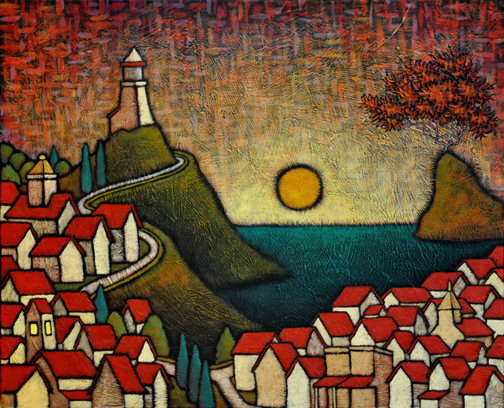
GC Myers- Guiding Lights This is a new painting, a 20″ by 24″ canvas, that I call Guiding Lights.  I showed the image yesterday on my Facebook page but didn’t have a chance to write much about it.  The title come from the the triangulated trio of elements that dominate this piece’s center– the lighthouse, the sun and the Red Tree.  Each represents the forms of guidance available to us as we navigate through life.

The lighthouse symbolizes how others move us along.  Mentors, teachers, family and friends who try to shed light on our path so that we may stay safe and  keep us from the dangers that lie ahead.

The sun represents the spiritual here, the guidance that many seek from their belief in a greater, omnipresent power.

The Red Tree in this painting  is a symbol for the instinctual, inborn guidance that we all possess to some degree.  It is our conscience, our intuition, our moral compass– each weighing our every move forward.

There is a path that tees near the bottom of this scene, in one direction heading right back into the greater mass of  red-roofed houses and the other heading out path edge of the houses where it becomes less crowded.  The path is isolated with only the guides I mentioned above  along for the journey.  This reminds me of something that I read a while ago, although I can’t exactly remember where it was or who wrote it at this early hour.  It was someone writing specifically about artists although I feel it applies to any endeavor.

The author wrote that in the development of an artist there comes a point where in order to reach their fullest potential, to find that singular voice, an artist has to be brave enough to move beyond their friends and peers.  They must leave them behind and move on alone.  It’s a vital step but a difficult one that most are not willing to take, if they ever even realize there is a choice to be made.

I think that’s what I see in this piece– the  journey for a personal vision and growth.

Read Full Post »

Out of Bounds with Tish PearlmanJust a quick reminder that the public  radio interview that I did back in February is now available  and permanently archived online at the Out of Bounds website.  It’s a  conversation with the host of the show, Tish Pearlman, who expertly and gently guides me through a half-hour concerning the beginnings of my career and the evolution of my work.   It’s a good introduction to those who are interested and have never been able to make it to one of my gallery talks.  If you have been to a gallery talk, you may recognize some of the  stories and anecdotes from this interview.

Either way, it’s there for you to access.  Hopefully, there’s something in there for you to enjoy.

Read Full Post »

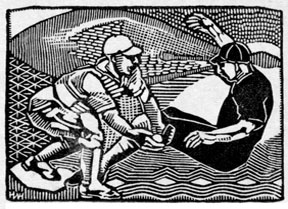
Baseball  Helen West HellerI was looking for woodcuts that had baseball in them and came across a couple that were by an artist with which I was not familiar, Helen West Heller.  I liked the design and look of the pieces that I had found, more modern and stylized than the others.  Unique.  I began to look up the artist, who lived from 1872 to 1955,  but found little.  No Wikipedia page and a few scant biographies that mainly listed her exhibits and the collections in which her work – both woodcuts and paintings-  was included.

Baseball2 Helen West HellerAnd it was a pretty impressive resume.  A retrospective at the Smithsonian.  Awards from the Library of Congress. Shows at the Brooklyn Museum and other galleries around the country.  Looking at the Metropolitan Museum website, I found that she had over 170 pieces in their permanent collection.  Why wasn’t there more on her?

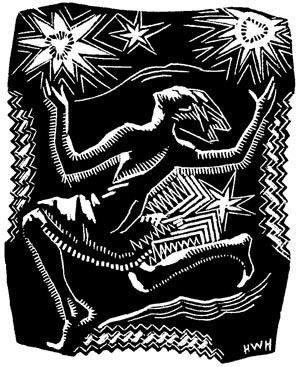
HellerBut then I came across a site devoted to her life and work, The Extraordinary Life and Art of Helen West Heller.  It’s a rambling website full of references and writings devoted to Heller but even as Heller’s most ardent fan and champion, Dr. Ernest Harms, wrote in 1957, just two years after her death: “Helen West Heller has lived the life of a full blooded personality striving and fighting for an artistic ideal . . . Far too little is known even among artists about this amazing woman.”

The tragedy is that when she did die, she did so alone and as a pauper in  Bellevue in NYC.  Her body remained in the morgue there for over 10 days until Artists Equity arranged for burial in NJ.  There’s a lot more on her in the rambling site devoted to her, much of it quite interesting but never completely revealing.  She lived at a time when there was still room for mystery and mythology in one’s life.  Perhaps that mystery, as well as the personality of her work,  is what makes her  so intriguing to me.

Heller-HoovesBig


Read Full Post »

genghis khan Chinggis Khaan statue horse equestrian mongolia 6I came across this photo of the Genghis Khan memorial in Mongolia, about 30 miles outside the capital city of  Ulan Bator.  I’ve always been a sucker for statues of epic proportion and I had never heard of this particular one.  It’s a pretty amazing  image, with Genghis astride his sturdy horse atop a museum,  and one can only wonder how it must appear in person in the vast open air of that Mongolian space.

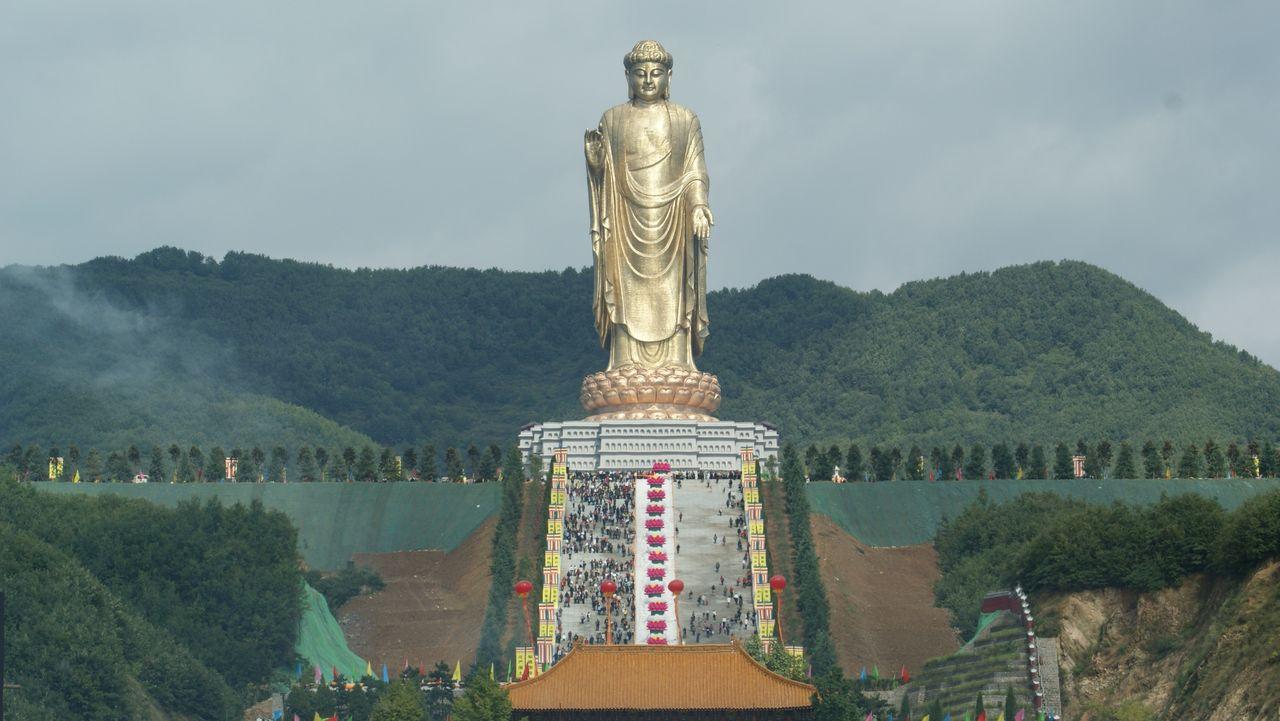
I always am inspired when I see memorials such as this Genghis Khan statue.  It makes me want to work on something epic in size or at least push the spirit of my  work even harder forward, to think in a bigger way.  Grander in thought.  Perhaps that is the purpose of such memorials, to expand our horizons and broaden our vision.  I know that when I think of some of the other monuments of this proportion, such as the  World War II war memorial featuring a sword-wielding Mother Russia near Stalingrad or the Spring Temple Buddha in China (both shown  below),   that is the feeling that comes to mind.  They push me beyond the smallness of  my inner self where  I often allow myself to retreat in my work.  And that is exciting.

So, thanks for the inspiration, Genghis Khan.  And you too, Mother Russia and Buddha.  I’ll try to be a bigger person.

Stalingrad War Memorial Spring Temple Buddha

Read Full Post »

Martin Johnson Heade Approaching Thunderstorm 1I don’t think I’ve ever mentioned Martin Johnson Heade here.  This is really an oversight on my part as some of his work was really influential on the direction of my work early on, even though our styles and methods of painting were wildly different.  The intensity of the color and contrast in his paintings of  floral subjects and tropical birds that he completed during his long and  prolific career ( born 1819- died 1904)  really made me want to push my own color ahead.  There is a , Martin Johnson Heade- The Complete Works, that has his complete works online where you can see the great quality of his color and  use of contrast.

But the painting shown at the top, Approaching Thunderstorm, from the Metropolitan Museum is my favorite Heade painting.  The forms of the  black water of the lake set against the vibrant color of the shoreline is striking and  a most ominous storm cloud churns toward the boaters who have not yet fully heeded the signs of the oncoming storm.

It was painted in 1859, in the years before our country exploded in civil war.  This painting was part of a cultural movement of the time that depicted the tension gripping our nation in metaphorical terms.    The metaphor is strong and obvious  in this painting and  several prominent abolitionist preachers owned versions of this painting , many often referring to the coming storm in their sermons.

Knowing this makes me appreciate the painting on a different level.  But it is still about the sheer emotional impact of the color and forms that hit me long before I knew its history.  There is a tension and that feeling of stillness that occurs in the moment just before action occurs, something I have tried to capture in my own work at times.  I still find this piece brilliant and inspiring.

Read Full Post »

GC Myers- Geometry of the HeartIt was Opening Day for Major League Baseball the other day, which is always  a red letter day for me.  It’s sort of like 2013 has officially began, that my day to day life now has something with which to synchronize, something to fall in rhythm with.  So, even though I have been feeling under the weather for several days,  I was able to complete a new piece, one that had been banging around in my head for a long time.  It incorporated the perfect geometry of the baseball diamond nestled among a tightly clustered neighborhood of Red Roofs.  It’s an odd piece, one that feels both typical and atypical at once.  That’s a quality that I like.

ralph_fasanella_sandlot_baseball_1373_356I have been wanting to incorporate the baseball diamond into one of my landscapes, perhaps influenced by some of the folk art paintings that did it so well.  I have featured some of these here, such as Malcah Zeldis’ Homage to Hank Greenberg, shown at the bottom of this page or Ralph Fasanella’s Sandlot Baseball,  shown here on the left.  These are paintings I like very much as much for the baseball aspect as for the wonderful folk art manner in which they are painted.  There is something in the sight of a diamond that has a hypnotic effect on me, something I hoped to capture in a painting.

I always remember the feeling when I was a kid and we went to Shea Stadium to see the Mets play, especially for night games.  You would head out from the dim light of the concourse and emerge into the brightness of the field lights.  The green of the field was so vibrant, the brownish red of the infield dirt so rich.  There was something perfect in looking down on that diamond, a design that made so much sense to a child’s mind.  A beautiful geometry, one that equalizes weaknesses and strengths.  The length of the basepaths, for example, are such that  on a hard hit  ball to the infield a fast runner can be easily thrown out at first but a slower runner can often beat out a soft groundball.

Here, a small man could easily conquer a much larger man from a distance of 60′ 6 “, the distance from homeplate to the pitching rubber.   Skill overcomes pure strength, size and athleticism.  If you ever saw Michael Jordan flailing helplessly at minor league curveballs, you’ll know what I mean.

I could write a lot more here.  And I probably should.  But I simply want to show this new piece, a 20″ by 24″ that I’m calling Geometry of the Heart.  Here, the ball park, a Little League sort of field, represents the heart of the neighborhood, the openness of the field stands in direct contrast with the cramped houses.  This is a painting that I have really enjoyed painting, one that is probably more for myself than for anyone else but one that I needed to paint.

malcah-zeldis-homage-to-hank-greenberg

Read Full Post »

GC Myers- Observers smallThis is a new painting that is called Observers, which is also the name of my upcoming June show at the Principle Gallery in Alexandria, VA.  It’s a triptych that measures 24″ by 48″ and is on a birch panel.  Because I’m feeling a bit under the weather, I am not going to write much on this piece today.  I’ll reserve that for another time when I’m a little more on my game.  But I did want to show this painting today, to get some feedback on it.

Have at it…

Read Full Post »

« Newer Posts - Older Posts »