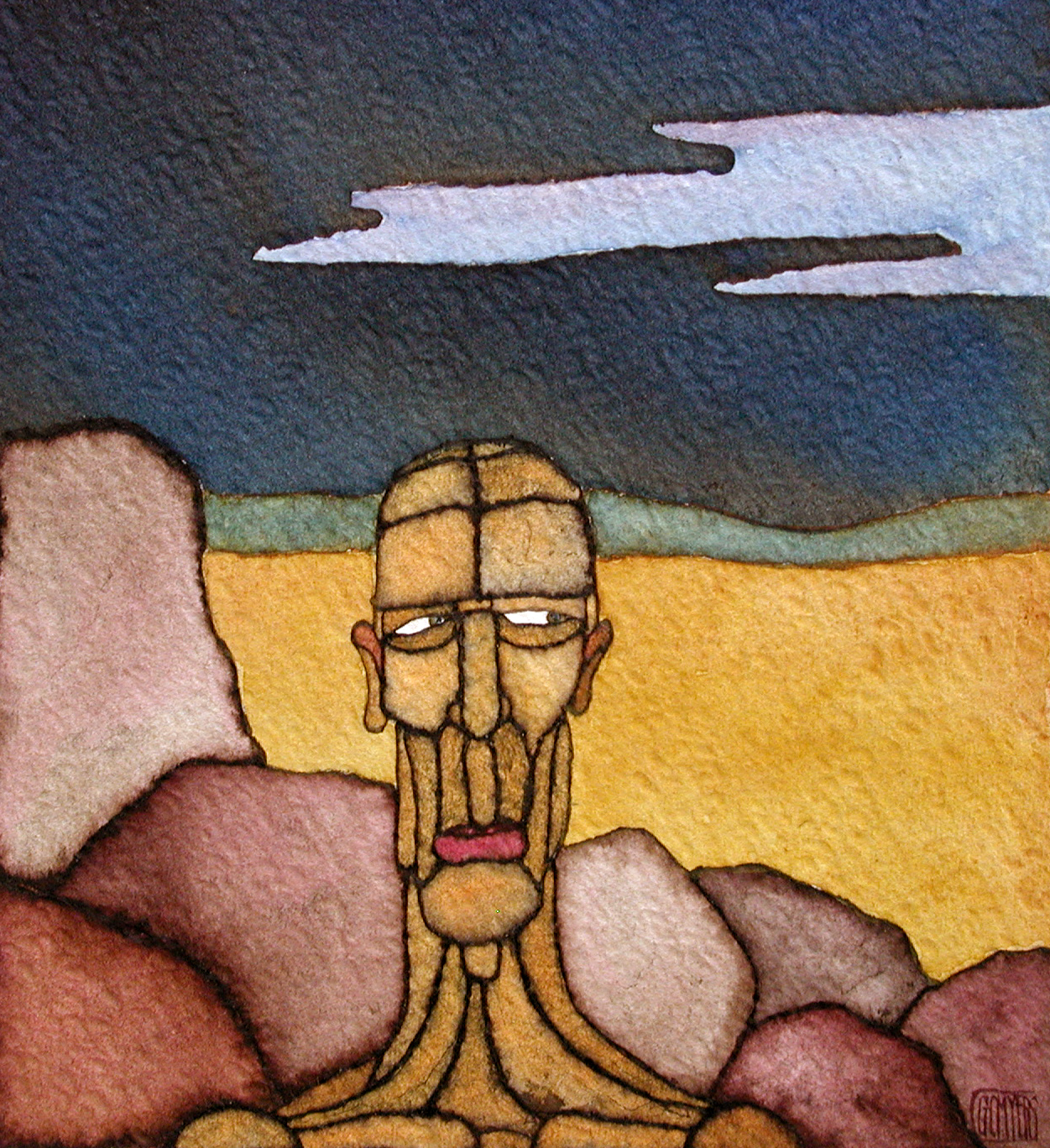
 I brought up a reference in last week’s Gallery Talk at the Principle Gallery that I would share here again. It’s about a posting that appeared here about five years ago, one that focused on one of the paintings from my Exiles series from around 1995. It’s a painting that I would never part with for many reasons but mainly for the meaning it holds for me in changing the course of my life at one point.
In 2008, I wrote:
I thought I’d take a moment and show this painting, Cain, another from the Exiles series that I’ve discussed in past posts. This is a smallish piece and one of my favorites, one with which I will never part.
He is based, somewhat, on the biblical story of the original exile, one expelled from his homeland after slaying his brother to create a new world for himself, never to return. It is also based on the novel Demian by Hermann Hesse, a book that meant much to me when I went through a trying time years ago. Actually, it seems a lifetime ago.
In Demian, Hesse uses the mark of Cain as a symbol for those seeking the truth in themselves. He also discusses the dual nature of man, an idea which has had a very formative aspect in my growth as a painter. The idea of opposing forces, light and dark, being contained in one element, one being, always struck a chord in me. It made sense of the struggles that I observed in myself and many others.
He also made a statement that resonated like a gigantic bell tolling for me.
Whoever wants to be born, must first destroy a world.
Without going into detail, that small sentence was a revelation. It changed my world forever.
I realize this is a fragmented explanation of this painting and the book that influenced it. I merely wanted to illustrate what personal meaning some pieces can have for an artist as well the serendipitous nature of moments when art and one’s real life converge.
Maybe I will elaborate in the future. Maybe not…
 Redtree Times
I just spent some time going through your Exiles series. Wow! Taking them all in one gulp was a little overwhelming. I know I’ve seen one or two, but most were brand new. I especially liked the drummer, and the martyr’s torso is so like the torso of a hand-carved crucifix I brought back from Africa it’s amazing.
What struck me is that every one of them has some little detail that allows for humor, perspective, whatever. With this one, it’s the eyes. The glance is open to every sort of interpretation – but it’s a wonderful detail.
To be honest, I was bit overwhelmed in creating them at the time. I do think they are most powerful when seen as a group and would love to show them at some point as an exhibit, if I could relocate the few that I regretfully let go. I am surprised at how many people pick the drummer as a favorite. And I agree that the eyes in this piece are the focus here, telling everything you need to know.