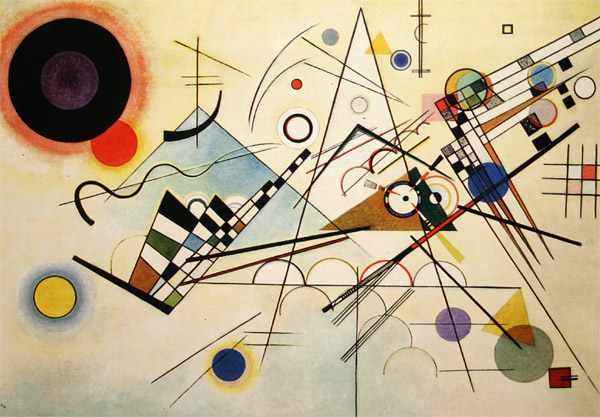
 In the final analysis, every serious work is tranquil….Every serious work resembles in poise the quiet phrase, ” I am here.” Like or dislike for the work evaporates; but the sound of that phrase is eternal.
– Wassily Kandinsky
********************
The above quote is from Wassily Kandinsky and concisely captures what might be the primary motive for my work. I think, for me, it was a matter of finding that thing, that outlet that gave me voice, that allowed me to honestly feel as though I had a place in this world. That I had worth. That I had thoughts deserving to be heard. That I was, indeed, here.
That need to validate existence is still the primary driver behind my work. It is that search for adequacy that gives my work its expression and differentiates it from others. I’ve never said this before but I think that is what many people who respond to my work see in the paintings- their own need to be heard. They see themselves as part of the work and they are saying, “I am here.”
Hmmm….
***********************
I wrote the above a little over five years ago in one of the early posts on this blog. I came across it and was going to re run it alone because I still feels it sums up a lot of what I feel about my work but I also wanted to expand just a bit more on Wassily Kandinsky, who ended up not really getting much notice in this outside of his quote.
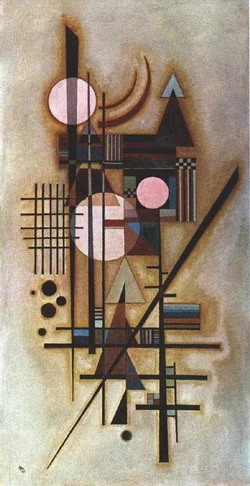
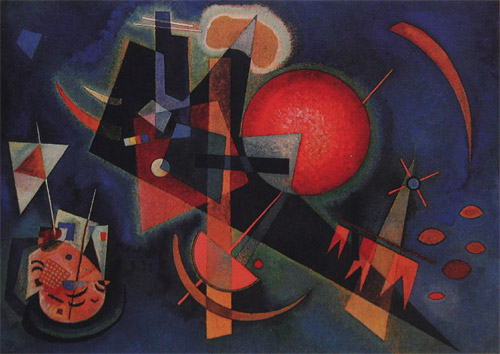
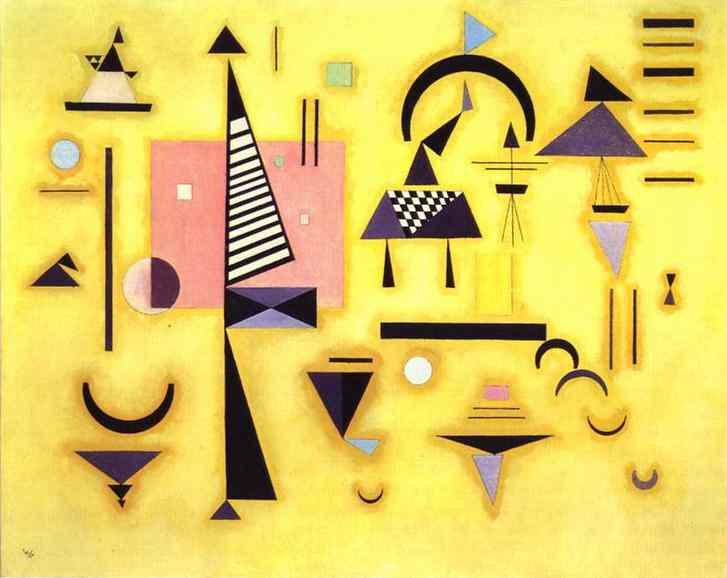
Kandinsky, who was born in Moscow in 1866 and died in Paris in 1944, was one of the most influential artists of the 20th century, leading the way into abstraction in painting. I have sometimes been ambivalent about his work- some I have found entrancing but others have done nothing for me. But seeing it chronologically, from his earliest efforts until the years just before his death, has made me see him in a different light. Seeing his evolution from a painter strongly influenced by his mentors and contemporaries to an artist with a distinct voice of his own is remarkable to witness. This was a man who was always seeking more than he was seeing, an artist who didn’t rest at a plateau. Seeing this evolution gave me a new respect for the work of Kandinsky
To see this clearly and for yourself, I suggest you go to WassilyKandinsky.net. His career is divided into four sections and each has a chronological gallery of work that you can scroll down. It’s worth a look.



 Redtree Times
“. . . every serious work is tranquil . . . ”
I’m probably missing something but that seems a strange statement. I think, off the top of my head, of something like Munch’s The Scream and “tranquil” isn’t the word that comes to mind. Or I think of this statement (attributed to Red Smith): “Writing is easy. You just open a vein and bleed.” Not much tranquility there. Or, in yet another medium, I think of Beethoven’s symphonies. It seems to me that if they’re saying “I am here”, they’re also saying, “That’s not nearly enough”. Or that it’s not good news.
I don’t know that it’s a strange statement except in implying that all serious work is tranquil. It may be that what he means by tranquil is not the same definition that comes to mind for you or me. Or it my simply be that there are always exceptions. Munch’s work is very much an exception, as is “Guernica” by Picasso and any other number of pieces.
As for the Red Smith attributed quote, I think there is something quite tranquil in what he says. There is often great peace in the honesty of confession, which is what I sense he meant by the opening of a vein and bleeding in order to fully establish contact with the reader.
And in music there is often a sense of “rightness”, a tranquility of form, that carries through the most exuberant and aggressive of pieces. I don’t know that exuberance and tranquility are exclusive of one other.
On Wed, Dec 18, 2013 at 4:06 PM, Redtree Times
I wonder if, as used here, “tranquil” doesn’t imply self-possession. Being “free of the disturbance” of other forms, emotions or ideas, the piece simply is what it is. That might allow for pieces such as “Guernica” to fit into Kandinsky’s view of things.
You may be on to something. Whatever the case, I have a feeling that “tranquil” here probably differs from the idea of it that immediately comes to our minds. I am sure that Kandinsky did not write in English, being a Russian living in France in the early 20th century. So there may be some variance in the translation of certain terms. But I do see a lot of merit in your view of this.