Feeds:
Posts
Comments

Archive for March, 2019

Earl Kerkam Revisited

I wrote the post below about Earl Kerkam about five years ago. He is an enigmatic character, a painter praised by many of the giants of modern art yet vastly underappreciated by collectors and the general public. I thought I would revisit it today (along with adding a few more images) after going through some auction records of his work from recent years and finding that he is still tremendously undervalued. As I sometimes point out, the artist can only control his creation of the work, not how it is perceived by the outside world. Earl Kerkam is a fine example of that.

earl-kerkam1891-1965-1361546399_orgI am very interested in the painter’s painter, those artists who garner the respect and  admiration of other artists while often not attaining the same sort of attention from the general public. I try to figure out where the disconnect comes in how these artists are perceived so differently by these two groups. I recently came across a prime example by the name of Earl Kerkam, a NY painter who lived from 1891 until 1965.

Kerkam trained in some of the finest art academies here and abroad, studying for a while with Robert Henri. He showed his work in important shows alongside some of the greats of the early 20th century. His work is included in some of the great museum collections of this country. In the aftermath of his death, modern artists of huge stature such as Mark Rothko and Willem  de Kooning proclaimed Kerkam to be one of the finest painters to ever emerge from America.

earl-kerkam1891-1965self-portrait-1361546314_bYet his work is basically unknown outside a handful of art insiders. His work sells at very modest, even low, prices at auction and I doubt if anyone who reads this will have ever heard the name.

There could be many reasons for this relative anonymity. Perhaps his work is too esoteric, too caught up in the dogma of style or too personally narrow in its range of emotional impact. Perhaps his work was caught between eras, never really falling into a classification where he would be swept to the forefront of a wave. This might have something to do with it because, while his work is modern, it never really moved into the realm of the abstract expressionism that was the rage of the day.

I don’t really know and looking at his work I found myself torn between liking it in some instances and being indifferent to others. I can see how both sides, artists and the  general public, might take opposing views on his work. His work remains an enigma to me and I don’t know if I will ever see enough of it, or at least a single piece that could be called a masterwork, to make me say that he deserves to be among the beacons of mid-20th century painting or if he was simply a fine painter who garnered just the attention his work deserved. But for now, the name Earl Kerkam is at least on my radar and I will be open to finding other works from him that will move my perceptions.

Read Full Post »

She turned to the sunlight

    And shook her yellow head,

And whispered to her neighbor:

    “Winter is dead.”


― A.A. Milne,

    When We Were Very Young

*************************

It’s just another reminder of who’s in charge from Mother Nature this morning as the temps here again sit at zero. There’s bright sunshine out there with the angle of the light making your mind believe that Spring is at hand and that, like the words of A.A. Milne in the bit of verse above, Winter is dead.

Stepping out into it, you realize that it was just another cruel trick. The air is sharp like a fresh razor blade. More so because your mind was telling you it would be warmly caressing your skin instead of biting at it.

Well played, Mother Nature. You got me again.

But Spring is coming and the seemingly endless wait will make the arrival of green grass and the first peeks of bulbs breaking the ground all the more special. The beauty of contrast.

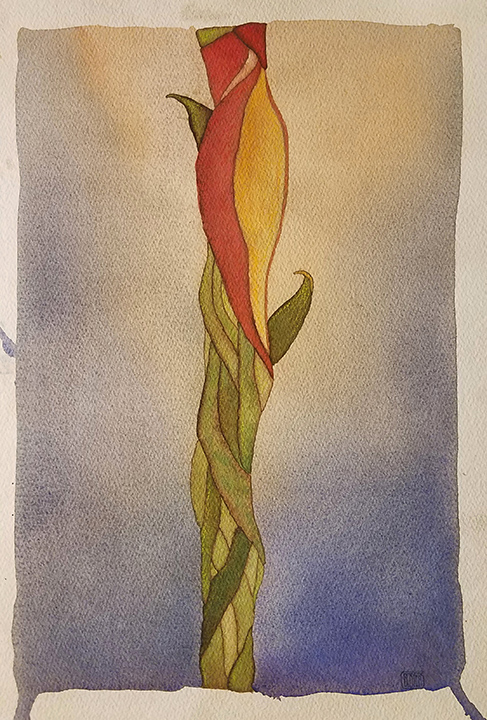
The painting above is an old piece from about 1994 or 1995. It was among a small group painted at that time that was meant to have an object serve as a pole bisecting the picture plane with the light seeming emanating from it. Kind of in a Georgia O’Keeffe manner. I did a few of these pieces with imagined flowers or tree trunks.

Don’t know why I didn’t continue following this path because I am generally very pleased with them when I come across them. They have the sense of completeness and color interest that I still seek in my work. But at that point, every day of painting brought so many new discoveries and ideas that it was sometimes hard to decide which way to turn next. I had so many sparks being generated in my head that it would not have been possible to follow them all.

That changes over time, of course. New discoveries are fewer and farther apart. Sparks still come, many with the same intensity, but they create a low banked fire now instead of the roaring blaze that it seemed like when everything was new.

When everything was new…

And that brings us back to Spring. Maybe that’s the attraction, trying to tie one’s own personal renewal to that of the Earth. If so, I will be green again soon.

And that is a good thing.

Read Full Post »

***********************************

A little busy this morning but never too busy to stop for a brief moment to consider an image or a few words from Andrew Wyeth. The words and image above are a good example. I just love this quote. It’s an idea–that a piece of art should not be judged on its craftsmanship but on how well it conveys emotion and beauty– that has always rang true for me.

Craftsmanship should not be seen as the goal but rather as a means, the handmaiden as Wyeth terms it, to get there.

Got to get to work now. Have a great day!

Read Full Post »

**************************

There are in every man, always, two simultaneous allegiances, one to God, the other to Satan. Invocation of God, or Spirituality, is a desire to climb higher; that of Satan, or animality, is delight in descent.

–Charles Baudelaire

**************************

The words above from the poet Baudelaire sum up the paradox of our existence, at least in the way it seems to me. We are creatures forever torn between opposing forces.

Good and evil. Love and hate. Desire and indifference. The physical and the spiritual.

It’s something that I try to represent in much of my work in terms of contrasts of dark and light. The warmth and coolness of colors. High and low tones.

Showing the contrast of the light of hope alongside the darkness of despair.

This newer piece, an 18″ by 24″ canvas, seems to follow Baudelaire’s words quite literally. Titled The Calling Out, the Red Tree here seems to have climbed to the loftiest point to appeal to a higher source as represented by the light emanating from the sun. There is a great, enveloping warmth in this painting but  for me, it is the underlying darkness that makes this piece effectively come alive.

Even the sun has a darker tone than the light it emits. This unnatural sun gives the piece an almost ominous feel but it is that same contrasting light coming from it that brings a redeeming sense of hope to the painting. It lives firmly between the darkness and light much like man according to Baudleaire’s words.

And that is where I want my work to live: Seeking the light but ever aware of its own darkness.

That, of course, is just how I see it. You might well see it in different terms and that is, as always, as it should be.

Read Full Post »


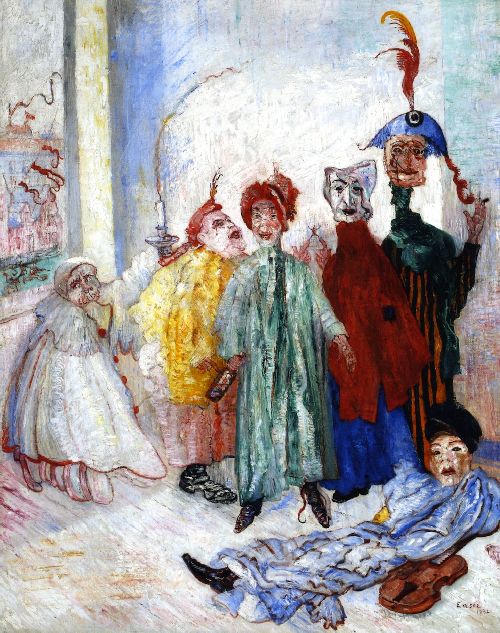
James Ensor- “Intrigue”

*******************

The mask means to me: freshness of color, sumptuous decoration, wild unexpected gestures, very shrill expressions, exquisite turbulence.

–James Ensor

*******************

As has been pointed out here, I have been working recently on some new work with large groups of faces, heads, masks, multitudes or whatever one sees in them. It has been exhilarating, with the work pulling me back into a rhythm where I am eager to see what the next work brings. While that is a great feeling in itself, I am still deliberating over where the work might take me, still trying to decide if it is work that is just meant to cleanse the system or if it is a new path to follow in some way.

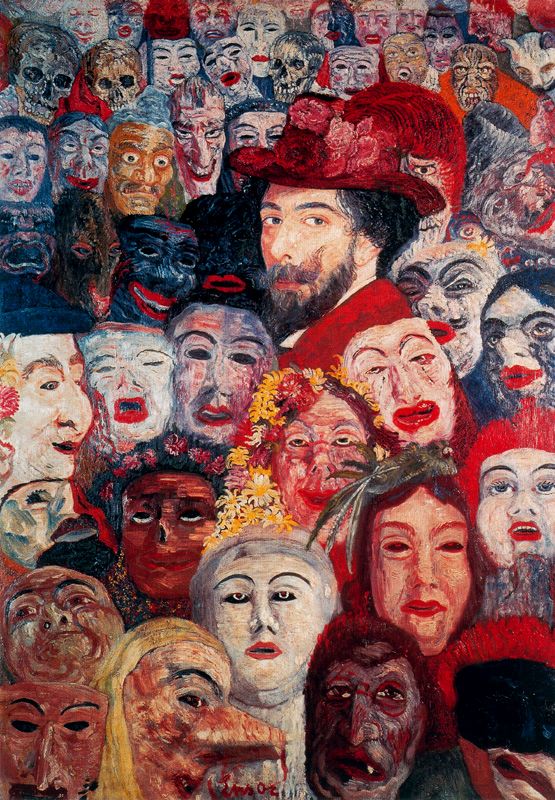
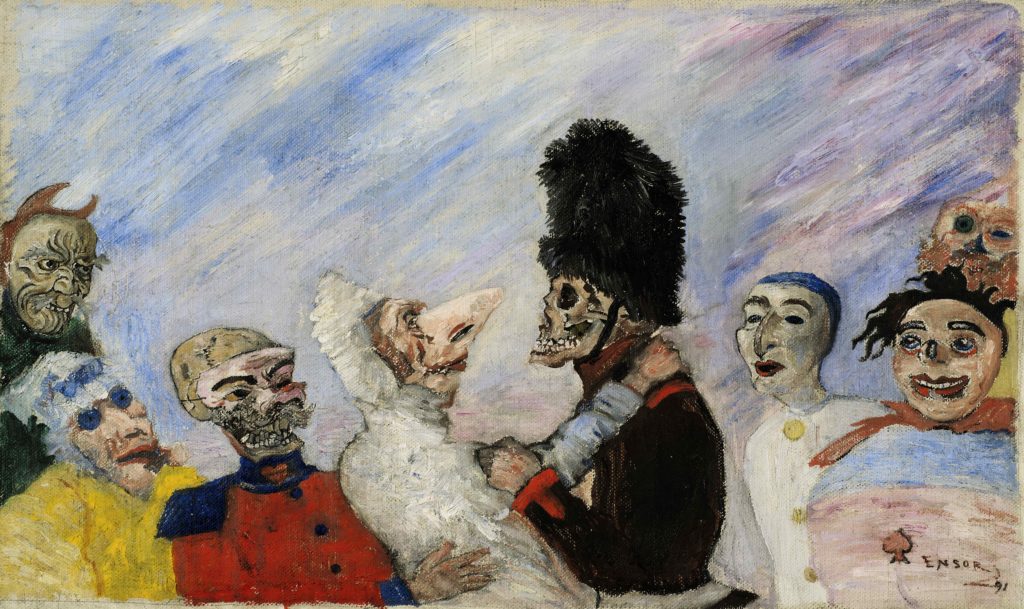
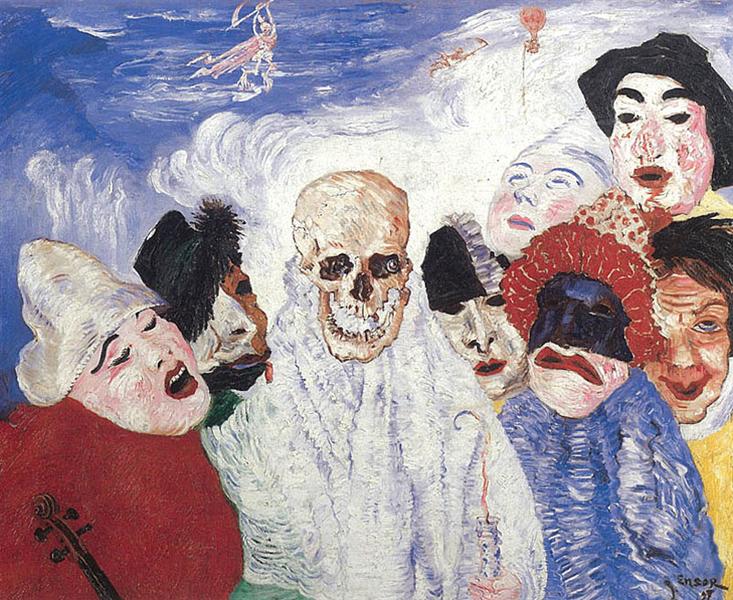
I turn for a bit of advice from art history going back to James Ensor (1860-1949), who I featured here a few years back with a post about his famed  painting Christ’s Entry into Brussels in 1889.  Ensor was well known for his paintings featuring groups people wearing contorted and strange, even grotesque, masks. Many were based on the masks seen at the carnivals and festivals of the time in his native Belgium.  But seen out of context, they were pretty controversial, as you might imagine, in the late 1800’s, given the subject matter and the rough method of much of his painting. This was around the time that the work of the Impressionists was still considered scandalous so you can imagine how the image of a soldier with a skull for a face embracing a maiden with a gigantic nose mask might play.

It’s fascinating work. Wish I could tell you more but the images themselves tell me a lot and inform my own work by providing fresh inspiration for new work. Just looking at this work this morning has me itching to get to the easel.

Take a look at some of the work of James Ensor and see if it does anything for you.

Ensor- “Christ’s Entry into Brussels in 1889”

Ensor- “Portrait of the Artist Surrounded by Masks”

James Ensor- Squelette Arretant Masques

James Ensor- Old Lady with Masks

James Ensor – ” Death and the Masks”

James Ensor- “Strange Masks”

James Ensor- “Masks Confronting Death”

James Ensor- “The Despair of Pierrot”

Read Full Post »

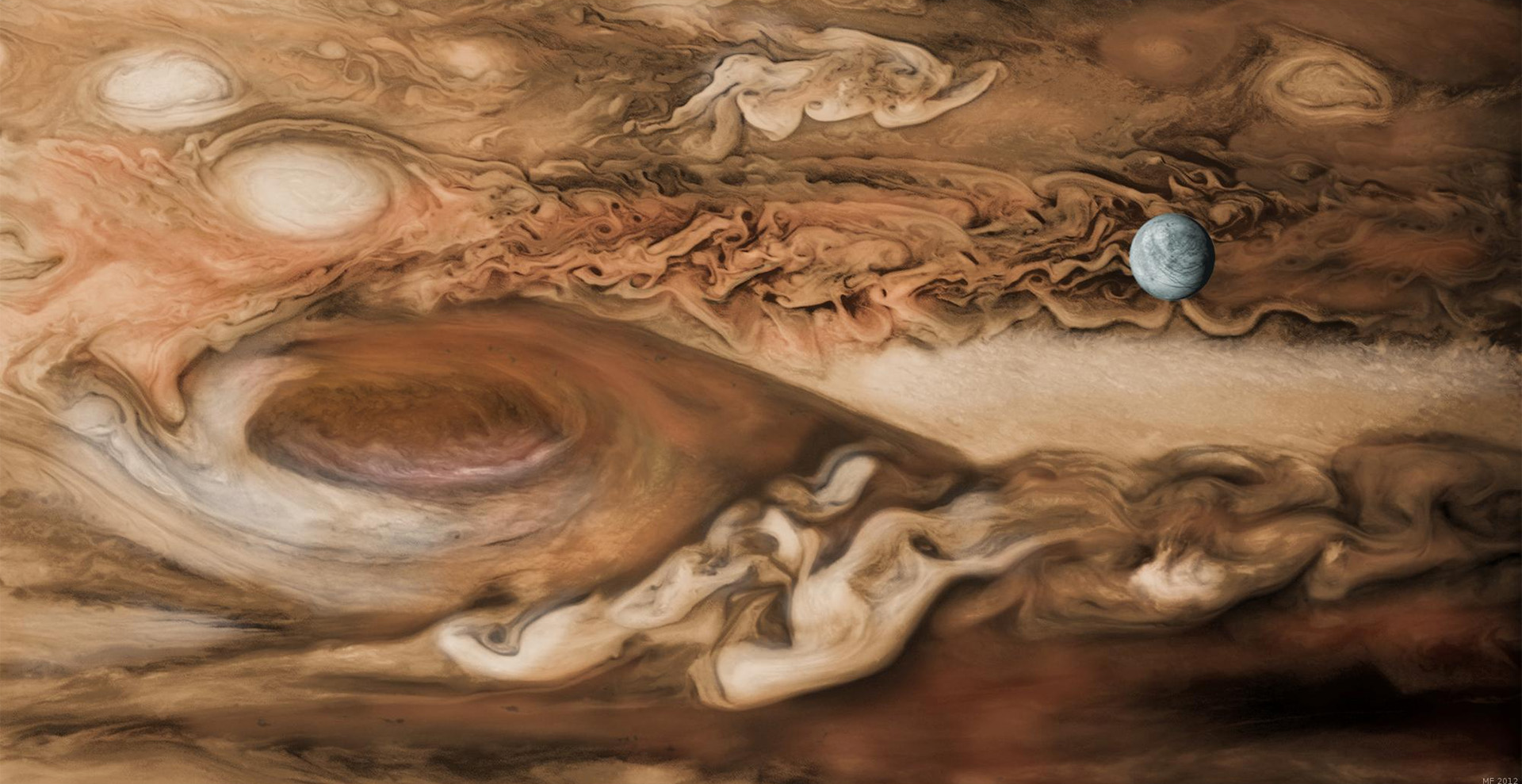
I don’t have much time but I wanted to share these images taken by the probe Voyager I way back in 1979. Hard to believe these are forty years old but I guess that’s a mere eyeblink in astronomical time. These are of the Great Red Spot on the planet Jupiter  with the one at the top having Europa, a moon of Jupiter, in front of it.

The bottom is a little more detailed view of the Great Red Spot. I wish I had the ability to paint in the way this image comes off. Whenever I stumble across these images, I am astounded at their abstract beauty.

Read Full Post »

Finisterre is a peninsula at the westernmost point of Spain. In Roman times, it was thought to be the end of the known world.

Thus the name: finis/end + terre/land.

Finisterre.

It is also the title of a lovely song from English folk singer June Tabor that I am featuring for this week’s Sunday music. Very atmospheric.

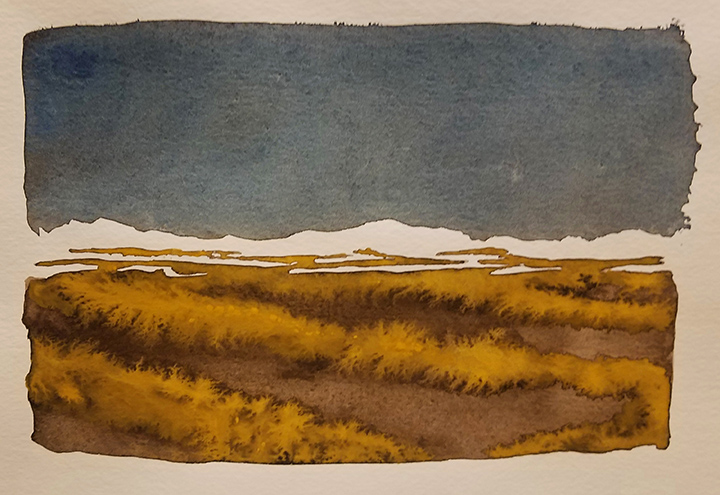
The accompanying painting at the top is a piece I came across this past week in an old sketchbook from back in 1994, when I was just starting to paint. I hadn’t seen it in some time and was pleased that it had aged well, that it had a completeness that was not the norm for the work I was doing at that time. The rest of the sketchbook, for example, is filled with landscapes that are cringeworthy enough that this piece seems out of place.

I chose it to accompany this song because it also has an atmospheric quality, one that speaks of open space and emptiness. Pauses and the quiet rush of the wind through the grass. It might not be Finisterre but it feels like it might be the end of the world for someone.

Have a good Sunday.

Read Full Post »

****************************

The artist performs only one part of the creative process. The onlooker completes it, and it is the onlooker who has the last word.

Marcel Duchamp

*******************************

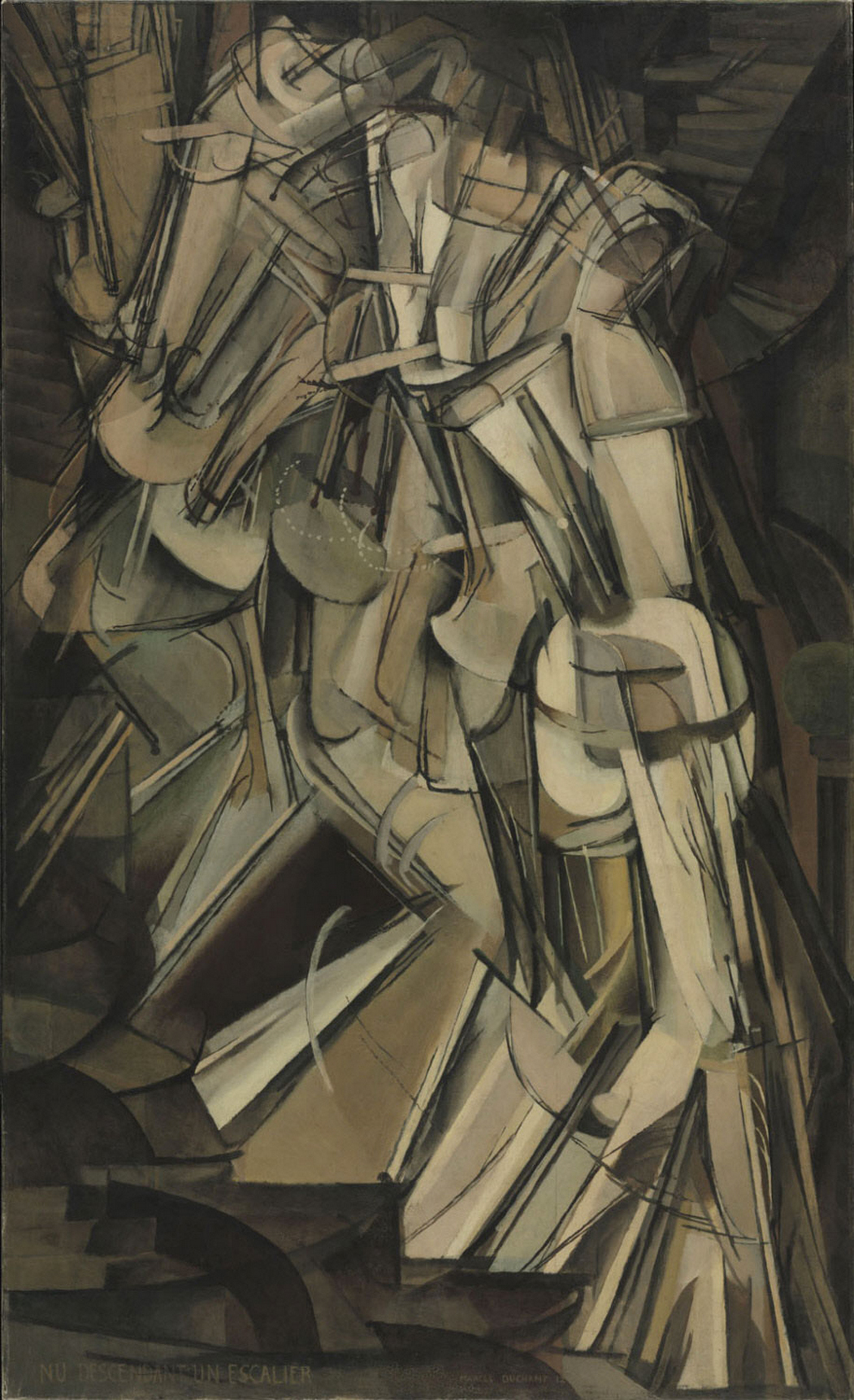
I can’t say I have always fully appreciated or understood all of the work of Marcel Duchamp (1887-1968). The French born artist is best known for his Nude Descending a Staircase #2 (above) which was the center of the fabled and highly influential Armory Show of 1913. The Cubist painting was considered a shocking departure from the norm, breaking the human form and its motion into abstracted blocks and lines. For an art world that was still basically reeling from the push of Impressionism against traditional academic style painting, it seemed like a gateway to total chaos.

Perhaps it was the notoriety from  this show and the effects of World War I that pushed Duchamp even more away from the art establishment of that era. His work became more and more provocative, as he became associated with the Dada movement which rejected all the norms of traditional art. You may know his 1917 sculpture, Fountain, which was a urinal signed with the pseudonym R. Mutt. Shocking the world at the time, it is considered a Dada masterpiece and one of the most influential works of the 20th century.

The thing I find interesting is that after the late 1920’s, Duchamp, still a relatively young man, more or less gave up the making of art and focused on playing chess. He viewed the game as more pure than art in that it was beyond commercialization. He did little art making in the time until his death in 1968.

But while Duchamp, with his contrarian nature, remains an enigmatic character for me, I do heartily agree with his words above. Art is not completely in the making of it. It is the viewer and the impression of the work that they carry with them that completes the artwork. Regardless of how or why the artist created the work, it is the impression that the work makes on the viewer that matters. A deeply personal piece that is that is beautifully crafted may not have the same impact as one that is rough and crudely executed.

That remains the last word of the viewer and what the see and feel in the work.

And that will always be a mysterious and sometimes confounding thing that is beyond the control of the artist.


Read Full Post »

*******************************

“The muses are ghosts, and sometimes they come uninvited.”

Stephen KingBag of Bones

*******************************

Finished this piece up a week or so back. The final product was never imagined beforehand. It was intended to be a canvas filled with faces but somewhere along the line something changed. Maybe, like the Stephen King words above, it was the uninvited act of a ghostly muse that caused this painting to form.

Who knows?

I do know that when I stepped back feeling that I was done, the whole of it surprised me very much. Mainly because it very much attracted me and raised so many questions, both about what the painting was and where it fit in my body of work.

I could even say it perplexed me. Part of me felt that it wasn’t even my painting, that it belonged to someone else’s mind. It was so unlike my other work that I wondered if this simply a one off event, something that pops up, maybe with the help of some vaporous muse, and never comes around again, or if it was a new direction that had pushed its way into my consciousness.

I can’t say but it sure keeps me looking its way.

It has some size at 24″ high by 30″ wide which gives it even more oomph in the room. I know that in a studio that is filled with new work, it dominates my eye every time I turn its way. There is a confectionary quality to it that passes on a delight of sorts to myself as I look at it. But it also has an ominous feel that makes me wonder where this ship is going and from where it came.

It feels as though there is a lot of mystery here, questions that will never be answered.

It’s been a struggle trying to pin down a title for this piece. I am leaning towards Ghost Ship. Thinking of a boat floating aimlessly on the sea that is empty but for the host of spirits of past travelers that hang on, their stories waiting to be told. Sounds right to me at the moment.

All in all, it pleases and perplexes. I am glad to have it with me for the next few months so that I can better consider its meaning for myself. It might be one of those pieces that is meant only for me.

Who knows?

Read Full Post »

« Newer Posts