Feeds:
Posts
Comments

Archive for May, 2020

Yesterday, on Mother’s Day, I was wondering how my own mother, who has been dead for 25 years now, would react to this current crisis. While she was not an educated person, having dropped out of school in the ninth grade, she had intelligence and strong survival instincts. I would like to think she would not have fallen into that group of conspiracy driven, Fox News watching folks who have seemingly given up most of their independent thought processes. My mom was definitely not a pack follower and was not shy about calling out BS so I think she would have avoided that fate.

But these past few years, and this crisis in particular, have exposed the vein of stupidity that runs through this nation. It is fed by steady streams of misinformation and outright lies in order to prop up the agenda of those who hold the ultimate power at the top of our government.

It all reminds me of the post below that I posted here back in the early days of this administration. Titled On Stupidity, it has been one of my most popular posts, pulling in quite a number of views each week. I thought at this time, when the uncertainty surrounding this crisis has people grasping for anything that somehow rationalizes it in their mind and has them falling behind ill-informed conspiracy movements and losing the ability to think independently, that it might be worth another look at this post. It’s a longer post but there is a lot of information and what I believe is wisdom here, including the following which neatly sums up the stupidity we are witnessing:

Upon closer observation, it becomes apparent that every strong upsurge of power in the public sphere, be it of a political or of a religious nature, infects a large part of humankind with stupidity. It would even seem that this is virtually a sociological-psychological law. The power of the one needs the stupidity of the other.

Give it a look, please.

******************

I have written a number of times here about the events that are taking place in this country and my frustration at how little effect reasoning and factual evidence have on the followers of the current president. Their stubborn stupidity seems impenetrable to even the most glaring truths.  I am sure that there are many of them out there who still, faced with an ever expanding list of acts of malfeasance, refuse to see anything other than a conspiracy against the leader of their cult.

It turns out that this phenomenon is nothing new. It can probably found in every major movement based on political power or religion. One of the most enlightening essays on the subject of the stupidity of the follower came to us in a letter written in a German prison during World War II by theologian and anti-Nazi dissident Dietrich Boenhoeffer. The first paragraph of the essay is shown above.

Dietrich Boenhoeffer was a pastor and theological writer who stood in direct opposition to the Nazi regime and spoke out against its programs of euthanasia and genocide. He had an opportunity to stay in the US in the late 1930’s, safe from the reach of the Nazis, but he insisted on returning, believing that if he were to rebuild the German church in the war’s aftermath he must endure it with its people.

He was imprisoned in a German prison in 1943 and later transferred to a concentration camp. He was implicated in a plot to assassinate Hitler and he was hanged in the waning days of the war, in April of 1945.

Dietrich Boenhoeffer’s story is most interesting and his writings live on and have great influence to this day. One of the terms he coined was cheap grace which also has great meaning today. I’ve included an apt description of this at the bottom of this page..

The following essay is taken from a letter written while in captivity. I urge you to read it. It may help you understand better your own frustration wit what you see today. And if you are one of those who fail to see what seems so clearly evident to most people, perhaps you should read it then ask yourself how you allowed yourself to be swept up in this grand wave of stupidity.

Stupidity is a more dangerous enemy of the good than malice. One may protest against evil; it can be exposed and, if need be, prevented by use  of force. Evil always carries within itself the germ of its own subversion in that it leaves behind in human beings  at least a sense of unease. Against stupidity we are defenseless. Neither protests nor the use of force accomplish anything here; reasons fall on deaf ears; facts that contradict one’s prejudgment simply need not be believed- in such moments the stupid person even becomes critical – and when facts are irrefutable they are just pushed aside as inconsequential, as incidental. In all this the stupid person, in contrast to the malicious one, is utterly self-satisfied and, being easily irritated, becomes dangerous by going on the attack. For that reason, greater caution is called for than with a malicious one. Never again will we try to persuade the stupid person with reasons, for it is senseless and dangerous.

‘If we want to know how to get the better of stupidity, we must seek to understand its nature. This much is certain, that it is in essence not an intellectual defect but a human one. There are human beings who are of remarkably agile intellect yet stupid, and others who are intellectually quite dull yet anything but stupid. We discover this to our surprise in particular situations. The impression one gains is not so much that stupidity is a congenital defect, but that, under certain circumstances, people are made stupid or that they allow this to happen to them. We note further that people who have isolated themselves from others or who lives in solitude manifest this defect less frequently than individuals or groups of people inclined or condemned to sociability. And so it would seem that stupidity is perhaps less a psychological than a sociological problem. It is a particular form of the impact of historical circumstances on human beings, a psychological concomitant of certain external conditions. Upon closer observation, it becomes apparent that every strong upsurge of power in the public sphere, be it of a political or of a religious nature, infects a large part of humankind with stupidity. It would even seem that this is virtually a sociological-psychological law. The power of the one needs the stupidity of the other.The process at work here is not that particular human capacities, for instance, the intellect, suddenly atrophy or fail. Instead, it seems that under the overwhelming impact of rising power, humans are deprived of their inner independence, and, more or less consciously, give up establishing an autonomous position toward the emerging circumstances. The fact that the stupid person is often stubborn must not blind us to the fact that he is not independent. In conversation with him, one virtually feels that one is dealing not at all with a person, but with slogans, catchwords and the like that have taken possession of him. He is under a spell, blinded, misused, and abused in his very being. Having thus become a mindless tool, the stupid person will also be capable of any evil and at the same time incapable of seeing that it is evil. This is where the danger of diabolical misuse lurks, for it is this that can once and for all destroy human beings.

‘Yet at this very point it becomes quite clear that only an act of liberation, not instruction, can overcome stupidity. Here we must come to terms with the fact that in must cases a genuine internal liberation becomes possible only when external liberation has preceded it. Until then we must abandon all attempts to convince the stupid person. This state of affairs explains why in such circumstances our attempts to know what ‘the people’ really think are in vain and why, under these circumstances, this question is so irrelevant for the person who is thinking and acting responsibly. The word of the Bible that the fear of God is the beginning of wisdom declares that the internal liberation of human beings to live the responsible life before God is the only genuine way to overcome stupidity.

‘But these thoughts about stupidity also offer consolation in that they utterly forbid us to consider the majority of people to be stupid in every circumstance. It really will depend on whether those in power expect more from peoples’ stupidity. than from their inner independence and wisdom.’

-Dietrich Bonhoeffer, from ‘After Ten Years’ in Letters and Papers from Prison (Dietrich Bonhoeffer Works/English, vol. 8) Minneapolis, MN: Fortress Press, 2010

Cheap Grace-

“But there is another, uniquely religious aspect that also comes into play: the predilection of fundamentalist denominations to believe in practice, even if not entirely in theory, in the doctrine of “cheap grace,” a derisive term coined by the theologian Dietrich Bonhoeffer. By that he meant the inclination of some religious adherents to believe that once they had been “saved,” not only would all past sins be wiped away, but future ones, too—so one could pretty much behave as before. Cheap grace is a divine get-out-of-jail-free card. Hence, the tendency of the religious base of the Republican Party to cut some slack for the peccadilloes of candidates who claim to have been washed in the blood of the Lamb and reborn to a new and more Christian life. The religious right is willing to overlook a politician’s individual foibles, no matter how poor an example he or she may make, if they publicly identify with fundamentalist values.”

Mike Lofgren

Read Full Post »

Was going to write something new today for Mother’s Day but decided to replay a post from five years back about my own mom, who died close to twenty five years ago now.

*************

I thought I would take the opportunity on this Mother’s Day, to dedicate this week’s Sunday music to my late mom. It’s hard for me to believe but later this year will mark twenty years [25 now] since she passed away after a short but brutal battle with cancer. Needless to say, I miss her very much and wish she could have seen the things that came in the years after she died, such as how well her grandchildren grew up and the great-grandkids she never got to meet or dote on.

For my parts, she never lived to see my work hanging in a gallery or museum, never got to see how it has grown over the years. Looking at two large pieces on easels next to me at this moment, I realize that there is a whole different world of mine she never got to witness.

But I think she would be pleased to know that things worked out okay, that I found something to ease my mind and give me something of a purpose. I would hope she would like the work I’ve done. I know she liked the earliest pieces, the only ones she would know, like the piece at the top. It was one of my earliest efforts in early 1994, long before I had experienced any kind of creative breakthrough. It was gift to her on Mother’s Day of that year and it hangs in my studio now, always reminding me of her.

So, for this bit of Sunday music, I thought I would play one of the songs I know to be a favorite of hers. She always loved Eddy Arnold‘s voice and I have specific memories of this song coming from our old stereo console. The title and the song itself,  Make the World Go Away, just seemed to fit Mom so well. For that matter, looking at the alternative world that surrounds me here in the studio, I guess it fits me as well. I am my mother’s child, after all.

Have a good Mother’s Day.

Read Full Post »

*********************

“In the life of each of us, I said to myself, there is a place remote and islanded, and given to endless regret or secret happiness; we are each the uncompanioned hermit and recluse of an hour or a day; we understand our fellows of the cell to whatever age of history they may belong.”

Sarah Orne Jewett, The Country of the Pointed Firs

********************

I’ve been looking at the work for my upcoming Principle Gallery show, Social Distancing, and as the title implies, much of it is concerned with isolation. There is distance and a lot of singularity in the elements of each piece. A lone house. A single tree, One chair alone. There are landscapes without a tree or person or structure. Just the still emptiness. And even in the cityscapes of this show that seem busy and crowded with buildings and lights, it is the emptiness of the streets and the lack of figures in the lit windows that mark them.

It’s familiar territory for me, places and themes I have explored for a long time. However, this current situation brings my familiarity closer to what has become a new normal for some of us.

It will be interesting to see how people react to the work now as opposed to how they have in the past. After all, each of us relates to our isolation and solitude in different ways. For some it is maddening with the sense of imprisonment. For others, it is liberating in a way, freed from social obligations and niceties, free to do things for themselves without guilt.

Unfortunately, for both there is a dark cloud of potential danger hovering always nearby. It’s creates a strain that is difficult in human terms but, in the artistic sense, this adds a desired tension, one that evokes some sort of emotional response.

And in the piece above, Sequester’s Moon, it is the slate blue darkness of the sky and clouds that evokes this tension. With a different sky, this piece might feel pastoral and idyllic. With this sky, some might see it as the scene as ominous. Or they might see the house as a safe place amidst the dangers.

Myself, I see it as a safe place. A place to expand, not contract. I am much like Sarah Orne Jewett’s character above who, in their isolation and solitude, identifies easily with the hermits and recluses of past ages.

So, here in my hermit’s cell of isolation, I am going happily back to work now.

Have a good day.


Read Full Post »

************************

“A writer – and, I believe, generally all persons – must think that whatever happens to him or her is a resource. All things have been given to us for a purpose, and an artist must feel this more intensely. All that happens to us, including our humiliations, our misfortunes, our embarrassments, all is given to us as raw material, as clay, so that we may shape our art.”

Jorge Luis Borges, Twenty-Four Conversations with Borges: Interviews by Roberto Alifano 1981-1983

*************************

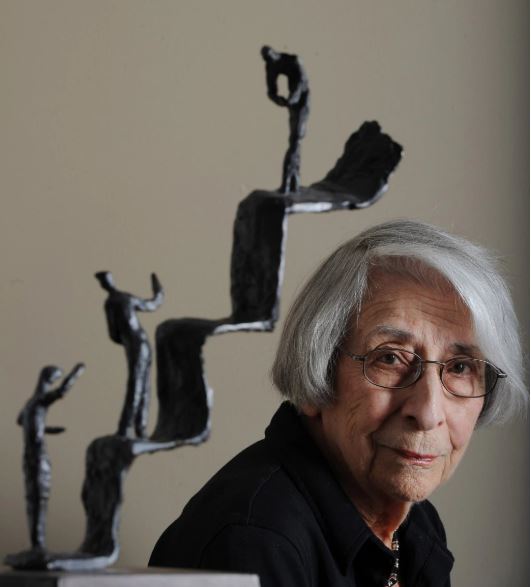
Marilee Shapiro Asher

Interesting article in the Washington Post yesterday about DC artist Marilee Shapiro Asher who at age of 107 is successfully recovering from a rough bout with covid-19. It was so rough that her doctor called her family saying that she would most likely not last twelve more hours. But the doctor underestimated Marilee and probably wasn’t aware she had already beaten another pandemic, having contracted the Spanish Flu in the Pandemic of 1918 at the age of 6.

That’s a great story in itself but for me, I was as interested in the fact that Marilee is still working as an artist at age 107. She began her artistic career as a metal sculptor in her 20’s and had her first show in 1938–82 years ago. Over the years she has worked in sculpture, painting, photography and now in digital art. In her late 80’s, when the physical demands of working with the large metal sculptures she was known for ( she has work in the permanent collection of the Smithsonian) became too much for her she enrolled in a digital art program. Her fellow students were almost all in their early 20’s.

She had her last show of her sculpture at the age of 100 and is looking forward now to a possible new show of her digital creations. At 107.

It’s obvious that art gives her a purpose that fuels her drive to live. It’s not an unusual story. I have encountered a number of stories of artists who have seemingly prolonged their lives through the purpose they find in their art, many productively working into their 100’s.

I find this encouraging.

Marilee had someone in the family to follow in taking up her late interest as a digital artist. Her mother, Bonnie Harris, took up painting at the age of 79 and worked at it until her death at age 92. Self taught, her folk art paintings garnered much notice and are in the permanent collection of several museums, including the Baltimore Museum of Art, the Smithsonian National Collection of American Art, The Phillips Collection and the Folk Art Museum.

Like I said, I find this encouraging. And these days, when there is so much happening that want to make you worry, it’s nice to know that these artist found purpose in their work and used lives that spanned the awfulness of pandemic, war and social upheaval as the inspiration and raw material for their work.

Get well, Marilee, and keep on working. Thanks for the inspiration.

Read Full Post »

*************************

It was the best of times, it was the worst of times, it was the age of wisdom, it was the age of foolishness, it was the epoch of belief, it was the epoch of incredulity, it was the season of Light, it was the season of Darkness, it was the spring of hope, it was the winter of despair, we had everything before us, we had nothing before us, we were all going direct to Heaven, we were all going direct the other way – in short, the period was so far like the present period, that some of its noisiest authorities insisted on its being received, for good or for evil, in the superlative degree of comparison only.

— A Tale of Two Cities, Charles Dickens

**********************

It seems like this current period of time, this year we call 2020, might be memorable. It definitely falls somewhere among those terms that Dickens set out in the opening paragraph of his A Tale of Two Cities.

I’m still waiting for the best of times part but maybe it will eventually show its shining face at some point this year. Got my fingers crossed on that one.

The painting at the top is part of my Social Distancing show that opens 4 weeks from tomorrow, June 5, at the Principle Gallery in Alexandria. As I was working on it, further into the process it felt like it was acting as a marker in some way of this year. It certainly reflected the social distancing in the show’s title.

But there was something more than that to it, something more like the Dickensian ( finally got to use that word!) words above. Perhaps best of times, worst of times sort of stuff.

Season of light and season of darkness, definitely.

I think it’s a fitting piece for this period with its fractured sky and darker, ominous tones set against the light from the sun/moon(?) and the sturdiness of the house.

It is neither optimistic nor pessimistic. Not fearful either nor foolishly filled with hubris. The word I might use is enduring.

Kind of like the final speech from Ma Joad ( played brilliantly by Jane Darwell) that ends the film version of The Grapes of Wrath:

“I ain’t never gonna be scared no more. I was, though. For a while it looked like we was beat. Good and beat. Looked like we didn’t have nobody in the world but enemies. Like nobody was friendly no more. Made me feel kinda bad and scared too, like we was lost and nobody cared…. Rich fellas come up and they die, and their kids ain’t no good and they die out too, but we keep on coming. We’re the people that live. They can’t wipe us out, they can’t lick us. We’ll go on forever, Pa, ’cause we’re the people.”

That speech always moves me because it speaks so strongly to my own survival instincts. There have been times when I wanted to give up but this same drive that Ma Joad describes kicks in.

You take the beating today but you keep plodding forward, doing whatever is needed to see the next day.

Because maybe that’s where the answer will be.

That’s what I see in this painting. Enduring. Resilient. Good time, bad times, fight through the darkness and look for the light. Just keep going on and not giving up.

I am calling this painting, which is 20″ wide by 30″ tall on wood panel, In the Year 2020.

It was somewhat borrowed from the old Zager & Evans 1968 hit In the Year 2525. That time 50 some years back felt as apocalyptic as this moment seems now. I am sure there was a lot of use of the best of times, worst of times at that point. But we did somehow endure the turbulence of that time. There might be much more ahead of us now that we will have to struggle past but we will most likely endure and look back at this year with mixed feelings someday, remembering the awfulness along with the goodness we discovered alongside it.

Here’s a video of that Zager & Evans song set to visuals from the 1925 silent futuristic dystopian classic from director Fritz Lang, Metropolis.
Have a good day and stay strong.

Read Full Post »

Last July, I wrote here about going up the hill to the old studio that I had worked in everyday for over ten years before moving into my current digs. It was in pretty bad shape back then, with a gaping hole in the roof and the floor heading in several different directions, none of them level. It was a mass of decay and debris but I had found several paintings tucked away that I had overlooked when I was cleaning it out years ago.

There were some I remembered well and had wondered where they were before finding them. It was great finding these pieces, most of them in pretty good shape considering the exposure to the elements– and critters of all sorts– they had faced.

I wandered back up the hill yesterday. There were still a few things there that I needed to bring back down the hill plus I wanted to see how the old structure had fared during this past winter.

Well, the structure was in even worse shape, the walls and floors beginning to part company at some spots and the hole in the roof expanding to let in even more of the weather. Mother Nature was quickly reclaiming everything she could. I gingerly moved through the tilting doorway and picked around in the debris, finding the items I was looking for. As I prepared to leave, I stopped by group of three or four old paintings that I had left last year. They were not good in any way. Kind of embarrassing , actually. Plus, I didn’t even want to waste the time to carry them back down the hill.

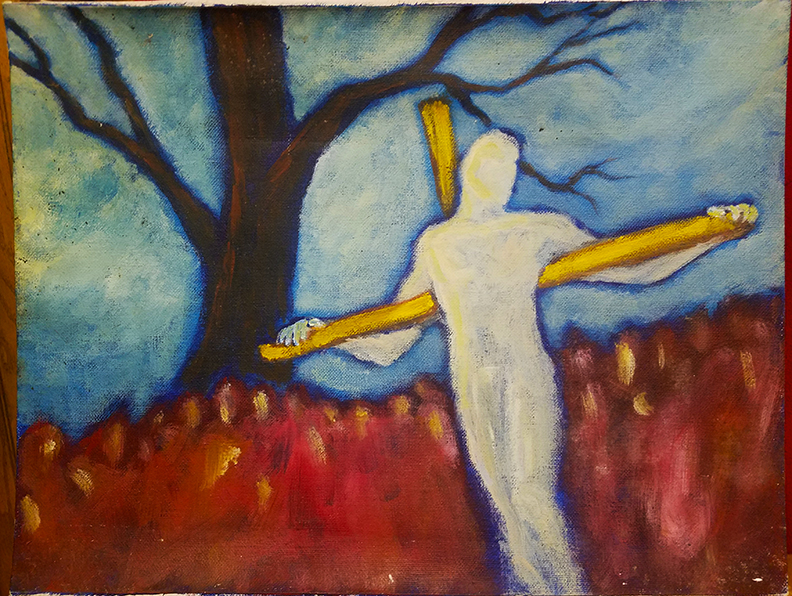
But I went through them again and while I agreed with my decision from last year to leave them, there was one that grabbed my attention. It’s the piece at the top. It was painted about 25 years ago and I remember, even then, not knowing what it was meant to be.

It was an enigma even when I first painted it. I may have painted it but I still don’t get it, don’t fully understand what it’s supposed to say. But I do remember painting it and liking things about it. The colors of the sky the mass of the crowd behind the glowing figure that seems to be reclining on a cross. Not nailed. Like it was his decision to be there.

Maybe it’s saying that we choose the crosses we bear?

I don’t know.

Perhaps it was just the contrast between its colors and the destruction around it, but this piece seemed to ask to be freed from the wreckage. It’s in rough shape from a decade or more of exposure and neglect. It was painted on a cheap canvas panel and the cardboard backing that was now deteriorating and falling apart. But something in it sparked my imagination, made me want to look at it again. Made me save it for another day.

So, I brought it back down to my current studio. It’s been propped up on a chair and I have stopped to examine it several times over the past day. And even now, I am still mystified by it and how I came to paint it.

I am pretty sure I didn’t have a title for it back then and maybe it doesn’t deserve one now. Like I said, I still don’t know what to make of it. But if I were to give it a title I might call it You Can Have the Crown, taken from the title of a Sturgill Simpson song. I think the guy on the cross might understand. Give a listen and see if you do as well.

***************

Read Full Post »

The_Torment_of_Saint_Anthony_(Michelangelo)

***********************

A man paints with his brains and not his hands.

-Michaelangelo Buonarroti

***********************

I am a little intimidated in quoting the words of a man who is believed to have painted the piece shown above, The Torment of Saint Anthony, at the tender age of 12 or 13. Pretty amazing. It’s obvious from this, and almost everything created afterward over his lifetime, that Michaelangelo had both brains and hands– the highest degree of craftsmanship along with thought and feeling that brought his work to life.

But his words ring true for any painter. Painting should not be mere craft, not formulaic process nor exact replication of the reality before them. No, it is beyond that. It is how the artist imbues the work with their own thought and emotion, their own spirit, their own essence that elevates the work above craft. It requires a total investment of the self.

Doing that is the trick. At first glance, it seems both a tall task and a simple one. Giving what you think is 100% of yourself seems easy, right? But not holding back something, not sharing every bit of yourself, makes it a Herculean effort. In the end, it comes down to simply feeling emotion in what you are doing and being willing to openly display it without reserve.

Now, maybe I am misinterpreting Michaelangelo’s words to fit my own subjective view of painting. Perhaps in these ten spare words he was speaking about taking a more scientific or mathematical approach to painting and composition. That I don’t know. But when I read it, it made sense to me because the differentiating quality I see in painting, from self-taught rough-hewn outsiders to the highest level of traditional representational painters, is how much of themselves a painter is willing to invest in their creations.

An investment of the self.

It is the thought process of the artist that makes the painting, not the mechanical process.

*******************

This post is from five years back. and is shared again because I love this youthful piece from Michaelangelo along with his words. Whenever I see this painting, or for that matter, anything from Michaelangelo, I am humbled beyond description. And that’s not a bad thing. 

Read Full Post »

*************************

“Numbers do not feel. Do not bleed or weep or hope. They do not know bravery or sacrifice. Love and allegiance. At the very apex of callousness, you will find only ones and zeros.”

― Amie Kaufman, Illuminae

***************************

Today is May 4th. By tomorrow, or even later today, the death toll from the coronavirus here in the US will hit the 70,000 mark. That 70K is a figure, according to the model used by the white house* to forecast the virus, was estimated to be reached on or around August 4.

We are a full three months ahead of this obviously faulty model’s schedule.

For the past month, we have averaged about 30,000 new cases and around 2,000 deaths per day. It has remained steady and is not moving in any sort of downward direction. Not even close to indicating the end of this first wave. And bear in mind that those figures come even while some states have tried to suppress testing as well as public reporting of the deaths caused by the virus there. The reality is that the actual numbers, both of those infected and those killed by the virus, are substantially higher.

What this means is that we have yet to even approach the midpoint of this event.

We have witnessed the white house* beginning to try to normalize these numbers, throwing out higher figures so that anything lower seems somehow better. They never attach faces or personalities to these numbers.

They only see and present them as numbers with the hope that the public will also begin to only view them in that way, as though these simple numbers are distant and totally unattached to their own very real lives. And so long as they see these deaths as mere numbers and not as flesh and blood, they will view these numbers as an acceptable normal.

Numbers are just symbols and tools to be manipulated. They don’t have lives.

Numbers don’t hold the door open for you or smile and wave as you drive by. They don’t bake you a cake. They don’t do you a favor or give you a hug. They don’t hold your baby or pet your dog or send you a card. Numbers don’t give you a hand when you need it. Numbers don’t cry at a sad movie or dance to a slow song. They don’t catch wedding bouquets or sob at a funeral. Numbers don’t beam with pride at the happiness of those they love.

Numbers don’t love, for that matter. Or hate.

Numbers alone simply do not do justice to the lives they represent.

There are going to be a lot more large numbers ahead of us. That is a certainty. And so long as the more selfish among us fail to see the real flesh and blood people represented by these numbers, so long as they feel it is their right to flaunt the small protections we have against this virus, these numbers will continue to grow. Their very actions against being required to sacrifice anything at all will prolong and expand this crisis, will grow the numbers.

We have become a selfish people, indeed. We see only what we want to see. Hear only what we want to hear. We live in an echo chamber of self that doesn’t have much room for the concerns of others outside of what they stack up to as numbers.

I don’t know how to end this diatribe this morning. There is no good way to end it. I am simply frustrated by the callous use of these numbers and the ugly selfish and stupid behaviors being displayed by those who do not recognize the humanity they represent.

*******************

“[Dona Maria] saw that the people of this world moved about in an armor of egotism, drunk with self-gazing, athirst for compliments, hearing little of what was said to them, unmoved by the accidents that befell their closest friends, in dread of all appeals that might interrupt their long communion with their own desires.”

Thornton Wilder, The Bridge of San Luis Rey

********************


Read Full Post »

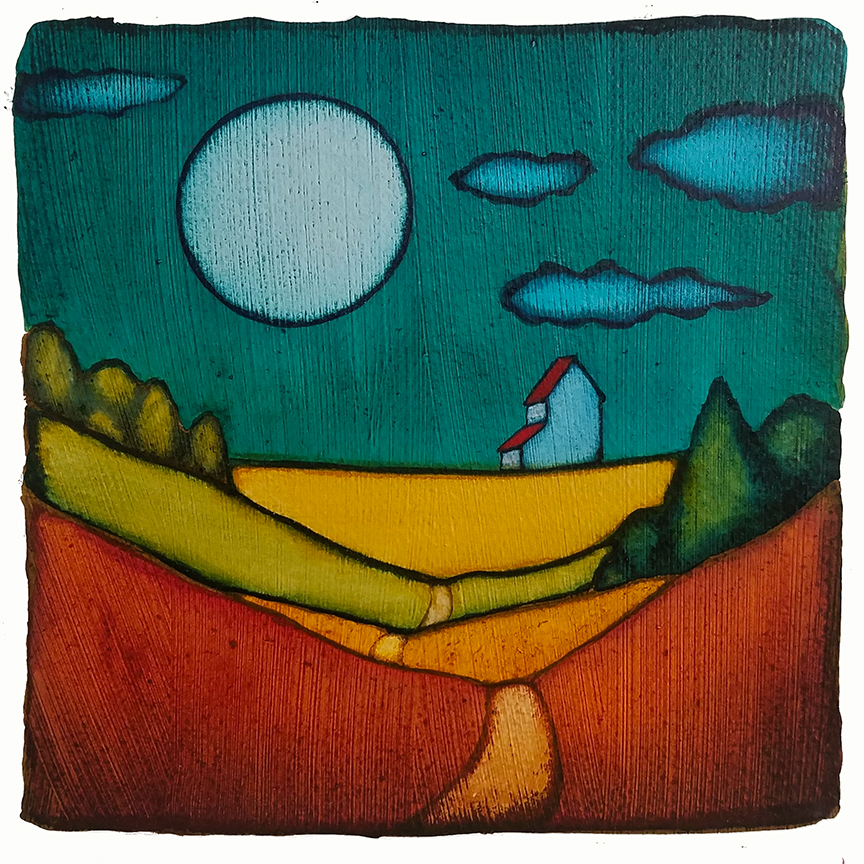
I call this painting Hunkered Down. It’s about 17″ square on paper and is part of my solo show, Social Distancing, that opens in just over a month on June 5th at the Principle Gallery.

Choosing the title for this piece, or for the show for that matter, was not a difficult task. Hunkered down is the term that most often jumps to mind when I think of this time of keeping socially distant.

The fact that this is the normal form of existence for me made it even easier.

Avoiding people and not having to go anywhere is something I have practiced for decades. I never thought of wearing a mask but like the idea of the vague anonymity it provides. Now that it’s acceptable and required, I might continue to wear one even after this thing someday subsides.

That is, if I ever leave my property again.

That’s a big if.

This piece is a return to my older style in transparent inks, more spare in detail which allows the primary elements, the simple forms of sky and land, to carry the larger part of the emotional load. This lack of detail brings a quietness to the whole that speaks volumes, at least for me.

The first song that came to  mind when I thought of an accompaniment to this painting was an old favorite from Elvis Costello, Almost Blue. There are several versions of the song that I like so I had some choices. I have played a wonderful version that is an absolute favorite from late jazz great Chet Baker here before so I decided to play a nice simple and spare performance of the song by Elvis himself from a 2005 radio broadcast. I also threw in a version that I also like very much from, Diana Krall, who also happens to be his wife.

Have a good Sunday. Be careful out there, okay?

****************


Read Full Post »

***********************

“He who does not understand your silence will probably not understand your words.”

― Elbert Hubbard

***********************

The painting above is called Endless Time, from back in 2008. It’s what I might call one of my Big Quiet paintings. Just color and forms. No central objects to garner the focus. No Red Trees or Red Roofs or Red Chairs. Not even a far point that seems like a destination.

I am not passing through, not heading anywhere past this point nor concerned with paths to follow.

In this piece, I’m just there. Now.

It’s a place without words. Pure silence.

The Big Quiet.

I would try to describe it further but unless you know or seek the Big Quiet yourself, as Elbert Hubbard points out above, you probably won’t understand.

Silence and quiet is a subjective thing as our recent isolation has proven. For some, it is a glorious thing without the sounds of traffic and crowds. For others, it is horrifying, maybe a reminder of the stillness of the grave.

We all experience the silence differently.

I think you know where I stand on the Big Quiet.

Enough said.

Read Full Post »

« Newer Posts - Older Posts »