Take your hand and place your hand some place upon your body. And listen to the community of madness that you are.
—How To Be Alone, Pádraig Ó Tuama
I am up and alone in the studio at 4:30 this morning, eager to get a brush in my hand. It might sound crazy but that doesn’t matter to me right now. I am excited about the work for my Principle Gallery show in June that I am working on and feel a compulsion to keep at it out of the fear that this feeling will soon pass.
But for as excited as I am still about the new work, I am not ready to show a lot of it quite yet. Something makes me want to hold most of it back for a bit, as though showing too much of it will somehow diminish the impact of it as a whole. Actually, the gallery hasn’t even seen a lot of this work, probably for that same reason.
I’ve spent more time already from this early morning than I had wanted before I get to work so I will get to the point of this post. It’s the author’s reading and animation of a piece, How To Belong Be Alone, from Irish poet Pádraig Ó Tuama. It’s a wonderful short poem that speaks to the need to belong which is similar to that driving need to have my voice heard that brought me to painting.
Some days I find myself questioning whether that need to have my voice heard is a necessity or a product of ego. I mean, here I sit writing about my paintings. Isn’t that an act of ego?
Part of me says that it is. But part of me rejects that idea. After all, we all need to know that our voices are heard, that our existence matters, that we belong in this world. Maybe if I believed that my voice or my work deserved to be heard and appreciated above all others or that it mattered more than that of anyone else, maybe then it would be an act of ego.
But I don’t believe that. We all deserve to let the world hear the voice of our unique selves. Each is as valid and valuable as the next.
I think this poem speaks well to this point.
… listen to the community of madness that you are.
Okay, got to get to work. before I burst. Take a look please.
From my seat here, I am looking across the studio at a canvas on the easel. It was nearly finished when yesterday’s painting session came to an end. It was just at that point where it was making the vital transformation into something more than just paint smeared on a surface. The most exciting and gratifying part of the process for me.
Thoughts of this piece haunted me all last night and were there waiting for me this morning. I was envisioning where my next move on the canvas would come and how it would blossom after that.
I found myself eager to move quickly through the woods and over to the studio.
Almost compelled, as though I had no choice in the matter. That painting was demanding my presence in its service, like I was serving some sort of strange psychic bondage to it. As though it was something that needed to released for my own wellbeing, and the sooner it was done, the better.
The difference, of course, that this is a voluntary thing, a welcomed binding to service. I don’t feel restrained by this.
Instead, I feel freed by the ability to follow this impulse.
It’s a hard thing to describe. And to be frank, I don’t have the time this morning to try to do so any further. That painting is waiting to be released out into the world from its own bondage. Got to go set it free.
Here’s a fitting song, I Feel Free from Cream from many moons ago, back in 1966. It has a real atmospheric, cinematic aspect to it. The painting at the top has no relevance here at all. It’s just an early piece from around 1994 that I call Winter Park. I include it this morning just because it pleases me and I am free to do this.
When I am halfway there with a painting, it can occasionally be thrilling… But it happens very rarely; usually it’s agony… I go to great pains to mask the agony. But the struggle is there. It’s the invisible enemy.
–Richard Diebenkorn (1922-1993)
I am in the middle of painting and preparing work for my upcoming shows, the first being my annual solo show at the Principle Gallery in Alexandria in June. This is my 22nd show there so there is a definite pattern of behaviors and responses that occur during this process of putting together a show.
Some are quite good, resulting in me feeling a sense of purpose or worth. Then there are others that have me wondering why I am doing this or if I am good enough. It’s a rollercoaster ride of highs and lows, sometimes both taking place within hours of each other.
Sometimes a new painting will elicit both elation and doubt. I sometimes finish a piece being totally enamored of its effect on me then begin to doubt my own feeling. Is the appeal I feel real and from the piece itself? Or is it something else? Does my own bias blind me to its flaws?
I had that happen yesterday as I finished a piece that had me very satisfied at its completion. I just loved it, thought that it captured what I felt and needed to say in it. And did so in a bold way. But within hours, my doubts dispensed with all good feelings. I felt like maybe I was seeing things in it that would not be visible to others.
I ended the day not sure what to think of it and not trusting any reaction I felt.
The words from the late painter Richard Diebenkorn above ring very true for me at times like this. There is a constant struggle in the process for me during this time of my painting year. I am up one minute and down the next. At least, I know and accept this so I don’t mistake it for something else, like a psychotic episode.
There might even be something to be gained from this struggle. Maybe it keeps down that form of blind confidence that ultimately stifles the work’s growth.
Conversely, maybe the doubt prohibits growth?
I don’t know and don’t know that I ever will. But I continue the struggle, day in and day out. And cherish the highs and persist through agony of the lows.
“Nothing is original. Steal from anywhere that resonates with inspiration or fuels your imagination. Devour old films, new films, music, books, paintings, photographs, poems, dreams, random conversations, architecture, bridges, street signs, trees, clouds, bodies of water, light and shadows. Select only things to steal from that speak directly to your soul. If you do this, your work (and theft) will be authentic. Authenticity is invaluable; originality is non-existent. And don’t bother concealing your thievery – celebrate it if you feel like it. In any case, always remember what Jean-Luc Godard said: “It’s not where you take things from – it’s where you take them to.”
― Jim Jarmusch, MovieMaker Magazine #53 – Winter, January 22, 2004
A friend of mine has picked up his brushes and is attempting to try his hand at painting. He sent a message saying that he was kind of copying my work and hoped that it was okay with me. I told him that it was perfectly fine. In fact, it was expected and maybe even necessary for someone to “borrow” from others.
That’s how I started painting, after all. For example, this watercolor from back in 1994 is my take at that time on the work of Georgia O’Keeffe. Some of you may see it immediately and some may not. I know that’s all I see when I look at it.
I liked this piece at the time but knew that it wasn’t enough of mine to really show. I hadn’t transformed it enough, hadn’t proclaimed it with my own voice.
To be honest, I didn’t fully have my own voice yet. But doing pieces like this and others that were derived ( a fancier way of saying stolen) from the work of others helped me get there.
“Borrowing” is a big part of making art. Like filmmaker Jim Jarmusch states above: Nothing is original.
You first take, but then you add your experience, your perceptions, your own way of expression to make something that is something all its own even though it may have the DNA of others within it.
The idea is to get to a point where you have transformed all your stolen ideas into something that is singular and honestly your own. Something beyond what you first recognized in the work of others.
The more intensely we feel about an idea or a goal, the more assuredly the idea, buried deep in our subconscious, will direct us along the path to its fulfillment.
—Earl Nightingale
It’s funny sometimes what you take from an experience in your life. At one point in my life I was in the retail car business, working at a Honda dealership both as a salesman and for a time as a finance manager. In order to keep their sales staff engaged and excited about pushing their product, the management there would periodically send us to seminars with industry-specific motivational speakers and would also have sets of motivational tapes from other speakers that they would encourage us to listen to in our free time.
One of the sets of tapes was from famed motivational speaker Earl Nightingale who had a deep and engaging voice that added a serious dimension to whatever he said. As I listened to his tapes, it was easy to feel my interest growing as he told his little tales and his lessons began registering within me.
One of his stories was a short retelling of a classic lecture called Acres of Diamonds from Russell H. Conwell (1843-1925), an interesting fellow who was a Baptist minister, a lawyer, a philanthropist and the founder and first president of Temple University. The lecture, one that Conwell delivered over 5000 times during his lifetime, made the point that the riches we seek are often right in our own backyards. His tale is of an African farmer who sells his farm in order to go in search of diamonds and finds nothing but failure that ends with his suicide. Meanwhile, the man who took over the farm found an abundance of diamonds and ended up with one of the largest diamond mines in Africa.
There were a lot of lessons to be learned from this tale. obviously. But the primary lesson for me was that I had to leave the car business– it was not my backyard. It was the place to which I had come in search of my own diamonds. I had not even, at that point, began to search my own backyard.
I am not sure if that was the message that management had been hoping would sink in.
Or maybe it was.
Their intent didn’t matter as I was soon on a different path, one that ultimately led me here, thankfully.
The other part of Nightingale’s message was that you had to set a course, aim for a destination. Everything was possible if you knew where you wanted to go and truly set your mind to it. He gave a laundry list of great human accomplishments that were achieved once we put our minds and wills in motion towards their fulfillment.
That resonated strongly with me. I had seen many people over the years who seemed deeply unhappy in their lives and most had no direction going forward, no destination for which they were working. Aimless, they drifted like a rudderless boat on the sea, going wherever the strongest current took them without having any influence over this motion.
If you can name it, you can do it in some form. Having a desired destination allows the mind, often subconsciously, to create a course that leads to that place.
As I said, it’s funny how things influence you. It’s been over thirty years since I heard those words but they still resonate strongly with me, even now. I try to be always conscious of the goals I set, knowing that the mind and the universe will always try to make a way for the possibility of achievement.
I run this post about every five years or so. As I say, there are lessons to be learned in every endeavor we undertake. Every job I ever held gave me something more than a paycheck. They showed me what I was and was not. In this case, I learned to work the fields that I knew and loved.
And she bare him a son, and he called his name Gershom: for he said, I have been a stranger in a strange land.
–Exodus 2:22
I was looking at the piece above early this morning. It’s been with me for a long time, since 2002. I sometimes take it for granted and don’t take the time to engage with it. But this morning I looked at it longer than I had in some time, reconnecting with what it has meant to me. Maybe it was because it’s near that time of the year when I get to indulge a guilty pleasure with my annual viewing of The Ten Commandments, the campy biblical epic from Cecil B. DeMille that always runs on ABC during the week before Easter. Or maybe it’s that the pronunciation of the Hebrew word ger which means stranger sounds the same as the shortened version of my name that my family often used for me growing up. I don’t really know but thought that it would be appropriate to share a post about it that has ran a couple of times during the many years this blog has been around.
I have been writing recently about some of the orphans, those paintings that make the rounds of the galleries and finally come back to me. The piece above is one of these orphans but it really isn’t. It’s mine alone, one of the rare pieces that I don’t think I would ever give up. Like many parents when looking at their children, I see much of myself in this painting.
Over the years I have periodically written about a group of paintings that were considered my Dark Work that were painted in the year or so after 9/11. The piece shown above is one of these paintings, painted sometime in early 2002. I very seldom consider a painting being for myself only but this one has always felt, from the very minute it was completed, as though it should stay with me.
It is titled Stranger (In a Strange Land) which is derived from the title of Robert Heinlein’s famous sci-fi novel which in turn was derived from the words of Moses in Exodus 2:22, shown here at the top. The name Gershom is derived from the Hebrew words ger which means stranger or temporary resident and sham which means there. Together Gershom means a stranger there. It is defined now as either exile or sojourner.
The landscape in this piece has an eerie, alien feel to it under that ominous sky. When I look at it I am instantly reminded of the feeling of that sense of not belonging that I have often felt throughout my life, as though I was that stranger in that strange land. The rolling field rows in the foreground remind me just a bit of the Levite cloth that adorned Moses when he was discovered in the Nile as an infant, a symbol of origin and heritage that acts as a comforting element here, almost like a swaddling blanket for the stranger as he views the landscape before him.
As I said, it is one of those rare pieces that I feel is for me alone, that has only personal meaning, even though I am sure there are others who will recognize that same feeling in this. For me this painting symbolizes so much that feeling of alienation that I have experienced for much of my life, that same feeling from which my other more optimistic and hopeful work sprung as a reaction to it. Perhaps this is where I saw myself as being and the more hopeful work was where I aspired to be.
Anyway, that’s enough for my five-cent psychology lesson for today. In short, this is a piece that I see as elemental to who I am and where I am going. This one stays put.
Here’s a little of the great (and I think underappreciated) Leon Russell from way back in 1971 singing, appropriately, Stranger in a Stranger Land…
Ah, St. Patrick’s Day. I grew up not knowing our genealogy. My mother, who would have been 89 today, was from the O’Dell family so we assumed we had Irish blood. But years later I discovered that the O’Dell name in our line had transformed over the years from the Woddell name. We were English, not Irish.
But while doing this research on my father’s side, which we always thought of as German, I found that his grandmother, my great-grandmother (who drowned in a canal in Allentown, PA just days after my dad was born but that’s another story) was fully Irish. I found out quite a bit more about her family’s past here in America though little of the actual Irish roots. However, my DNA has me at about 1/3 Irish
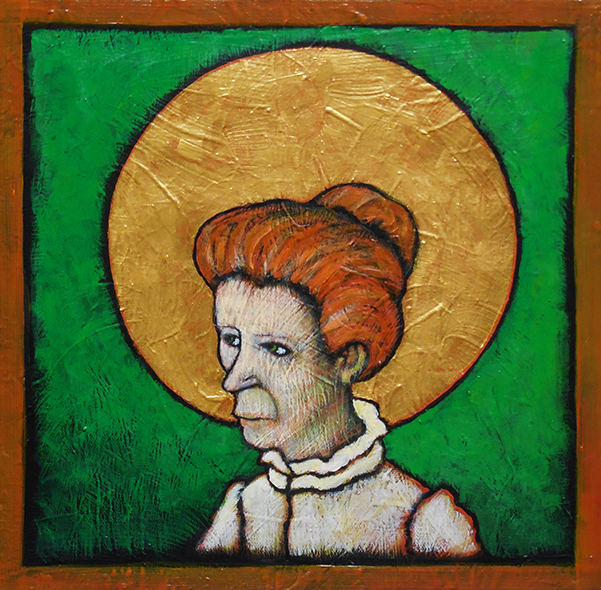
A few years ago I painted a small series of paintings of ancestors that I called Icons. One was of my great-great grandmother, Mary Tobin. I am including a post, sort of tragic in an Irish way, from a few years ago about her along with a song, The Donegal Set, from those venerable Irish musicians, TheChieftains.
Have an enjoyable St. Patrick’s Day. Or just a nice Wednesday, if that appeals more to you.
From 2016:
One of the things I am trying to emphasize with this current Iconseries is the fact that we are all flawed in some way, that we all have deficiencies and stumbles along the way. Yet, uncovering these faults in my research, I find myself holding affection for many of these ancestors that dot my family tree. Perhaps it is the simple fact that without them I would not be here or perhaps I see some of my own flaws in them.
I’m still working on that bit of psychology.
The 12″ by 12″ canvas shown here is titled Icon: Mary T. She is my great-great grandmother. Born Mary Anne Ryan of Irish immigrant parents in the Utica area she married Michael Tobin, an Irishman ( I believe he was from County Kerry but the research is still up in the air on this) who came to the States around 1850, right in the midst of the Great Irish Immigration.
Michael worked on the railroads being built throughout central New York in the late 1800’s. Following the progress of the railroads, the couple and their growing family worked their way down through the state towards Binghamton, NY where they eventually settled. Mary Anne eventually ended up as a housekeeper in a prominent home in the area. Michael died around 1890 although records are sketchy on this and Mary died at my great-grandmother’s home on Church Street in Elmira in 1914.
All told, they had seven daughters and three sons. Most worked in the then booming tobacco industry of that time and place. Most of her daughters worked as tobacco strippers and some worked as cigar rollers, as did her sons.
That’s the simple telling of the story. Looking into the back stories provide a little more depth which can sometimes change all perceptions.
None of her sons ever married and all were had desperate problems with alcohol. One son was listed in a newspaper report from some years later as having been arrested for public drunkenness around 40 times over the years, seven times in one year. He was also arrested for running a still more than once during the prohibition years. Two of her sons died in institutions where they had been placed for their alcoholism.
A Silk Spencer
I came across a story in the local Binghamton newspapers about Mary and two of her daughters, who were also working as domestics with here in the prominent Binghamton home owned by a local attorney and nephew of the founder of Binghamton. In 1874, the story reports that a number of items came up missing from her employer, including a “forty dollar silk spencer,” which is a sort of short garment like the one shown here at the right. Her neighbors informed the owner of the spencer that Mary had a number of the stolen items in her possession and a search warrant was sworn out.
Detectives came to the Tobin home and made a thorough search but turned up nothing. They then tore up the carpets which revealed a trap door that led to a small basement. There they found many of the stolen items but no spencer. But they did find a silk collar that had been attached to it.
Mary and her two daughters were arrested.
Mary did finally claim to be the sole thief and her daughters were released. I have yet to find how this particular story ends and how Mary was punished but based on the futures of some of her children I can’t see it being a happy ending.
Doing this painting, I was tempted to make my Mary a bit harsher, a lit more worn. But as I said, there’s some sort of strange ancestral affection at play even though I know she was obviously a flawed human. She’s smaller and more delicate looking in the painting than I imagine she was in reality. In the only photo we have of her daughter, my great grandmother, was sturdy looking lady. But maybe making her a bit less harsh is a little gift to my great-great grandmother for the information her story reveals about the future of my family.
This is a simple painting because, as I pointed out, this is a simple story at its surface. It’s the story of many, many families.
Knowledge of what is possible is the beginning of happiness.
— George Santayana
As St. Patrick’s Day approaches, which was also my mother’s birthday, I gave some thought to my parents this past weekend, thinking about how they influenced me early in my life. It reminded me of a post that ran many years back, in 2009.
It was a brief recollection of that time as a child when I had not idea what was or wasn’t possible in my life. Oh, I had an idea that I would never be roaming the outfield for the Yankees or taking one small step on the surface of the moon but for the most part, everything seemed in play.
To an 8 year old everything is still attainable, anything is possible. My parents never pushed me in any one direction or tell me what I should try to accomplish, mainly because they most likely because they themselves didn’t know what was possible. They simply didn’t have the knowledge needed to direct me in any way. At the time, it seemed frustrating because of the lack of direction given.
Kind of like being told that you should build a cabinet but you’re not given any materials or instructions. You had to figure it out for yourself. You had to design and build it on your own. Except it wasn’t a cabinet, it was your life.
But to their credit, my parents never discouraged me or imposed any limits on my imagination or aspirations. They gave me free rein to explore and a little help when the opportunity to do so arose. That was their form of encouragement.
It worked out in the long run. It took a lot more trial and error but the independence gained in those early years got me through the difficult times. I overlook their flaws now and focus on the appreciation I have for the things they did try to do for me, knowing that they were grasping at straws in the dark. They didn’t know what to do, didn’t know what was possible. They just wanted to help. And I am forever grateful for that expression of their love.
Here is what I wrote back in 2009:
When I give gallery talks, generally there is a part at the beginning where I run through how I came to be a painter. I usually tell how I somehow came across the idea that I wanted to be a painter when I was a small child, maybe 7 or 8 years old. Don’t know what made me come to that idea.
My parents didn’t know how to foster this idea but they did react, buying me an oil painting set from the old Cardinal Paint store in Elmira, where they sold art supplies alongside their house paints. I remember standing on the street looking at the display of art supplies in the window of their store on Water Street. I think I was only there because it was next door to the S&H Green Stamp Redemption Center, the place where you traded in your books filled with those green stamps for household items. I guess S&H Green Stamps may have had something to do with me becoming a painter.
Of course, I didn’t have the first idea how to use the paints and the canvas panel ended up covered with a smear of a color that could best be described as looking like gray and brown puke smeared on a board. Unfortunately, that was not what I was hoping to see. Discouraged, I put the paints aside and moved on to other things. Many other things through the years.
Now, that might seem, at first blush, like a sad little story but it always touches me. My parents didn’t know how to go about helping me but they did what they could and never discouraged me from whatever avenue I chose to follow. I was never told I couldn’t be this or that I should be that. They didn’t know what was possible and never tried to put limits on my hopes.
In high school, I harbored dreams of being a writer and for Christmas one year they gave me a Remington Rand office typewriter. It was a reconditioned monster of a machine, must have weighed 75 pounds. I had it for years, hefting that monster from place to place, and when I did finally get rid of it, it was with great sadness. It remains one of the best gifts I’ve ever been given and is forever a symbol of my parents’ desire to encourage me.
The point of this is that my parents allowed me the freedom to discover what was possible for me in my life. Did they always go about it in the best way or guide me in any way? Probably not but that didn’t seem as important as the freedom they gave me to search for what was possible for me.
And being able to find what was possible, as the saying above says, is the beginning of happiness…
We sprung forward in time tonight. An hour just swept away which for me at this time of the year always gets me a little on edge, especially on this first morning. Actually, to be fair, anything that gets me out of my routine gets me a little on edge but losing time of any sort affects me the most. It’s one of those tics that seem to get more and more pronounced with each passing year.
Time!
Came in this morning an hour later and wanted to write the blog quickly to save a little of this precious stuff, this time. Of course, my computer is running oddly and my internet connection seems to be an hour behind still, it’s running so slow. So, my time-saving has gone awry as I reboot this and reboot that.
Darn you, time!
This is still not going well, technology-wise. Everything is glitchy as I write this so instead of fighting it and getting even more frustrated, I am going to wrap it up and introduce this week’s song for Sunday morning. It is, of course, Time from Pink Floyd off of their classic Dark Side of the Moon album. I realized this morning that I never play anything off this album, as much as I like it, or from Pink Floyd at all.
It’s probably a deep reaction to how ubiquitous this music was in the 70’s and 80’s. You couldn’t go a half hour on any FM station that played rock music without hearing a song from Dark Side of the Moon— or Hotel California, Free Bird, or Stairway to Heaven.
After awhile, you develop an aversion to even those things you like when you are exposed to them all the time. It’s like I really enjoy hot fudge sundaes but I wouldn’t want to have that same thing every hour of the day. Bad example. I could totally eat hot fudge sundaes day in and day out.
But now I am excited to hear these songs again since time– yes, time– has cleansed away that stench of ubiquity.
So, if you have time, give a listen. If not, get to it. You have time to make up.
And suddenly you know: It’s time to start something new and trust the magic of beginnings.
― Meister Eckhart
The magic of beginnings…
That is such an elegant phrase. Poetic. Leave it to Meister Eckhart, who last showed up here just a week or so back.
The advantage of these using these short maxims is that they can often possess meanings apart from those that were intended by the original speaker. Meister Eckhart was most likely talking about some sort of religious awakening or changing one’s life in a positive manner.
I don’t really know.
But I am pretty sure that the meaning I attach to his adage might divert from his own.
For me, the message in it rings true in regards to going back to look at work from when I was first painting, when I was just gaining a toehold on whatever direction my painting might go or what form it might take. It was a time of finding voice, as I have said many times here.
It was also a time that possessed the magic of beginnings.
It’s that time when there is a blank slate before you and you are standing there with the few tools that you have brought with you– your own experiences, your observations of the world, some desire to create something of your own, an affinity for the visual, and maybe a little time spent doodling in the columns of newspapers and journals.
But beyond these things, you are a clueless, empty vessel. Everything is new. Every day is at least one new lesson learned. Each new piece has some sort of revelation, pointing out those things that resonate and those things that most definitely do not.
Every new stroke or color was an epiphany, like discovering the “open sesame” that unlocked the door that opened to new and wide horizons of possibility.
It truly felt like magic at the time.
Now, it still feels like magic– at times. Sometimes I find myself feeling like the wizened old magician who has pulled his rabbit out of his hat day after day for twenty five years. Yeah, it’s still a great trick for those who haven’t seen it before but it has lost the thrill for the magician, has lost that excitement that came with first learning that trick, on first wanting to display his newfound feats of magic to a crowd.
So, I sometimes go back and look at these old pieces from that time, those pieces that represent the magic of beginnings for me. And I almost always find something that I have lost over time, a small thing that somehow was set aside through a conscious choice or simply forgotten.
And finding these little things reignites that magic that came in the beginning. It changes my perspective, allows me to get out of the ruts of time that have been blocking my vision.
There is inevitably something from these forays into the past that I bring back with me to the present. A reminder to do something a bit different than the way I have fallen into the habit of doing it over a long period of time. Maybe even something as basic as how I start each new painting. These old pieces may not be gems in their own rights but they have raw material whose potential I can use.
But more importantly, they have the magic of beginnings within them.


 A friend of mine has picked up his brushes and is attempting to try his hand at painting. He sent a message saying that he was kind of copying my work and hoped that it was okay with me. I told him that it was perfectly fine. In fact, it was expected and maybe even necessary for someone to “borrow” from others.



 Redtree Times