Feeds:
Posts
Comments

Archive for the ‘Biographical’ Category

Looking out the studio windows this morning and there is a little snow falling. Not much expected, just a bit more than the dusting that fell overnight. Looking out at my driveway I thought reminded me of my daily walk over here and how much easier it is this time of year than it was for the first ten years in my old rustic studio in the woods.

That studio served me well for a decade but now sits idle, as Mother Nature constantly reclaims it as her own, which has been the subjectof a blog post or two here. For all its positive attributes, when I think of that early studio, I always think first of how cold it was in the winter when the wood pellet stove would not quite keep it comfortably warm, my breath coming out in visible mists at times as I worked at my table. I probably worked for those ten winters there in about an average of 45-50°, a fact I didn’t even realize until I moved into my current studio with an efficient heating system. But I also think of the path to it that I walked several times a day and did battle with each winter snowfall on my little plow. I wrote about that path many years ago and thought I would share that today:


GC Myers- Old Studio 2007

GC Myers- Old Studio 1997-2007


For ten years I walked up the road through the woods to my old studio. It was a logging road from the two or so times the forest had been harvested over several decades and ran along a run-off creek that dries up most summers. It was just wide enough for a vehicle with two visible tracks from the tires of trucks that had climbed the gentle rise over the years and as the years passed, another track formed between them from my own footsteps.

This was the path I walked several times a day, up and down the hill. At first I thought nothing of it. It was simply a path. But over the years I began to notice things about it. I could walk the path in the absolute black of the darkest night without a problem, each step falling in a natural way directly to this path. If I tried to walk off the path it seemed unnatural and required a degree of attention to my stride so I wouldn’t stumble.

I came to realize that my trail was the path of least resistance. It was the path that carried me with the least effort. Each step fell naturally in place, accounting for the slightest change in the topography and had the same effect as water flowing down a creek.

I began to notice that the trails formed by deer and other animals were  the same. When I followed them, they would move slightly in one direction or the other, just when your stride wanted to shift naturally and simply from gravity.

It occurred to me that the movement of these paths was much like the sense of rightness I talk about in my painting. They never veer drastically, always in smooth, subtle curves. They would always  run along the grade as though were the elevation lines on a topographical map. There was a natural flow and following them required little effort or thought.

Going off the path was a different matter. It took thought, concentration and effort. There were new obstacles to overcome. Branches that crossed the path, blocking your view ahead and slapped the side of your head. Downed trees that had to be climbed over. Roots that rose through the dirt and tripped you.

It was real work.

I guess herein lies the point. If I wanted to go where others had went before me, I could follow their trail. This would be the simple and logical way. But if I wanted to go to a different place, one that was fresher and less visited, I might have to set my own path. It wouldn’t be easy. It would require more effort, more thought and the risk of not finding my way. But if I forged ahead and found my way, there would be a new hard won discovery and the sense of accomplishment that comes with it.

I could blather on a little more but I think my little lesson learned from the land (nice alliteration, eh?) has come to an end. We all choose our paths. Some take the easier trail.  Some blaze new trails.  And some go into the woods and never come out…

Read Full Post »

“The Fulfillment”- Now at the West End Gallery


To be what we are, and to become what we are capable of becoming, is the only end of life.

― Robert Louis Stevenson, Familiar Studies of Men and Books


Do you ever come across something, maybe a movie or book or song, that you haven’t thought of in a long, long time? So long that it has become almost new to you when you once again meet up with it. It makes you wonder how it has lost its place in your synapses, makes you marvel that while it has faded into almost nothingness it reignites itself anew with a bright blaze.

I had that feeling yesterday as we were driving in the car as the radio played. It was a little local station that plays an odd collection of oldies from many genres that I think I find appealing because it reminds me of the old AM stations I grew up that played a wide range of music, swinging from Johnny Cash to the Doors to Nat King Cole to Jesus Christ Superstar all within minutes of one another. Those stations represented a far wider swath of the population’s tastes that the niche stations of today. If you didn’t like what was on wait a minute and something more to your taste would surely be there soon.

Anyway, a song came on our little eclectic station and the intro caught my ear. I couldn’t recognize it at all. Usually, a song you know reveals itself within a second or two, those opening chords are so imprinted in your mind. But this lead in didn’t sound familiar at all even though I really liked it and wanted to hear more.

But as soon as the vocals entered I knew what it was. It was like a light went on and something in a closet that had been hidden for 40 years was suddenly rediscovered. Something you didn’t realize you were missing all this time.

It was just great to hear this song once more and it kept playing in my head until I went to sleep last night. I woke up and was humming it as I walked over here in the dark this morning. Maybe it was the song and the simple message attached to it.

And it is simple. Be what you are and celebrate that fact.

So simple that we sometimes forget and try to be people and things we are not. We sometimes desire to be something other than what we are when the fulfillment of this life comes in loving who and what you are.

That’s my lead in to this song. It’s I Shall Sing from Art Garfunkel in 1973. The song was written and recorded by Van Morrison in 1970 but it’s the Garfunkel version that resonates best with me. That happy, celebratory calypso beat just fills the song with an ebullience that adds depth to the meaning behind the song. Glad to have reencountered this song at this moment.

I needed it. Give a listen, if you’re so inclined.


Read Full Post »


Finally finding a groove in the studio and need to get back into it so I just want to play a song this morning. Little comment and more work. The song is from the late blues legend John Lee Hooker, a longtime favorite who I haven’t played here in a while. The song is This Is Hip.

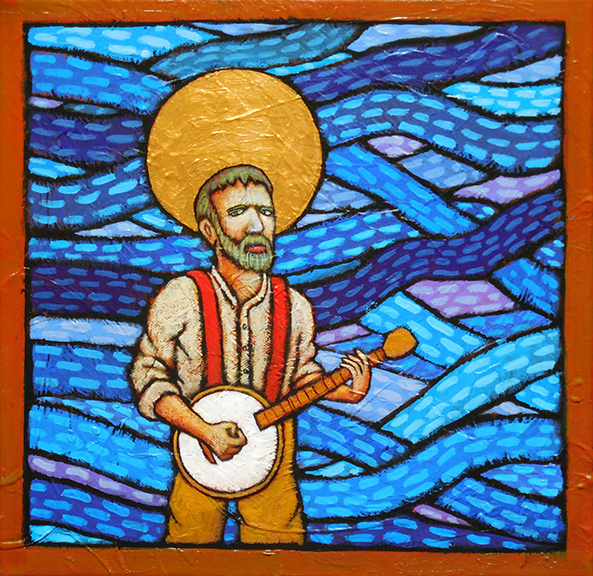
The painting at the top has nothing to do with this song. Obviously no banjo in John Lee’s work. It’s just a piece that caught my eye this morning. It’s one of my Icon paintings that represent ancestors I came across while doing genealogy. This is Joe Harris who was my gr-gr-great grandfather. He died in 1922 at age 88, and fought in the Civil War. He was also at one time in the late 19th century the United States Champion Banjo Player. At least, that’s what the headline for the article about his death in the local paper said.

For some reason, this painting just stuck with me this morning. Maybe Old Joe was pretty hip in his time.

Anyway, give a listen. Do something today. Make it a good day.


Read Full Post »


The other day, I wrote about a new piece, Shadow of the Red Eye. I wrote that the feeling I was getting from the painting was very much like the tone of my recent dreams. Almost like a premonition of some sort.

This prompted a response from a friend who wrote about how his work in construction  often has him having strange and troubling dreams that take place in worksite settings, often dealing with huge problems arising in the middle of a building project. He said he would wake in a panic then go back to sleep only to reenter the same dream. He said he usually could shake them off after finally fully waking but this very morning of the post about dreaming premonitions he had such a dream, one that had him rattled, one that he couldn’t just shrug off.

He wanted to know if I had such dreams about my painting, Maybe one where everything goes awry, where nothing works. It made me think.

I certainly know the kind of dreams he was experiencing. I think anyone who has waited tables has had those recurring nightmares of waiting on an ever expanding section of a full restaurant where you don’t know where anything is located or how anything there works, all the time more and more tables being seated in your station. I hated those dreams. I actually had one several months ago and in the middle of the actual dream I found myself saying that I I wasn’t a waiter anymore, that I didn’t have to put up with this. I woke up and laughed then went on to sleep soundly.

I am sure I had them but don’t remember my dreams, good or bad, when I ran my swimming pool business. Any nightmares I would have had most likely paled to the reality I was living. I was working 100+ hours a week and was usually so exhausted and frazzled by the time I went to be that dreams of any sort didn’t register much.

There have been other freaky, scary dreams through the years, many that lingered with me for decades– most of my life, actually– and reside within me even now.

But painting dreams?

There have been painting dreams but few have been of that frantic, things-going-wildly-wrong sort that he was having. The closest thing  was a dream I had abut a year before I went fulltime as a painter. The dream even had a name– the Van Gogh Spiral. Set in a darkened museum-like space, I came in the dream to a doorway at the center of the space. I was warned not to enter it by a person who I couldn’t make out. They warned that behind the door was the Van Gogh Spiral. As I entered, there were these bursts of rich, deep colors that all came together in the form of a downward spiral, and I descended the spiral as one might go down a large spiral staircase. As I came around the bend in each new layer, imagery would flash before my eyes becoming stranger and stranger the further I descended. I saw it as a sort of symbolic descent into some sort of madness, some nether region, perhaps an place that had drawn Van Gogh in his final days.

It was a strange and troubling dream that felt like a warning of some sort. Still don’t know what to do with this but it remains pretty vibrant with me even nearly 25 years later. 

But for the most part, my painting dreams are usually somewhat good dreams, showing me paintings that I feel I need to paint, paintings that feel perfect to me. The problem is that usually the moment I awaken, that image is gone. The memory of dreaming it  and responding to it is still there but the image itself is absent. Frustrating, to say the least. But it makes me feel like it is still in there if I can somehow work it out. 

Some painting dreams have to do with showing my work. Some are positive, with the work there beyond what I have done to this point. Again, images gone when I wake up. Some are not as good, with me struggling to get people to look at my work on the wall as they walk by with total indifference. I guess that would be as close to a bad work dream as I get.

Now, the painting at the top, Not Quite an Island, from 2013, was the result of a dream. It came to me one night and I woke up a little before 4 AM with its image in my head. One of the rare times when the image lingered. Instead of going back to sleep, I headed over to the studio and was soon working on it in the early morning darkness. It actually came out very much as I dreamed it which in itself is an oddity as any pre-visions I have of a painting seldom match up with the final work.

The conscious mind usually edits the subconscious. It’s sometimes good, sometimes not. I am trying to stop this process.

In this case, the subconscious persisted.

That, along with its symbolic implications, might be why this painting holds a lot of meaning for me. Plus, the folks who gave it a home are some of the best people I know.

If all my painting dreams could be like this one, then  would be very happy.

Okay, got to work on a non-dream painting now. Wish me luck and have a good day.

Read Full Post »


“What appears to be definite and precise does not belong to any acceptable reality. It is only the experiences, the queer previsions, the fleeting premonitions, that are real. Vague and insubstantial though they may appear to be, compared with anything else in the mists and shifting lights of Time theory, they loom up like mountains of iron ore.”

― J.B. Priestley, Man and Time


This painting is titled Shadow of the Red Eye and is part of the current Little Gems show at the West End Gallery. It’s a painting that really spoke to me when I was working on it, as well as after. It just seemed to have something to say to me the whole time.

It’s been out there in the ether for weeks now and I am still wrestling with its meaning. Some pieces are like that. Some immediately let me know what part of me, what part of my psyche and internal world, they are displaying. Positive emotions usually show themselves quickly.

Others take awhile.

They are usually darker in tone. And while their meanings may not jump out, there is a sense of certainty and reality in them. I may subconsciously try to avoid putting meaning to these pieces, not wanting to face the possible darker realities they may represent.

Maybe realities is not the right word. Or maybe I should include the word possibilities as an accomplice to realities. That would align well with the Priestley quote above which I read as being about how each of our personal realities is not just a timeline of facts and tangible data. It is not black and white. No, our reality is in shades of grays and subtle tones of black and white. It is a compilation of personal emotions and feelings in the present, interpretations and reactions to our past, and premonitions of our future. That is the reality in which we reside.

And that might be where this paintings fits in. It coincides with darker dreams I have been experiencing in my sleep lately, dreams that are a bit uncomfortable and worrisome. I wake in the morning with pangs of anxiety from them, fearful that they are some sort of premonition. Perhaps, a call out to my outer self from my inner self to pay heed to the clues it has taken notice of in the patterns and movements of the outer world. 

I am still taking this piece in so I am not really sure what it means. I hope it is not a pure premonition but is maybe more of a simple reflection of my own worries for the future. But it has a real attraction for me and maybe that comes because it feels real to me, that is has something of true meaning in it for me.

Even with my own personal uncertainty, it seems to have certainty.

Like a mountain of iron ore.


Read Full Post »

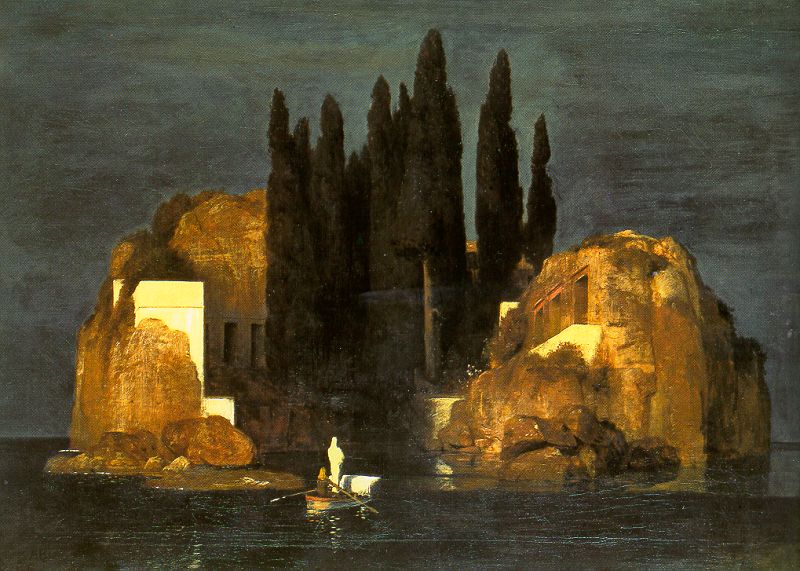
Arnold Bocklin- Isle of the Dead


I was working in the studio yesterday with the television on in the background. Born Yesterday, the 1950 film that featured the Academy Award winning, tour-de-force performance of Judy Holliday as a ditzy mobster girl friend who discovers she has a brain was playing. It’s a great film to work by, easy to follow without watching closely thanks to great writing from Garson Kanin and the very distinct voices of its main  characters– Holliday’s snorts, squeaks, and honks, Broderick Crawford‘s rough barks and William Holden‘s smooth, educated eloquence.

I have seen the film several times over the years but had missed, or at least overlooked, one part that jumped out at me yesterday. It was  scene where Holden, who is a journalist paid to educate Holliday so that she can better mingle with the DC power crowd that mobster Crawford is looking to buy into, recites a portion of a famous essay from orator Robert G. Ingersoll. This caught my ear this time because I have recently become aware of Ingersoll and have wrote about his once celebrated but now fairly forgotten life here, back in September.

Ingersoll interested me because, for one thing, his childhood home and a museum dedicated to his life is not too far from me. Once this pandemic is in the rearview I look forward to visiting it. But I am also interested in people who are widely celebrated and have great influence in their own time but seem to fall into the darkness with each new generation. Ingersoll certainly falls into that category.

This particular essay, After Visiting the Tomb of Napoleon, was wildly popular in its time. It was written in 1882 and was recorded via the new technology of voice recording– invented by Thomas Edison, a big Ingersoll fan– by Ingersoll himself and other famed public speakers. It was sold on gramophone recordings so that families could hear the words of Ingersoll in their homes, a wild concept at the time.

It goes a s follows:


After Visiting the Tomb of Napoleon
by Robert G. Ingersoll, 1882

A little while ago I stood by the grave of Napoleon, a magnificent tomb of gilt and gold, fit almost for a dead deity, and gazed upon the sarcophagus of black Egyptian marble where rests at last the ashes of the restless man. I leaned over the balustrade and thought about the career of the greatest soldier of the modern world.

I saw him walking upon the banks of the Seine contemplating suicide; I saw him at Toulon; I saw him putting down the mob in the streets of Paris; I saw him at the head of the army of Italy; I saw him crossing the bridge at Lodi with the tricolor in his hand; I saw him in Egypt in the shadows of the pyramids; I saw him conquer the Alps and mingle the eagles of France with the eagles of the crags. I saw him at Marengo, at Ulm and Austerlitz. I saw him in Russia, where the infantry of the snow and the cavalry of the wild blast scattered his legions like winter’s withered leaves. I saw him at Leipsic in defeat and disaster, driven by a million bayonets back upon Paris, clutched like a wild beast, banished to Elba. I saw him escape and retake an Empire by the force of his genius. I saw him upon the frightful field of Waterloo, when chance and fate combined to wreck the fortunes of their former king. And I saw him at St. Helena, with his hands crossed behind him, gazing out upon the sad and solemn sea.

I thought of the orphans and widows he had made; of the tears that had been shed for his glory and of the only woman who had ever loved him pushed from his heart by the cold hand of ambition.

And I said I would rather have been a French peasant and worn wooden shoes. I would rather have lived in a hut with a vine growing over the door and the grapes growing purple in the kisses of the autumn sun. I would rather have been that poor peasant with my loving wife by my side, knitting as the day died out of the sky, with my children upon my knee and their arms about me. I would rather have been that man and gone down to the tongueless silence of the dreamless dust than to have been that imperial impersonation of force and murder known as Napoleon the Great.

And so I would ten thousand times.


The essay talks of visiting Napoleon’s grave and recalling all the highpoints of his celebrated life. But after taking it in, including all the human suffering that took place due to this man, Ingersoll decides that he would rather live the life of a French peasant that lived a poor life but one that had love and family in it.

Hearing and reading this brought two things to mind. The first was a conversation I had while walking down King Street in Alexandria with another artist, many years ago now. This artist was much more celebrated than me, his work selling for much higher sums than mine which made it appealing to those in power, both in government and in the corporate world. He rubbed elbows with that crowd much more than I. As we walked, he talked about the proximity to power there in Alexandria, how you could almost feel it in the atmosphere.

He asked if being that close to it made me wish that I could access that kind of power. I didn’t even think a bit about it, answering no immediately. I knew that I was an artist for just that reason, that I didn’t want to feel the weight of responsibility that I knew I would take on in such a position. If I were to change people’s lives it would have to come on my terms, as a gentle influence and not with the power of force and will that has the potential for death and destruction in the lives of others.

To the best of my knowledge, my painting has never killed anyone nor caused anyone to lose their homes or livelihood. That sounds like a goofy thing to say but it has great comfort for me. I already worry about so much that to add the wellbeing of a whole constituency would be a burden I couldn’t bear. 

My answer surprised my companion who seemed much more open to the idea of having power. This morning, this memory along with the Ingersoll essay made me think about the 500,000 Americans who have died in the past year due to covid-19. It’s a figure that is most likely at least 10% higher when you consider excess mortality figures and take into the fact that the mitigation efforts put in place for covid-19 have more or less eradicated deaths normally seen from the seasonal flu.

But even if the figure is right, half a million folks dead and half a million families affected is a sobering thing. To be somehow responsible for even a portion of those lives would be a burden I certainly would not want to bear. I think of the former president** and his administration’s laissez-faire response and it rings a bell similar to those lines from Ingersoll. To have such a thing take place under one’s watch and to only selfishly concern yourself about one’s own desires– the cold hand of ambition as Ingersoll called it– would be Napoleonic, to say it one way.

Criminally cruel and negligent is another way.

No, I wouldn’t want the life of Napoleon or our former president. I would rather gladly live the life of a French peasant with wooden shoes. Or a simple artist painting away as the snow fell outside his studio  in the woods. 

And I would ten thousand times.

Have a good day in whatever position you are.


Read Full Post »


“Memoir” – At the West End Gallery


As machines become more and more efficient and perfect, so it will become clear that imperfection is the greatness of man.

—Ernst Fischer 


I’ve wondered about the concept of perfection for some time, given the way some folks are always going on about it and seeking it.

Not me, of course. Quite some time back, I came to that conclusion that perfection is not a human quality, that we are defined by our imperfections and how we cope with them. How we adapt and compensate for all the area in which we are lacking.

And that’s somewhat what the quote above says, as I read it.

When I read it, it struck me at once but I had never heard of the writer, Ernst Fischer.  Looking him up, I found him to be an Austrian Marxist writer/journalist born in 1899 who waved the banner for Stalinist policies for many years but in his later years– he died in 1972– Fischer came to regret his past. His memoir of his life began with a chapter that was titled Was That Me?, indicating his astonishment at looking back and seeing the many phases and changes he went through in his life.

I think most of us could start our own memoirs with that same first chapter title.

I know I could, even though I feel that I am very much the same at the core now as I was in my earlier days. However, my actions were not always consistent with that core and didn’t really reflect well on me. I did some things that were–how should I put this?— less than perfect. I was then, and am now, a walking exhibition of flaws, imperfections.

As are we all. At least, that applies to everyone I know.

Maybe it’s when we recognize what sort of person we want to be that we begin to alter and align our actions to what we are at our core. Then life becomes somewhat easier to swallow and our imperfections become less evident, not worn on our sleeves for all to see.

I’m not talking about trying to acquire perfection. No, I mean that we just try to recognize the flaws that make up each of us and to accept them. Life is in toleration- of others as well as of ourselves. And in adapting to and overcoming our shortcomings.

Please bear with me here. One of the negative aspects of doing a daily blog is that I often post things as though I were writing them in a journal, unedited and just as they fall out of the mind. They are not always fully realized thoughts or ideas and will soon be questioned in my own mind.

It’s like reading an old journal written when much younger and wondering, “What was I thinking there?” or, echoing Fischer, “Was that me?”

You hope that, as we age and gain experience, that this is a less frequent happening in our lives.  But writing in this public forum, forcing out words each day, it sometimes reappears. One’s imperfections become apparent.

Phew!  I don’t know what I just said here and I don’t really want to reread it so I’ll let it hang out there for now, flawed though it may be. Someday in the near or distant future I just know I’ll read it and ask myself, “Was that me?”


This post first ran back in 2010. Some things never change.

Read Full Post »


I too am not a bit tamed,
I too am untranslatable,
I sound my barbaric yawp
over the roofs of the world.

Walt Whitman, Song of Myself


I finished this smaller piece the other day (it is headed to the West End Gallery today) and with the Red Tree appearing to hover above the Red Roofs both near and far, all I could think of were the lines above from Uncle Walt. That’s Walt Whitman, actually, but I always think of him in familial terms not that he was anything at all like my own uncles.

These lines from Song of Myself have rang in my ears for decades and are at the core of my desire to paint and in the formation of my voice as an artist.

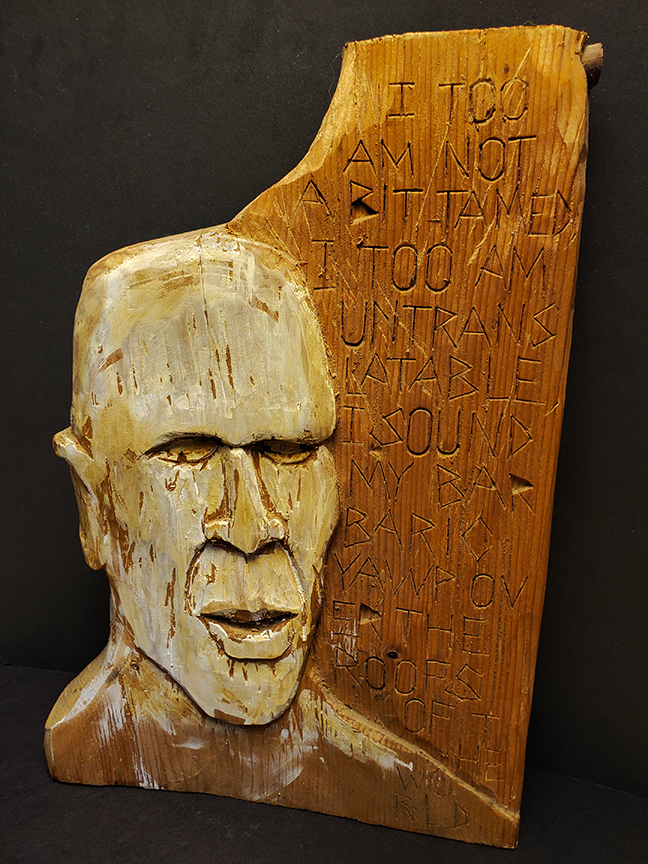
Before I even thought of beginning to paint, I tried my hand at wood carving. I did a number of bas-relief carvings that were fairly crude in a folksy kind of way. I was untrained and just went at it, much as I did later on with my painting. I believe that the painting worked out much better but the carving had a part to play for me at the time.

One of the first things I carved was a rough-hewn face with the four lines– poorly executed– from Whitman next to it. It was nothing to write home about, carved as it was from the end of an old 2×12 pine board. I am not particularly proud of it as a piece of art but it has great meaning to me and stays near me in the studio.

I have described what these words have meant to me in the past like this:

…the four lines above have been a guiding beacon for me throughout the past 25 years as I have tried to be an artist. These words instructed me to be only myself, to openly and boldly express my feelings without fear or shame. To not hide my scars, my fears or my weaknesses because they are part of my wholeness and keep me in balance. To not be underestimated or devalued by myself or anyone else. To claim a foothold in this world and bellow out the proof of my existence in my own voice:

Here I am.

There are paintings that I do that are meant to represent this thought, paintings that are meant to be plainly expressions of that Here I am. I consider them icons in my body of work, pieces that fully represent my work and what I want from it. This painting definitely falls in that category. It’s simply put but not a simple expression.

When I look at this painting I personally see myself and all my hopes and aspirations, all that I am or desire to be.

What I hope for this painting is that someone else sees that same here I am in it for themselves, that they see in it those things that make them a whole and perfectly imperfect person with a place in this world and a voice that demands to be heard.

Is that asking too much?

I immediately thought looking at this new painting that it fit into this category, that the Red Tree here represented my own need to let out my barbaric yawp, to announce my existence in this world. I am calling it I Sound My Barbaric Yawp.

It might not be quite as roughly finished as the carving but the yawp is the same.

Sound your own yawp in the world today. Have a good one.

Read Full Post »


I’m helplessly and permanently a Red Sox fan. It was like first love…You never forget. It’s special. It’s the first time I saw a ballpark. I’d thought nothing would ever replace cricket. Wow! Fenway Park at 7 o’clock in the evening. Oh, just, magic beyond magic: never got over that.

― Simon Schama


Maybe it takes the words of an esteemed British historian like Simon Schama to best describe the grand attraction of a ballpark when first seen in the waning light of the day, with the lights making the green grass and bright white chalk lines of the field pop into your eyes. I remember that feeling at Shea Stadium in the late 60’s, going up the darkened ramp from the concourse to the stands, emerging into a burst of deep colors and lights along with the buzz of the crowd increasing with each step forward.

It was magic beyond magic.

Baseball is back this week, with Spring Training beginning. For me, baseball is the canary in the coalmine. It felt odd and out of place last year with a raging pandemic and the country ripped apart by culture wars and the political apocalypse of an election that felt as existential as any we have had in recent times. Baseball was still there in a weird bubble that took away much of what made it important as a cultural touchstone.

It felt sporadic and detached.

Like most of us.

But it is coming back, as it always has each February, and with it comes the hope that we are nearing a point where we can sometime soon return to a form of normalcy. Where kids can experience that burst of color and light for themselves, can root loudly for slick fielding infielders and hard hitting sluggers. Where old farts like me can revel in the cyclical nature and routine of the game along with its esoteric details, its poetry, and its history. That

Author Michael Chabon, in his book Summerland, put words to my own feelings the game and how it echoes and rhymes with day to day life:

 The first and last duty of the lover of the game of baseball,” Peavine’s book began, “whether in the stands or on the field, is the same as that of the lover of life itself: to pay attention to it.

I have had trouble immersing myself in spectator sports this past year with all that is happening. But the start of Spring Training offers renewed hope. And that hope is a big part of the game. While personal glory and team victory are the goal, baseball is a game about how one copes with failure. It is a game of humility. The greatest players of all time failed more than they succeeded and most players go through their careers without winning the World Series. 

The hope is that if you give it your best effort, this pitch might be the big pitch or this catch will be the big catch. This hit might be the big hit.

This year might be the year.

It is a grand metaphor for the hardship and grace of life that repeats itself 162 times a year. Like life, it offers us everything if only we pay attention.

Pay attention and have a good day.

Here’s a favorite baseball tune from Mabel Scott to kick off the season:


Read Full Post »


“Everyone must leave something behind when he dies, my grandfather said. A child or a book or a painting or a house or a wall built or a pair of shoes made. Or a garden planted. Something your hand touched some way so your soul has somewhere to go when you die, and when people look at that tree or that flower you planted, you’re there.

It doesn’t matter what you do, he said, so long as you change something from the way it was before you touched it into something that’s like you after you take your hands away. The difference between the man who just cuts lawns and a real gardener is in the touching, he said. The lawn-cutter might just as well not have been there at all; the gardener will be there a lifetime.”

― Ray Bradbury, Fahrenheit 451


I recently finished this small piece shown above, a little guy that’s only 2″ by 4″ on paper. I wasn’t — and am not yet– exactly sure what meaning it holds for me, what message, if any, it carries. It certainly felt like it had something to offer.

It might be small but it seemed like it was speaking with a much larger voice. I was mulling this over this morning when I heard a new song, Calling Me Home, from one of my big favorites, Rhiannon Giddens. It’s from a new album coming out in April. There’s a line in the song that immediately struck me:

Remember my stories, remember my songs/ I leave them on earth, sweet traces of gold

It made me think of that existential question: What is it we leave behind?

That immediately brought to mind a favorite excerpt, shown at the top, from Ray Bradbury in his sci-fi/ dystopian classic Fahrenheit 451. It’s those things to which we devote or full effort, our mind and time, that have lasting effect. Often, things that are done with no real expectation of anyone recognizing your thought or effort in doing them.

It makes me think of my pond. I can see its top now in the winter since the leaves have fallen from the trees. I built it back in the summer of 1998 during a week spent pounding the hard pan soil beneath the clay of my property on a rented Cat D9 dozer. I am not sure my brain has come to rest yet from that beating. But the thrill of seeing it fill in the rains later that summer and fall along with the many life forms that soon made it their home were as satisfying as anything I have painted. I often look at it and think that it will be here long after I am gone, supporting lives of creatures that will have no knowledge of my efforts.  

And that pleases me greatly. Even as much as any legacy my work here in the studio, if any, will have.

I think I will call this little painting Calling Me Home. Not sure it’s absolutely the title others will see but if fits for me this morning.

Here’s the song from Ms. Giddens. have a good day, 


Read Full Post »

« Newer Posts - Older Posts »