Feeds:
Posts
Comments

Archive for the ‘Biographical’ Category

Well We All Shine On

“Fire and Ice”- Now at the West End Gallery


Well we all shine on
Like the moon and the stars and the sun
Yeah we all shine on
On and on and on on and on

— John Lennon, Instant Karma


This morning, I wanted to hear the song Instant Karma because it was stuck in my head as I walked through the woods to the studio at 5:30 AM. I have a song, or at least the chorus of that song, running through my head most mornings as I make this short journey and this morning it was Instant Karma. I went in and turned it on and was a minute into the song before I realized that today, December 8, marked 40 years since John Lennon was murdered in NYC in 1980.

Quite a coincidence. Maybe something in my mind, hidden from its conscious part, remembered that date and wanted to remind me. I don’t know.

But it’s been forty years and it seems like yesterday. Lennon was 40 years old at the time which means he has been dead as long as he lived. I don’t know why I brought that up. After all, we all eventually are dead for much longer than we ever lived. But for some reason I can’t explain, it seems pertinent in the moment.

A couple of Lennon’s post-Beatle songs like this, Power to the People, and Give Peace a Chance (all  are below) are personal markers from my youth, remembered always in the tones of being heard through a transistor radio or on the tinny speaker in our old Chevy. They helped form much of the outlook on the world I still maintain.

Instant Karma for instance and its message that our actions have reactions and consequences taught me about being more mindful of what I did and said. I didn’t always succeed and was usually treated to some form of instant karma that reminded me to do better the next time. Eventually, the idea that good begets good and bad begets bad got through to me.

So, this morning give a listen if you’re so inclined. If you’re of a certain age this is most likely somewhat ingrained in you and you probably have some memory of that day back in 1980 or at least some memory of Lennon in his Beatle days. Feel free to sing along: 

Well we all shine on
Like the moon and the stars and the sun

Have a good day. Shine on.


Read Full Post »


“Its was one of those events which at a crucial stage in one’s development arrive to challenge and stretch one to the limit of one’s ability and beyond, so that thereafter one has a new standard by which to judge oneself.”

Kazuo Ishiguro, The Remains of the Day


This large painting, something like a 18″ by 42″ oil on wood panel, has been hanging in my studio for quite some time now. It’s become like a permanent fixture on a wall in one of the rooms here in the studio, to the point that it sometimes surprises me when I take a moment to stop and take it in.

It’s called Challenger which came from my memories of the Challenger explosion in early 1986. I was ill with salmonella poisoning, laying on my couch in a feverish state with severe stomach cramping. I was in kind of a haze watching that day which added to the horror of the whole tragedy. I remember the brightness of that day with the light of the winter sun streaming through our windows. It just seemed too bright and positive a day for such a thing. That memory of the light still remains with me.

When first painted fifteen years later, I didn’t mean for this piece to represent that day, wasn’t looking to make a tribute of any kind. There was just something in the light and sky of this painting that brought me back to that day. I began to see the Red Tree and its posture as a sign of fortitude and determination, a symbol of the continuance of our journey even after taking such a hard blow.

Our own challenge.

We may very well be at our best when we face challenges. Any challenge, whether it is one which is taken on voluntarily or one which is forced upon us, requires us to call on all our strengths and creative powers in order to succeed because if we know beforehand that our success is guaranteed, it’s not really a challenge, is it?

I am pretty sure I have never shown this painting here before. It’s one of those paintings that I can’t judge objectively. It’s certainly not a great piece based on some standards but the inherent meaning in it makes it a memorable piece for me, at least. 

It’s one of those pieces that I am glad never found a home outside this studio. I see it as a reminder to continue to push myself to set new and higher standards, to accept the failures when they come and not be too satisfied with any successes.

To face every day as a challenge to be overcome.

And in the times, when it’s so easy to fall prey to the paralysis of angst and worry, I can use the push it provides. 

Good luck in facing your own challenge today.


PS:  My memory is fading, obviously. I actually did write about this painting before, back in 2016. However, that post focused on the piece’s strengths and weaknesses and didn’t go into the meaning behind it for me. 

Read Full Post »


“There is a time in the life of every boy when he for the first time takes the backward view of life. Perhaps that is the moment when he crosses the line into manhood. The boy is walking through the street of his town. He is thinking of the future and of the figure he will cut in the world. Ambitions and regrets awake within him. Suddenly something happens; he stops under a tree and waits as for a voice calling his name. Ghosts of old things creep into his consciousness; the voices outside of himself whisper a message concerning the limitations of life. From being quite sure of himself and his future he becomes not at all sure. If he be an imaginative boy a door is torn open and for the first time he looks out upon the world, seeing, as though they marched in procession before him, the countless figures of men who before his time have come out of nothingness into the world, lived their lives and again disappeared into nothingness. The sadness of sophistication has come to the boy. With a little gasp he sees himself as merely a leaf blown by the wind through the streets of his village. He knows that in spite of all the stout talk of his fellows he must live and die in uncertainty, a thing blown by the winds, a thing destined like corn to wilt in the sun.”

― Sherwood Anderson, Winesburg, Ohio


“Suddenly something happens; he stops under a tree and waits as for a voice calling his name.

I’ve only read bits and pieces of the writings of Sherwood Anderson but the paragraph above always knocks me out. It feels like he was somehow following me from his distant past and witnessed me stopping under ten thousand trees through the years, waiting for that voice to call out my name. He saw the uncertainty that marks my living days and saw my early recognition of our mortality, that those living days must someday end.

I want to say that I like this bit of prose simply because it’s a beautiful piece of writing but even now, my own uncertainty won’t allow that. How do I know what is good or beautiful?

It just feels that way to me because it comes so close to the bone, leaving me cut to the core.

Maybe that’s the definition of beauty.

Who the hell knows?

Anyway, just wanted to share it today along with a song from Glen Hansard that has that same close to the bone feel. Here’s his Say It To Me Now from the film, Once. The small painting at the top bears that same title, not by accident, and is at the West End Gallery. Have a good day.


Read Full Post »


“How far that little candle throws his beams! So shines a good deed in a weary world.”

William Shakespeare, The Merchant of Venice


And such a weary world it is.

It’s Veteran’s Day 2020. My sister and I visited Woodlawn National Cemetery in our hometown where my parents are buried along with my grandfathers, uncles and assorted other relatives. It’s a lovely spot that holds over 11,000 veteran graves including a sizeable contingent of Confederate troops who died as inmates in the Elmira prisoner-of-war camp during the Civil War.

I am always moved by the sight of the symmetry and starkness of the lines of the white marble stones there. There’s an inherent symbolism contained in them. To me, they’re like the heads of candles lit against the lush green of the grass.

As always, I try to read a number of the names when I wander through the stones. Some are familiar local names, some of folks that I have known or known of. But most, of course, are unknown to me.

They all served their country in some way. Some, no doubt, performed courageous and heroic deeds while others served in other ways. But beyond that, I wonder about their lives after their service, their legacies, the memory of them that remains with their families.

What light did these candles shine?

No answers for that, really. Just a question that I ask myself in cemeteries.

Anyway, I am sharing this thought fragment along with the painting at the top, Finally, Light, which I recently took to the West End Gallery. It’s another older piece, from 2008, that has been hanging in my studio for well over a decade now. It’s a piece that I have tight to for some time for reasons I can’t determine. Whenever I was gathering work to take to a gallery I would always decide that I wanted to keep this piece when I came to it.

I am pairing it with Morning Song, a lovely tune from the Avett Brothers. Enjoy and have a good day. Try to spend a moment remembering a veteran you might have known.

Let their candlelight shine a bit.


Read Full Post »


“The word was born in the blood, grew in the dark body, beating, and took flight through the lips and the mouth. Farther away and nearer still, still it came from dead fathers and from wondering races, from lands which had turned to stone, lands weary of their poor tribes, for when grief took to the roads the people set out and arrived and married new land and water to grow their words again. And so this is the inheritance; this is the wavelength which connects us with dead men and the dawning of new beings not yet come to light.”

― Pablo Neruda


Found myself awake early this morning. So many things racing through my head that it was hard to focus on trying to sleep. Big things and little things- a gnawing worry for this country and tiny nagging reminders of things that need to be done soon. All things that couldn’t be resolved at 2 AM in the woods where I live.

Then it struck me that it was around this time of the morning that my mom died 25 years ago on this very date.

Geez, 25 years come and gone. And there I was, in bed thinking of her death. 

I tried to dredge up memories of her, hoping that it would drown out the other things in the background of my mind, all screaming for attention or at least equal air time. Some memories came easily. Those are the ingrained ones that have become part of the synapses.

But I tried to dig deeper and there were only shadows of memories. Not real recollection. Maybe not even real. I don’t know for sure and most likely never will.

25 years has a way of changing things in your mind.

So, I tried focusing on the traits that I may have inherited from her, some good and some bad. Some neither. They just are what they are.

Some made me laugh. Some made me cry.

Laughter and tears. Quite the inheritance.

There are certainly worse things in this world.

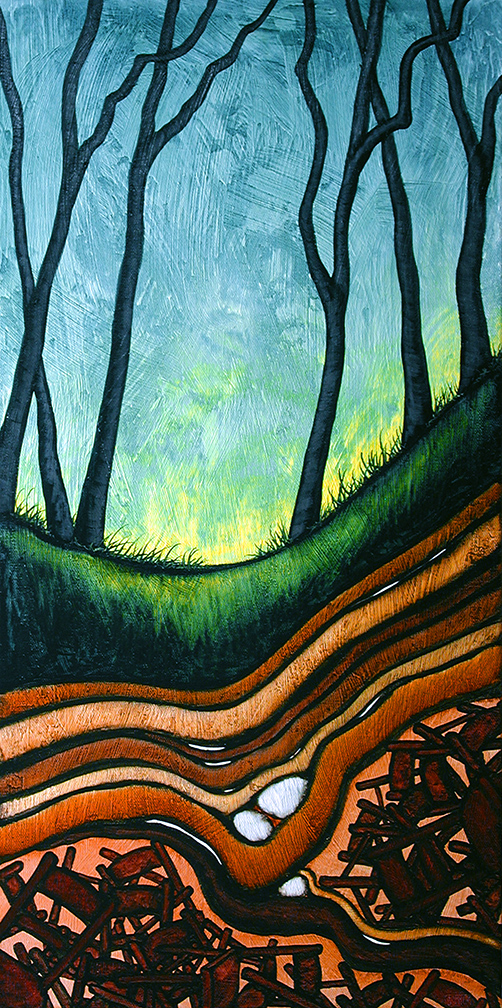
It made me think in bed of the painting above that I recently took out to the West End Gallery. Called From Whence I Came, it’s part of my Archaeology series from back in 2008. I think this piece was only shown once in a gallery before it came back to me. For some unknown reason, it found its way to the back of a closet, where it has been residing for the past 12 years. I pulled it out a few weeks back and it was like seeing it for the first time again. 

It made me think of all the choices and serendipity that it took for me to arrive at this place in the world. It’s the same for all of us. We’re all products of the decisions and events that took place throughout the history of man on this planet. One person succumbing to a virus instead of surviving it a thousand years ago and our whole history as a person would be different. 

We’re all the spearpoints, the leading edges, the very top of the pyramids of all that came before us. We were brought to this point by the bones and blood of thousands of lives before us.

All their strength. All their vulnerability.

I don’t know where I want this to go. Just thinking out loud, I guess, between the laughter and the tears.

Gotta go. Have a good day, folks.


Read Full Post »

“Light and Wisdom”- Currently at the West End Gallery

“If outer events bring him to a position where he can bear them no longer and force him to cry out to the higher power in helplessness for relief, or if inner feelings bring humiliation and recognition of his dependence on that power, this crushing of the ego may open the door to grace.”

***

“Every test successfully met is rewarded by some growth in intuitive knowledge, strengthening of character, or initiation into a higher consciousness.”

***

“The source of wisdom and power, of love and beauty, is within ourselves, but not within our egos. It is within our consciousness. Indeed, its presence provides us with a conscious contrast which enables us to speak of the ego as if it were something different and apart: it is the true Self whereas the ego is only an illusion of the mind.”

― Paul Brunton, The Notebooks of Paul Brunton


I was surprised to find I have never mentioned Paul Brunton here. I came across his work many years ago in a moment of serendipity at perhaps the lowest point in my life. I don’t think I am exaggerating in saying that without that encounter with his books, I most likely would not be sitting here this morning, writing this blog. Might not be an artist.

Might not even be. Period.

Paul Brunton (1898-1981) was a British writer who traveled to India in the aftermath of his service in World War I and encountered Hindu/Buddhist mysticism for the first time. He wrote several best selling books on his experiences that more or less brought Hindu/Buddhist to the west for the first time.

His magnus opus was published series of 16 of his notebooks, The Notebooks of Paul Brunton, containing observations and experiences. These were the books of Brunton’s that I first came across. As I said, I was at my bottom at that point and my mind was spiraling. I opened one of his notebooks and immediately found something, a short paragraph with his observation on the ego, that seemed to describe where I was at that point, something that I could latch onto.

That simple moment was a huge spark of hope. A beam of light.

I looked at the title page and saw that it was published by a organization located not too far from where I live now, my home area. I was across the country at that time and it was as though these words and that address near my home were telling me that what I needed, what I sought, was at hand, was inside me all the time.

That’s the short version of the story and it will have to suffice for today. I just thought Paul Brunton deserved a mention. He’s part of my path, my story, and when I look at pieces like the one at the top, Light and Wisdom, his words often jump to mind for me. I know that when I get spinning out of control, his words are gentle reminder of where I am now, where I have been in the past and what I was, what I am and what I want to be. 

Was, Am, Will Be.

Just keep trying and have a good day.

Read Full Post »


I have always had a passion for the beautiful. If the man in me is often a pessimist, the artist, on the contrary, is pre-eminently an optimist.

—Jules Breton (1827-1906)


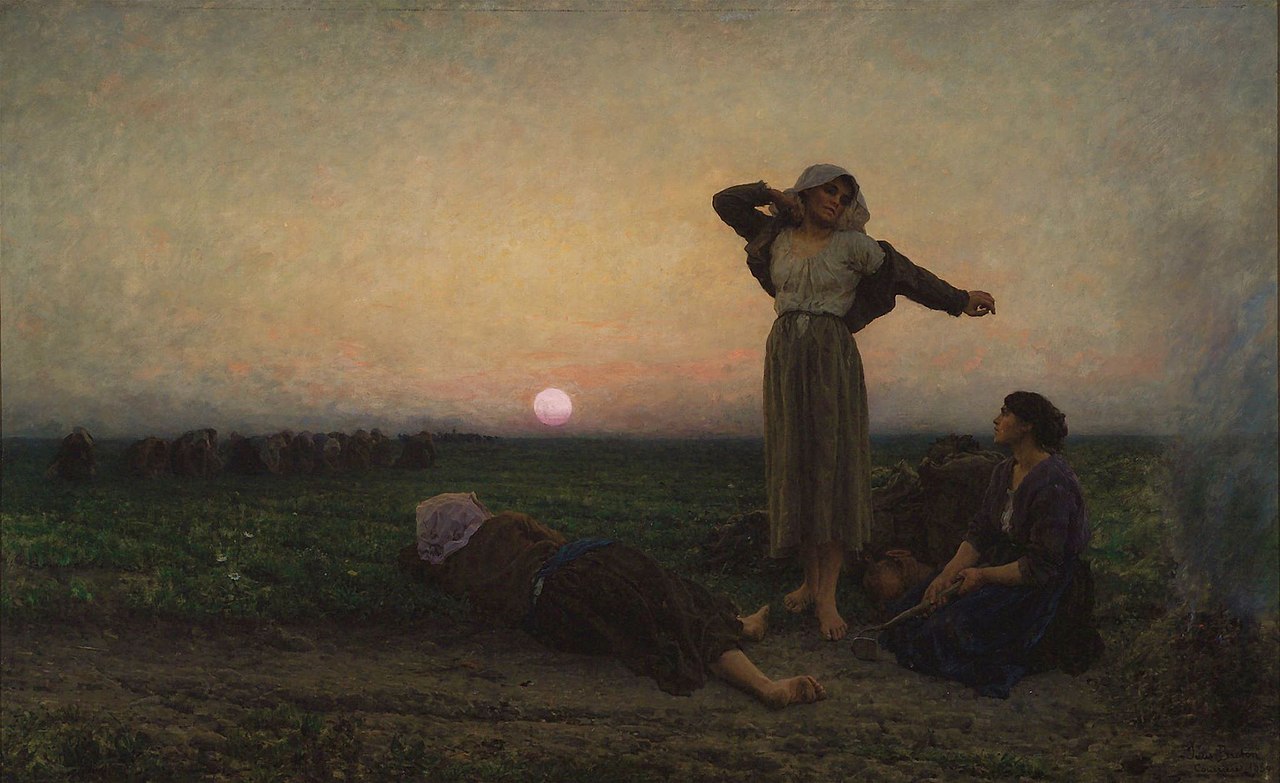
Just a short one today. I’ve used the quote above from artist Jules Breton once before here but it was with another of his paintings. The piece above of his, Le Soir (The Evening), is in the permanent collection of our local art museum, the Arnot Art Museum. It was an important painting for me, really one of the first real pieces of art with which I interacted as a kid.

In junior high school, I would sometimes ride home after school with my father. The junior high I attended was just down the street from the Sheriff’s Department where he worked and the museum was just one block over from that. So, between the end of the school day and my dad’s shift, I had an hour or two to explore a little, trying to stay out of trouble as best I could. Not always successful on that front but I won’t go into that part of the story right now.

Most days I found myself at the Steele Memorial Library which was at that time housed in a beautiful old Carnegie-endowed building. It had such warmth and was a great place to spend several hours at a time searching the stacks. Some days, however, I found myself at the Arnot Art Museum which was not yet expanded. It’s collection wasn’t large but it was quite good, with plenty of classic European paintings from well known artists of the mid and late 19th century. It was the type of work that a wealthy collector of that time would acquire on his yearly sojourn to the continent.

This piece from Jules Breton then dominated the front parlor of the museum, as it still does today. I knew nothing of art then, had only been in one museum at that point. Well, two if you count the Baseball Hall of Fame. But even with that lack of knowledge, this painting spoke volumes to me. The glow of that sun going down behind that far horizon. The tired laborers getting ready to head home from a long day in the fields. The gorgeous blend of colors that made up that sky. 

And the sense of space. It was simple and elegant. Quiet but forceful.

It was the first painting that spoke to me, the first that offered me possibilities beyond my own meager knowledge and limited opportunities. It made me think. And feel.

It remains an important piece for me. So, to see the words of Breton and whole-heartedly agree with them as an artist feels almost like coming full circle back to this painting and the small spark it kindled in me as a kid. It took a while for the spark to grow but it was always there after that.

Okay, that’s enough for today. Maybe too much.

Have a good day. 

Read Full Post »


“The tides of time should be able to imprint the passing of the years on an object. The physical decay or natural wear and tear of the materials used does not in the least detract from the visual appeal, rather it adds to it. It is the changes of texture and colour that provide the space for the imagination to enter and become more involved with the devolution of the piece. Whereas modern design often uses inorganic materials to defy the natural ageing effects of time, wabi sabi embraces them and seeks to use this transformation as an integral part of the whole. This is not limited to the process of decay, but can also be found at the moment of inception, when life is taking its first fragile steps toward becoming.”

Andrew Juniper, Wabi Sabi: The Japanese Art of Impermanence


The photo at the top is the floor of our garden shed. It’s a simple structure that we bought new probably 35 years ago. Over the years, the once pristine plywood floor has darkened, taking on a smooth rich patina on the parts that have not pitted or worn away from decades of comings and goings.

It’s a beautiful thing and I often find myself stopping while I’m in there, which is every day, just to take some small pleasure in looking at its worn surface. The fact that it took time and innumerable footsteps to smooth and wear down the surface adds to my appreciation. It’s not something that could be replicated easily. Oh, you could try but it would lose that organic depth that comes with time.

Just a bit of the wabi-sabi of things around us. That’s the Japanese concept of finding beauty in the imperfection and natural wear shown by things.

And I guess that applies to people, as well. I know I am fascinated in seeing how folks age, how their faces and bodies reflect the life they have lived. There is beauty in the lines on the face or the graying of one’s hair.

Of course, I am talking about other people. I don’t find any beauty at all in my wrinkles or my whitened and thinning hair. In fact, I close my eyes now when I walk past my bathroom mirror out of the fear that some old man will jump out of it at me. 

Nah, that’s not true. As much as I would sometimes like to have the smooth skin and the darker, fuller head of hair of my youth, I am satisfied, even pleased, in seeing the wear and tear written on my features. I see a small scar high on my forehead and remember the wound that left it so well. 

It was many years ago and I was playing with my Magpie, our highly charged husky-shepherd, chasing her around our yard. As I pursued her, I went through some low hanging branches on a birch tree next to the deck I was building off the back of our home. Midway through, as I ducked my head lower to avoid the sweep of the branches, I slammed it suddenly into a deck board that I had not yet cut off. I was knocked on my back and could feel the instant throb of pain on my forehead from the blow.

Maggie was on me in an instant, licking and urging me to get up and play some more. I laid there on the ground on my back and just laughed as hard as I could while the blood trickled down my forehead. I tend to laugh at my own misfortune, especially when it is of my own doing, which is almost always the case.

Maybe there is a bit of wabi-sabi in our laughter? Maybe it comes from the recognition of our imperfections, our humanness, in those moments?

And even while I was there on the ground, that same garden shed was not far away, its floor not yet so deeply darkened or worn. It didn’t yet have the accumulated memory of its being written on its surfaces. It was newer but it certainly wasn’t as beautiful.

And maybe that’s the attraction of this concept of wabi-sabi for me, that the wear and tear that appears is evidence of our being here, that we existed in this place and in this time. It’s much the same way in which I view my work, my paintings. Evidence that I was here, that my hand made these things and in some way my voice was heard.

That I, like that garden shed and its floor, had a purpose in this world.

Appreciate and enjoy the wabi-sabi in your own life.

Read Full Post »

My Dad, right, with Jesse Gardner


Since my dad died last week I have been thinking a lot about his life and his influence– and sometimes, lack of influence– on my life. Just trying to see if I can recognize those sometime intangible things he might have passed on. It’s not an easy task because he was not a sentimental person in any way and the idea of him trying to consciously pass on words of advice to any of his kids is unthinkable.

I wish he had because he had a lot of traits that, when I really think about it, are worth passing on.

For example, I don’t ever remember seeing him exhibit fear. I am not saying he was fearless. Who truly is? I think he just faced it and reacted to threats in a in a different way than myself. He was more than likely to react to danger with confidence and an anger directed at the imminent threat. Direct with no overthinking involved. More fight than flight.

Man, I wish I had that trait.

And I don’t remember him worrying or, at least, expressing his worries outwardly. He must have had worries, right? But he never sat wringing his hands while wailing about what might come. It was more of a just-take-it-as-it-comes attitude. 

Man, I wish I had that.

There are a lot of other little things, good and bad, that I could go over but I just wanted to contemplate what he might have really said if asked to give advice to his kids. I doubt that it would have looked anything like the list below that F. Scott Fitzgerald wrote to his daughter in 1933, which was coincidentally the year my dad was born.

That’s probably unfair. My dad was obviously no F. Scott Fitzgerald. But then again, I doubt that Fitzgerald could throw a decent knuckleball.

What advice would you pass on to a young person?

Here’s Fitzgerald’s list:


Things to worry about:

Worry about courage
Worry about Cleanliness
Worry about efficiency
Worry about horsemanship
Worry about…

Things not to worry about:

Don’t worry about popular opinion
Don’t worry about dolls
Don’t worry about the past
Don’t worry about the future
Don’t worry about growing up
Don’t worry about anybody getting ahead of you
Don’t worry about triumph
Don’t worry about failure unless it comes through your own fault
Don’t worry about mosquitoes
Don’t worry about flies
Don’t worry about insects in general
Don’t worry about parents
Don’t worry about boys
Don’t worry about disappointments
Don’t worry about pleasures
Don’t worry about satisfactions

Things to think about:

What am I really aiming at?
How good am I really in comparison to my contemporaries in regard to:

(a) Scholarship
(b) Do I really understand about people and am I able to get along with them?
(c) Am I trying to make my body a useful instrument or am I neglecting it?

–F. Scott Fitzgerald, 1933, Letter to his Daughter


Read Full Post »

Inertia


“Nothing is more obscene than inertia. More blasphemous than the bloodiest oath is paralysis.”

Henry Miller, Tropic of Cancer


The painting at the top hangs in my studio and has been a favorite of mine since it was painted five years back. Every day, I find myself often looking over at it. There’s something in it that satisfies or completes something in me. It’s 24″ by 24″, so it’s not a small piece, but I think it’s not large enough to fully transmit what is has to offer. I often wonder how it would feel as a much larger painting, say 6′ by 6′ or even larger.

These thoughts went through my head this morning before 6 AM as I found myself, coffee in hand, turning to gaze at this piece. I realized then that I couldn’t remember the title of this painting that I look at with intention each and every day. I don’t think of it in terms of its title given to it years ago.

Now, it just is. It exists free of words for me. It is defined by the moment and the circumstance in which I am seeing it.

But I had to get up this morning and go over to it and peek at the back of the painting to see its given name: October Sky.

How fitting, I thought. It’s what I might have called it this morning. That mood that produced it back in 2015 was here in 2020, as odd as it is to think that anything could be similar in any way in this most unusual year. 

I went back to my desk and continued to stare at October Sky, thinking that I should be working on a larger version, if only for myself. I could start it today.

But I probably won’t.

I’ve been ensnared in a state of inertia for a while. Been hard to get started and even harder to finish things. I have personal projects around the studio and home to still finish, commissions to work on, new work to begin and a plethora of other things in the hopper. But getting up a head of steam to simply take that first step seems so difficult right now. It feels like paralysis of some sort, one that paralyzes the mind and not the muscles.

I can’t fully pinpoint the cause behind this though there are certainly a lot of possible contributing factors. Just opening your eyes these days is an existential threat to one’s peace of mind. I don’t even think I need to find the cause.

I just need to take that first step forward and I know from past experience that the dullness of mind and body will quickly fade. It’s just getting to the point of taking that step. It’s like I am waiting for something to happen right now and am afraid to be distracted even if that distraction is my own wellbeing.

Now, that sounds more ominous than it is, I am sure. I know I will soon be past this and the work will be flowing, that the synapses will be snapping and shooting off like fireworks. In fact, I think just writing this indicates that I am nearing the end of this malaise, this paralysis of the soul.

I am signing off now. I want to look again at October Sky. Maybe today’s the day I start a larger version. Or just take a first step toward something, anything else. I think there’s something pretty damn good in there just waiting to come out so maybe it’s time to get moving.

Sounds like a plan. Let’s get to the day and make it count.

Read Full Post »

« Newer Posts - Older Posts »