Will the wind ever remember the names it has blown in the past?
–Jimi Hendrix
That’s a line from the Jimi Hendrix song The Wind Cries Mary. It’s one of my favorite songs from Hendrix and is a delicate quiet song with a ghostly quality that I think fits Hendrix’s existence in this world. It’s both strong yet fragile. On this quiet morning, before the world is fully stirring in a fury of spring activity, I thought this song would fit the moment.
_______________________________________________
Contest Reminder!
I’m asking for your help in naming this painting and am offering a prize (it’s better than you think though it doesn’t involve air travel or posh resorts) for the title that I deem fitting for the piece.
So put on your thinking caps and let me know your title for this painting. Even if it’s not chosen as the final name, your title will be included on the painting’s reverse side for all of eternity. Well, for an extended period of time. I’m just not so sure about eternity.
So, submit your title by simply commenting or email me at info@gcmyers.com
I use a single bird sometimes in my paintings. The most common meaning for me is of the bird being the watcher, overseeing everything. It represents patience and wisdom in this case.
I see the bird most often as a hawk but sometimes it’s a crow. I admire both, the hawk for its physical prowess and the crow for its intelligence. I remember watching a group of crows chase a hawk and when it appeared the hawk had nowhere to go he started leading the crows upward in long loops. As he rose, the crows closed in and just as they were about on him he made this powerful dive that carried him from above the spot where I was on a hillside to a point in the valley below, nearly a mile away. The crows couldn’t match the dive and were left so far behind they gave up the pursuit. It was an impressive escape.
Sometimes the bird represents to me a type of memento mori, a reminder of our mortality. The bird is still the watcher but more of a spirit guide.
In the spirit of this meaning, I’m segueing into a video of the old gospel song I’ll Fly Away sung by Allison Krauss and Gillian Welch. It feature scenes from the movie from which was taken, the Coen Brothers’O Brother Where Art Thou?, one of my favorites. It’s one of those films where when I see it’s on television will turn in it at any point to see what point the movie is at. I particularly like the look of the film, the way they pulled a lot of the color out, replacing it with a sepia tone that kind of gives it a dated look. The title of the movie is taken from the great Preston Sturges film, Sullivan’s Travels. In it, Sullivan is a movie director of mainly comedies who wants to make a deep, socially conscious film chronicling the poor and downtrodden, to be titled O Brother Where Art Thou? He sets out disguised as a tramp to get a first hand look at the conditions of the poor and encounters many obstacles along the way. Ultimately, his film is not made. That is, until the Coens took the baton and finished the job. Both are great, great films.
I came across a snippet of an interview with Bob Dylan where he was asked about his favorite songwriters. It was a short list with some interesting choices that might surprise some. He mentioned the late Warren Zevon and Jimmy Buffett, two artists who were more or less pigeon-holed by the success of their best known hits. For Zevon it was Werewolves of London and for Buffett, Margaritaville. But when you look deeper into their work you find a treasure chest of beautifully written, poignant songs. For instance, in the years before he became a caricature as the leader of the parrotheads (and vastly wealthy as a result) Buffett wrote several powerful albums. Living and Dying in 3/4 Time is a beautiful album.
But he also mentioned John Prine.
I don’t know how well known he is among the general public but for me he has been a giant for about 35 years, writing simple songs that mix wit, wisdom and raw emotions. His wordplay is wonderful and his melodies have deep hooks that instantly catch in my head. His first album, John Prine, is packed with classics. Angel From Montgomery, Sam Stone, Donald and Lydia, Six O’Clock News, Spanish Pipedream and on and on. But my favorite is Paradise, a song wistfully recalling a young boy going with his parents to visit relatives in western Kentucky.
It brought to mind how the idea of paradise changes as we grow older, hopefully gaining wisdom. When we’re young paradise is defined by place. Where to find paradise. For some, it might be a beach in the sun or a mountain in the snow. For others, it’s being in the midst of a big city with everything at their fingertips. We run to these places hoping to find what we define as a paradise.
But as we grow, we come to realize that paradise is not place. You can be in the perfect place and still not be happy or fulfilled. Paradise is an inside thing. You have to find it in yourself to really find it. Much like the kid in the Prine song. Doing simple things in less than glamorous environments but feeling happy, safe and secure. Kids can find paradise everywhere.
Anyway, I wanted to show this song. There are other versions out there but I like this one from many years ago. A much younger John Prine sings from his backyard. Enjoy the paradise…
In an earlier post I talked about the great American painter Andrew Wyeth on the day after he died. His father was NC Wyeth who was the preeminent illustrator of the early 20th century, illustrating some of the great books of the time.
Throughout his life, he wanted to be known not as an illustrator but as an easel painter, a fine artist. There seemed to be this fine distinction that because an illustrator brought the scenes and ideas of others’ stories to life that they were somehow below the work of those who painted solely their own ideas. I never understood that concept because it was still Wyeth who composed the paintings and created the colors and brushstrokes that distinguished the work. Wasn’t this very much the same as many Renaissance artists who painted many of their great works for the Church? Are they not considered fine artists?
I’ve always been attracted to the work of NC Wyeth having seen it innumerable times in print. There was a real dynamic quality, punch, in his paintings. However, it wasn’t until I saw his work in person that I truly appreciated how beautiful his work truly was.
He treated many of his illustrations as fine paintings, with glorious paint appplication that created beautiful surfaces within the painting. His colors were complex, hardly ever a pure single color. His blues often had glazes of red, his whites tinged with yellows. All of his colors had an earthy base that gave them a dark edge and weight. His compositions were bold and inventive, highly contrasting and dramatic to best illustrate many of the adventure stories on which he worked. In person, many of these paintings are even more stunning than on the printed page.
His non-illustrative work was much more mundane, less dramatic but well executed. His real spark seemed to be from the stories he was bringing to life. The Arthurian legends, the Leatherstocking tales of Cooper, the pirates of Robert Louis Stevenson– all seemed fresh and new in his paintings. Unlike many artists, I think being freed from having to create a narrative of his own actually gave him the opportunity to fully exploit all the knowledge of technique and composition he held. As though having the decision of what to paint taken from his hands allowed that energy that would be expended to be used on making the painting stronger. Whatever the case, whether you choose to call it fine art or illustration, the resulting work was memorable and deserves a nod. It continues to inspire to this very day.
Well, it’s the day before Easter which can only mean one thing: the annual showing of The Ten Commandments, the 1956 epic film from Cecille B. DeMille.
I always look forward to watching this movie not so much from any admiration of its quality as great cinema (though it is great moviemaking with its beautiful cinematography and color and the great musical score) but more so for the treasure trove of kitsch it bears. I love the clumsy, stilted lines of dialogue. The stylized overacting- Anne Baxter’s Nefretiri and John Derek’s Joshua are right out of the earliest, clumsiest silent films. The boo-hiss quality of Yul Brynner’s Rameses. And how can you not love Edward G. Robinson playing Dathan, snarling, “Where’s your Moses now?” in that oft imitated voice straight out of Little Caesar.
But the star is Moses. Love him or hate him, Charlton Heston was the perfect specimen for this or any epic movie. Don’t get me started on Ben Hur. His physical stature, his deep voice and his ability to deliver the most wooden lines with complete commitment make his portrayal a complete pleasure to watch. A tour de force.
Modern moviemakers always try to remake these epic type movies with full attention to every detail, trying to bring realism and authenticity to the story. But while there may be realism there is no entertainment quality and they never measure up to the very films that some of these people mock. This is is real entertainment.
So if you get a chance tonight, look in for a while (because it is a very lonnnng movie) and enjoy…
I recently picked up a book titled Baseball’s Golden Age: The Photographs of Charles Conlon. It is, as it says, a book of photos of baseball players from the first part of the 20th century. The photos are all black and white and give the players a grim, rough edge. Not that they needed the help.
From the time I was a kid I was always interested in baseball from the turn of the century. I read all sorts of books on my heroes and we had an old souvenir-like program from the 40’s that had many of these same photos with short stories and stats of many of these players. I spent hours and hours looking at these faces and names until they took on a talisman-like quality in my mind. Guys like Nap LaJoie, Rabbit Maranville, Wee Willie Keeler, Cy Young and on and on. In reality, many of these guys probably wouldn’t shine in today’s game but in my mind they were magic.
Of course, there was a hierarchy. Shown above, the Bambino, Babe Ruth, was the king. An actual Sultan of Swat accompanied by his prince, the steady Iron Horse, Lou Gehrig. Then there was the nasty tempered Ty Cobb, the Georgia Peach, shown here in one of the most famous of baseball photos of its time. Renowned for sharpening his spikes and using them on waiting fielders as he stole numerous bases, Cobb was always bitter over Ruth’s dominance of the spotlight.
These players always really stuck out in my mind because of the images and stories I encountered as a kid. They were brawny and raw looking. They drank hard. They fought. They had a hardened mythic look in their gray wool uniforms. They didn’t look like the players of my youth. In the 70’s baseball started to be played in awful multi-purpose stadiums with hard artificial turf surfaces, vast cold edifices that sapped all of the organic quality from the game. The uniforms were evolving as well. The 70’s brought these stretchy polyester space suits that only added to the artificial feel of the stadiums. I always think of Willie Stargell, a large first baseman for the Pirates with a big personality who would’ve fit in well with my old-timers) in this god-awful form-fitting spacesuit. He looked ridiculous.
It was easy at that time to drift away from the game that had provided so much magic when I was young. I stayed away for almost twenty years, barely checking the races or stats. I have a huge hole in my knowledge of the game from the 80’s and early 90’s. The return of smaller stadiums built to fit baseball saw a rebirth but it was the Yankees that brought me back. I had grown up despising the Yanks ( the voice of their announcer Phil Rizzuto was like fingernails on a chalkboard to me) but this team in the 90’s was a throwback. They had grit. They fought. They made plays that became mythic. They made me feel like I was 9 years old again, reading the wonderful hyperbole of the old sportswriters as they made mighty pronouncements about the exploits of the Bambino. Baseball was magic again.
So leafing through this book rekindled many memories. With that I leave you with a short piece of film that simply shows the great Big Train, Walter Johnson, throwing. I saw a part of this on Ken Burns’ wonderful documentary series on the game and was mesmerized by his extraordinarily long arms and the whipping action his arms. There is a kind of poetic beauty in the motion.
Maybe that’s the poetry of baseball that people talk of…
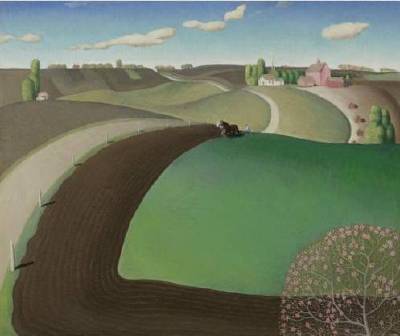
In an earlier post I spoke briefly of my admiration of Grant Wood, primarily for the rhythm of his landscapes. The piece shown to the right, Near Sundown, was a huge influence on my earliest landscapes for this rhythm. The way the hills rolled and the treeline rode them fit perfectly with the way I saw things.
I failed to mention how much I loved his use of color, the way his shapes had a darkness that gave their color a richness that really appealed to my eye. This color coupled with the way his landscapes moved in such a organic, human manner made me see that one could interpret the landscape in new ways. He took what might be considered a mundane Iowa landscape and made it seem alive and moving. It gave me hope and something to aspire for in my own landscapes.
Most people, of course, know Wood primarily for American Gothic, shown here. It is perhaps the most recognizable American painting of the 20th century, widely referenced, and often parodied, in popular culture. I really admire the way the piece is put together, the way the figures come together with the house to form a classic triangular composition. I also like the color blocking with the darkness of the clothing making a base that holds up the lighter colors.
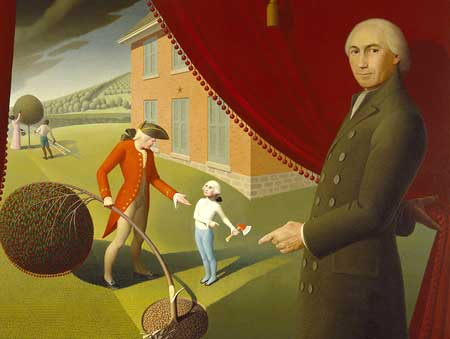
A lot of people see this as being a humorous piece, somewhat ironic. I don’t know but given Wood’s use of humor in other pieces, this may be true. A good example of his humor is Parson Weems’ Fable, below, which illustrates the famous tale of a youthful George Washington chopping down the cherry tree. The Mini-Me Washington always makes me laugh.
It’s yet another Sunday morning. Time to stop and look back at what has transpired over the past week. Have a cup of tea. Read the paper. Watch the deer walking through my yard.
Just time to stop and release some of the anxiety that builds up in a chaotic world. A time to breathe.
Something we all need, probably more often than the occasional Sunday morning.
I’ve decided to share a little music from the Beatles. This is And I Love Her from their first movie A Hard Day’s Night. I chose it because it always brings back pleasant memories and there’s something calming in those opening notes played on the acoustic guitar. Something very protective and very soothing.
One of my favorite contemporary painters is Wayne Thiebaud, a West Coast based painter known primarily for his paintings of confections, often in multiples. Things like cakes, pies, suckers, sundaes and so on. Those are the type of paintings that are his signature work and that first introduced me to his work but, while I liked that work, it was his landscapes that made me a fan.
His landscapes are often from an aerial perspective which gives them an abstract quality especially given his use of clean, bright colors. I think it is his use of color that most draws me. In print, you can’t see the texture of his work which is characterized by heavy, beautifully applied strokes. That is what stands out most in mind from seeing his work in person. A beautiful tactile look. I wanted to run my fingers over it.
I have often cited artists who have been influences on my work , people who are often giants in the world of art and sometimes lesser known but equally talented artists. Sometimes you overlook the obvious.
Last night, TCM honored the great cartoonist Chuck Jones by showing a documentary and some of his landmark cartoons starring Bugs Bunny, Elmer Fudd and Daffy Duck. He also did the Roadrunner/ Wile E. Coyote cartoons as well as the seminal holiday favorite, How the Grinch Stole Christmas. His work was and is a vivid part of an incredible number of people’s childhoods. His What’s Opera Doc? with Bugs and Elmer in a Wagnerian setting with a tragic ending is classic and might be the only exposure to higher culture that many viewers may get.
For me, I was always so drawn to the color quality that Jones had in his cartoons as well as the way he interpreted the landscape with a form of artistic shorthand that cut out extraneous detail yet never took away from the feeling of place, unlike some of the lower quality cartoons from Hanna-Barbera in the early 60’s. Don’t get me wrong. I loved those cartoons as well but even as a kid I was really distracted by the poor quality of the landscapes that scrolled continuously behind their characters. With Chuck Jones, it always felt fresh and real, as though there was thought given to every detail in every frame. Who else could put imagery like this set from What’s Opera Doc? before the eyes of impressionable children? Probably only the artists from Disney can match Jones’ work at Warner Brothers, but that’s another post.
His work also treated you, as a kid, like you had intelligence. They were smart. Clever and nuanced. They never talked down to you.
For a kid this was potent stuff. Scratch that- it’s just potent stuff. Period.
 Will the wind ever remember the names it has blown in the past?
  Contest Reminder!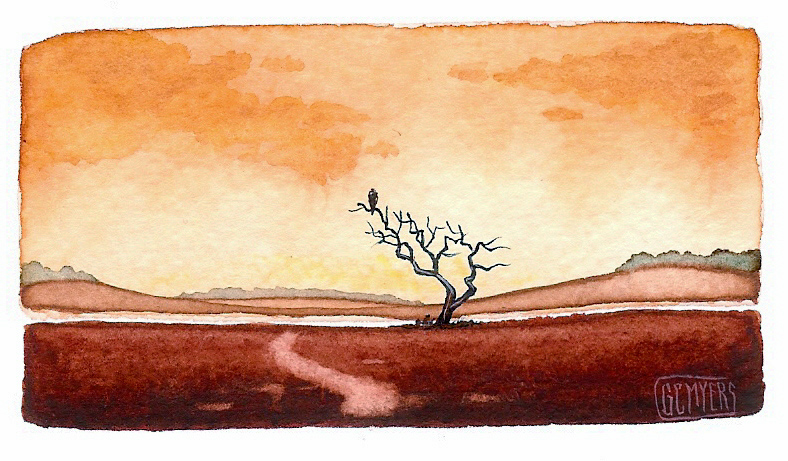





 Redtree Times

