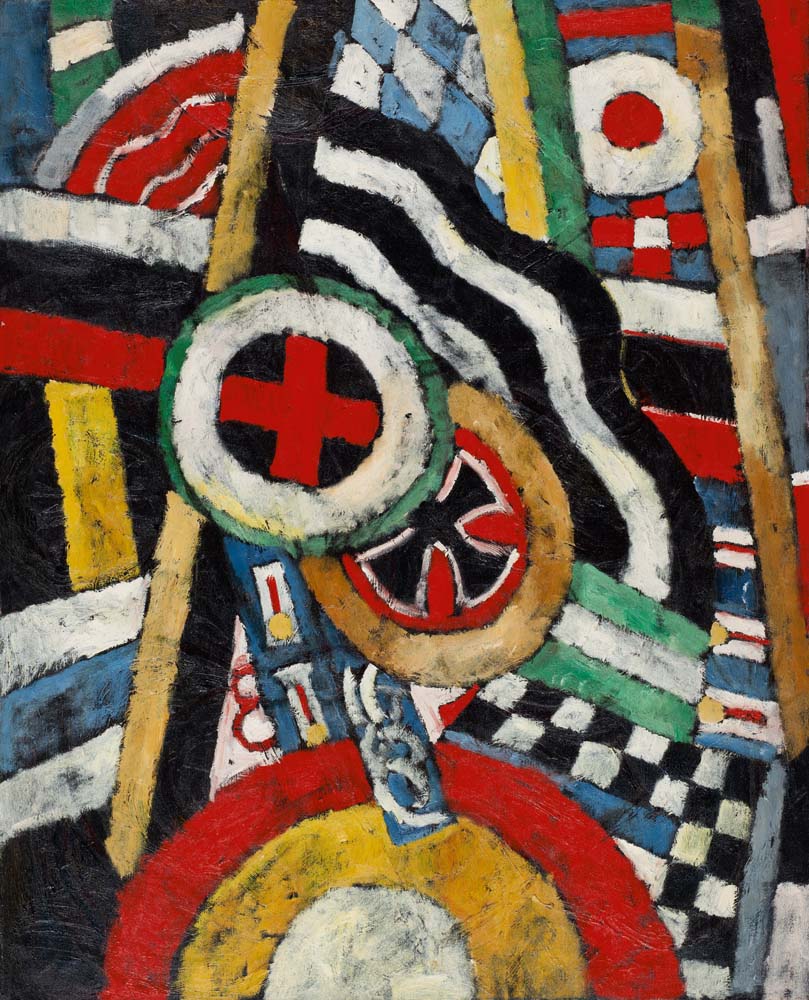
“I have always said that you do not see a thing until you look away from it. In other words, an object or a fact in nature has not become itself until it has been projected in the realm of the imagination.
~ Marsden Hartley
*************************
Marsden Hartley (1877-1943) is a favorite of mine both for his paintings and his words, which often express thoughts about painting that ring true for my own experience. For example, I love this quote above. Some of the strongest images for me are those that are taken at a glance, sometimes while driving down the highway at 70 miles per hour.
If the imagery strikes me in a powerful way, my mind immediately starts breaking down the image into a sort of shorthand, blocking in the forms and organizing them in a way that registers deeply. It is simplified but contains the elements and the effects that struck me. Sometimes I will move my arms while doing this, trying to create a muscle memory of the rhythm of that which I am seeing in my mind.
The image is thus entered into my imagination. Everything else around it that is not part of image that spoke out to me seems to not exist in that moment. It s a funny process and is deeply ingrained to the point that I don’t even think about it but for this reminder from Hartley.
… With your majestic and superior cackling hen Your people I do not understand, So to you I shall put an end And you’ll never hear surf music again…
–Jimi Hendrix, Third Rock From the Sun
*****************
It’s said that that the final line from the spoken word section of Jimi Hendrix’s Third Rock From the Sun in 1967 was a response to hearing that Dick Dale, the King of Surf Guitar, was gravely ill with colon cancer. Well, Dick Dale got past that dangerous episode and continued his reign for another 50+ years, passing away yesterday at the age of 81.
His background hardly pointed to his rise as the King of Surf Guitar. Born in Boston, Dale (the name he adopted for the stage– his real name was Monsour) was of Lebanese descent and was raised playing Middle Eastern instruments which provided the basis for his style of playing. You can really hear it in his most popular song, Misirlou. It was revived with its prominence in the film Pulp Fiction.
Dale had a great run promoting himself as the King of Surf Guitar through the years, even as surf music faded into a its niche as a nostalgic reminder of its popularity in the early 1960’s. But Misirlou had staying power beyond nostalgia. It’s just good stuff that can still get people on their feet.
So, here’s to you Dick Dale. Your music will live on. Here’s a performance of Misirlou from Dick Dale in 1995.
For this Sunday morning music, it would be hard to not feature a bit of the Irish. It is St. Patrick’s Day, after all. So I thought I’d share a beautiful version of old Irish chestnut, Raglan Road, performed by actress Cristin Milioti. Hardly an Irish name but this is a lovely version of a beautiful tune. (You can click here to see the poetry of these lyrics.) You might recognize her from her work on the second season of Fargo where she played Betsy Solverson, the cancer stricken police chief’s wife.
I thought I’d also replay a post from a few years back about one of my Irish ancestors. As I say in the post, it’s story of many immigrant families. Have a great day. You, too, St. Patrick.
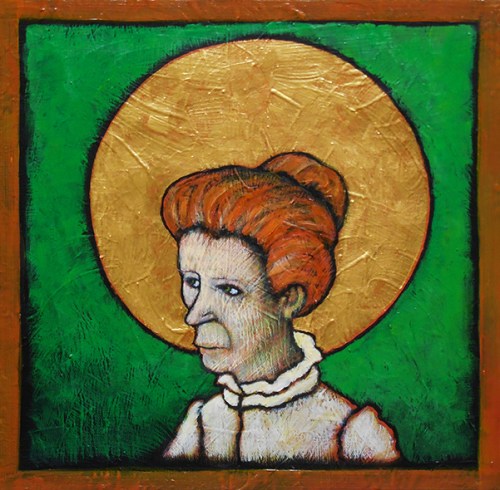
One of the things I am trying to emphasize with this current Iconseries is the fact that we are all flawed in some way, that we all have deficiencies and stumbles along the way. Yet, uncovering these faults in my research, I find myself holding affection for many of these ancestors that dot my family tree. Perhaps it is the simple fact that without them I would not be here or perhaps I see some of my own flaws in them.
I’m still working on that bit of psychology.
The 12″ by 12″ canvas shown here is titled Icon: Mary T. She is my great-great grandmother. Born Mary Anne Ryan of, I believe, Irish immigrant parents in the Utica area (though some records list her as being born in Ireland) she married Michael Tobin, an Irishman ( it is thought that he was from County Kerry but the research is still up in the air on this) who came to the States around 1850, right in the midst of the Great Irish Immigration.
Michael worked on the railroads being built throughout central New York in the late 1800’s. Following the progress of the railroads, the couple and their growing family worked their way down through the state towards Binghamton, NY where they eventually settled. Mary Anne eventually ended up as a housekeeper in a prominent home in the area. Michael died around 1890 although records are sketchy on this and Mary died at my great-grandmother’s home in Elmira in 1914.
All told, they had seven daughters and three sons. Most worked in the then booming tobacco industry of that time and place. Most of her daughters worked as tobacco strippers and some worked as cigar rollers, as did her sons.
That’s the simple telling of the story. Looking into the back stories provide a little more depth which can sometimes change all perceptions.
None of her sons ever married and all had desperate problems with alcohol. One son was listed in a newspaper report from some years later as having been arrested for public drunkenness around 40 times over the years, seven times in one year. He was also arrested for running a still more than once during the prohibition years. Two of her sons died in institutions where they had been placed for their alcoholism.
A Silk Spencer
I came across a story in the local Binghamton newspapers about Mary and two of her daughters, who were also working as domestics with here in the prominent Binghamton home owned by a local attorney and nephew of the founder of Binghamton. In 1874, the story reports that a number of items came up missing, including a “forty dollar silk spencer,” which is a sort of short garment like the one shown here at the right. Neighbors informed the owner of the spencer that Mary had a number of the stolen items in her possession and a search warrant was sworn out.
Detectives came to the Tobin home and made a thorough search but turned up nothing. They then, acting on a hunch, tore up the carpets which revealed a trap door that led to a small hidden basement. There they found many of the stolen items but no spencer. But they did find a silk collar that had been attached to it. Mary and her two daughters were arrested.
Mary did finally claim to be the sole thief and her daughters were released. I have yet to find how this particular story ends and how Mary was punished but based on the futures of some of her children I can’t see it being a happy ending.
Doing this painting, I was tempted to make my Mary a bit harsher, a lit more worn. But as I said, there’s some sort of strange ancestral affection at play even though I know she was obviously a flawed human. She’s smaller and more delicate looking in the painting than I imagine she was in reality. But maybe that’s little payback for the information her story reveals about the future of my family.
This is a simple painting because, as I pointed out, this is a simple story at its surface. It’s the story of many, many immigrant families.
“You study, you learn, but you guard the original naïveté. It has to be within you, as desire for drink is within the drunkard or love is within the lover.”
― Henri Matisse
*******************************
I can always turn to Henri Matisse for something interesting, either in his work or in his words. While he was prolific in his painting there is also a wealth of quotes, interviews and essays from him that give insight into a warmly wise and giving spirit. I will admit that there are painters whose body of work more readily excite me but the words of Matisse never fail to provide inspiration and reassurance when I am seeking some form of validation of what I am doing.
For instance, he speaks of maintaining one’s own original naïveté as one learns and grows as an artist. That rawness and the natural sense of excitement that comes with it, is something I have also felt was important to maintain even as my craft has grown. I see the raw energy of naïveté as the blood that gives a painting its life force, that allows the viewer to see past the improbabilities and imperfections and see the beauty and truth being presented.
Maintaining that naïveté is much more difficult than you might think. You sometimes have to fight against the proficiency gained through years of practice and trade the reality of the world shared with everyone else for the reality contained within yourself, trusting that this inner world, imperfect as it is, will have a commonality that might speak to similar inner worlds among some of those who view it.
And that brings us to another favorite Matisse quote, below. The link to the universe he mentions is very much the same thing that links one’s inner world to that of another. At least that’s how I see it. This seems like a good spot to end this. Have a great day
***************************
“We ought to view ourselves with the same curiosity and openness with which we study a tree, the sky or a thought, because we too are linked to the entire universe.”
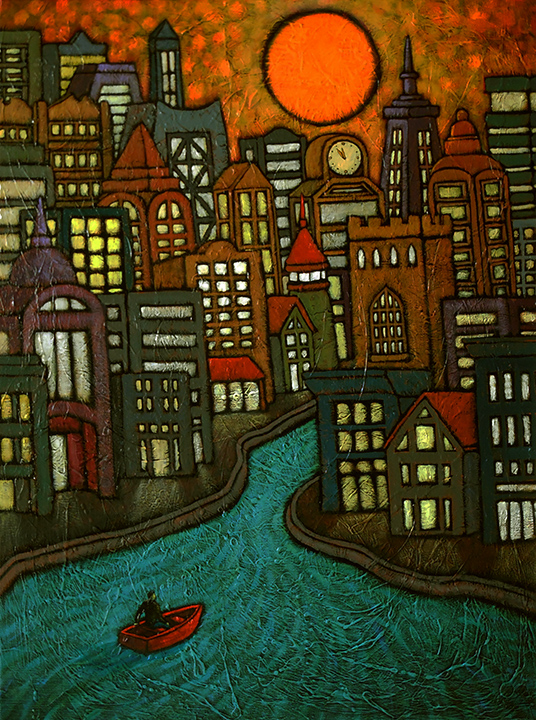
Daylight Savings Time! Woke up late this morning so I am hustling around trying to get to a piece on the easel that has been gnawing at me overnight. I just realized yesterday that in all the time I’ve been doing his blog and sharing some of my favorite music I hadn’t played any Jimmy Reed, the late great bluesman. Going to rectify that today. I came across his albums when I was teen and some of his songs from the 50’s and early 60’s remain among my faves including Big Boss Man (You ain’t so big/ You just tall That’s all), Baby What You Want Me to Do ( You got me runnin’/ You got me hidin’), Ain’t That Lovin’ You Baby, and the song I’m sharing below, Bright Lights Big City.
Thought the painting above might fit. It’s fairly new and is one that I am still taking in mentally. There’s a lot going on and I thought the idea of being taken in by the movement and bright lights of the big city as one approaches it was a nice complement to the song.
It’s just another reminder of who’s in charge from Mother Nature this morning as the temps here again sit at zero. There’s bright sunshine out there with the angle of the light making your mind believe that Spring is at hand and that, like the words of A.A. Milne in the bit of verse above, Winter is dead.
Stepping out into it, you realize that it was just another cruel trick. The air is sharp like a fresh razor blade. More so because your mind was telling you it would be warmly caressing your skin instead of biting at it.
Well played, Mother Nature. You got me again.
But Spring is coming and the seemingly endless wait will make the arrival of green grass and the first peeks of bulbs breaking the ground all the more special. The beauty of contrast.
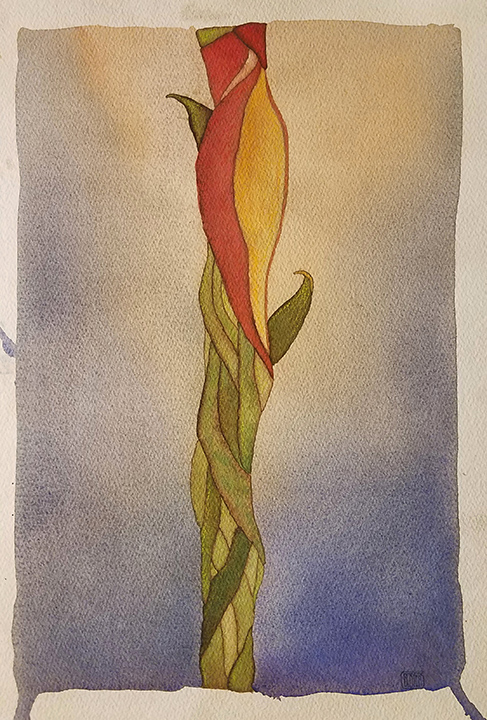
The painting above is an old piece from about 1994 or 1995. It was among a small group painted at that time that was meant to have an object serve as a pole bisecting the picture plane with the light seeming emanating from it. Kind of in a Georgia O’Keeffe manner. I did a few of these pieces with imagined flowers or tree trunks.
Don’t know why I didn’t continue following this path because I am generally very pleased with them when I come across them. They have the sense of completeness and color interest that I still seek in my work. But at that point, every day of painting brought so many new discoveries and ideas that it was sometimes hard to decide which way to turn next. I had so many sparks being generated in my head that it would not have been possible to follow them all.
That changes over time, of course. New discoveries are fewer and farther apart. Sparks still come, many with the same intensity, but they create a low banked fire now instead of the roaring blaze that it seemed like when everything was new.
When everything was new…
And that brings us back to Spring. Maybe that’s the attraction, trying to tie one’s own personal renewal to that of the Earth. If so, I will be green again soon.
A little busy this morning but never too busy to stop for a brief moment to consider an image or a few words from Andrew Wyeth. The words and image above are a good example. I just love this quote. It’s an idea–that a piece of art should not be judged on its craftsmanship but on how well it conveys emotion and beauty– that has always rang true for me.
Craftsmanship should not be seen as the goal but rather as a means, the handmaiden as Wyeth terms it, to get there.
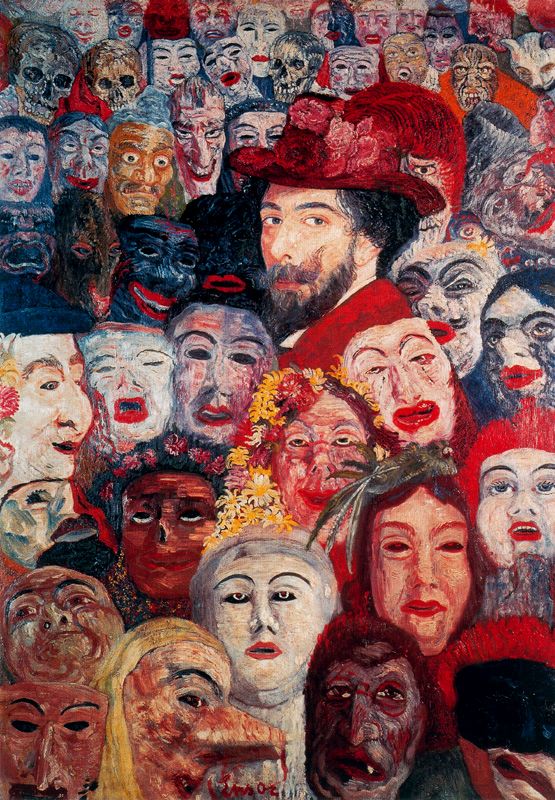
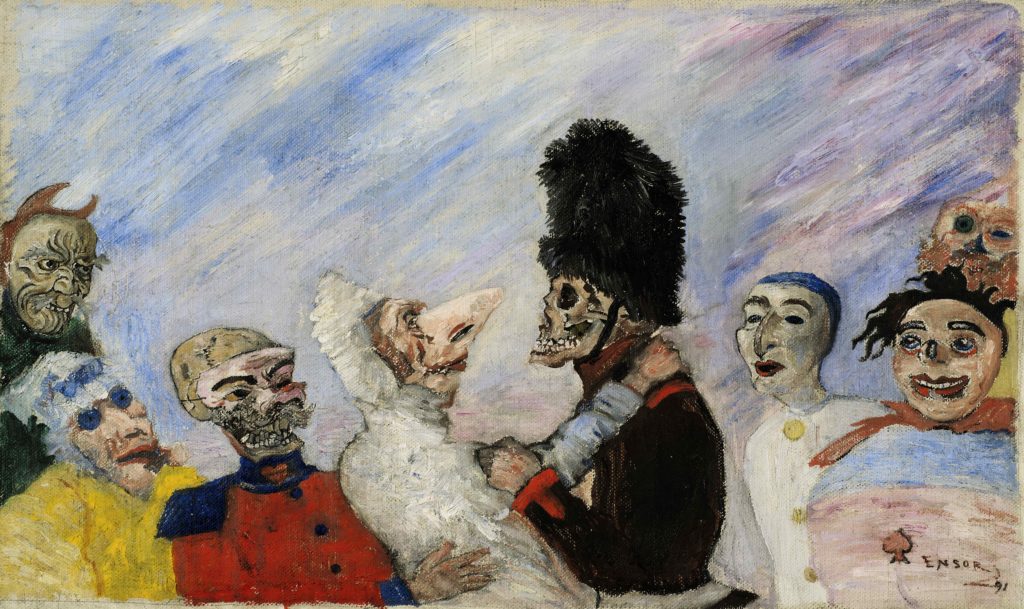
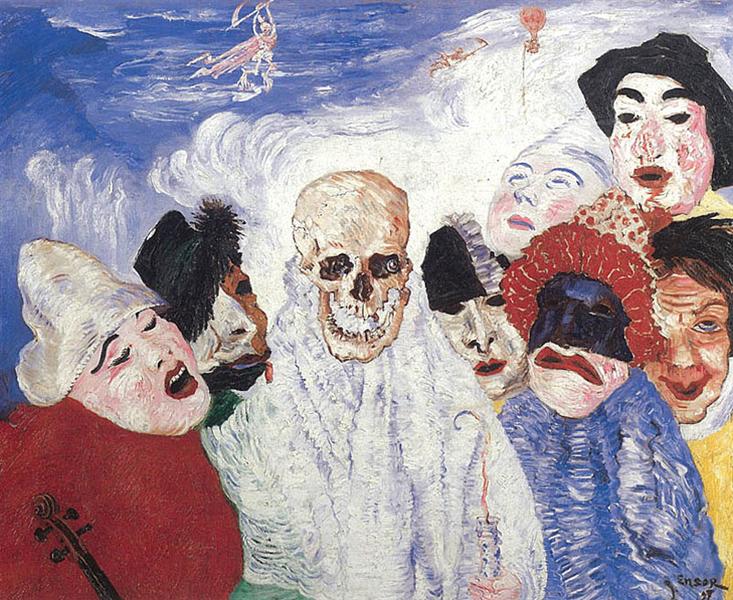
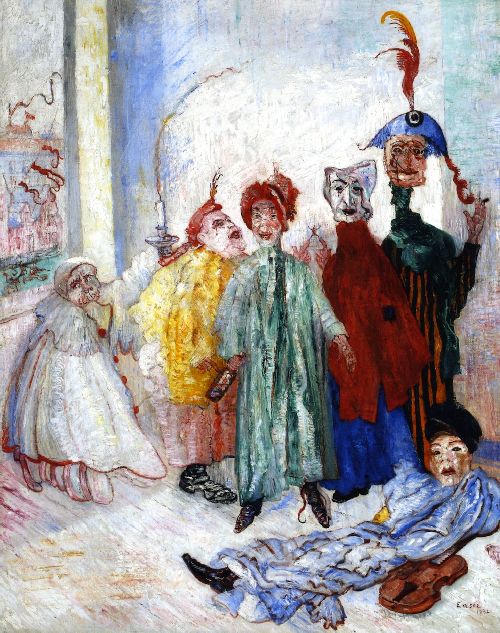
The mask means to me: freshness of color, sumptuous decoration, wild unexpected gestures, very shrill expressions, exquisite turbulence.
–James Ensor
*******************
As has been pointed out here, I have been working recently on some new work with large groups of faces, heads, masks, multitudes or whatever one sees in them. It has been exhilarating, with the work pulling me back into a rhythm where I am eager to see what the next work brings. While that is a great feeling in itself, I am still deliberating over where the work might take me, still trying to decide if it is work that is just meant to cleanse the system or if it is a new path to follow in some way.
I turn for a bit of advice from art history going back to James Ensor (1860-1949), who I featured here a few years back with a post about his famed painting Christ’s Entry into Brussels in 1889. Ensor was well known for his paintings featuring groups people wearing contorted and strange, even grotesque, masks. Many were based on the masks seen at the carnivals and festivals of the time in his native Belgium. But seen out of context, they were pretty controversial, as you might imagine, in the late 1800’s, given the subject matter and the rough method of much of his painting. This was around the time that the work of the Impressionists was still considered scandalous so you can imagine how the image of a soldier with a skull for a face embracing a maiden with a gigantic nose mask might play.
It’s fascinating work. Wish I could tell you more but the images themselves tell me a lot and inform my own work by providing fresh inspiration for new work. Just looking at this work this morning has me itching to get to the easel.
Take a look at some of the work of James Ensor and see if it does anything for you.
Ensor- “Christ’s Entry into Brussels in 1889”
Ensor- “Portrait of the Artist Surrounded by Masks”
I don’t have much time but I wanted to share these images taken by the probe Voyager I way back in 1979. Hard to believe these are forty years old but I guess that’s a mere eyeblink in astronomical time. These are of the Great Red Spot on the planet Jupiter with the one at the top having Europa, a moon of Jupiter, in front of it.
The bottom is a little more detailed view of the Great Red Spot. I wish I had the ability to paint in the way this image comes off. Whenever I stumble across these images, I am astounded at their abstract beauty.
The artist performs only one part of the creative process. The onlooker completes it, and it is the onlooker who has the last word.
—Marcel Duchamp
*******************************
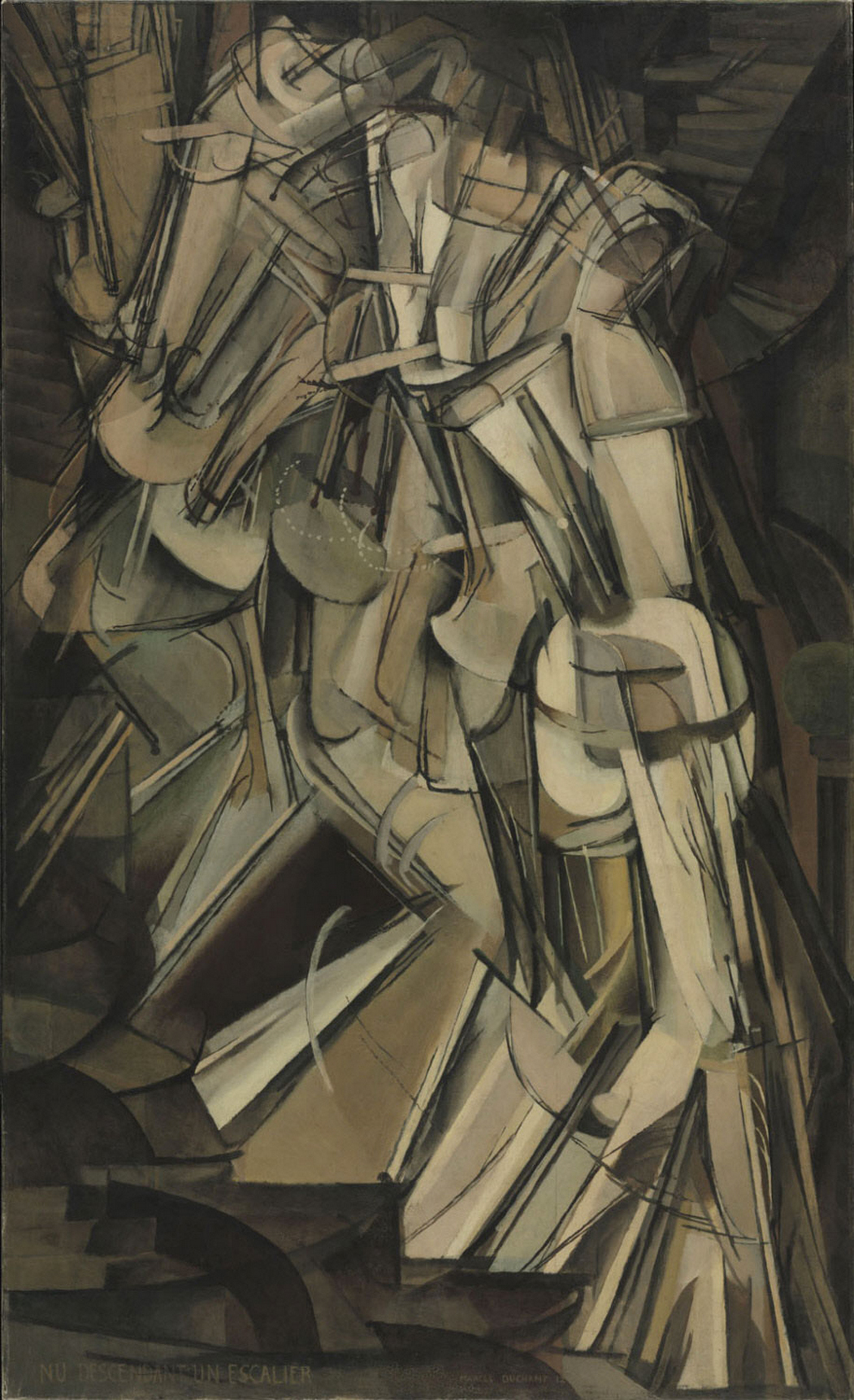
I can’t say I have always fully appreciated or understood all of the work of Marcel Duchamp (1887-1968). The French born artist is best known for his Nude Descending a Staircase #2 (above) which was the center of the fabled and highly influential Armory Showof 1913. The Cubist painting was considered a shocking departure from the norm, breaking the human form and its motion into abstracted blocks and lines. For an art world that was still basically reeling from the push of Impressionism against traditional academic style painting, it seemed like a gateway to total chaos.
Perhaps it was the notoriety from this show and the effects of World War I that pushed Duchamp even more away from the art establishment of that era. His work became more and more provocative, as he became associated with the Dada movement which rejected all the norms of traditional art. You may know his 1917 sculpture, Fountain, which was a urinal signed with the pseudonym R. Mutt. Shocking the world at the time, it is considered a Dada masterpiece and one of the most influential works of the 20th century.
The thing I find interesting is that after the late 1920’s, Duchamp, still a relatively young man, more or less gave up the making of art and focused on playing chess. He viewed the game as more pure than art in that it was beyond commercialization. He did little art making in the time until his death in 1968.
But while Duchamp, with his contrarian nature, remains an enigmatic character for me, I do heartily agree with his words above. Art is not completely in the making of it. It is the viewer and the impression of the work that they carry with them that completes the artwork. Regardless of how or why the artist created the work, it is the impression that the work makes on the viewer that matters. A deeply personal piece that is that is beautifully crafted may not have the same impact as one that is rough and crudely executed.
That remains the last word of the viewer and what the see and feel in the work.
And that will always be a mysterious and sometimes confounding thing that is beyond the control of the artist.
 *************************
 One of the things I am trying to emphasize with this current Icon series is the fact that we are all flawed in some way, that we all have deficiencies and stumbles along the way. Yet, uncovering these faults in my research, I find myself holding affection for many of these ancestors that dot my family tree. Perhaps it is the simple fact that without them I would not be here or perhaps I see some of my own flaws in them.









 Redtree Times