Feeds:
Posts
Comments

Archive for the ‘Favorite Things’ Category

+++++++++++++++++

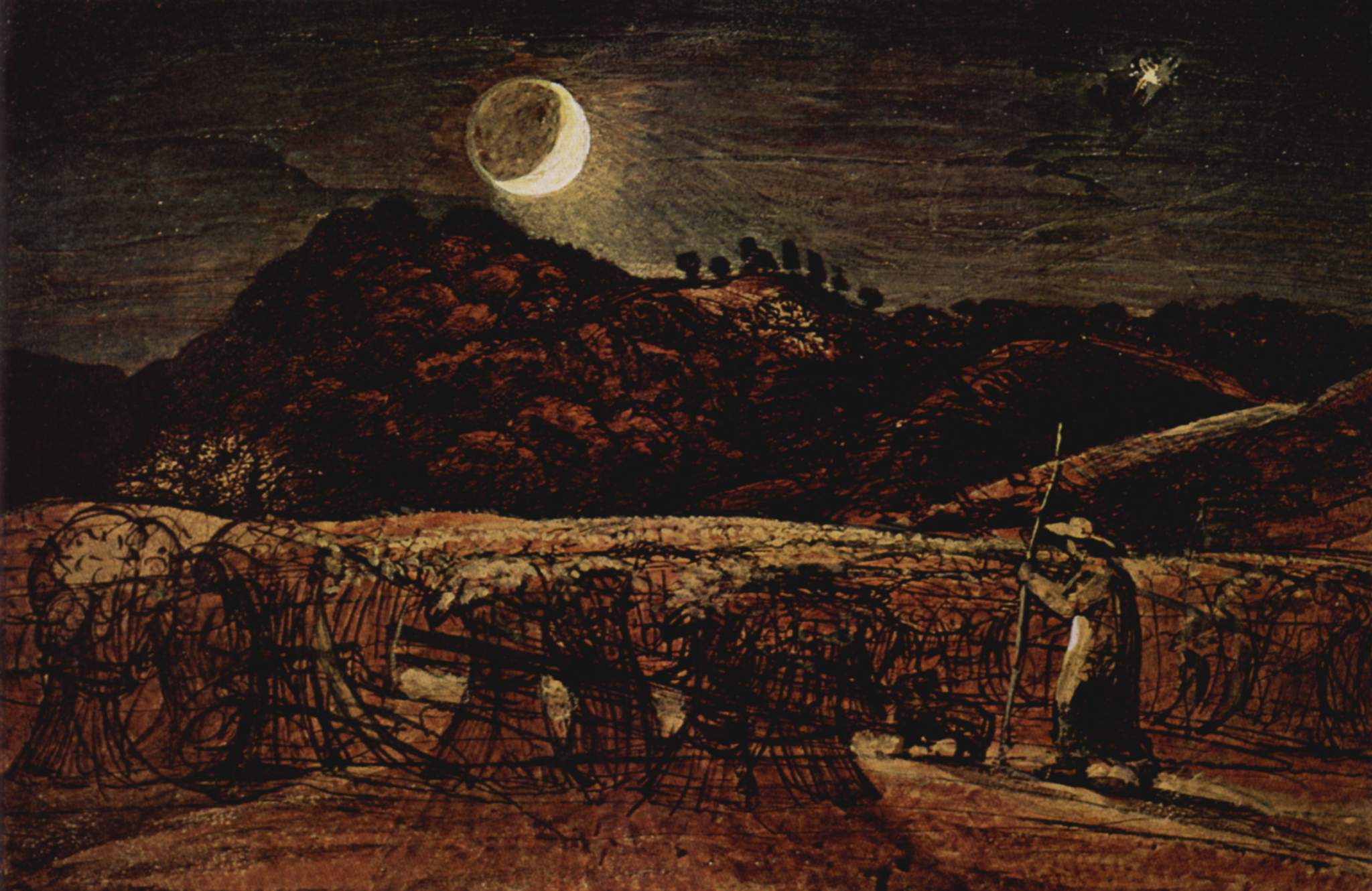
When less than four years old I was standing with my nurse, Mary Ward, watching the shadows on the wall from branches of an elm behind which the moon had risen. I have never forgot those shadows and am often trying to paint them.

-Samuel Palmer

+++++++++++++++++

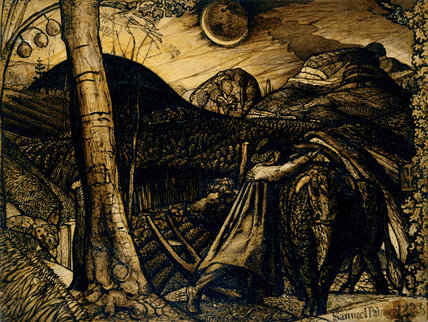
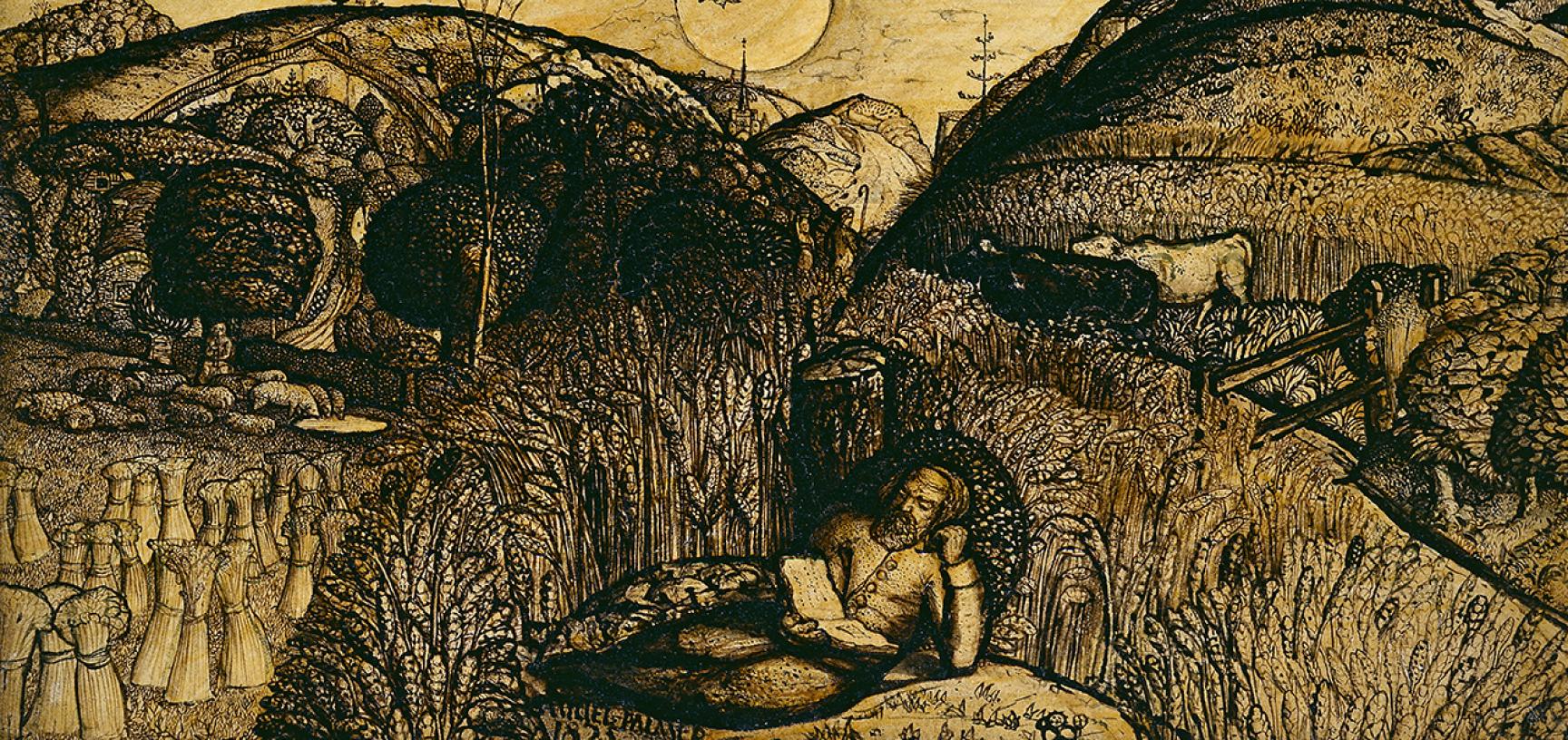
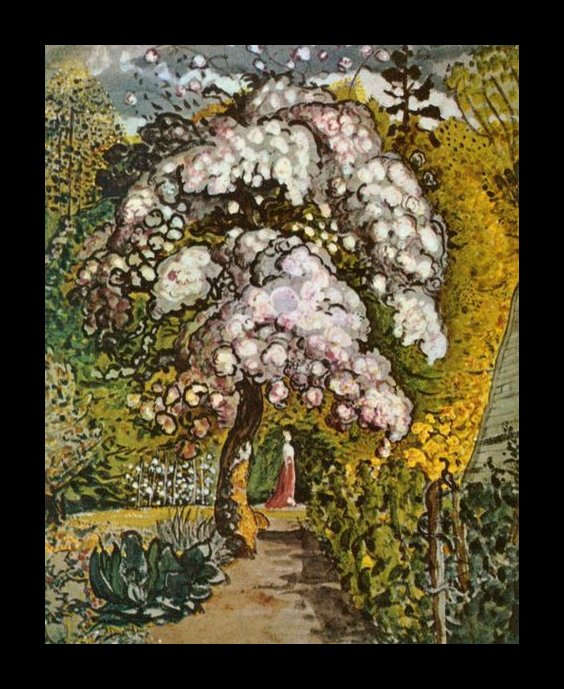
I have long admired the work of the British painter Samuel Palmer (1805-1881).  He is sometimes called the British Van Gogh even though he painted much of his work much of his work before Van Gogh was even born. There’s a wonderful darkness underlying much of his work that no doubt relates to the shadows from his childhood that he mentions in the quote above. Interesting how things from our childhood that might be easily overlooked or downplayed affect us throughout our lives.

His compositions have a very unique quality, one that strives to create a sense of fullness in the view he is revealing. It is very stylized and personal, more so than most artists of the first half of the 19th century. His often condensed compositions create an air of unreality but nevertheless make sense and translate easily in the journey from the eye to the brain. This really appeals to my own sense of composition and I find myself relating easily to his work, almost sensing how he was putting his pieces together.

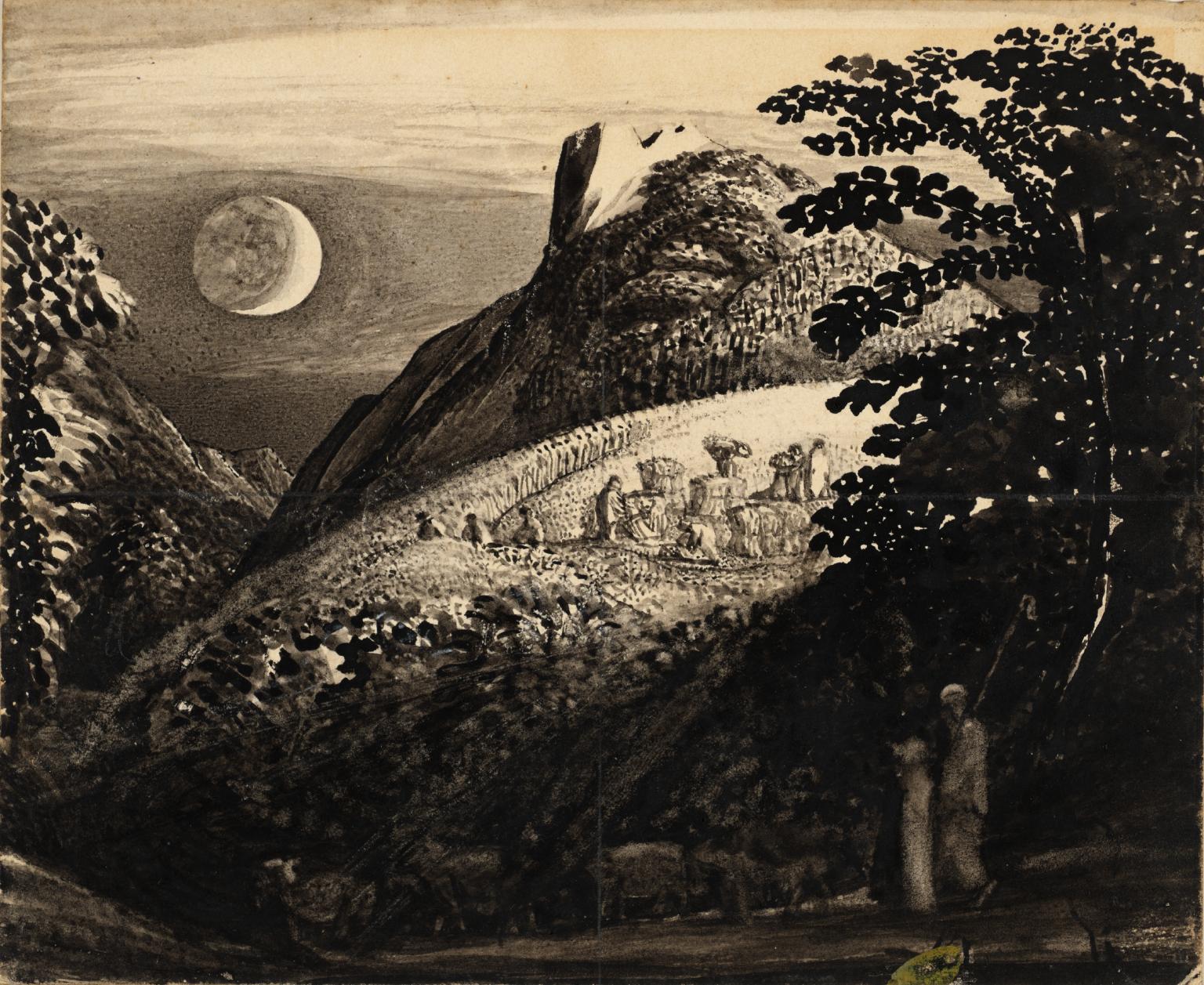
Many of you have probably never heard of Samuel Palmer but he certainly has had my attention and respect for some time. Here’s a short video of his work and a few more of my favorite pieces.

The Harvest Moon: Drawing for ‘A Pastoral Scene’ c.1831-2 Samuel Palmer 1805-1881 Purchased 1922 http://www.tate.org.uk/art/work/N03699

Read Full Post »


You can’t force inspiration. It’s like trying to catch a butterfly with a hoop but no net. If you keep your mind open and receptive, though, one day a butterfly will land on your finger.

–Chuck Jones
++++++++++++++++++
I came across the quote above from the great animator/artist Chuck Jones and it made me think of a blog post I wrote back in 2009, citing him as an influence. Nine years later, I still feel that way as strongly as ever. I still see hints of his landscapes in my own. His strong visuals, along with those of the early Max Fleischer Popeye cartoons, really imprinted on me. I thought it deserved a second run. Actually, I just wanted to show Marvin the Martian again.
++++++++++++++++++


Marvin the Martian and Daffy
I have cited artists here who have been influences on my work, people who are often giants in the world of art and sometimes lesser known but equally talented artists. But sometimes you overlook the obvious, those ones who have always been right in front of you.

What's Opera DocLast night [from 2009], TCM honored the great cartoonist Chuck Jones by showing a documentary and some of his landmark cartoons starring Bugs Bunny, Elmer Fudd and Daffy Duck. He also did the Roadrunner/ Wile E. Coyote cartoons as well as the seminal holiday favorite, How the Grinch Stole Christmas. His work was and is a vivid part of an incredible number of people’s childhoods. His What’s Opera Doc? with Bugs and Elmer in a Wagnerian setting with a tragic ending is classic and might be the only exposure to higher culture that many viewers may get.chuck_jones-opera-set

For me, I was always so drawn to the color quality that Jones had in his cartoons as well as the way he interpreted the landscape with a form of artistic shorthand that cut out extraneous detail yet never took away from the feeling of place, unlike some of the lower quality cartoons from Hanna-Barbera in the early 60’s. Don’t get me wrong. I loved those cartoons as well but even as a kid I was really distracted by the poor quality of the landscapes that scrolled continuously behind their characters. With Chuck Jones, it always felt fresh and real, as though there was thought given to every detail in every frame. Who else could put imagery like the above scene from What’s Opera Doc? before the eyes of impressionable children? Probably only the artists from Disney can match Jones’ work at Warner Brothers, but that’s another post.

His work also treated you, as a kid, like you had intelligence. They were smart, clever and nuanced. They never talked down to you.

For a kid this was potent stuff. Scratch that- it’s just potent stuff. Period.

Read Full Post »

+++++++++++++++

The artist has to transcend a subject, or he loses the battle. The subject wins.


Fritz Scholder
.
+++++++++++++++
Fritz Scholder (1937-2005) was an Native American painter. I wasn’t going to use the Native part because he had claimed at one point in his career that he was not an Indian painter nor would he ever paint Indians. Much of his work adhered to that idea but his work, in many cases, definitely reflected his experience as a Native American. His work followed the modern trails of painters like Francis Bacon and Willem de Kooning but certainly expressed his personal viewpoint and experience. It’s great work that I always enjoy taking in.
.
The subject matter in his work is strong but Scholder seems to have won the battle, to have transcended pure subject. His words above are important for artists in any genre to keep in mind. I know that that this act of transcendence is something I aspire to whenever I am before the easel.
.
Sometimes I win and sometimes I don’t.
++++++++++

Read Full Post »

+++++++++++++++++

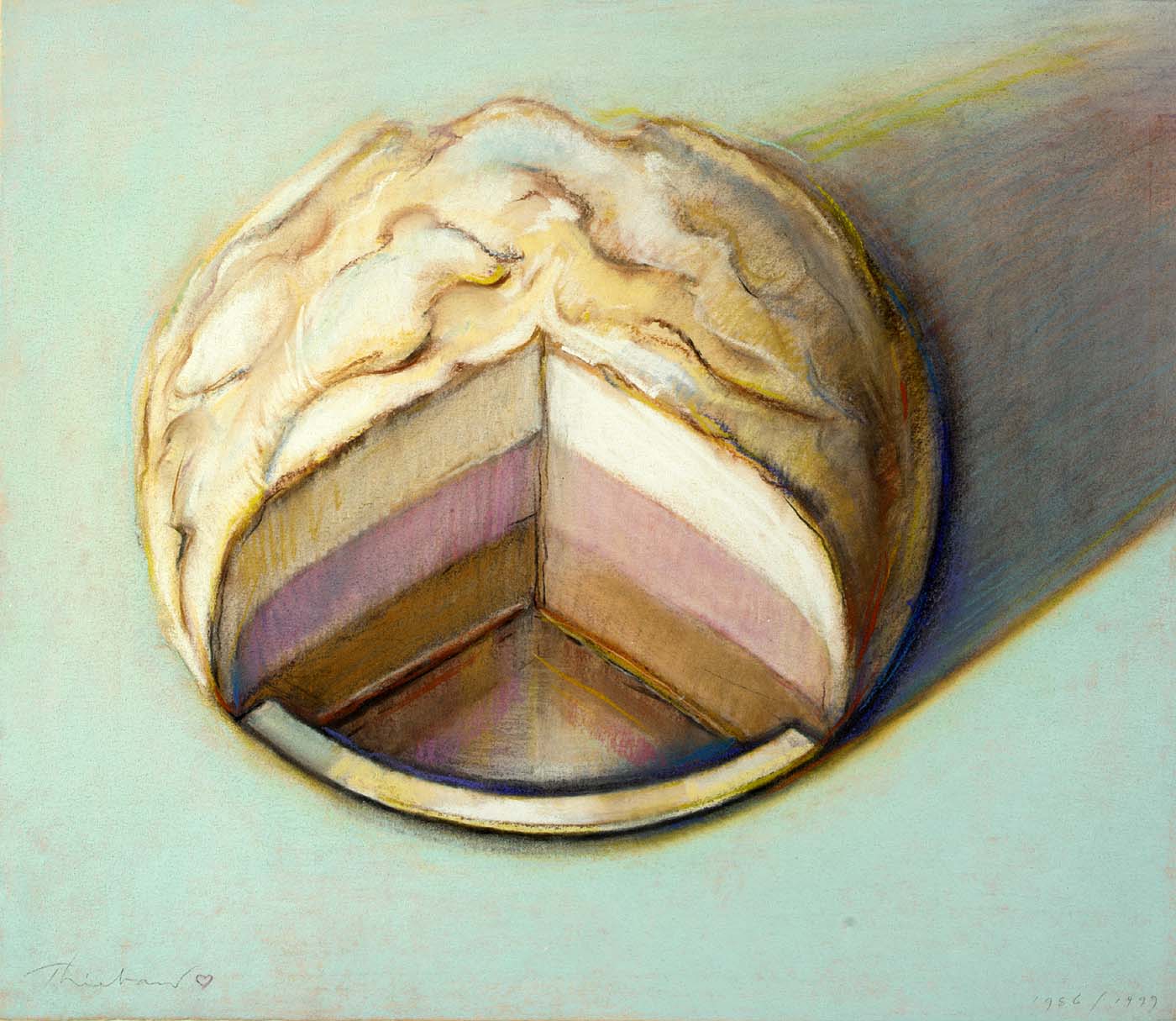
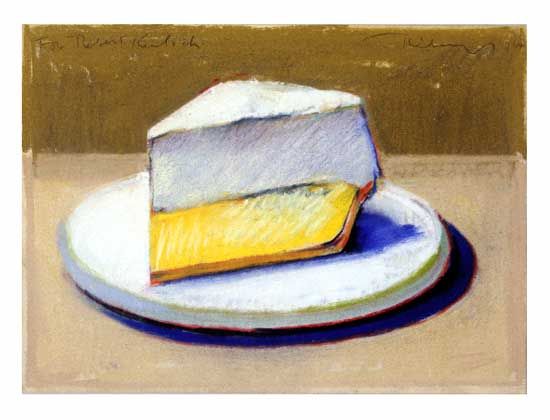
Commonplace objects are constantly changing… The pies, for example, we now see, are not going to be around forever. We are merely used to the idea that things do not change.

Wayne Thiebaud
+++++++++++++++++
I am not really hungry this morning but I felt like looking at some pies. Well, paintings of pies. And more specifically, those from Wayne Thiebaud, a favorite of mine. He’s going to turn 98 years old in November. I am not sure if he is still painting but I think he probably is. He was still painting two years ago when the following short film was produced by Christie’s auction house. If you have five minutes I urge you to take a look.

Read Full Post »

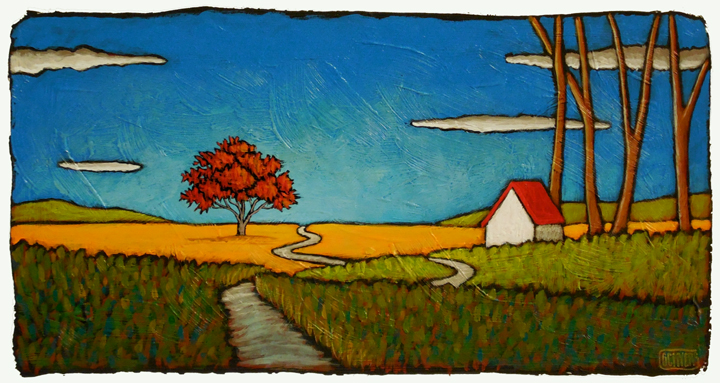
It has become a tradition for my Gallery Talks at the West End Gallery to have a very portion– a pretty popular one– that involves a drawing for those on hand to win one of my paintings. I have written in the past about how I take this very serious and try to find pieces that have meaning for me and which are, I believe, somehow overlooked. The painting I have chosen for this year’s Talk ( next Saturday, August 4 at 1 PM) definitely fits in that category.

Shown below, it is called Pipedream. I have watched with consternation as it traveled around the country, always coming back to me. You see, it was a favorite of mine from the minute it was done. It just felt right with a warmth and clarity that appealed to me and with its Red Tree and Red Roof, it is very much a signature piece. I wracked  my brain figuring out why this piece hadn’t found a home and all I could think was that this might be one of those cases where the title might be confusing if the viewer wasn’t aware of its origin. And if you knew what it meant, given the opioid crisis in this country, you might find it distasteful.

But I saw it in the best sense of the word, as a perfect dream with solitude, rich fields, clear sunlight and calm blue skies. A perfect retreat from a crazy world. So, to clear things up I am running the post about this painting from a few years back.

Hope you can make it to the Gallery Talk at the West End Gallery on August 4th to have a chance at winning this favorite of mine. Plus, as always, there is a little more at these talks. Put it on your calendar and come grab a seat. It could be fun.

GC Myers- Pipedream sm

Blow up your TV , throw away your paper
Go to the country, build you a home
Plant a little garden, eat a lot of peaches
Try and find Jesus on your own

–John Prine, Spanish Pipedream

*****************************

This is a small new painting that is about 6″ by 11″ on paper. I call it Pipedream after the old John Prine song, Spanish Pipedream. I say old but it ‘s one of those songs that never feels old to me despite the fact that it came out back in 1971, forty three years [47 now] ago. It is old. One hint of its age is at the beginning of the song when he says he was a soldier on the way to Montreal, referring to fleeing north into Canada to avoid the Viet Nam war and the draft. But it’s still such an infectious chorus with a message that so hits the point that I still find myself humming this song quite often.

I guess this painting’s simplicity and cheery feel made me think of this song. There is something very idyllic and charmingly essential in this little guy. It does look a bit like a pipedream, which is one of those words that we often use while not thinking about its origin or meaning. This word, pipedream, is from Victorian era Britain and refers to an improbable fantasy or hallucination that came while smoking opium. Maybe this is an improbable fantasy? It does have a fantasy feel about it but lets hope it is not so improbable.

Now here’s the song  from one of my favorites, John Prine.

Read Full Post »

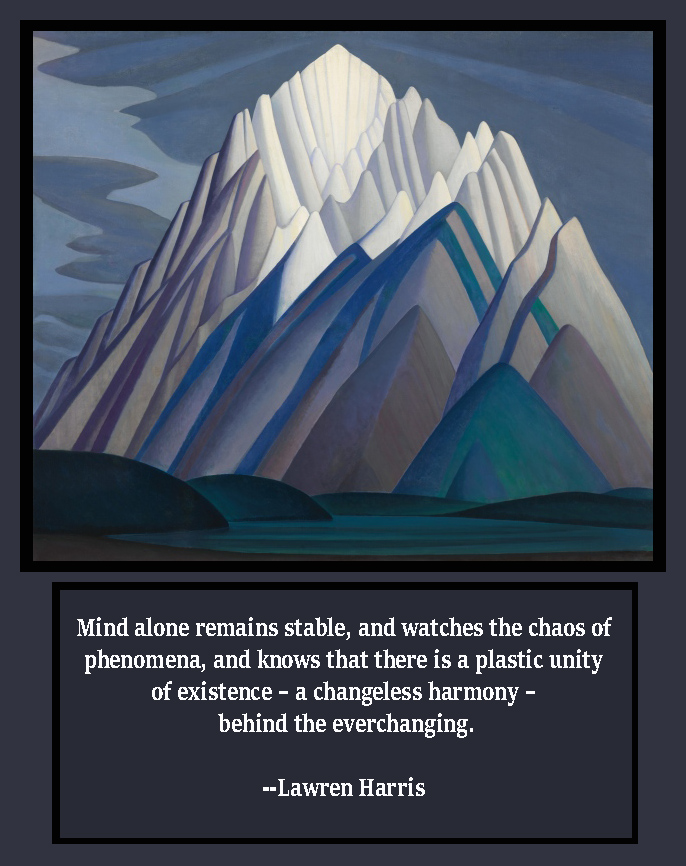
In these crazy times, there is some comfort to be found in art. For me, the paintings of Lawren Harris always fill the bill. His work definitely represents a quality of spiritual harmony, that thing, that force, that universal mind that remains stable even as the world drastically seemingly changes before our eyes.

So, this morning I am taking a few moments and taking in his 1926 painting, Mountain Forms, shown above.

And I feel better already.

Read Full Post »

 “People like you and I, though mortal of course like everyone else, do not grow old no matter how long we live. What I mean is we never cease to stand like curious children before the great Mystery into which we were born.”

Albert Einstein, Letter to Otto Juliusburger, September 29, 1942 

+++++++++++++

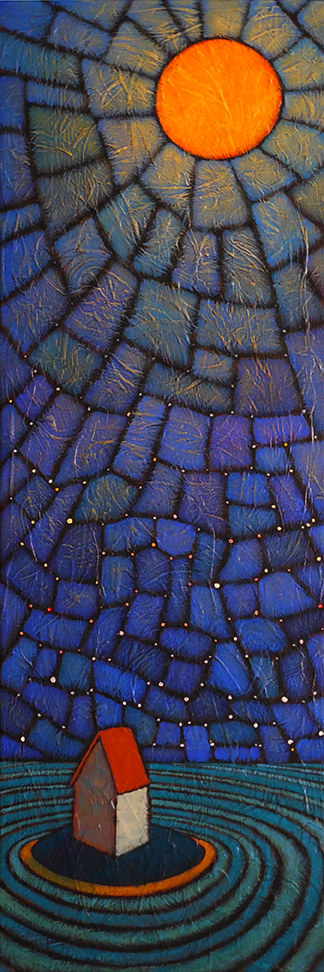
This is a new painting, at 30″ by 10″ on canvas, that is part of my current West End Gallery show, The Rising. I have titled this painting Eye to Eye and was considering at one point adding to Eye to Eye to Eye to Eye, et cetera.

In my mind, the idea of looking out at the stars in the night sky feels sometimes like looking into a multitude of eyes looking back at us, the flash of the whites of their eyes creating the starlight that we see. It is a benign feeling, not tinged with animosity or congeniality.

They are just there, dispassionately looking back at us. Perhaps they are seeing the flash of the light from our sun that reflects on our moon as being our eyes looking out at them. Who knows?

The sense I get from this painting is one of having this connection with the universe even in those times when we might feel absolutely alone in this world. Maybe the connection is in understanding that the Great Mystery, as Einstein calls it, may very well be the same throughout the cosmos. Whether here on Earth or a billion light years away, the night presents us with tangible evidence of this Great Mystery and our desire to know our place in it creates the curiosity that Einstein mentions.

And maybe that curiosity, that feeling that there is always more to learn from this Mystery, is the key in maintaining a youthful mind.

Who knows?

I used the words from Einstein above as they originally appeared in a letter to a colleague. The gist of his words were later paraphrased by others as this popularly quoted piece of advice:

Do not grow old, no matter how long you live. Never cease to stand like curious children before the Great Mystery into which we were born.

I like it better in its original form, not as advice but as simply an observation between friends.


Read Full Post »

++++++++++++++++++

Charles Burchfield- Sun and Rocks- Albright-Know Art GalleryAn artist must paint not what he sees in nature, but what is there. To do so he must invent symbols, which, if properly used, make his work seem even more real than what is in front of him.

–Charles Burchfield

*********************

I am a big fan of the work of Charles Burchfield (1893-1967), a western  New York painter who lived and painted in the Buffalo area for most of his life. His work was decidedly visionary in its scope, taking the environment that he knew around western New York and embellishing it with a life force and energy that he sensed beneath the surface. That’s what he was referring to in the quote above– taking what you see around you and not simply recording it but painting how it moves you emotionally. To me, his work is as emotionally charged in the same way as that of Van Gogh.

Charles Burchfield- An April Mood- Whitney Museum of American ArtCreating symbols, as Burchfield refers to in the quote, has been a big part of my work. I have long emulated his use of creating a visual vocabulary that moved through a body of work. It becomes a sort of language of its own  that people who take it in and understand it find easy to read and absorb as they move from picture to picture. Those who can’t read it find less in the images and feel less drawn into them. In an earlier post featuring Burchfield, I wrote about an artist friend who just didn’t get Burchfield’s work in any sense.  He just one of those people who couldn’t read the language clearly written in the work.

I also have been influenced by the way Burchfield would constantly go back to earlier work and use it as a new starting point, as though the added knowledge gained through the years would take this work in a new direction. I often do the same thing, constantly revisiting images and motifs from years ago looking for a thread or path to follow anew.

Even this post is a revisitation, going back and looking at an influence, trying to pull that original inspiration from it. With Charles Burchfield, that’s always an easy thing to accomplish.

Charles Burchfield- Childhood's Garden

Read Full Post »

A few weeks back, we had the pleasure of seeing a series of three one-man shows at the Shaw Festival in beautiful Niagara-on-the-Lake, Ontario. They were written and performed by writer/actor/comedian Stephen Fry who you may better recognize from his longtime partnership with Hugh Laurie (House) in the comedy team Fry and Laurie.

The performances were based on Fry’s recent book Mythos which contains his droll retelling of the classical Greek myths. The shows were divided into different segments: God, Heroes, and Men. God dealt with the stories of Zeus and the other surrounding gods. Heroes dealt with the epic tales of Odysseus, Heracles and Theseus. The final show, Men, told the stories of men and their interactions with the gods. All were highly entertaining.

I was pleasantly surprised that during Men, Fry chose to tell the tale of Baucis and Philemon, a story that I have retold here a number of times and one which I also have used as the basis of a series of paintings over the last several years, including not too long ago with a favorite of mine, Nuptiae. It is the story of an old couple in a poor town who share their hospitality with Zeus and Hermes who have been treated poorly by all the other townspeople.

Fry’s retelling had a bit of a different ending than the version I knew, one that I believe is based more on that from Ovid and his Metamorphoses. In the version I know, the ending is a bit happier with the couple living out their lives together as priests in the temple of Zeus and together in death as two separate trees– a linden and an oak– growing from a single trunk.

Fry’s is a bit harsher, related in many ways to the biblical story of Lot and his wife. In Fry’s retelling, Zeus tells Baucis and Philemon that they shall be spared from the terrible wrath he is setting loose upon the other townsfolk. He instructs them to walk up the hill and not turn back. But hearing the great storm and the horrible sounds coming from the village, they agree to turn back to look together, whereupon they are transformed into linden and oak trees, much as Lot’s wife was turned into a pillar of salt.

I still prefer the version I first knew but it was great to hear a variation on this story. That is the beauty of storytelling and art– it takes what we believe we know and reflects it back at us in a different and sometimes revelatory manner.

The painting at the top is a new painting from my West End Gallery show that opens tomorrow, Friday, July 13. Titled The Belonging, it is a 36″ by 24″ painting on canvas that is my most recent interpretation of the Baucis and Philemon myth– the version I knew before the Mythos shows.

These pieces may be my favorite to paint. The intent to paint them, that beginning point in their creation, has a certain feeling that pleases me and sets the tone for the whole piece. The paintings that spring from this starting point seldom disappoint me or fall short of what I hope to see. This piece very much lived up to the story for me and is one that never failed to stop and make me look when it was with me in the studio. The combination of the story and the colors, shapes and textures of the painting come together, for me at least.

Hope you can come out and see for yourself at the West End.

Read Full Post »

There’s a lot I would like to write about this painting as it hits so many notes for me personally. Titled Night Gem Rising, it’s a 12″ by 36″ painting on canvas that is one of those pieces that goes past any expectations that were gathered at its beginning. It feels like so much more than anything I put into it  or the sum of my own parts.

It’s funny but it is sometimes harder to write about these pieces that hit so closely on a personal level. Maybe it’s because they get so close to the core. Too close to conceal one’s own tears, fears, desires and doubts.

So, I am just showing it with that little explanation today. It is included in my annual show at the West End Gallery,this year called The Rising. The show is now hung in the Market Street gallery for previews and the opening reception takes place this coming Friday, July 13, running from 5-7:30. Please stop in and take a look.

For this Sunday morning music I thought I’d pick a version of a favorite of mine from singer/songwriter Richard Thompson. It’s Dimming of the Day and it fits perfectly for my feelings on this painting. This is one of those songs that will no doubt go down as a modern classic if it isn’t already thought of as such, considering the long list of artists who have covered it. There are so many great versions but I still prefer Thompson’s performances of it. This is a recent live version from an NPR radio broadcast.

Enjoy and have a good Sunday.

Read Full Post »

« Newer Posts - Older Posts »