Feeds:
Posts
Comments

Archive for the ‘Favorite Things’ Category

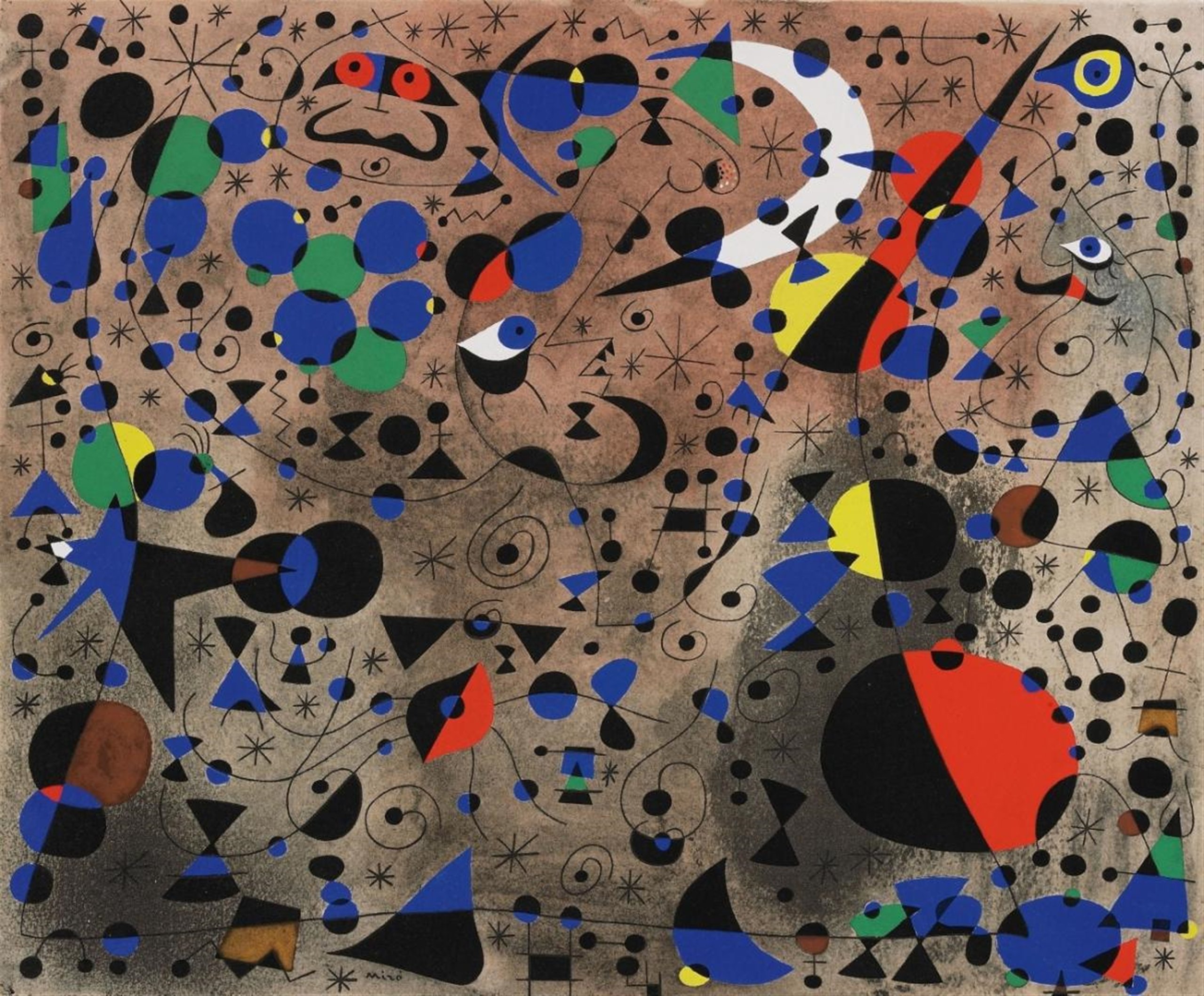
Joan Miro, Constellations 1959

———————-

The older I get and the more I master the medium, the more I return to my earliest experiences. I think that at the end of my life I will recover all the force of my childhood.

–Joan Miro, from 1960 at age 67 

———————–

It’s the young people who interest me, and not the old dodos. If I go on working, it’s for the year 2000, and for the people of tomorrow.

–Joan Miro, from 1975 at age 82

————————-

There are two quotes here from the great Spanish painter Joan Miro (1893-1983) that really strike a chord with me. Both come from him when he was older and both speak very much to the way I feel about my own work.

In the first he speaks about gaining more mastery over the medium through the years while simultaneously moving closer to the vibrant energy that one has in their youth. I have felt the same feelings. The more one gains control over their form of expression, the more they are freed from the constraints of conscious thoughts and decisions. The work becomes reactive to the feel and emotion of the moment.

Now, I will add that with this acquired mastery there is also a new barrier erected to overcome. Well, at least, in my experience. I have found that with years of work, which is, in effect, rehearsal and practice, there is sometimes a loss of spontaneity and passion in the actual making of the marks. They become a little too precise, a little too mannered and a bit too clean and neat. They don’t have that feeling of wanting to burst off the surface. I have found ways to get past this–using bigger brushes and making strokes quicker with more urgency, for example– but every so often I will get near the end of a piece and it just feels too neat, too precise, for the underlying emotion.

It needs the innate exuberance of a child at play.

The second Miro quote, made when he was 82, speaks of painting not for those of his age but for the younger and the future generations. I certainly understand this sentiment. I am most thrilled when children react to my work, knowing then that it is speaking to the aforementioned innate exuberance.

It means I am not dealing with intellect or acquired knowledge or conscious thought. It is a pure and uninformed reaction. It means the work is communicating emotionally across and out of time.

And I think this is important because I believe most artists wants to break free from their own era, to not be consigned to any single period of time. To be known for what they were at their inner and eternal core, not where or how they were categorized in their time.

Maybe like the Miro painting at the top, a single small voice among the multitude of stars and constellations in the universe.

I don’t know but that might be my primary goal in doing what I do.

Read Full Post »

One of my favorite paintings is the one above, a depiction of the biblical Tower of Babel painted by Pieter Brueghel the Elder, the Flemish painter around 1563. It is probably the image that jumps to mind for many folks when they think about that tower. It is an iconic image.

But it also spurred many generations of other artists to render their own vision of how they thought the tower may have appeared. I am fascinated by the hundreds of different, yet in many ways similar, ways in which the Tower of Babel has been depicted and have scanned over numerous iterations.

All are captivating to me, filled with all sorts of compositional possibilities that always seem to have me on the verge of painting my own tower. I may have already attempted and haven’t even realized it, like the characters in Close Encounters of the Third Kind who are compelled to by their visions of Devil’s Tower to recreate that landmark in whatever is at hand, such as the mashed potatoes in the case of the Richard Dreyfuss character.

Here are just a handful of other paintings of the Tower of Babel along with a short video I came across that contains a few more.

Read Full Post »

Schiele -Eternal

Egon Schiele- Setting Sun 1913


+++++++++++++

Art cannot be modern. Art is primordially eternal.

Egon Schiele

++++++++++++++++


Read Full Post »

+

It is the treating of the commonplace with the feelings of the sublime that gives to art its true power.

–Jean-Francois Millet

++++++++++++++++

Jean-Francois Millet (1814-1875) is mainly known for his peasant scenes painted in the genre of the Barbizon school, of which he was an originator.  This genre marked the move from Romantic painting to Realism which depicted the reality of all aspects of the world, including the rural working class which were seldom portrayed heretofore.

This work played a huge role in the evolution of modern art as a number of artists from subsequent generations ran with this work , adding their own voice and style to the subject matter. Van Gogh, for example, directly copied a number of Millet works, such as The Sower below, in his own distinct style.

I am not moved by all of Millet’s work. Some of it feels generic but I think that is understandable as its style was so influential that it was emulated, creating a vast body of similar work. But there is something in a segment of his work that I feel is truly visionary in a way that lends credence to the statement from Millet at the top of the page. Here are a few of my favorites.

Read Full Post »

Life has no meaning unless one lives it with a will, at least to the limit of one’s will. Virtue, good, evil are nothing but words, unless one takes them apart in order to build something with them; they do not win their true meaning until one knows how to apply them.

– Paul Gauguin

***********************

Busy, busy, busy this morning but I wanted to share the quote above from Paul Gauguin. I think it pairs perfectly with the  Gauguin painting above it, one of my favorites, which is titled Vision After the Sermon or Jacob Wrestling with the Angel.

Many of us have noble ideas of how we want to live our lives but all too often we fail to live up to the words that we attach to these aspirations. Virtues such as good, kind, thoughtful and so on. But living up to those words takes, as Gauguin points out, is much more than a matter saying that we are good and kind and thoughtful. It requires the will to put those words into action each new day.

And that struggle is like Jacob wrestling with his angel throughout the night.

That’s a short interpretation but, like I said, I’ve got things to do. But before I get to it I want to share a few more words from Gauguin that made me laugh this morning:

We never really know what stupidity is until we have experimented on ourselves.

Unfortunately, I know from personal experience that this is true. Maybe that’s what made me laugh.

Have a great day.

Read Full Post »

The Starry Night ~ September 2015

I have a good friend, Linda Leinen, who lives down on the Gulf Coast of Texas and writes two wonderful blogs, The Task at Hand and Lagniappe. In today’s post on her Lagniappe site she write of finding a loving tribute to Vincent Van Gogh tucked beneath a bridge at the Medina River crossing on Texas State Highway 16, just a few feet above the river in a spot where only a handful of folks- swimmers, kayakers and perhaps a fisherman or two– might ever see it.

She documents it’s surprising endurance from September of 2015 until November of 2017, as it has went through a number of flood events that would have seen fast running waters and all sorts of debris brushing by the painting.

I love the idea of this little hidden treasure that is meant to give small dose of unexpected pleasure to unknown folks, people that the person who put it there will most likely never know.

Linda also included a great video that explains the real scientific forces behind Van Gogh’s Starry Night. I ran this video several years  back and enjoyed seeing it again. Take a look at Linda’s post today and see for yourself.  And while you’re at it, take a good look at her site and follow her if you like what you see. I know that I always enjoy reading her work. She writes beautifully and always does a masterful job.

The Task at Hand

Lagniappe

Read Full Post »

Read Full Post »

Do not try to do extraordinary things but do ordinary things with intensity.

–Emily Carr
*****************
Emily Carr was one of the first artists that came to mind when I saw the question last week that asked if you name five female artists. She is most likely off many of your radars but I am sure some of my friends to the north in Canada recognize her name very well.
 –
Carr was born in 1871 and died in 1945 in Victoria in British Columbia. Aspiring to be an artist, she was trained in the tradition of classical painting methods early in her life. But the first decade of the 20th century saw her work take a radical turn. After a period of time in Paris, influenced there by the Fauvist and Post-Impressionist with which she met and painted, her work took on bolder colors and more expressive brushwork.
 –
She took this new found energy back to Canada where she opened a gallery in Vancouver in 1912. The gallery faltered as she failed to see the response that she had hoped for. Dejected, she basically put down her brushes for the next 15 years, doing little painting.
However, some influential people were aware of her work, especially paintings she had executed with the native tribes of Canada as her subjects, and in 1927 she was invited to show a group of work in an exhibit about the tribes of the West Coast at Canada’s National Gallery in Toronto. It was here that she met Lawren Harris and  other painters who made up the fabled Group of Seven, which were several great Canadian painters of the time who had distinct modernist styles. I have featured the brilliant work of Lawren Harris here several times.
 –
Encouraged by Harris, who proclaimed her as one of that group, Carr was rejuvenated and for the remainder of her life worked with great vigor, trying to capture the spiritual essence of her native homeland. Like Maudie Lewis, Carr is a Canadian national treasure.
 –
I am enchanted by much of her work and the spirit that is imbued within it. This has been a very cursory look at her life with just the highlights and a few images and a video. Please do some research on your own. It’s well worth the time.


Read Full Post »

I came across this blog entry from about seven years back earlier this morning. While the painting remains a favorite of mine for a number of reasons, the thought behind this entry hit a chord with me this morning. It seems that even in 2011, the idea of alternative facts had taken hold and was a dark omen for our current state of affairs. 

This is a new 12″ by 24″ painting that sits in my studio at the moment. It draws a lot of my attention at the moment and I’ve been enjoying it over this time. I find this a very hopeful piece, the whiteness of the house’s reflection of the bright rising light set in contrast to the dark foreground. It’s this contrast that creates the hope I see.  Like many things, hope is relative to the conditions of the situation.

I’ve left the landscape bare of other trees other than those in the foreground which form a stage-like setting for the scene beyond, wanting to create  more focus on the starkness of the house. The path moves from dark to light and also conveys this sense of hope, of moving towards a more illuminated situation.

I’m thinking of calling this Obscurity. I know that this doesn’t convey the hope of which I speak but I have been thinking of a line from John Locke’s An Essay on Human Understanding that has been bouncing around in my head for a week or so. Locke states:

 Untruth being unacceptable to the mind of man, there is no defense left for absurdity but obscurity.

It sounds wonderful. In a perfect world, the absurdity of obvious falsehoods would only exist in the darkest and most obscure corners of humanity. Unfortunately, we live a most imperfect world, leaving me to wonder if, in fact, the opposite might apply to our times: Untruth being acceptable to the mind of man, there is no defense for rationality but obscurity.

This thought has hung hauntingly on me for some time and maybe I see this house as a refuge of some kind for rational thought in what seems an irrational time.

A place of obscurity.

Or maybe it’s just a house. After all, sometimes a cigar is just a cigar.

Read Full Post »

Edward Hopper- Pennsylvania Coal Town

***********************

I believe that the great painters, with their intellect as master, have attempted to force the unwilling medium of paint and canvas into a record of their emotions. I find any digression from this large aim leads me to boredom.

Edward Hopper

***********************

Emotion is that intangible quality that separates art from craft. Emotion does not have to be at the extremes of rage or depression or giddy elation. It is often subtle and calm or densely introspective. Hopper’s work was imbued with quiet emotional undertones that make his paintings, even those scenes of the most seemingly mundane moments, truly memorable.

Art is, at its foundation, emotion.


Read Full Post »

« Newer Posts - Older Posts »