Feeds:
Posts
Comments

Archive for the ‘Favorite Things’ Category

“There is only one valuable thing in art: the thing you cannot explain.”

 — Georges Braque

*******************************


This is a quote from artist Georges Braque that I used on the first artist statement I ever wrote many years back. It still pops up in my mind on a regular basis, especially at times when I find myself looking at a just finished painting, wondering what is there that is triggering my emotional response to it.  These words from Braque reminds me that what I am trying to capture is not the subject matter, not a mere representation of reality.  I am trying to capture an indefinable feeling or spirit that is not calculable or even visible.

Definitely beyond the reach of my words.

It is the sum of color and light.

And texture and line.

And the spaces in between.

It is of the spirit and the life force.   When it is there, it is obvious and undeniable. And though I can’t explain it, I can see the purpose and value of that work.

And that is a good day…

***********

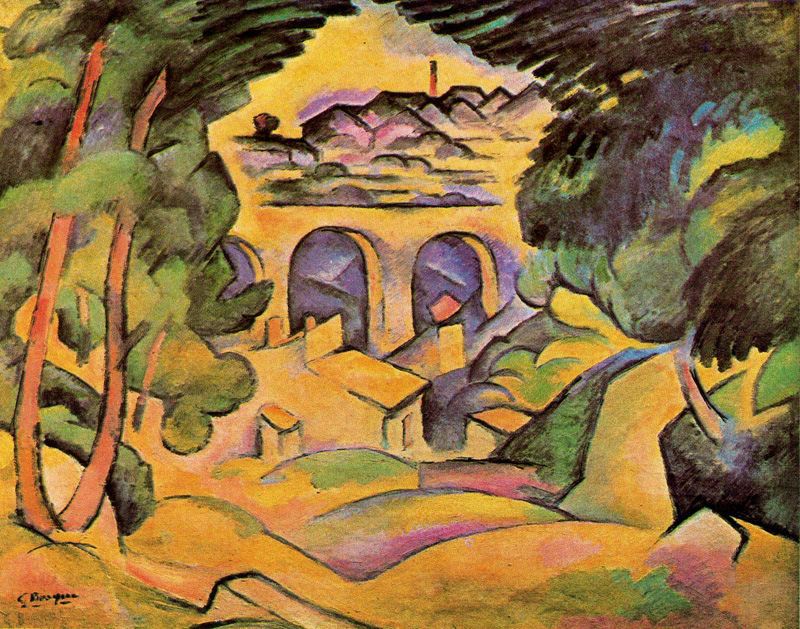
I have never really focused here on the work of George Braque (1882-1963) who is mainly known as one of the major artists, along with Picasso, of the Cubist movement. His work, through all the differing phases of his long career, is always impressive. I thought I’d share the video slideshow below of his work. It’s set to Mozart’s Piano Concerto No. 21, better known as the Elvira Madigan concerto, which makes it a most pleasant and calming thing to spend a few minutes with on the first cool morning of November.


Read Full Post »

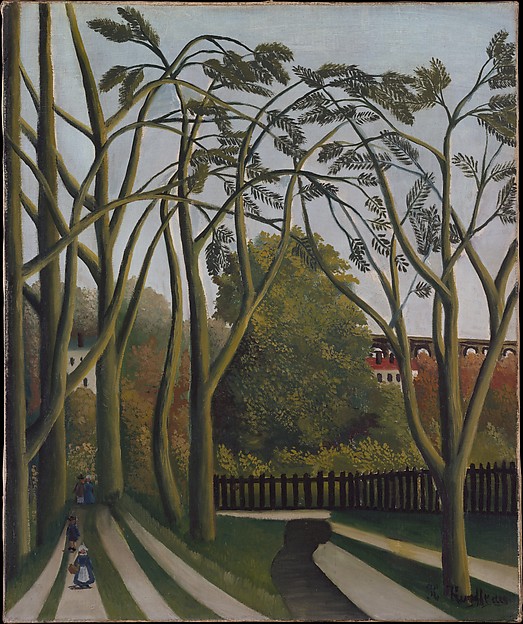
What wisdom can you find that is greater than kindness?

Henri Rousseau

*********************

Read Full Post »

I am running late this morning and there’s a long to-do list of things waiting for me. But I definitely wanted to get out a little music for this Sunday morning. Here in the northeast, it’s rainy, dark and gray. It would be easy to gravitate towards music that reflects that mood but I think I am going to go the other way.

Bright and light. Pop.

So I am going to play a song written and released by Cat Stevens in 1967. The British group the Tremeloes also released the song that same year.

It’s hard to believe that this song is 50 years old. It feels like a perfect pop song. It’s bright and clean and doesn’t feel dated in any way. If you’re a fan of Wes Anderson films, you probably will remember the song ( the Cat Stevens version) from Rushmore.

I like both versions but slightly favor the Tremeloes version which is the one I am showing here today. Plus it has a neat live video of the era, which is always fun to see. It’s a little unusual in that it focuses on the band without the usual go-go dancers from TV performances of that time. Hope it brightens your day.

Have a great Sunday.

Read Full Post »

I have always had a passion for the beautiful. If the man in me is often a pessimist, the artist, on the contrary, is pre-eminently an optimist.

Jules Breton

****************

A bit of hope for today. I have to agree with Breton: even on those darker days when I feel my most cynical, I find hope in doing my work. Or in considering that far horizon in Breton’s painting.

Read Full Post »

The poet Robert Frost wrote a wonderful preface to the 1939 edition of his collected poems. It was titled The Figure a Poem Makes and it described how he viewed his process of unveiling the true nature of his work. Reading it, I was struck by the similarities between his work as a poet and how I view my work as painter.

For example, the following paragraph-I have highlighted individual lines that jumped out at me. I probably could have highlighted them all:

It should be of the pleasure of a poem itself to tell how it can. The figure a poem makes. It begins in delight and ends in wisdom. The figure is the same as for love. No one can really hold that the ecstasy should be static and stand still in one place. It begins in delight, it inclines to the impulse, it assumes direction with the first line laid down, it runs a course of lucky events, and ends in a clarification of life–not necessarily a great clarification, such as sects and cults are founded on, but in a momentary stay against confusion. It has denouement. It has an outcome that though unforeseen was predestined from the first image of the original mood-and indeed from the very mood. It is but a trick poem and no poem at all if the best of it was thought of first and saved for the last. It finds its own name as it goes and discovers the best waiting for it in some final phrase at once wise and sad-the happy-sad blend of the drinking song.

A painting often begin in delight. A certain tone of color, the way a line bends, the manner in which a brushstroke reveals the paint or in how the contrast of light and dark excites the eye.  The delights pull you in and keep you engaged and it is not until you have finished that you are able to understand the sum of these elements, to detect the wisdom, the meaning, behind it all. It is only then that you know what you have uncovered and how it should be named.

The work itself, if left to its own means, knows what it is and will tell you.

Then there is this gem of a paragraph:

No tears in the writer, no tears in the reader. No surprise for the writer, no surprise for the reader. For me the initial delight is in the surprise of remembering something I didn’t know I knew. I am in a place, in a situation, as if I had materialized from cloud or risen out of the ground. There is a glad recognition of the long lost and the rest follows. Step by step the wonder of unexpected supply keeps growing. The impressions most useful to my purpose seem always those I was unaware of and so made no note of at the time when taken, and the conclusion is come to that like giants we are always hurling experience ahead of us to pave the future with against the day when we may want to strike a line of purpose across it for somewhere. The line will have the more charm for not being mechanically straight. We enjoy the straight crookedness of a good walking stick.

I have often spoke of the need to be have my emotions near the surface when I work, to always need to feel excited and surprised by what I am working on. To recognize things I never knew as being part of me. If I am not moved by the thing I am working on at any given time, how can I expect others to be moved by it? This paragraph speaks clearly to my experience as an artist.

Then there is the final sentences of the essay:

Like a piece of ice on a hot stove the poem must ride on its own melting. A poem may be worked over once it is in being, but may not be worried into being. Its most precious quality will remain its having run itself and carried away the poet with it. Read it a hundred times: it will forever keep its freshness as a petal keeps its fragrance. It can never lose its sense of a meaning that once unfolded by surprise as it went.

My translation of this, as a painter, is that the work must be free to move and grow of its own volition. It tells you where it wants to go and, if you don’t constrain it and try to push it to a place where it was not intended to go, will reveal its truth to you. If you can do that, it remain always fresh, always in the present and always filled the excitement and surprise that it contained in that burst when it was created.

I don’t want to bore you too much. It’s a great essay and is a valuable read for anyone who makes art in any form. You can see ( and download) the whole book, The Collected Poems of Robert Frost, with this essay in full by clicking here.

Read Full Post »

Horace Pippin- Amish Letter Writer


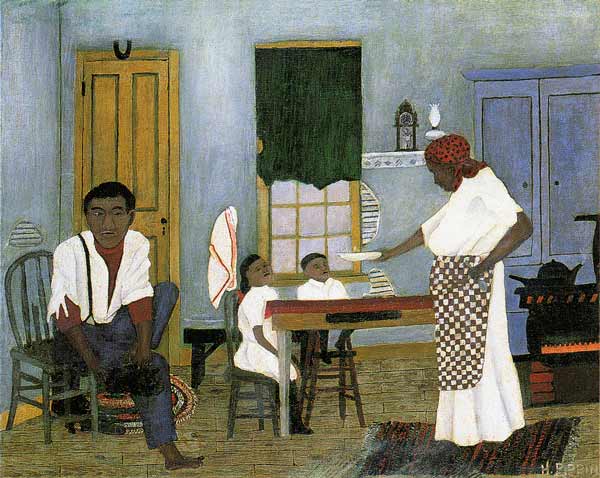
Not surprisingly, I have a real affinity for self-taught and naive painters. Among my favorites is American Horace Pippin who lived from 1888 until 1946.  He only produced about 140 paintings in his relatively short life but they are real gems, displaying a wonderfully sophisticated and more mature form of naivete. He achieved a pretty high level of recognition in his short career, being championed by a number of critics as well as artist N.C. Wyeth. The bulk of his work is now held in museums.

Though born in West Chester, PA, Pippin grew up in Goshen, NY, which interests me because I have three grand-nephews living there.  Goshen was where he began his artistic journey after winning art supplies in a newspaper contest, using them to make drawings of the jockeys and horses at the famed Goshen racetrack. He was wounded in World War I, serving in the famed Harlem Hell Fighters, and turned to art in a more serious manner to strengthen his damaged right arm.

He married and moved back to West Chester and his work began to draw notice, appearing in numerous exhibits in museums and galleries alongside some of the giants of the art world. In 1946, he suffered a stroke and passed away.

As I said, he produced a fairly small number of paintings, many depicting the African American experience of the time along with a number of biblical and historical paintings, John Brown and Abe Lincoln being favorite subjects. They are a rich American treasure.

Here’s a nice video of much of his work with Ella Fitzgerald’s great Cry Me a River backing it.

Horace Pippin- Milk Man of Goshen

Horace Pippin- Domino Players

Horace Pippin- Abe Lincoln Good Samaritan

Horace Pippin- The Trial of John Brown

Horace Pippin- Sunday Morning Breakfast

Horace Pippin- John Brown Going to His Hanging


Read Full Post »

Have a lot on my plate this morning, a lot of things needing to be done. But I came across this video by one of my favorite singer/songwriters, the late Townes Van Zandt, and thought I would share it. It’s called Big Country Blues and the video features the photos of primarily working class Americans from the great Richard Avedon.

It’s a compelling video, given this time in this country. I watched it twice this morning just to fully take in the imagery and Townes’ music never lets me down. I wish he were around just to hear his take on these times. He could write some sad songs, after all.

Give it a look and a listen.


Read Full Post »

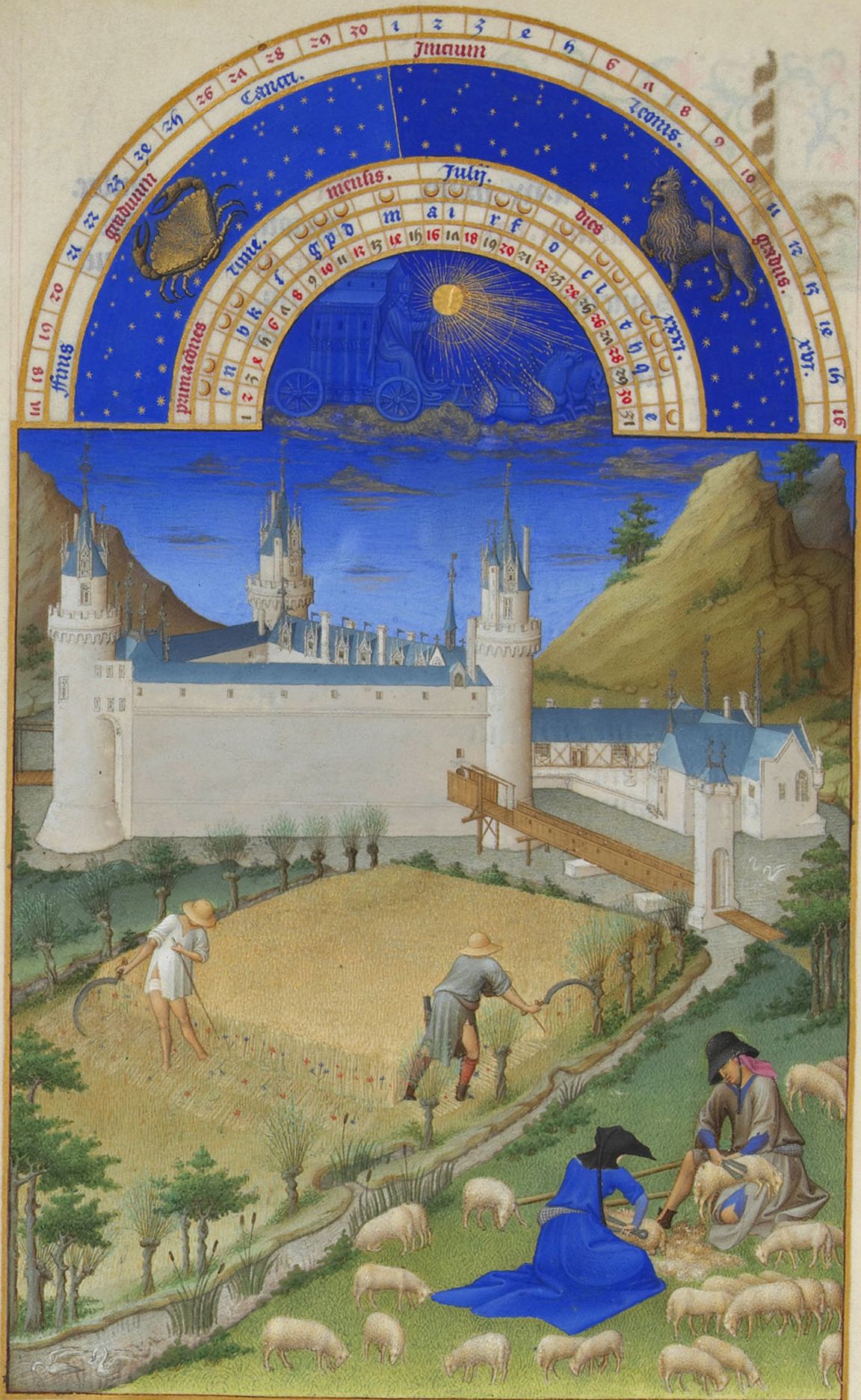
Several years ago I wrote about a spectacular illuminated book called Tres Riches Heures du Duc de Berry. It was a Book of Hours created for a French Duke in the 15th century filled with prayers, calendars, timetables and the like. It also included some of the most extraordinary paintings that illustrated the text, including twelve pages that showed each month in proper seasonal context. I came across the film below that focuses on these beautiful pages, showing them in some detail.

After hitting the start arrow on the video below, you have to click on the link to go to YouTube to watch the video at the request of its creator.  But it’s well worth a look to start out your week on such a calm and lovely note.

**********

Limbourg Brothers- Tres Riches Heures du Duc de Berry FebruaryOne of the great pleasures in being fairly ignorant is the thrill that comes from stumbling across something that is absolutely spectacular without any knowledge of its existence beforehand.  Of course, the flip side of this experience is the depressing realization that sets in when you realize how little you really know.  I know this from experience.

The other day,  while searching for images of medieval snow scenes for the previous post, I also came across a beautiful image taken from a 15th century illuminated manuscript called the Tres Riches Heures.  It was a gorgeous winter scene, very Dutch looking, with a astronomical chart with beautiful blue lapis bands arching across the top of the page.   I was immediately taken in by the image.

Limbourg Brothers- Anatomical Man- Tres Riches Heures du Duc de Berry FebruaryDoing some quick research I discovered that this image was but one of over 130 painted images in the Tres Riches Heures, many of which were done by a trio of Dutch siblings, the Limbourg Brothers, between 1412 and 1416 for the French Duke du Berry.  The Tres Riches Heures is a book of hours which consists of prayers and devotional exercises along with  timetables for specific prayers and calendars for feast days and other days of note in the liturgical year, along with some customized additions.  This particular book of hours was the most spectacular ever produced.

Of course, something this incredible never comes easily.  The Limbourg Brothers, unfortunately, all died within the year of 1416, most likely from the plague, leaving the Tres Riches Heures incomplete.  It was worked on for many years by an unknown intermediate painter, most likely a court painter for French king Charles VII, who had attained the unfinished group work in the years after the Limbourgs died.  Finally, between 1485 and 1490, the work was completed by artist Jean Colombe.

Limbourg Brothers- Hell- Tres Riches Heures du Duc de Berry FebruaryToday, this considered arguably the most valuable book in the world– a book filled with 130 beautiful Dutch paintings, a book that took nearly eighty years to complete.

As I say, I was thrilled to come across it, having no prior knowledge of it or the magnificent work of the Limbourg Brothers or Jean Colombe.  But then I was a bit taken aback by the realization that I had such a gap in my knowledge, especially of a work of such grandeur.  But, that’s the way it goes.  You trudge forward, a blind squirrel periodically stumbling across a nut.

Now I know…

Read Full Post »

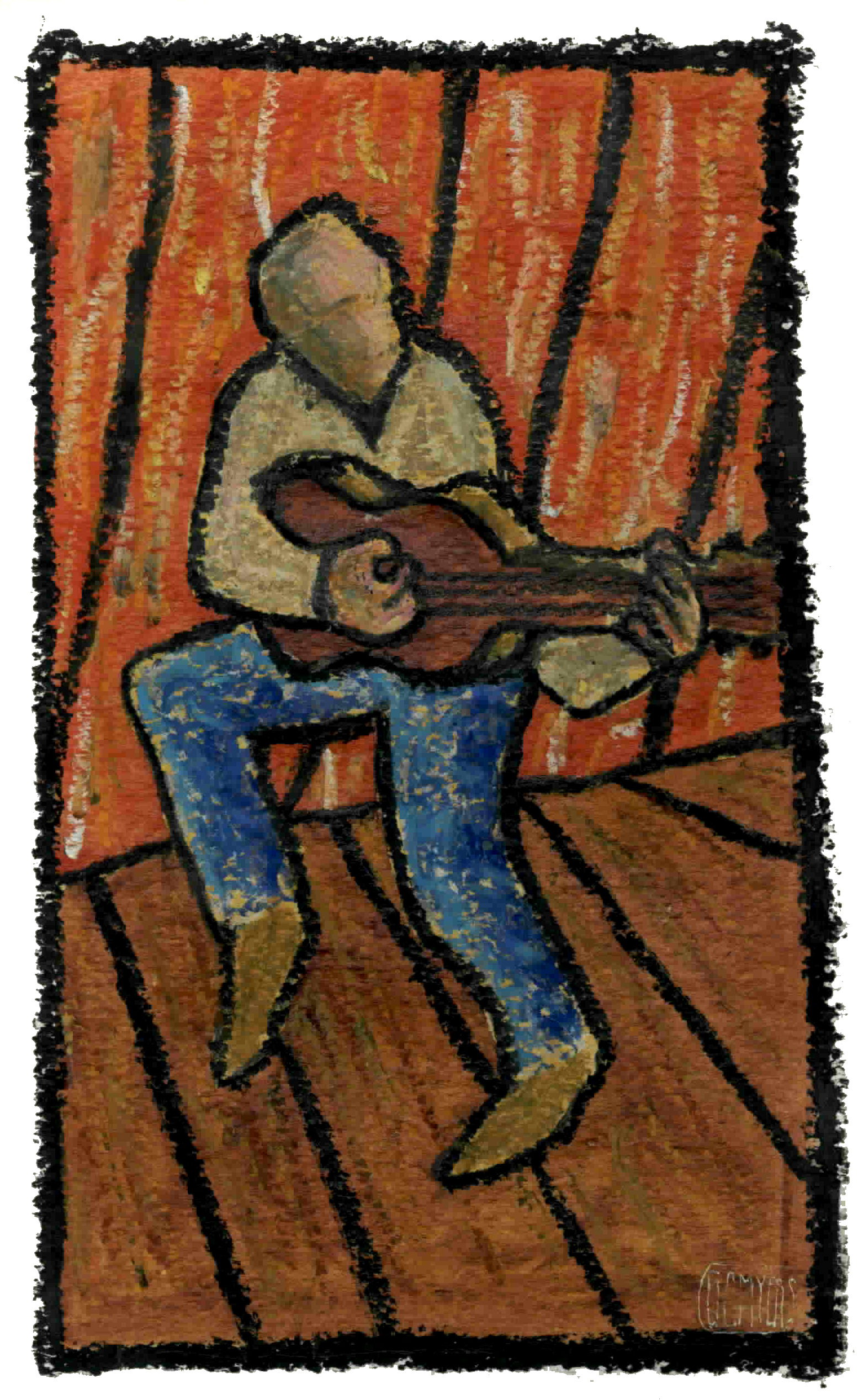
I’ve been revisiting a lot of very old work lately here in the studio, taking little walk down memory lane. Some of the memories  are pleasant enough with “oh, yeah, I remember that” coming up periodically in my mind. Some are  cringeworthy, making me glad I moved past that time. Some please me greatly and some make me smile. Such is the case with this  little piece done in 1994.

Called Rockin’ Billy, it was done quickly in crayons. It’s rough-edged and kind of crude but has movement. I think I was listening to a bunch of old rockabilly at the time. Johnny Burnette, Warren Smith, Jerry Lee Lewis, that kind of stuff– rough-edged and a little crude with some real movement.

But I am pretty sure that this piece was a direct result of Billy Lee Riley and his distinct guitar playing, especially in a couple of my faves from that time, Flying Saucer Rock and Roll and Red Hot. Every time I stumble across this piece I have to break out the rockabilly for at least a few songs and that’s how it is on this Sunday morning. Here are those two songs from Billy Lee Riley.

Oh, what the hell, let me throw in Johnny Burnette’s Rock Billy Boogie. I can see Rockin’ Billy dancing across the stage now. Hope this helps you have your own rockin’ good time today.


Read Full Post »

Busy morning here in the studio but I wanted to replay a post from over eight years ago about a painter whose work always dazzles me, Joseph Stella. I’ve added a few images from the original post as well as a video that shows the wider range of his work over his lifespan. Just plain great work…

When I see the paintings of Joseph Stella, particularly his modernist work, I am immediately engaged. They seem dense and complex, almost manic in their compositional content, yet the color and symmetry have an effect that I find calming.  I often wonder how Stella viewed this work, what he felt from it. Not in an artspeak sense. Not academic jargon. Just how it made him feel.

Stella (1877-1946) was an Italian immigrant to this country who has often been linked with several movements- modernism, futurism, and precisionism among them.  There is a contradiction in this in that everything I find about him points to someone with an outsider’s mentality, someone who never felt himself a part of any group  and with an “antipathy for authority” as it has been described, with which I strongly identify.  Joseph Stella Brooklyn Bridge

Maybe that’s what I see in the work.  I don’t know. I do know that I am drawn to the boldness and beauty of it. The strength of the lines. The depth of the colors. The sheer visceral bite of the  image that when taken in as a whole seems to engulf you. Gorgeous stuff. Work that makes me feel smaller, even tiny, for a moment yet inspires me to want to move my own work further ahead. To grow and expand.

Maybe that’s how I classify other’s work in my head- by how much they make me want to do better, by the way their work’s impact becomes an endpoint for me, a goal that I hope to achieve.

The work of Joseph Stella is definitely such an endpoint. Now I must work…
_

_

joseph stella old brooklyn bridge

Read Full Post »

« Newer Posts - Older Posts »