Last week I shared a couple of videos of the paintings of Edward Hopper set to music. I thought that I’d do the same this week for the work of another of my favorites, the great American Regionalist painter Thomas Hart Benton.
I’ve always loved the rhythm and movement of the elements in Benton’s paintings, in even his most remote landscapes. They seem to be filled with potential energy and the landscape becomes a living, breathing figurative element in his work. That is a trait that I try to emulate in my own work.
This video features his paintings set to the music of late American composer Walter Piston‘s Symphony #6, Movement #4as performed by the St. Louis Symphony Orchestra as directed by Leonard Slatkin. It has that sound of youth, motion, and energy that is often associated with America in the late 19th/early 20th century. Plus it has Benton’s work.
Another Sunday morning which means it’s time for a little music. I thought that for this week’s choice I would go with something a little further off the beaten track, going all the way up to Regina, Saskatchewan to grab this tune from the group The Dead South.
The song, In Hell I’ll Be In Good Company, is a song that I stumbled across awhile ago. I thought it was catchy and found the video engaging and fun. I’ve listened to it several times since and thought it would be a good song for today.
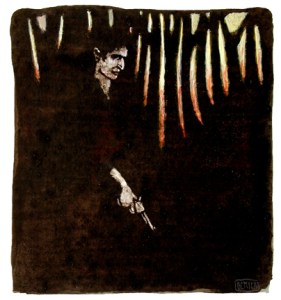
The accompanying painting is titled Confession and is from my Outlaws series. It’s hard to believe that it’s been over a decade since that group was painted. It was a relatively small and short lived series but I find myself going back to this group on a regular basis. Sometimes it’s just to look at the imagery and other times it’s to see how the narrative that I see in the image has changed over time.
There are pieces in the group where the narrative remains constant and others like this piece are a bit more ambiguous and open to new interpretations. This little painting always make me think.
Anyway, take look, give a listen and don’t worry if you think you’re going to Hell– there will be plenty of good company. Have a good day.
I am really busy today. I am working on a bigger piece that I started late yesterday. There are just a lot of things percolating and I really want to get at it this morning. I’ve been at this long enough that I know this is a time of which I need to take advantage.
The Muses come in fleeting moments and rarely, if ever, stick around for you if you don’t give them the attention and the time that they demand.
So while I go back to work I thought I would share a nice video of Edward Hopper landscapes and cityscapes set to music. The maker of the video didn’t credit the music but I was able to discover that it is a solo piano cover of Pink Floyd’s Wish You Were Here from musician Steven Garreda. It’s a really nice fit for the contemplative quiet of the Hoppers.
It’s a dark, damp day here that seems to sap the color out of the forest around the studio. All grays and browns and pale washed out greens.
It very much feels like the blues. The music, not the color.
I’ve got much to do today so I’m going to share a video that shows many of the works from one of my favorite painters, Charles Burchfield, set to the sound of one of my favorite Miles Davis songs, Blue in Green.
It’s a fitting song for a day like the one outside my studio windows.
I was thinking about what song to use for this week’s Sunday morning musical interlude and the song I chose brought to mind an old painting of mine, one that lives with me still. It from the early Exiles series from around 1995 and is called The Deacon’s New Tie.
Finished near the end of the series, it is a bit lighter and more whimsical than the other pieces in the earlier post. Outside of going out for an exhibit many years ago, the Deacon has been a constant companion here in the studio.
There’s really no back story to the Deacon. He sort of just emerged from the surface. I had no preconception of what he would be when I started. I remember clearly starting this piece on a blank sheet and making a nose. Slowly, the face formed and when his eyes with their hangdog look came around I knew he was different than my other Exiles characters.
The funny thing about the Deacon is that several months after the piece was done and include in the Exiles show, I came across an article in the newspaper about a 95 year-old man in central Florida who had won a case where he was trying to be forced from the land on which he had lived for nearly 70 years. There was a picture of a bald old man sitting on his veranda, a slight smile on his lips. There was something slightly familiar in that face, something that caused me take a second look. There it was: he was the spitting image of my deacon.
Then, reading the article, it stated that he was a longtime member of a local church and was known to friends and neighbors as the Deacon. Coincidence or maybe just a certain look reserved for those Deacon-like characters.
As you may have already surmised from the title, this week’s song is Deacon Blues from Steely Dan, a group that I often think people have let slip away in the collective memory. I was a fan and know that I often forget them until I stumble across their music by chance. Luckily, there’s a local restaurant where we’ve dined for many years and we can’t remember a single visit where a Steely Dan song hasn’t played on their sound system at some point during the meal. The owner must be a Steely Dan fan but I think many people would be surprised at the huge success, both critical and commercial, that this band achieved in the 1970’s. Solid then and now.
Anyway, this is one of their hits from back in 1977, Deacon Blues. Give a listen and have great Sunday.
You do not have to be good. You do not have to walk on your knees For a hundred miles through the desert, repenting. You only have to let the soft animal of your body love what it loves. Tell me about your despair, yours, and I will tell you mine. Meanwhile the world goes on. Meanwhile the sun and the clear pebbles of the rain are moving across the landscapes, over the prairies and the deep trees, the mountains and the rivers. Meanwhile the wild geese, high in the clean blue air, are heading home again. Whoever you are, no matter how lonely, the world offers itself to your imagination, calls to you like the wild geese, harsh and exciting — over and over announcing your place in the family of things.
—Mary Oliver
****************
A while back, a person interested in my work sent me the poem above, Wild Geese. It was written by the esteemed Pulitzer Prize winning poet Mary Oliver. This person wanted to know if I would be interested in translating this poem into into one of my paintings for them. I replied that when I had some time I would gladly do that as I think the poem strikes a chord that very much resonates in my work.
After a short while, this person contacted me again and said they had been looking at my work and had found a painting that they felt captured the spirit of the poem. The painting is the one shown at the top, The Singular Heart.
I was thrilled by the choice. It had the feeling and message of the poem without being absolutely literal. It’s exactly how I wanted to portray it. And the message and title of the painting fell perfectly in line with Oliver’s poem. The Red Tree stands, singular and alone, with the realization that it has a unique place, as does every being, in the family of things.
I told this person a bit about this painting and an experience I had with it that stuck with me. Once it hung in my home area gallery, the West End Gallery, and I met with a local college art class there. One of the questions was which of the pieces there was my favorite. I normally don’t answer that question because I have always felt that any painting that I decide to show has something unique to it, some quality that makes it special to me. Kind of like a parent with their kids.
But on this occasion I didn’t hesitate and pointed at this painting. I told them if I were to try to describe in one painting what I wanted to say with the body of my work and what I hoped for myself as a person, that this piece would summarize it perfectly.
I told this person that I felt it was perfect choice and was pleased when they chose this painting to represent the poem in their home. It means a lot when any painting finds a home but is even more special when I know that it resonates on many levels with its owner, that it goes deeper than the surface.
Here’s a clip of Mary Oliver reading her poem, Wild Geese:
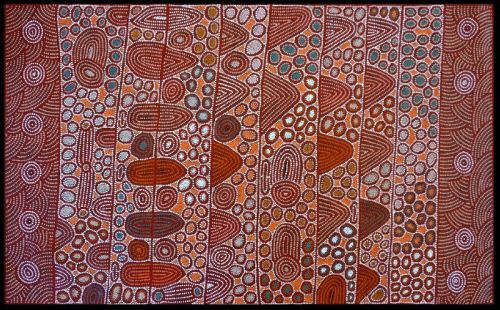
Whenever I come across a piece of Australian Aboriginal art online it just stops me cold. I am immediately pulled in amid the dots and forms and earthy colors. There seems to be something beyond what I am looking at, something deeply rhythmic and pulsing, something that connects me to a bigger pattern.
And that makes sense as even the most contemporary of this art is directly connected to the very beginnings of these people, documenting their paths, ceremonies and customs through the ages. It tells who they are as a people and perhaps, in its own way, does the same for even us non-aboriginals, connecting us in our humanity.
It has an organic authenticity that artists in other genres strive to capture in the voice of their own work. It is new and ancient at the same time. It has a modern abstract feel yet has representational symbology that comes through. As has been said, most of this work could hang in a modern art museum or in a museum devoted to anthropology– it is art and history.
I just find it fascinating and have nothing but great respect for these artists. I spent about an hour looking at the site of a wonderful gallery devoted to Aboriginal art, the Kate Owen Gallery, based in the Sydney area of Australia. I could have spent many more hours on the site. I urge you to take a look.
I’m showing a few pieces that jumped out at me and I barely scratched the surface of all the great work there
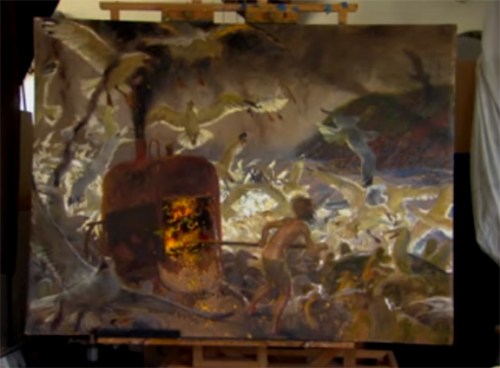
While I’m a much bigger fan of the work of his father and grandfather, Andrew and N.C. Wyeth respectively, I do like many paintings by Jamie Wyeth. I came across a video that shows him at work in his Monhegan Island studio on a painting titled Inferno which depicts gulls swarming around a boy as he stokes a trash fire that blazes in a burner made from an old fuel tank.
I was surprised, for instance, by his use of a large sheet of corrugated cardboard as his surface as well as by the way he uses watercolor paint in the same manner as an oil paint. Even if you don’t paint, the video is an interesting insight into the physicality of his process. And if you do paint, it may make you want to consider a different way of approaching your next piece. Give it a look.
Lend your ears to music, open your eyes to painting, and… stop thinking! Just ask yourself whether the work has enabled you to ‘walk about’ into a hitherto unknown world. If the answer is yes, what more do you want?
–Wassily Kandinsky
*****************
Just wanted to share a great little film from Alfred Imageworks that features an animation of the elements from some of Kandinsky’s great paintings. Below that is a film from 1926 of Kandinsky creating a drawing with these same elements.
One of the great benefits in my job is that I occasionally get to hear from kids who like my work. For example, last month the Principle Gallery forwarded a lovely note from a young girl from Arlington, Virginia who declared herself a big fan of my work. She told me about how she likes to draw the trees in her backyard and how she hoped to be able to show me some of her art at some point.
I can’t tell you how happy that little note and its simple affirmation from a little girl I have never met made me feel on the day that it arrived. Maybe it’s because I trust kids’ eyes and their instinctual reactions. They don’t like something because someone thinks they should like it– they just like it because they like it, because there is something in it that they see as clearly speaking to them, not needing explanation or translation. It’s as though they are not aware of their lack of knowledge and, as a result, see with a pure, unadulterated vision.
And that is exciting to me.
The latest incident came earlier this week when I received an email from a local elementary school art teacher, Joanna Martinec at Big Flats Elementary. She said she had introduced her 3rd grade class to my work as a way of teaching them different elements of composition in art. They were especially taken with my Archaeology series with its hidden underground artifacts and created their own versions of it.
She forwarded two photos of the collected pieces that I am sharing here. I couldn’t be more happy with this work and love them all. In fact, there are a couple that have effects and feeling that I would love to capture in my own work. Just darn good stuff!
The kids were also pleased to know that I was both alive, local and self-taught. She sent me a list of questions from the kids that I found to be very insightful and inquisitive, much more in depth than I expected. We are trying to arrange a time for me to talk to the kids and answer those questions in person.
I am looking forward to that and to seeing some of these pieces up close. Thanks, Joanna, for passing them on to me– they made my day!
 Last week I shared a couple of videos of the paintings of Edward Hopper set to music. I thought that I’d do the same this week for the work of another of my favorites, the great American Regionalist painter Thomas Hart Benton.
 Another Sunday morning which means it’s time for a little music. I thought that for this week’s choice I would go with something a little further off the beaten track, going all the way up to Regina, Saskatchewan to grab this tune from the group
  I am really busy today. I am working on a bigger piece that I started late yesterday. There are just a lot of things percolating and I really want to get at it this morning. I’ve been at this long enough that I know this is a time of which I need to take advantage.
 It’s a dark, damp day here that seems to sap the color out of the forest around the studio. All grays and browns and pale washed out greens.
 I was thinking about what song to use for this week’s Sunday morning musical interlude and the song I chose brought to mind an old painting of mine, one that lives with me still. It from the early Exiles series from around 1995 and is called The Deacon’s New Tie.
 You do not have to be good.


 While I’m a much bigger fan of the work of his father and grandfather, Andrew and N.C. Wyeth respectively, I do like many paintings by Jamie Wyeth. I came across a video that shows him at work in his Monhegan Island studio on a painting titled Inferno which depicts gulls swarming around a boy as he stokes a trash fire that blazes in a burner made from an old fuel tank.
 Lend your ears to music, open your eyes to painting, and… stop thinking! Just ask yourself whether the work has enabled you to ‘walk about’ into a hitherto unknown world. If the answer is yes, what more do you want?
 One of the great benefits in my job is that I occasionally get to hear from kids who like my work. For example, last month the Principle Gallery forwarded a lovely note from a young girl from Arlington, Virginia who declared herself a big fan of my work. She told me about how she likes to draw the trees in her backyard and how she hoped to be able to show me some of her art at some point.
 Redtree Times