Feeds:
Posts
Comments

Archive for the ‘Favorite Things’ Category

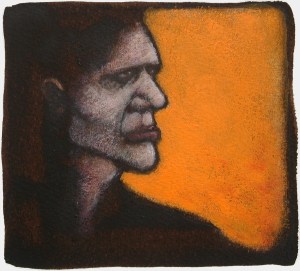
GC Myers- A Hard PastIt’s Mother’s Day again. You might think the image I am showing today is an odd selection for this day. It’s a small painting called A Hard Past that is from my 2008 Outlaws series.  It’s one of a few pieces that I deeply regret ever letting go as it holds personal meaning for me.  I just didn’t realize this at the time.

I know that this may not seem like a flattering thing to say but every time I look at this image I see my Mom’s face.  At least,  a certain look she had when she was sitting by herself in silence at the kitchen table, drinking a cup of tea and smoking her ever-present Camel cigarettes, those unfiltered beauties that no doubt contributed to the lung cancer that took her life at age 63.

She would sit in stillness for a long period time at that table with a distant and hardened gaze on her face.  I always wondered what she was thinking or where she was in that moment.  But when you’re a kid you just move through the kitchen without a word or a question.

More’s the pity…

The title, A Hard Past, came from this memory of her.  She had a pretty hard life- her mother died when she was three,  no school beyond ninth grade, years of toiling in a factory and a long, turbulent and angry marriage to my father.  It gave her a hard edge, a toughness that several people commented on after her death back in 1995.  But they also commented on her humor, generosity and willingness to help others who might need a hand– those qualities that I also saw in her.  Those qualities that I so miss.

So while it may not seem like a flattering tribute, just seeing my Mom in this piece means so much to me.

For today’s music, I’m going with her favorite, Eddy Arnold, and a song that she probably felt fit her like a glove, You Don’t Know Me.  It’s a classic song that Arnold is credited with co-writing along with songwriter Cindy Walker in 1955.

Have  great Mother’s Day…

Read Full Post »

Portrait of a Group of LumberjacksI’ve got a soft spot for pictures of lumbermen.  I’ve written here before about my great-grandfather, Gilbert Perry, who was a pioneer in the Adirondack logging of the late 1800’s.  It was in the days before chainsaws and gas-powered tractors when everything was done with axes, crosscut saws, teams of horses and the brute force of large crews of men.  My aunt once had a photo of him alongside a huge stack of logs atop a horse-drawn sled but it was lost before I able to see it.
But besides Gilbert, early loggers from the Eastern forests are pretty numerous in my family and in my wife’s family.  I am always surprised at how many turn up when I am doing research. Being a lumberjack was a rough and dangerous job, one that was romanticized in the late 1800’s in magazines such as Harper’s Weekly and the Atlantic as the Eastern equivalent of the Western cowboys of that time.

A number of those in our families lost their lives in the forests.  Among them, Cheri’s great-grandfather was crushed beneath a large log and died before he could be extracted.  I read an account of a great-uncle of mine in the Pennsylvania Black Forest whose leg was crushed between two logs in a sluice that was being used to move them.  The article tells how they  rushed him to a train and sped at breakneck speeds towards Williamsport trying to save him.  Unfortunately,  he passed away as they pulled into the city.

So whenever I run across a photo from of early lumberjacks I have to stop and take a look.  I don’t know anything about the photo at the top, when or where it was taken.  I suspect it’s from around the turn of the century but whether it is from the Eastern forests, the Northwest or the great forests of the upper Midwest is beyond me.  Regardless, it’s just a great photo on so many levels and is one of my new favorites.

Read Full Post »


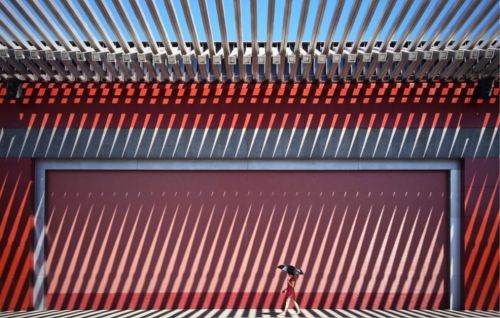
2016 Smithsonian Photo Contest Winner- The China Red- Jian Wang

2016 Smithsonian Photo Contest Winner- The China Red- Jian Wang

I came across the photo above this morning which is titled The China Red.  It was shot by photographer Jian Wang at Olympic Forest Park in Beijing, China and is the winning image in the Mobile Category of the Smithsonian’s 13th Annual Photo Contest.  I spent about five minutes just staring at it, transfixed by the pattern of the shadows and colors.  Just a great image.

The color and forms incorporated in the photo reminded me of some of the work from the Precisionist painters such as DeMuth and Sheeler.  I thought I would share the following post from back in 2009 about Demuth:

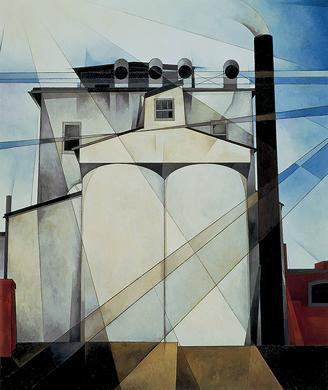
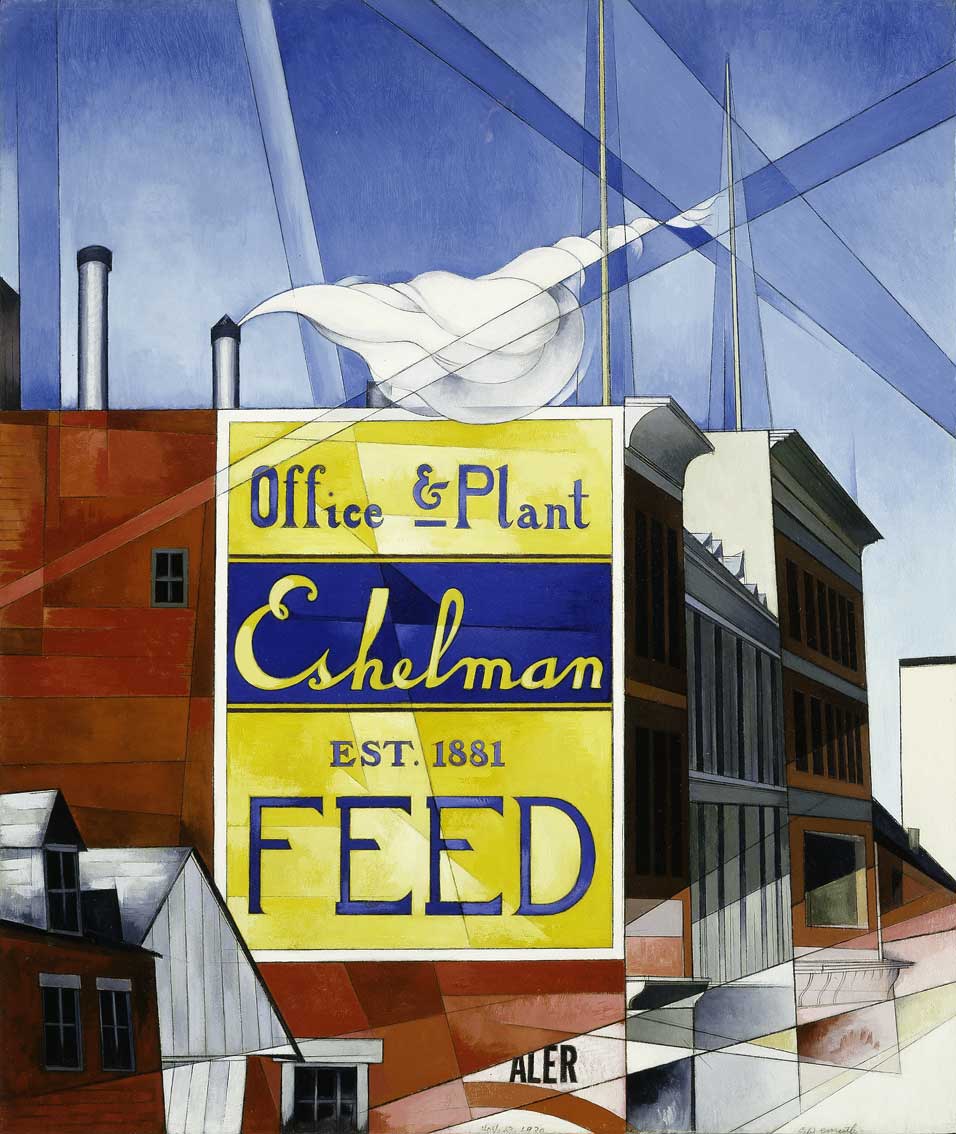
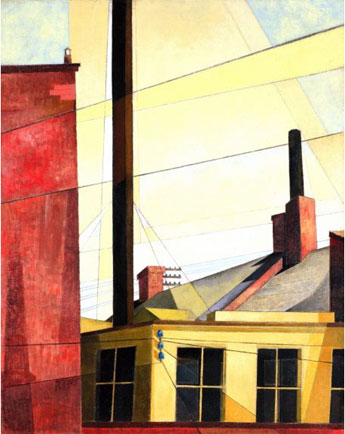
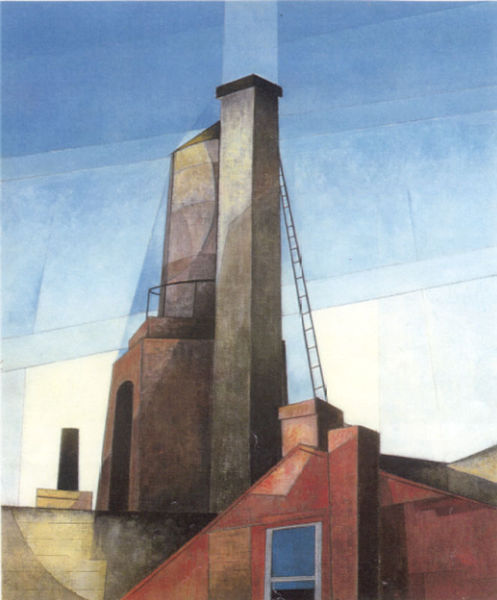
demuth-number-5I’ve been a fan of Charles Demuth since the first time I saw his work.  He was considered a part of the Precisionist movement of the 20’s, along with painters such as Charles Sheeler and Joseph Stella among many others, with his paintings of  buildings and poster-like graphics such as this painting, I Saw the Figure 5 in Gold.  He was also one of the prominent watercolorists of his time and while they are beautiful and deserve praise in their own right, it’s his buildings that draw me in.

Demuth’s work has a tight graphic quality but still feels painterly to me.  There’s still the feel of the artist’s hand in his work which to me is a great quality.  There are photorealist painters out there whose craftsmanship I can really admire but who are so precise that they lose thatdemuth-my-egypt feel of having the artist’s hand in the work.  I like seeing the imperfection of the artist.  The first time I saw one of the Ocean Park paintings from artist Richard Diebenkorn, it wasn’t the composition or color that excited me.  It was the sight of several bristles from his brush embedded in the surface.  To me, that was a thrill, seeing  a part of the process.  The imperfect hand of the artist.  I get that feeling from Demuth.

He also had a great sense of color and the harmony and interplay of colors.  His colors are often soft yet strong, a result of his work with watercolors.  His whites are never fully white and there are subtle shades everywhere, all contributing to the overall feel of the piece.  His work always seems to achieve that sense of rightness I often mention.

His works, especially his paintings of buildings, have a very signature look, marked by a repeated viewpoint demuth-after-all where he views the buildings above him.  His paintings are usually fragments of the building’s upper reaches.  There’s a sense of formality in this view, almost reverence.  I don’t really know if he was merely entranced by the forms of industrial buildings or if he was making social commentary.

Whatever the case, do yourself a favor and take a look at the work of Charles Demuth.  It’s plain and simple good stuff…

Buildings, Lancaster 1930demuth-from-the-garden-of-the-chateau

demuth_charles_aucassiu_and_nicolette_1921

Read Full Post »

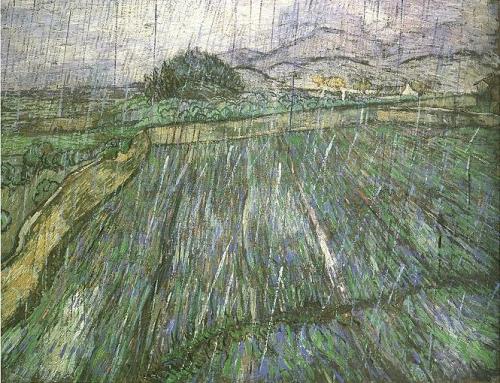
Vincent Van Gogh Wheat Field in Rain 1889If you work diligently… without saying to yourself beforehand, ‘I want to make this or that,’ if you work as though you were making a pair of shoes, without artistic preoccupation, you will not always find you do well. But the days you least expect it, you will find a subject which holds its own with the work of those who have gone before.

-Vincent Van Gogh

***************

I really just wanted to show these two Van Gogh paintings that feature the falling rain as part of the overall composition.  I recently have been particularly interested in seeking out  lesser known Van Gogh paintings.  There is something quite exciting about these more obscure pieces, something that fills in the blanks between the better known work.

But beyond that, the sentiment above from Van Gogh really resonates with me.  Sometimes it seems as though those paintings which you aim at with all your greatest effort fall flat while on those days when you have little idea of where the work will go, something special emerges quite unexpectedly.

It is those days and those painting that you crave as an artist.  Oh, it is gratifying to create work that you feel is well within your body of work.  That is to say, work which follows a path you have trod upon many times before.  But to have those days and those pieces that surprise you– well, that is beyond gratification.  It has an almost religious aspect,  like a confirmation of one’s belief in something greater.

But those days are often rare and come without a hint of what may emerge.  Even sitting here now, I don’t know if today will be one of those days.  But just knowing that it is possible makes me anvious to get at it.

Enjoy the Van Goghs and I am going to move into my day.

Vincent Van Gogh-Landscape at Auvers in the Rain 1890

Read Full Post »

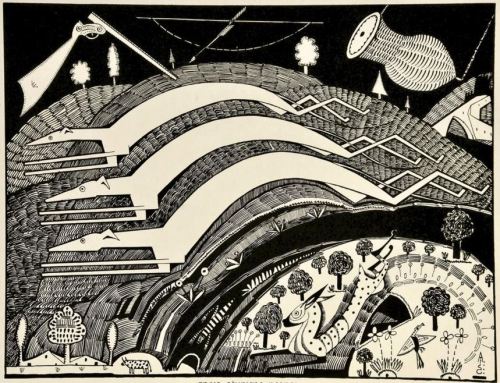
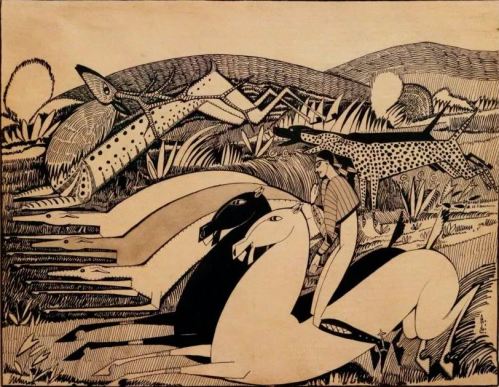
Amadeo de Souza Cardoso-Corpus Christi ProcessionThere is an exhibit of paintings currently hanging at the Grand Palais in Paris that features the work of the early 20th century Portuguese artist Amadeo de Souza-Cardoso.  It is only the second major retrospective of his work and the first since 1958.  He is another of those artists who are probably not on your radar– I know I was unaware of his work.  But once I found it, I couldn’t shake the memory of it.

Amadeo de Souza Cardoso-Greyhounds 1911He was born in the north of Portugal in 1887 near the small city of Amarante.  While still a teen he made his way to Paris where he absorbed the fertile art scene that was in place.  He began painting and drawing while becoming close friends with many artists and writers such as Gertrude Stein, Modigliani, Juan Gris  and Brancusi.

His work encompassed the Cubist, Modernist and Futurist movements, moving seamlessly among them while maintaining his unique voice in whatever style he was working at the moment.  When I viewed a large number of  his work, I was knocked out by the consistency and strength that ran through it.  Whether his work is in paint or in pen and ink, it is both vibrant and fully realized.

During the time of the first World War, Souza-Cardoso’s star was rising quickly.  But like so many other millions of people, he was struck down by the Spanish Flu pandemic of 1918.  He was only 30 years old.

What might have been…

In the fast paced and quickly changing atmosphere of the art world of the era, Souza-Cardoso’s work soon forgotten until a minor awakening in 1952 in his native  Portugal.  In Amarante, his work was given a room in the museum there and in the years since a small museum has been formed to feature it.

Hopefully, the greater public will soon know the name Souza-Cardoso.  I think it’s a name worth knowing.  I am showing just a few  pieces of his work here.  There were so many more that I could have chose.  Just great stuff.

AMADEO_S_CARDOSO-SEM_TIT(CLOWN_CAVALO_SALAMANDRA)191112 Amadeo de Souza-Cardoso-Parto Da Viola Bom Ménage Amadeo de Souza-Cardoso- The Kitchen at Manhufe House 1913

Eduardo Mota digitalizou "Le Saut du Lapin" de Amadeo de Souza-Cardoso

Eduardo Mota digitalizou “Le Saut du Lapin” de Amadeo de Souza-Cardoso

Amadeo de Souza-Cardoso-Three White Greyhounds Amadeo de Souza Cardoso-Le Tigre Amadeo de Souza Cardoso-La Dentate du Cerf 1912

Read Full Post »

PurpleIn the last few months we lost two of the most unique and transcendent musicians of our time, David Bowie in January and now Prince.  Luckily for us, both had long and prolific careers and left large musical legacies behind.  I admired Prince greatly and I think that is all there is to say, especially after the millions of words written and spoken over the past few days.  I don’t think I can stand to see another tweet on one of the news channels form some celebrity saying that this is how it sounds when doves cry.
So, instead of trying to dig up some Prince that you might not have heard in the last few days, I thought for this Sunday morning music I would go in another direction and play someone who was one of Prince’s early influences, Sly and the Family Stone.  It’s his performance of I Want to Take You Higher at Woodstock in 1969. I’ve played this clip here before but I am going to play it again just because I think it is a great performance and a great piece of film.  I think you can see how Prince took elements of Sly’s work and made it into something distinctly his own.  That synthesis is part of artistry.

Have a great Sunday.

Read Full Post »

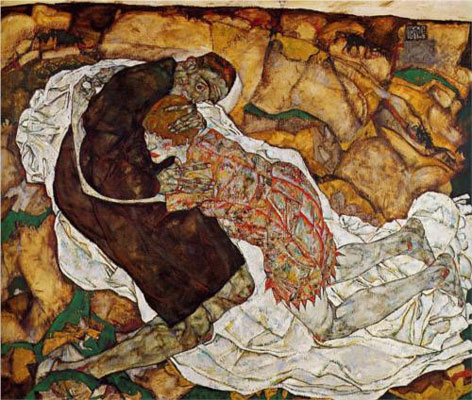
Egon Schiele- Death and the Maiden

Egon Schiele- Death and the Maiden

Going to the Neue Galerie the other day rekindled my fascination with the work of Austrian artist Egon Schiele.  There’s a lot of disturbing material in some of his work as well as in his bio that is hard to overlook even as I admire the work.  But Egon Schieledespite that, Schiele created, to my way of thinking, one of the most provocative and  distinct bodies of work in modern art– all before an all too early death from the Spanish Flu in 1917.
He was 28 years old.

I think of  that and then think of looking closely at the beauty and quality of his brushwork, I can only wonder what might have come in later years.  What masterpieces he might have created.  But as it is, he left us a rich and varied body of work, one that constantly both satisfies and provokes.

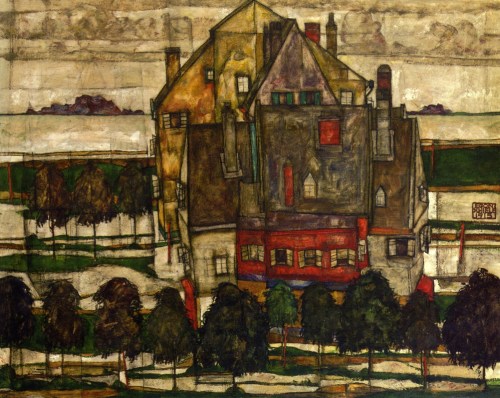
I particularly love his landscapes and cityscapes.  Their abstract qualities and coloring just draw me in immediately.  I always find myself inspired after looking at his work, like there’s something pushing out from it that runs into my own need for expression.

I am showing some of my favorites here:

Egon Schiele  Einzelne Häuser 1915 Egon Schiele - Krumau Town Crescent I  1915 Egon Schiele Hauswand um Fluss Egon Schiele Houses with Washed Clothes Egon Schiele -Landscape at  Krumau Egon Schiele Summer Landscape Egon Schiele Town Among the Greenery egon-schiele_agony1


Read Full Post »

Took a day or two to shoot into NYC.  We packed a lot into a very short time and quickly fled the throngs that packed the streets and parks of the city. Hit and run.

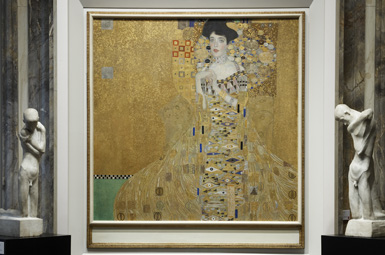
Neue Galerie - Gustav Klimt Portait of Adele Bloch-BauerWe first ran up through Central Park  to the Neue Galerie, a small museum just above the Metroplitan Museum that features German and Austrian Modern art.  It’s a beautiful collection situated in a beautiful 5th Avenue mansion which makes for intimate, if sometimes crowded, viewing of the art.  If you’re in NYC, the Neue Galerie is worth a visit if only to see this piece even though there is much, much more to see there.

It has a memorable group of Germanic paintings and drawings from the likes of Klimt, Schiele, Kirchner, Beckman and many others.  But undoubtedly, the crown jewel of their collection is the  Portrait of Adele-Bloch Bauer by artist Gustav Klimt, the $135 million masterpiece with the fabled past that spawned last year’s film, Woman in Gold.

The lighting in the room with this painting is a flat and even light that dampens the gold’s glimmer, making it less shimmering than you may have seen it in photos.  But even that can’t diminish this stunning piece which is evidenced by the flocks of people that surround it, a long with a docent who monopolized the piece for about 30 minutes.

That was all the time we had for museum hopping and it was on to the theater.  We were meeting our neighbor and friend Bill’s English class from our local high school the next day for a matinee of the Eugene O’Neill landmark drama Long Day’s Journey into Night so we figured that we needed something a bit less weighty and dark to counter the dose of O’Neill that was to come.  We hit the musical  Something Rotten which tells the story of two playwright brothers struggling to outdo William Shakespeare, who is wonderfully portrayed by Tony-winner Christian Borle as a rockstar who is idolized by the masses in Elizabethan England.

Very high energy, very funny and a really great cast.

The next day’s performance continued that theme, if you substitute the word dark for funny.  The revival of O’Neill’s biographical masterpiece features a tremendous cast with Jessica Lange, Gabriel Byrne, Michael Shannon and John Gallagher, Jr. and they did not disappoint in any way.  You could sense their total engagement with the material which is really needed for a production that runs over 3 1/2 hours and features very dark and probing dialogue between the small cast.  In lesser hands, it could be a tortuous 3 1/2 hours but they made the time pass easily for the viewer.  Great, great show.

Bill’s students seemed to understand the significance of what they were seeing which is a great thing to witness.  Many kudos to Bill for exposing these kids to this part of the world.  And if you get a chance and like the idea of seeing great actors doing great material, check out this show before it ends its short run at the end of June.

All in all, a good couple of days in the city.  That being said, there is nothing better than that time approaching home when the traffic that snarls the city has fallen away and all you can see ahead of you is a single pair of taillights far in the distance and the outline of darkened hills set against the clear night sky.  No crowds, no traffic, no noise– home is near.

Okay, for this Sunday’s music, here is a little sample from Something Rotten.  It is the real theme of the whole show.  It’s God, I Hate Shakespeare sung by Brain d’Arcy James.

Read Full Post »

Henry Matisse Blue Nudes I-II-III-IV 1952I wanted to feature some music this morning that kind of jibed with the Henri Matisse Blue Nude cut-outs above that the artist  produced in the early 1950’s.  I wasn’t sure what I wanted but I settled on something  from composer Burt Bacharach.  

Bacharach, along with lyricist Hal David, collaborated with singer Dionne Warwick a number of times back in the 1960’s when they had an amazing string of hits that didn’t really sound like anything else on the radio at the time.  It’s an unmistakable sound, light and breezy but complex and full.

When I was looking I came across this video that shows how beautifully Bacharach and Warwick worked together.  It’s interesting to see how he communicates his vision for the song to Warwick and how she responds.  It goes a long ways towards explaining why she was such a perfect vessel for his music.  The clip ends with the full recording of the song.

So, have a great Sunday and here’s Burt Bacharach and Dionne Warwick with Loneliness Remembers What Happiness Forgets.  I may steal that title at some point…

Read Full Post »

Ralph Fasanella - Night Game/ 'Tis a Bunt 1981

Ralph Fasanella – Night Game/ ‘Tis a Bunt 1981

GC Myers -Foundation smAh, the dark days of winter are receding.  The trees are budding out and the green of the grass (under the newly fallen four inches of snow!) is pushing aside the dead growth of a long gone last year.  The robins have returned and once again the world makes sense–  the daily metronome that is major league baseball returns today.

It’s opening day.

I am not going to wax poetic today about the game, its history or the place that it holds in the hearts of so many.  It just feels like the real New Year’s Day for me and many other fans, that day on which the year truly begins.

The painting at the top, Night Game/ ‘Tis a Bunt,  is one of my favorite baseball paintings from the great folk painter Ralph Fasanella.  I love this particular piece and the way the baseball diamond feels more like a real diamond in an ornate and wondrous setting.  Great piece.  And this piece on the right is from my own baseball series from a few years back.  I loved doing that series and these pieces remain among my personal favorites.  I haven’t painted one in a while but sometimes think about revisiting that old ballfield.

For this Sunday Morning Music, in honor of the game, I’m going to make it a double-header.  First, there’s Take Me out to Ballpark, as played by Harpo Marx on I Love Lucy in 1955 , which is Cheri’s all-time favorite.  I’ve shown it several times but it’s so darn good, it never gets old.  And after that there’s  bluesy 1976 homage to late great pitcher Jim “Catfish” Hunter which is called, of course, Catfish.

Have a great Sunday and hopefully you’ll get to hear the umpire call out “Play ball!

Read Full Post »

« Newer Posts - Older Posts »