Feeds:
Posts
Comments

Archive for the ‘Favorite Things’ Category

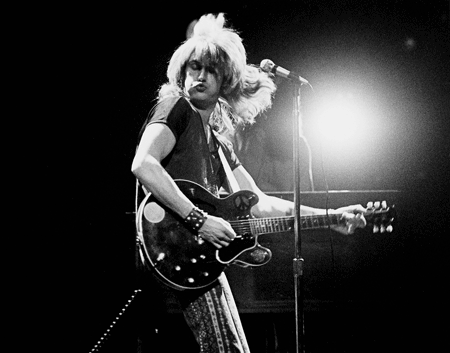
Alvin-Lee-III heard last night that guitarist Alvin Lee had died, at the age of 68, on Wednesday in Spain  from surgical complications.  I am sure the name doesn’t mean much to a lot of you but to those of you who grew up in the time of Woodstock, his name brings up memories of one of the more memorable  performances from that show.  Lee was the leader of the British band Ten Years After and their frantic version of  I’m Goin’ Home  took off when the documentary and soundtrack of that festival came out soon after.  It was electrifying stuff , then and now, and was one of the definitive moments of that landmark show.  I know that it really stood out for me even with all of the the many other incredible performances.

Unfortunately, he always felt that the attention that the Woodstock performance brought forced them in a different musical direction, more pop and away from the electric blues that he so loved and which their earlier success was built.  It’s one of those instances where success is a double-edged sword.

Lee’s biggest hit here, besides the Woodstock performance, was the 1971 song I’d Love to Change the World, which hit the Top 40 here.  It has a great sound and  in many ways expresses the chaos and uncertainty that marked the late 60’s and early 70’s.  Lee’s playing on this cut is memorable.  Here it is, in memory of Alvin Lee.

Read Full Post »

Garrett-Mcnamara-100-Foot-Wave-Nazare-PortugalThere was a story on 60 Minutes Sports last night that featured surfer Garrett McNamara‘s ride in late January of a wave outside of a small fishing village in Portugal that may have been 100 feet tall, a world record when and if it is certified by the Guinness people.  McNamara already held the world record for riding the largest wave, a mere 78 footer.  But this is a one of a kind monster.  If you’ve never seen the ocean or seen much more than a small swell, it may be hard to imagine how big a wave we’re talking about here.  It is awe inspiring and to think that someone would look out at this moving mountain of mayhem that is breaking so close to the shore and think that they might want to put themselves out in it seems like madness.

And maybe it is.  But I have to admit to being envious of the guts and ability of the big wave riders, the guys who take on the challenge of these wave behemoths that other world class surfers would run from.  To put yourself at the mercy of nature’s fury  on such a grand scale is truly elemental.  I could sit and watch these guys all day, captivated by the way they dart across the waves.

Here’s a video that I showed about four years ago that feature the penultimate surf song, Pipeline, from the Chantays.  The setting for the video is a bit odd, however.  It’s hard to imagine this music that symbolizes the wildness of the surf culture on The Lawrence Welk Show but   here it is.  It adds to the kitsch factor.

Read Full Post »

Hans Memling

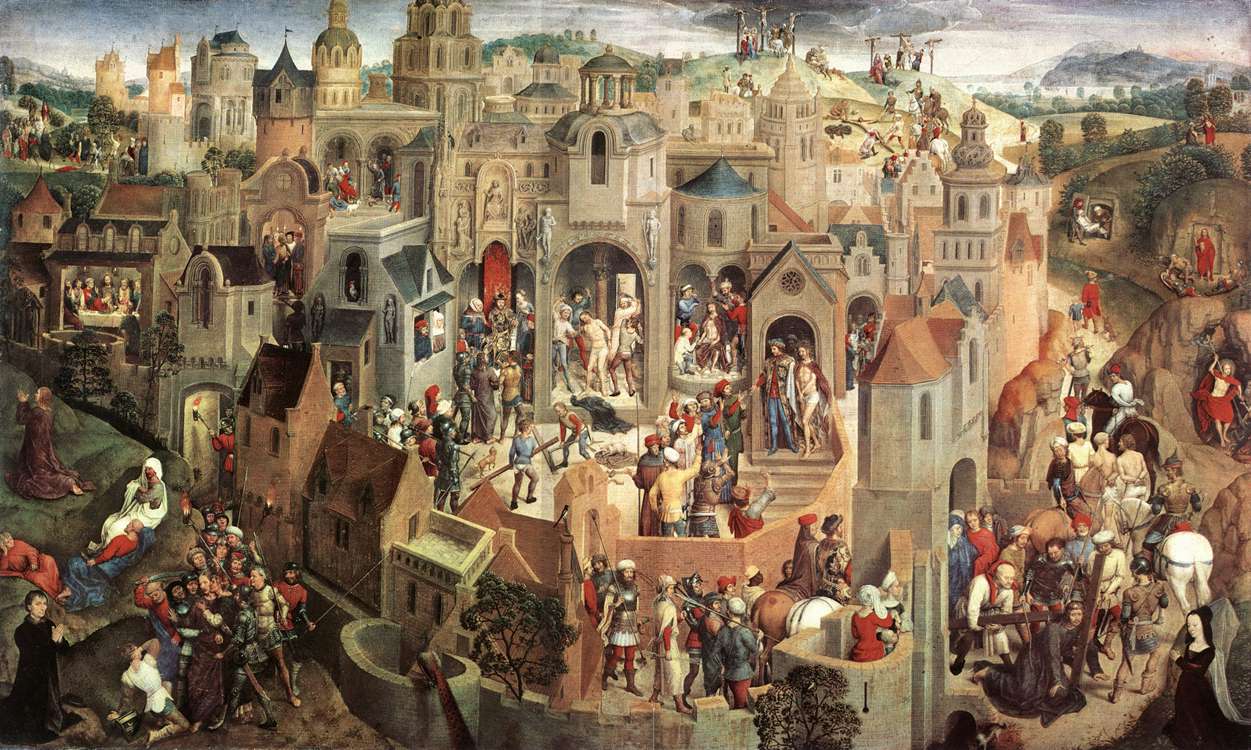
I’m not an art historian.  I try to maintain a certain knowledge about artists, especially those work I have seen and taken something from in the form of influence for my own work.  But  I am often reminded by how little I really know.  A friend recently stopped by the studio and, while looking at a couple of my large landscapes, said that their compositions reminded him of some of the panoramic pieces from Hans Memling.Hans Memling- scenes-from-the-life-of-mary-1480

I hesitated before responding, running the name through my mind, wondering if it was someone that I should really know if I wanted to call myself an artist and deciding if I should just feign knowledge of the name– “Memling? Oh, yeah…”   But I finally admitted that I wasn’t familiar with the name or the work.  Of course, after my friend left, I was online looking for Hans Memling.

And was pleasantly surprised at the beauty and power in his work.

Memling was a German-born painter who lived in the 15th century, painting in the style of the Dutch masters.  Painters, not cigars.  His work employed beautiful contrasts and deep, rich colors.   His panoramas, such as Scenes From the Life of Mary shown above, were feasts  for the eyes. Every glance offered a new and compelling vignette, each which would make a powerful painting on it’s own.  Just beautiful stuff, to use a technical term.

I know  many of you will look at his work and wonder how in the world my friend could see any equivalency between his and mine.  And that’s a fair question because they are worlds apart  in time, expression and style.  But I see  a similarity in the rhythm of the composition, the way each part plays off the other to create a harmony of movement throughout.  That’s what I take from them because I have no desire to paint like Memling or express the things he conveyed in his work.  I want to paint in my own way and express feelings that dwell within me now.  But I am moved by the rhythm and  the way they’re put together.  Looking at them made me aspire for even more in my own work.  More detail.  More areas of concentrated interest.  Greater depth into the picture plane.

Just more.

Now I know who Hans Memling is and another item is taken from the list of things I don’t know.  Hey, you do what you can…

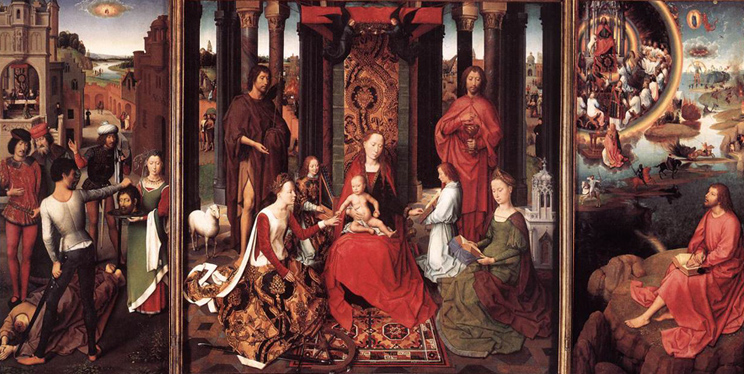
Here are some other magnificent Memlings-

Hans Memling- Scenes from the Passion of ChristHans Memling- St John Altarpiece Hans Memling- The Last Judgement

Read Full Post »

Abraham Lincoln Tintype Medallion  1860I’m always intrigued whenever I come across images of Abraham Lincoln.  There aren’t many I haven’t seen  as his image has remained in the public eye on a regular basis throughout my life.  Growing up, in our family photos there was a small image of Lincoln that was mixed in with a handful of early photos from my great-grandmother.  I didn’t yet understand the place that Lincoln held in the heart of the American people   and wondered why it was there.  I actually felt more related to his image in that I at least recognized who he was which was something I couldn’t say for some of the folks in those old photos of people standing in front of what appears to be 1920’s automobiles in some totally unfamiliar rural farm setting .  Maybe that’s why I am drawn to his image even now.

So when I come across an image that doesn’t seem familiar, I take notice.  It’s part of trying to capture another part of the prism of the man, to fill him out as a human rather than as the icon he has become.  The token shown above, obviously a souvenir from the 1860 campaign, is new to me.  Lincoln is still youngish in appearance, not yet showing effects that the ravages of the weight of a nation at war would  appear  in later photos.

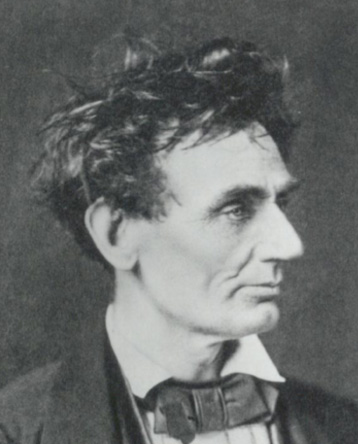
Abraham Lincoln- Early with Wild hairThis photo on the right brings up questions.  Why was his hair so wild?  Would he not have been aware of that when he agreed to sit for the photo?  It’s not like there was a paparazzi at that point snapping candid shots at every turn or a White House photographer documenting every moment.  You had to more or less pose for most photos.  But I like it.  Again, it fills out the man.  And it makes me feel a little better about my own crazy professor hair as I sit here.

There are a few more images below and some of them are a bit more familiar.  The first one seems to be a shot from the same sitting as the wild-haired one above.  Maybe the photographer noticed and offered up a comb.  I don’t know.  The second is from the War years and he has began to age.  But it’s a noble and strong image with that steely look of determination staring directly into the camera. The last is an earlier image when he is obviously not as consumed by the tasks before him.   But all are interesting in their own way and give us more insight into this most compelling character.

Abraham Lincoln George Ayres 1861

Abraham Lincoln- Alexander Gardner 1860s

Abraham  Lincoln-attributed to Nicholas H Shepherd

Read Full Post »

I had a good trip down to Alexandria yesterday, a fast down and back jaunt with a pleasant, as always, visit with my friends there.  It’s always great to spend a little time with the folks there– Michele, Clint, Julia and Chris.  Oh, and my dog, Asher, who wants to play fetch from the minute you enter the gallery to the minute you leave.  He pretends to be Clint’s dog but I know that he’s really mine.  But since Clint wouldn’t part with him for the world and takes great care of him, I guess that’s okay.  Thanks for making me feel at home there, guys.

Sartenada -klaukkala_tsasouna_finland I was going to write about the trip a bit more but I was looking at a photo blog that I read on a semi-regular basis, Sartenada’s Photo Blog.   He is a retired pilot and amateur photographer   who travels around his native Finland and Europe snapping photos of some interesting subjects.  I particularly  like his photos of the rustic wooden churches in Finland, such as the one shown here on the left,  that are so beautifully designed.

Sartenada- ahlainen_church_iglesia_eglise_-16A recent post featured a group of folk art sculpture that he had noticed outside several of these churches, near life-size figures of what seemed to be people in great hardship, some missing limbs.  They often have a hand out as though asking for help.  It turns out that these are Poor Man Statues which are really just large and elaborate poor boxes.  There are slots in the sculptures to insert money that will be passed on to the needy of the church and the community.

Sartenada -pomarkku_church_iglesia_eglise_-19I was really taken by these statues which reminded me so much of some of the great folk art sculpture of the past  here in the States.Some are really expressive such as this one on the left. His face has deep creases in his weathered face  and, as Sartenada implies, may be based on an actual member of the church or community.  I think these are just wonderful and wanted to pass them on.  I’m pleased to see these surviving and hope that they will be preserved.

Again, you can see more of these at Sartenada’s Photo Blog.   It’s worth a visit if only for the statues and the beautiful rural churches of Finland.Sartenada-- historic_wooden_poor_man_statue_in_kuortaneSartenada - siipyy_church_iglesia_eglise_-4

Sartenada- pomarkku_church_iglesia_eglise_-18

Read Full Post »

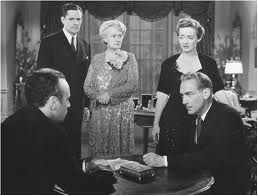
Watch on the Rhine 1943Tonight is night when the Oscars are handed out for the best movies, directors, actors and so on.  I’ve always been a big film fan and I always look forward to seeing who wins even on the years when I have hardly seen a movie.  It also makes me think of many of my favorite movies, films that stick in my mind and, like any other  form of art, define who I am.

A few weeks ago, I saw one of these favorites of mine, Watch on the Rhine.  It was made in 1943, adapted for the screen by Dashiell Hammett from  the prize-winning play written by his wife, the great Lillian Hellman.  It concerns a family in the Northern Virginia area across the Potomac from DC whose daughter ( Bette Davis in a supporting role here) returns home from a war torn Europe for the first time in many years with her husband and children.  It is set, and was written,  in the years before our entry into World War II.

Her husband is a German freedom fighter, Kurt Muller,  who is a wanted leader in the underground movement against the Nazis. He is  played by Paul Lukas in a magnificent performance, one that won him the Academy Award for Best Actor that year over Humphrey Bogart in Casablanca and Gary Cooper in For Whom the Bells Toll.  Yes, it was that good.

His Muller is the common man who finds himself in the role of the selfless hero willing to give up everything– his career, his family, his life– in order to stand against evil.  It’s not a task Muller sought but is one he must shoulder.  His words are simple, direct and powerful.  Lukas, who also originated the part on the Broadway stage, is brilliant and, whenever I see this movie, I am haunted for weeks afterwards by Lukas’ performance.  The power of it thrills me but I find myself questioning my own strength and beliefs as a human.  Thankfully, I have never been put into a situation like that faced by Kurt Muller and hopefully never will.  But would I be able to stand with even a fraction of the grace and courage of Lukas’ character?

I doubt it but I don’t know.

But I know that this movie’s ability to fix that question in my mind for weeks make it a great movie with great acting and world-class writing.  Hopefully, this year’s movies will have a film like Watch on the Rhine that will haunt future generations when they watch it years from now.


Read Full Post »

Lawren Harris Bylot IslandThere seems to a big void in my collected knowledge, which is not too large to begin with, when it comes to artists form our neighbor to the north, Canada.  I’ve written about David Blackwood, the master printmaker whose work documents the world of the Canadian maritimes, on this blog a couple of times but beyond that, I come up short when thinking about Canadian painters.  Based on what I know about other Canadian artists in other fields such as music, acting and writing, I figured there had to be a wealth of great painters waiting to reveal their work to me. I wasn’t disappointed.

Lawren Harris Mt Lefroy - 1930This all came about because  I had a comment the other day comparing my brushwork to a Canadian painter who I was not familiar with in the least, Tom Thomson.  I am saving his story for another day because it is a big story with twists and mystery.  But Thomson is considered one of the pillars of Canadian painting along with the artist whose work I am showing today, Lawren Harris.

While doing a search for Thomson, I stumbled across a mention of Harris and followed the link.  The images of his work jumped out at me.  Strong, simple images of the Canadian landscape with beautiful color and form with a sense of abstraction that I found irresistible. The Google Image page  with Harris’ paintings just glows.  How had I not heard of this guy or Thomson  or any other Canadian painters?

LawrenHarris-North-Shore-Lake-Superior-1926Lawren Harris was born into a relatively wealthy life in 1885 in Brantford, Ontario, his family part of the Massey-Harris company that made farm and construction equipment.  After attending college in Toronto, he headed to Berlin in the early years of the 20th century where he painted and started his involvement with Eastern philosophy and Theosophy, which he maintained throughout the remainder of his life.   He was one of the founders of the Group of Seven which is a  group of Canadian painters of formidable talent from around 1920 until the mid 1930’s , a group which deserves much more attention than I can give at the moment.  In the 40’s, Harris  headed out to Vancouver where his work became more and more abstract. He died in 1970.  Buried on the grounds of the McMichael Art Gallery in Ontario, his work has sold for impressive sums in the years since.  In 2010, the painting at the top of this post, Bylot Island, sold for 2.8 million dollars.

LawrenHarris-Mount-Thule-Bylot-Island-1930I really identify with a lot of the things I have read in my brief research into Harris, how he felt that art was “a realm of life between our mundane world and the world of the spirit.”   I like the continuing simplification of his work and his expression of spiritual emotion through his explorations of color and form as he saw them in the starkness of the Canadian landscape.  It’s hard to believe he has escaped my notice, and probably most of America’s as well, for so long.  Just beautiful work…Lawren-Harris-Isolation-Peak-1930lawren_harris_greenland_mountains_c1930-450x379

Read Full Post »

Holy Family-  American Folk Art MuseumI wasn’t going to write anything today but I opened a book that I have featuring works from the American Folk Art Museum, one that I browse on a regular basis.  The page I turned to is near the middle of the book, a page that I always seem to turn to when I open the book,  showing a carved piece, Holy Family,  that I  just love.  It is attributed to the 19th century  woodcarver John Philip Yaeger, a German born craftsman who worked in the Baltimore area.  I’m not religious in any traditional sense of the word but I thought this would be a fitting image to show today, which is Ash Wednesday on the Christian calendar.

There’s something irresistibleabout this carving,  beyond the subject matter,  that I just can’t put my finger on.  The color of its patina is beautifully golden and warm. The lines are smooth and rhythmic.  There’s a wonderful balance of fineness and roughness in the way the pieces of wood that make up the sculpture are put together.  It has a modern feel yet seems old– a timeless quality.  Everything about it has that sense of rightness that I have tried to describe here without much success in the past.

I also am intrigued but he damage on the left shoulder of the father.  I don’t know if this is just a property of the wood after these many years but it looks like it may have been near a cat who saw this as a perfect scratching post.  But even that doesn’t lessen the power of the piece.  It fits right into the wholeness of it.  Imperfectly perfect.

Read Full Post »

Eric Burdon- 'Til Your River Runs DryGrowing up,  I was always kind of fascinated by Eric Burdon, then lead singer for the Animals, the British rock band who always seemed just in the shadow of the Beatles and the Stones.  But they were different than the other bands of that early British Invasion.  They seemed rougher, more closely connected to American blues.  Their songs were not mere love ditties.  They were angrier, more defiant and fatalistic.

And it was all captured in the face of Eric Burdon.  He was not a pretty boy, not the smiling cute one that even moms found charming.  He was sleepy eyed with  pock marked skin and an almost surly demeanor that never broke into a toothy smile.  I might be mistaken, but I think he even had a broken tooth.   But he sang those songs that still resonate today–House of the Rising Sun, Boom Boom, Please Don’t Let Me Be Misunderstood, Don’t Bring Me Down, Sky Pilot,  We Gotta Get Out of this Place.  

It’s my life and I’ll do what I want…

He has had a long career, starting the band War, best known for Spill the Wine, Cisco Kid and Low Rider.  Today. he lives in the desert of Southern California and, at age 71, has a new CD, ‘Til Your River Runs Dry,  out on the market.  I am including a song from it today, Water, that deals with the ever growing problem with maintaining the availability of  safe and potable water now and in the future.   Water is that thing that we all need– more than oil, more than gas, more than any precious metals.  Water is the cause of the current battle over hydro-fracking and might be the thing that nations battle over  in the future.  Give a listen…

Read Full Post »

Mark Reep Issue -Blue Canvas CoverThere’s a great article in this month’s issue of Blue Canvas, a quarterly magazine that is distributed worldwide and features articles and interviews with some of the finest artists around the globe. The article that I mention concerns the work of Mark Reep, an artist who has shown at the West End Gallery since 1995 and lives in Lawrenceville, PA. It’s a wonderful article that focuses on Mark’s process and the motivation behind the mysterious places that populate his unique artistic world. It shows several pieces of his beautiful black and white work , including two full page images. Just a great opportunity for the rest of the world to see the work that the folks around here have been lucky enough to have right under our noses for these last 17 years.

Mark Reep - Stone of Turning

Mark Reep – Stone of Turning

I have always felt a kinship with both Mark and his work. We started showing at the West End Gallery around the same time and our work was different than much of the other work in the gallery at the time, both of us focusing on landscapes that originated internally, based on creating a world based on feeling and emotion rather than one that represented the world around us.

Mark’s pieces were moody and mysterious small pieces, meticulously crafted with a laborious stippling that created magnificent depth and detail. They rewarded the viewer who stopped and deeply pondered the work with a stillness and quiet that was almost spiritual in its nature, all the time filling you with questions. Where does that path lead? Who lives in that stone house perched atop that high cliff? How do I get there?

Over the years, there has been an incredible consistency in his vision, even as his process has evolved and the world that he portrays has expanded. I never get the sense that his created world is not real because of this great commitment. As a result, his world is always distinctly his own, something I really appreciate and struggle for as an artist.

Mark Reep-  All the Silent Years

Mark Reep- All the Silent Years

I have to admit to being awestruck by Mark’s work over the years, perhaps more than any artist I have ever shown with. And that includes some truly great artists. Maybe it’s because I know of his commitment to this work, his unwavering belief in it. Maybe it’s because I see its timeless appeal, something that makes me believe it will only become stronger as the generations pass.

Maybe I don’t know exactly why. But I am thrilled that Mark’s work is being seen on a worldwide stage. It is well deserved. I have often felt that we took his work too much for granted on a local level, that we didn’t see the diamond in our presence. And his work is a diamond.

Read Full Post »

« Newer Posts - Older Posts »