Feeds:
Posts
Comments

Archive for the ‘Favorite Things’ Category

GC Myers- Passing Clouds

Optimism is the faith that leads to achievement. Nothing can be done without hope and confidence.
-Helen Keller

***************

Who can speak more about optimism than Helen Keller?

I still struggle to get my mind around how she persevered to overcome blindness and deafness.  Such a remarkable thing.  It makes me question my own strength of character, makes me wonder how I would respond if similar circumstances.  I wonder how well known her life’s story is to the younger generation, outside of the tale of her early years with the woman, Anne Sullivan,  who taught her how to join the world as portrayed in the play and movie, The Miracle Worker?  That drama, while marvelous, doesn’t tell of the great influence that Helen Keller had through her life as an activist and inspirational speaker.  She is a pretty amazing case, to say the least.

That brings me to this  little piece, a new 12″ by 12″ canvas that I call Passing Clouds.  There’s a lot of joy, a lot of bright-eyed optimism in this painting, both in the process of painting it and in the final product.  It’s one of those pieces that I truly enjoyed every moment that I worked on it and never felt a twinge of doubt about the strength or validity of it.  It felt in rhythm with the first brushstroke and every subsequent move was made with complete confidence.  That’s a rare thing.  Usually there is a struggle at some point.  But occasionally things come together and a painting like this flows out with complete ease.

No, there are no clouds over this one.

I wanted to include a version of Irving Berlin‘s classic song  Blue Skies, one of my favorites.  But as I searched  I came across this different song  with the same title from Tom Waits.  I had forgotten this song that I hadn’t heard in many years but it immediately came back to me.  Just a lovely small song, perfect for a lovely small painting.

Read Full Post »

166_1934_CCI find it hard to believe that I haven’t mentioned the work of Charles Sheeler here, outside of a mention of his collaboration with Paul Strand on the film Manhatta, a landmark American art film from 1921.  Sheeler (1883-1965)  is one of my favorite artists who as  a pioneer in photography and painting in the early decades of the 20th century is often called the father of Modernism.  Oddly enough, I am particularly drawn to his industrial imagery which replaces almost all evidence of things natural in completely man-made factoryscapes.  This  might seem to be the antithesis of my own work,  which often omits all evidence of human intervention in my landscapes.

Charles Sheeler River Rouge PlantSome of his most potent work came from an assignment where Henry Ford hired Sheeler to photograph his factories, wanting him to glorify them in an almost religious manner, as though they were cathedrals for the new age.  As Ford had said at the time, “The man who builds a factory builds a temple. The man who works there, worships there.”  Sheeler was impressed with the factory complexes and felt that, indeed, they represented a modern form of religious expression.  His painted work from this time glorified the machine of industry in glowing forms and color.

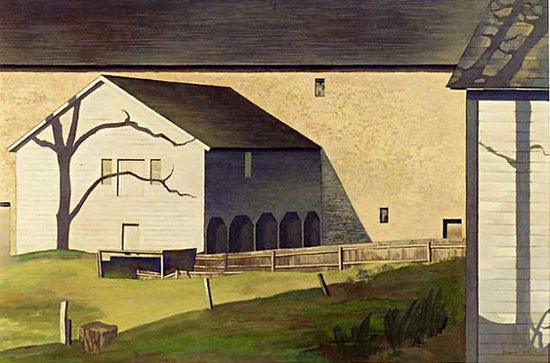
Charles Sheeler Shaker BarnHe saw the factory as a continuation of the American idea of work as religion, one that was rooted in the sense of  reverence and importance of the barns and structures of the farms of the earlier pre-industrial age.  He   painted many scenes of farms and barns, abstracting the forms as he had with the factory scenes.

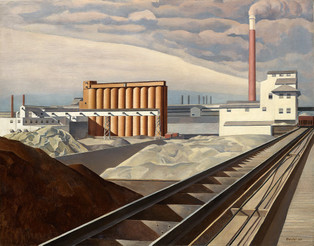
Charles Sheeler Classic LandscapeI don’t know that I completely agree with Sheeler on his idea of the factory as cathedral but I do have to admit to being awestruck in the presence of large factory structures.  I remember working in the old A&P factory, a huge building that was said to have the capability to produce enough product each day to feed everyone east of the Mississippi.  It no longer exists.  Some of the huge rooms in the building were amazing to stand in, as the machines hummed and throbbed while workers hustled about servicing their needs.  I particularly remember the tea room which was a huge ca cavernous space with row after row of steampunk  looking machines that bagged the tea then sewed it shut.  I cleaned these machines for several weeks and, standing in the grand space in silence after most of the workers had gone and the machines turned off, felt that feeling of awe.   I would sometime walk around from area to area, just taking it in.  I didn’t necessarily adore it in the manner of a religious zealot but there was no denying the  power in its magnitude and the power of the machine.

Maybe that’s why I’m drawn to Sheeler.  Maybe its his use of form and color.  I don’t know.  I guess it doesn’t really matter.  I just like his work. Period.

Charles Sheeler Conversation Sky and Earth

Read Full Post »

“Not I, nor anyone else can travel that road for you,
You must travel it for yourself.

It is not far, It is within reach,
Perhaps you have been on it since you were born, and did not know,
Perhaps it is every where on water and land.”

–Walt Whitman- Part of Song of Myself from Leaves of Grass. 1855

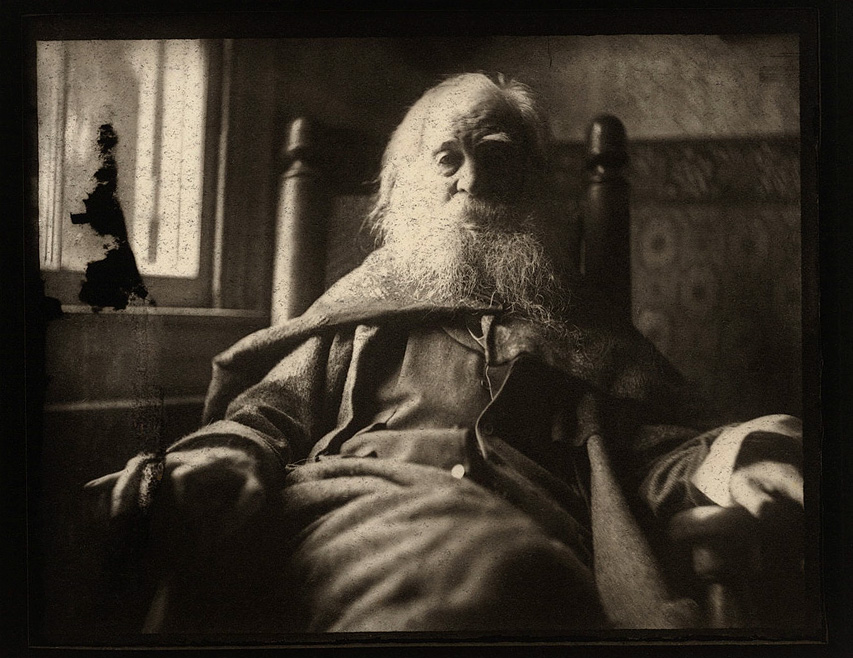
Walt Whitman-  Thomas Eakins 1891

I’m in a bit of a hurry but really wanted to show this great photo of Walt Whitman.  I don’t think I’ve ever seen a photo of him that wasn’t interesting but this one is special.  It’s taken by the great American painter Thomas Eakins in 1891, a year before Whitman’s death in 1892.  Eakins was also a pioneer in the use of photography in the art studio and an innovator in motion studies with film, among many other things.  I plan on writing more about his remarkable career in the future.  But for now, I just wanted to show this simple elegant photo of America’s voice.  At least to my ears.

Read Full Post »

Cameron_Julia_Margaret_Iago_Study_from_an_ItalianA few months ago, I posted one of my favorite photos, Sadness, from the  British Victorian era photographer Julia Margaret Cameron.  I was struck by the contemporary feel and presence of the photo taken of the actress Ellen Terry in 1864.  It had a naturalness that was unlike much of the photography that we think of from that era, making me feel that it could be a photo from any time.

I recently came across another of Cameron’s photos that hit me in very much the same way.  It is an 1867 study of a young Italian man,  Angelo Colarossi, portraying Iago, the betrayer of Shakespeare’s Othello.  With downcast eyes, his unshaven face fills the frame and you don’t see any props to give away his character.  It may be betrayal that fills his face but for me it is more along the lines of Judas than Iago.  There seems to be remorse and even a bit of Christlike genuflection in his downward gaze.

Like Cameron’s Sadness, this piece has a freshness that makes it feel out of time.   It is a document of emotion that crosses time.  Cameron had a real knack for capturing the universal and eternal in her work, when all others were capturing stiff, glassy-eyed portraits in her own time.  For me, I use Cameron’s work as reminder of the quality that I want in my own work, that universal and timeless appeal, even though our methods and materials and eras are so different.

Just a great photo.

Read Full Post »

Howard Pyle-  Marooned PirateLater this year, the Fenimore Art Museum will be presenting a big show featuring the works of the first family of American art, the Wyeths, in a show titled  The Wyeths: A Family Legacy.  I have written several times here about my admiration for the work of  family patriarch NC Wyeth and son, Andrew Wyeth.  Their work is woven into the cloth of American art and this should be a great exhibit highlighting their work as well as other talented members of the clan.  Also included in this show will be work  by the great American illustrator, Howard Pyle, who was the teacher and mentor to NC.

Howard PyleAlthough his name is not nearly as well known as many who followed in his footsteps, it’s hard to overstate the influence that Pyle (1853-1911)  had on future generations of American illustrators and artists.  He was huge in his time, a celebrity who mingled with the great writers and thinkers of the time.  His illustrations for many of the most popular magazines of that time, based on the great stories of literature, shaped how we saw those stories.  Cinematographers, costumers and set designers took their clues from Pyle’s visions of the stories they were staging.  For example, his vision of Robin Hood became the idealized version that we came to know in the old Errol Flynn classic movie.  His idea of the pirates of Treasure Island became ours.  His cowboys, knights  and explorers ingrained themselves into our collective psyche as we saw them on the page and on the movie screen.

Howard-Pyle-The-Wolf-and-Doctor-Wilkinson-Once-it-Chased-Doctor-Wilkinson-into-the-Very-Town-ItselfThere is an interesting sidebar to the extent of Pyle’s fame.  In a letter to his brother, Theo, Vincent Van Gogh wrote ” Do you know an American magazine Harpers Monthly?  There are wonderful sketches in it…which struck me dumb with admiration…by Howard Pyle”  His work may have been illustration but it was  pure art as well and the eye of Van Gogh could see that in the  line work and rhythm of his compositions.   I know that I am always inspired by his work and the that of his acolytes,  including NC Wyeth and Norman Rockwell.   I am  really looking forward to seeing his work alongside the Wyeths this year at the Fenimore.  It should be a memorable show.


Read Full Post »

Chester Cornett  CrucifixChester Cornett  CrucifixI came across an image of a hand-carved crucifix that caught my eye.  it had rough craved ribs and was painted in a haphazard fashion and adorned with human hair.  The photo made it look small and intimate but it was huge, about eight  feet tall and four feet wide.  It would be a truly dynamic thing to see.  I knew nothing of its maker,  Chester Cornett.  This wild expression, while effecting in its presence,  didn’t give me any real idea of the story behind the name or of the nature of his true special talent.

You see, Chester Cornett was born and raised as a traditional chairmaker from the hills of Kentucky, learning at the knees of his grandfather and father.  He was born in 1912 and died in 1981, living a life filled with hardship as the  world surged progressively into the modern era,  moving further and further away from the need for the handmade.  But Chester persisted, perhaps because he knew no other way or because his special talent, his genius, was too great to forsake.

Chester Cornett Rocing Chair BookcaseHe made all sorts of chairs, simply built traditional chairs and rockers.  But it was when he moved beyond that form that his genius manifested itself.  Folding chairs with eight legs.  Rocking chairs with bookcases built around them.  They were masterfully crafted with innovative joinery and intricate engineering.  Just amazing creations.

I’m just learning about Chester Cornett so I’m not going into much depth here.  There’s not a wealth of info out there outside of a film, Handcarved, from 1981, and a book that features him among other mountain craftsmen, Craftsmen of the Cumberlands.  But I find his work and his life captivating.  There’s something special in seeing ingenuity show itself in unlikely places and conditions.  And Cornett seems to me an unlikely genius that deserves greater examination.

I like this exchange from the book, Craftsmen of the Cumberlands:

Chester Cornett Snake Chair“Do you think it takes a special talent to be a chairmaker?” I asked Chester. 

“I don’t b’lieve so,” he said. 

“You think anybody could be a chairmaker?” 

“No, I don’t b’lieve just anybody could… too hard a work.” 

“Does it take some special skill?” 

“Yes sir, it does. It takes a skill specially for, uh, you got to learn how to use that drawin’ knife—use it just right to take off hick’ry bark with or whatever you’re making.” (Though other chairmakers used a drawing knife much less frequently and for fewer tasks than Chester did.) 

“Can anyone learn how to use a drawing knife?” 

“I’d say so, excepting uh, you got to learn to get interested in anything to learn it… you have to learn to get interested in a thing like that before you could learn it. And anyway, I b’lieve anyone could learn how to use a drawin’ knife and do that work.” 

“Anybody could learn how to be a chairmaker, then?” 

“Well, yes, they could, but they’d have to learn to be interested in that first.”

Maybe that’s the whole point of life– finding that thing that we can learn to be interested in.

Read Full Post »

hunter s thompson anthony hope-smithThe Edge… There is no honest way to explain it because the only people who really know where it is are the ones who have gone over. The others — the living — are those who pushed their luck as far as they felt they could handle it, and then pulled back, or slowed down, or did whatever they had to when it came time to choose between Now and Later

*******************************

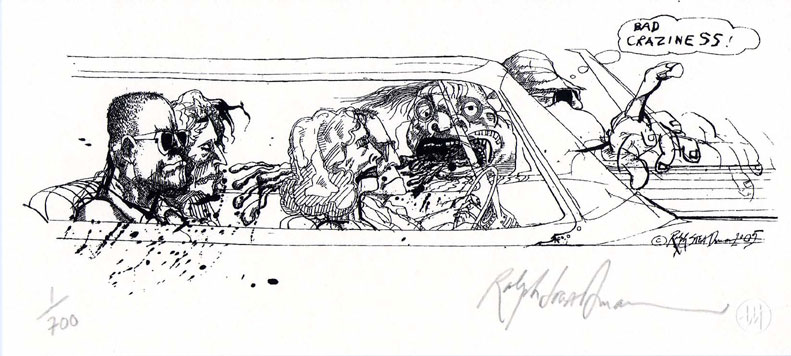
The quote above is taken from Hunter S. Thompson’s 1966 book , Hell’s Angels: The Strange and Terrible Saga of the Outlaw Motorcycle Gangs.  I read that book and most of his other work , including that from his  longtime union with Rolling Stone magazine,many years ago with great glee but never really got caught up in the whole gonzo mania that sprung up in later years as he became an almost mythic figure.  No, I just loved the Ralph Steadman -Bad Crazinessway his journalism, if indeed it was that or purely fictional, took on sometime serious subjects with a skewed and jaded eye.  And it was just laugh out loud funny at times with imagery that is as vivid in my mind as when I first read it oh so many years ago.  Plus, it usually was accompanied by the ink-splattered artwork of Ralph Steadman, including this drawing shown here taken from a memorable incident in  Fear and Loathing in Las Vegas.  I think Steadman’s manic drawings of Thompson’s adventures were a major force in the  building of the Thompson legacy and legend.

And for some, Thompson is a legend, an icon, a caricature that still lives on.  There have been numerous books and films on his life including a graphic novel last year, Gonzo: A Graphic Biography of Hunter S. Thompson , illustrated by Anthony Hope-Smith.  I don’t know if I’m still buying in but some of the imagery is wonderful and the early stories are still great reads.

Here’s a video from artist Piotr Kabat that is his graphic interpretation of the quote at the top of this post.  Well done.

Read Full Post »

Morris Hirshfield TigerThere are so many artists out there, both now and from the past,  that I’m not surprised when I come across an artist with which I am not familiar whose work knocks  me out.  But sometimes I come across work that is so strong and consistent in its vision that I just can’t understand why the name is not known to me.  That’ happened recently when I was browsing through a book on the collection of the American Folk Art Museum and came across the name Morris Hirshfield.  The name didn’t ring a bell but the work was so wonderful.   It had a naive feel in the rendering of the figures but there was a sophistication in the composition and coloring that made me feel that it was anything but folk.

I definitely had to find out more about Morris Hirshfield.

Morris Hirshfield Angora CatBut there’s little to learn about the man.   Not a lot is written, only a few mentions in books. That surprised me.  But his story is pretty simple.

He was born in Poland in 1872 and came to America around 1890 at the age of 18.  Like many many of the Jewish immigrants of that time who settled in the New York area he began working in the garment industry.  With his brother, he opened a coat factory that evolved into a slipper factory which was very successful.  Morris  encountered health problems and retired in 1935, at which point he took up painting, following up on an artistic urge he had as a child but had put aside long ago.

Morris Hirshfield Girl With PigeonsWithin four short years, his work had attracted the attention of collector and art dealer Sidney Janis, who used two of Hirshfield’s paintings for an exhibit he was putting together in 1939 for the Museum of Modern Art, Contemporary Unknown American Painters.  MoMA , at that time, was committed to collecting and showing the work of self-taught artists.  In 1941, MoMA purchased two of Hirshfield’s paintings for its collection and in 1943 gave  Hirshfield a solo show.  He had only painted 30 pieces up to that point in his career.   There was great controversy over the show at the time as the critics of the era savaged it.  It was, according to Janis’s biographer,  “one of the most hated shows the Museum of Modern Art ever put on.”  It led to the dismissal of the museum director at the time.

Morris Hirshfield Dogs and PupsBut Hirshfield survived and painted his paintings of animals and the occasional figure for a few more years until his death in 1946.  His career spanned a mere 9 years over which he produced only 77 paintings.

I don’t really understand the controversy of the time or why Hirshfield hasn’t inspired more  writers or artists.  Or maybe he has and I just can’t find  much evidence of it. When I clicked on the Google image page for him, I was immediately smitten.  There was that sense of rightness that I often speak of here.  Just plain good stuff.  Just wish Morris Hirshfield had been around longer so there might be more to see.

Morris Hirshfield Beach GirlMorris Hirshfield Baby Elephant With Boy 1943Morris Hirshfield Lion 1939Morris Hirshfield Zebras


Read Full Post »

henri-cartier-bresson-leningrad neva riverI wrote the other day about the decisive moment  and mentioned the French photographer, Henri Cartier-Bresson,  who made great use of the term and concept in his work.  I am a fan of his work.  It would be hard to not find something in his work that draws you in.  Many are simply great images  with superb composition and an artistic rhythm running through them, showing the influence of his early training as a painter.  Some are mysterious and enigmatic, making you stop and just wonder what exactly was the story behind the photo, such as the image shown above of a sun bather along the Neva River in 1973 Leningrad .  And many capture defining moments in the 20th century, moments of history and change.

Decisive moments.

henri cartier-bresson_gestapo_informer_1945Cartier-Bresson was born in 1908 and witnessed nearly a century of such moments, his death coming in 2004.  He lived through both World Wars in Europe.  He fought in the second war and was a POW for nearly three years until he escaped and continued the war serving with the French underground resistance.   The photo here on the left is from 1945 showing a Gestapo collaborator being confronted in the aftermath of the war.  He traveled around the world at important moments, capturing the people on the street as change was taking place.  His photo of henri-cartier-bresson China 1949people in 1948 China in a crushing line to get gold allotted to them by the government as it teetered on the brink before finally falling to Communism.  Ten people were killed in the crush of this line.  In that same year, 1948, Cartier-Bresson also met Mahatma Gandhi.  He was one of the last people to meet Gandhi and his photos, taken a mere hour before he was shot and killed, are the last photos of him while alive.  Again,decisive moments.

As I said, there’s a lot in his body of work, something for everyone.  He is considered the grandfather of modern photojournalism, making the move from clumsy large  format cameras to the more portable 35mm  that allowed greater spontaneity and mobility.  It brought the immediacy of the moment on the street to film.

Something I find interesting about his grand life is that  he hung up his camera almost thirty years before his death and spent his final decades at his first love, drawing and painting.  Just an amazing life, a witness to a world at the most decisive moments of the time.

henri-cartier-bresson Aquila degli Abruzzi 1952henri cartier-bresson istanbul 1964


Read Full Post »

Breaking AbbeyTonight’s the much anticipated American debut of Downton Abbey‘s third season.  I know that I’m looking forward to get my fix of the drama following the family and serving staff of a huge British manor as it struggles, financially and socially,  through the changing times around World War I as the era of the great landed estates nears its end.

Speaking of needing a fix, a few weeks back, in response to his faux outrage over Michelle Obama getting a preview of the new episodes ahead of the general public,  Stephen Colbert presented a video featuring three of the main characters from the series in a parody.  They were supposedly reading lines from the upcoming season of Vince Gilligan’s Breaking Bad, the series dealing with the story of a  science-teacher-turned-meth-kingpin.  If you’re a fan of either series, or both like me, you may get a kick out of this uncensored mash up.  Maybe they can next do a Homeland/Mad Men version with Carrie and Saul carrying out the parts of Don Draper and Roger Sterling?

The Colbert Report Mon – Thurs 11:30pm / 10:30c
Uncensored – Breaking Abbey
www.colbertnation.com
Colbert Report Full Episodes Political Humor & Satire Blog Video Archive

Read Full Post »

« Newer Posts - Older Posts »