Feeds:
Posts
Comments

Archive for the ‘Influences’ Category

GC Myers-- Into the Clear AirI said to my soul, be still and wait without hope, for hope would be hope for the wrong thing; wait without love, for love would be love of the wrong thing; there is yet faith, but the faith and the love are all in the waiting. Wait without thought, for you are not ready for thought: So the darkness shall be the light, and the stillness the dancing.

T.S. Eliot

****************

I’ve read these lines from T.S. Eliot before but it was only this morning that I equated them to the creative process.  Well, so far as I see it in my own experience.  You see, you can struggle to describe in words how things come about, how things finally appear.

You might describe an inner process of visualizations and intricate thought synthesis, of pulling deep emotions to the surface and so on.  Maybe that is so but I think it is not really part of the process but is rather an interpretation of what you believe happened.

I think the real creative aspect occurs in a way much like the words above describe– in the stillness and darkness of a meditative void.  The mind emptied and all thoughts of the past and the future are set aside.  No hopes or desires.  Just a quiet dark blankness that waits in endless patience for the first crackling of light to pierce through.

But there are times when the light doesn’t come and you lose patience in the waiting.  So you start without the light and occasionally, nearing the end of the process, you find that your mind has emptied and the light has caught up with you.  What you are looking at it something quite unlike what you thought it might be when you struggled to begin.

I know this all sounds pretty esoteric, pretty out there and maybe it won’t make a lick of sense to most who somehow slog through to this point. But really it comes down to the idea that you clear the mind and let it just happen.

If it happens at all.  Sometimes the light doesn’t find you.  But on those times when it does, it is like the freshest clear air has wafted over you and left you with a feeling of ethereal lightness. The clearest air.  And I guess that is why I keep doing this and probably will until the day I die.

********************

The painting above is a 16″ by 20″ canvas titled Into the Clear Air and is included in Part of the Plan, my show that opens tomorrow, Saturday, October 29, at the Kada Gallery in Erie.  The reception begins at 6 PM.  Hope you can make it!
Read Full Post »

GC Myers- The Introspective MindIntrospection, or ‘sitting in the silence,’ is an unscientific way of trying to force apart the mind and senses, tied together by the life force. The contemplative mind, attempting its return to divinity, is constantly dragged back toward the senses by the life currents.
Paramahansa Yogananda

*********************

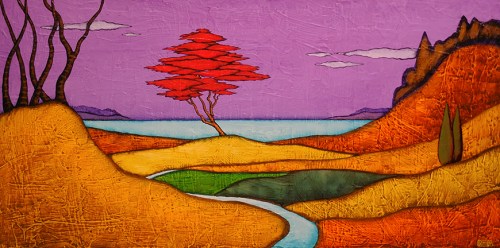
I often consider my landscapes as being deeply introspective even though by their very nature they are outward looking.  They are most often scenes where the central figure– the Red Tree in most cases– finds itself in a moment and place where the inner and outer, the mind and the senses, converge.

It is a moment of calmness, one that allows the mind to expand and soar outside itself, to see the world and itself from new perspectives.  It allows it to see all that it is and is not.  To see all possibility, paths that are open but not yet visible.  Perhaps even a return to divinity as the words of the great Hindi yogi Paramahansa Yogananda states in the quote above.

I like the idea of this juxtaposition of contrasts, the inner and the outer set side by side, each strengthening the other so long as they stay in balance.  I can’t say that I go into a painting with that as a goal in the front of my mind.  I think it’s just one of those things that when you recognize it in the final product realize that it was what you were looking for even though you didn’t know it at the outset.

And perhaps letting it slip from your consciousness was the key all along.  Trying too hard to find something so elusive usually ends in failure.  But just letting things go without placing too much emphasis on any aspect sometimes brings what is important to the forefront.

I know that in this new painting, a 15″ by 30″ canvas titled Introspection, that how I see it now had little to do with where I initially thought it would go or say.  At its start I never gave a single thought as to leading it to the message that it now holds for me.  I just let the paint work, let my mind move freely in the forms and color to release what it ultimately held.

So maybe that is the key– to free the mind from the senses as Yogananda says.  Easier said than done…

——————-

The painting above, Introspection, is included in Part of the Plan, my solo show opening October 29 at the Kada Gallery in Erie, PA.

Read Full Post »

GC Myers- WatchmanFor thus hath the Lord said unto me, Go, set a watchman, let him declare what he seeth.
Isaiah 21:6

******************

The biblical verse above is of course the one which was the basis for the title for Harper Lee‘s sequel, to her classic To Kill A Mockingbird.  In the books, Scout regarded her father, Atticus Finch, as such a watchman, a moral and righteous sentinel looking out for injustice and evil.

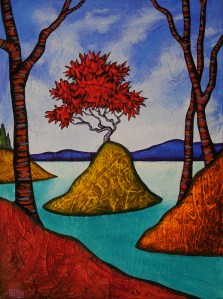
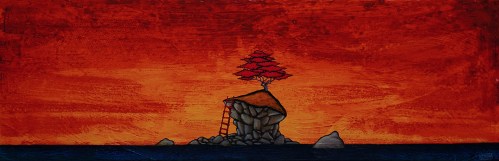
And that is kind of how I see the central figure of this new painting, the lone Red Tree set high on rocky outcropping in what seems to be an endless sea.  Maybe it is the red of the sky that sets such a tone.  I don’t know.

I’ve been fascinated by small islands in my work lately.  The isolation of them gives these pieces a brooding quality and reminds me a bit of working as an artist.  I’ve often felt that the job of an artist is to act as a sort of watchman.

It is very much a job of isolation, one that is often formed in the solitariness of youth when one always felt like an outsider, observing the world quietly and mostly unseen from the edges of life.  The work itself is done and grows in isolation but is very much influenced by one’s observations of the world around them.  And much of the work, if it reaches the level of art, is based on a sensitivity to what that artist has observed and felt.

And maybe that is the real purpose of artists, to act as a watcher, looking to warn us of our own straying from reason and to keep our humanity intact.  Maybe that is what I see in this painting.

gc-myers-defiant-heart-smThis painting is 8″ by 24″ on canvas and is titled, of course, Watchman.  It is coming with me to the Principle Gallery this Saturday, September 17, when I give my Gallery Talk there beginning at 1 PM.  There will be a group of new paintings including this piece as well as a group of selected pieces from my studio that will only be available for that day.  And there is, of course, the drawing at the end of the talk for the painting, Defiant Heart.

Should be a good time and I hope you can make it to the Principle Gallery this Saturday!

Read Full Post »

Hugette Caland-- Boat Race on the Potomac

Hugette Caland– Boat Race on the Potomac

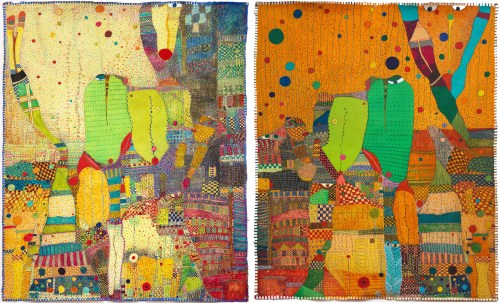
I am not going to be able to write much here today but I did want to at least share a few images from artist Hugette Caland.  Born in Lebanon in 1931 to a father, Bechara El Khoury, who was to become the first President of that country in 1943, Hugette Caland, now 85, lives and works in .  Over the past five decades she has created a wonderful and diverse body of work that has become very celebrated in recent years.

I am showing the pieces that struck me but be advised that this is only a tiny glimpse of the range of her work.  I was immediately struck by the piece at the top, Boat Race on the Potomac, a very large piece measuring something in the area of 5′ high by 11′ wide.  Many of the pieces shown here, such as this piece, are very large textile wall hangings that are done with markers.  It set off all kinds of fires in my brain when I saw it and during the past few trying weeks has been an image that I often return to when I get a chance to move my mind away from the situation at hand.

As I said, I don’t have time today to spend much time giving all the background info that Hugette Caland and her work deserves but I just wanted to share these images as I feel they have something to say to me at this moment, something that I will use moving forward.  Please take a look and I urge you to seek out her story and some of the other images and videos available online.  Great stuff.

Hugette Caland-Rossinante Under Cover III diptych 51x84  mixed media on canvas 2011

Hugette Caland-Rossinante Under Cover III diptych 51×84 mixed media on canvas 2011

Hugette Caland-Rossinante Under Cover IV

Hugette Caland-Rossinante Under Cover IV

Hugette Caland-Out of Venice 58.5x76

Hugette Caland- Out of Venice 58.5″x76″

Hugette Caland-The Purple One 65x165

Hugette Caland- The Purple One 65″ x 165″

  Golden Daisies

Hugette Caland- Golden Daisies

Read Full Post »

I am often asked about the meaning of the tree that looms large in my painting.  I normally stumble around while trying to explain what feeling, what meaning I find in this form.  But I recently came across an extraordinary short essay from a favorite author of mine, Herman Hesse, that expresses all those things I have tried to say about trees with my own words and images.  From Trees: Reflections and Poems, this is just a beautiful piece that rings the bell for me:

GC Myers- Moon Communion smFor me, trees have always been the most penetrating preachers. I revere them when they live in tribes and families, in forests and groves. And even more I revere them when they stand alone. They are like lonely persons. Not like hermits who have stolen away out of some weakness, but like great, solitary men, like Beethoven and Nietzsche. In their highest boughs the world rustles, their roots rest in infinity; but they do not lose themselves there, they struggle with all the force of their lives for one thing only: to fulfill themselves according to their own laws, to build up their own form, to represent themselves. Nothing is holier, nothing is more exemplary than a beautiful, strong tree. When a tree is cut down and reveals its naked death-wound to the sun, one can read its whole history in the luminous, inscribed disk of its trunk: in the rings of its years, its scars, all the struggle, all the suffering, all the sickness, all the happiness and prosperity stand truly written, the narrow years and the luxurious years, the attacks withstood, the storms endured. And every young farmboy knows that the hardest and noblest wood has the narrowest rings, that high on the mountains and in continuing danger the most indestructible, the strongest, the ideal trees grow.

Trees are sanctuaries. Whoever knows how to speak to them, whoever knows how to listen to them, can learn the truth. They do not preach learning and precepts, they preach, undeterred by particulars, the ancient law of life.

A tree says: A kernel is hidden in me, a spark, a thought, I am life from eternal life. The attempt and the risk that the eternal mother took with me is unique, unique the form and veins of my skin, unique the smallest play of leaves in my branches and the smallest scar on my bark. I was made to form and reveal the eternal in my smallest special detail.

A tree says: My strength is trust. I know nothing about my fathers, I know nothing about the thousand children that every year spring out of me. I live out the secret of my seed to the very end, and I care for nothing else. I trust that God is in me. I trust that my labor is holy. Out of this trust I live.

When we are stricken and cannot bear our lives any longer, then a tree has something to say to us: Be still! Be still! Look at me! Life is not easy, life is not difficult. Those are childish thoughts. . . . Home is neither here nor there. Home is within you, or home is nowhere at all.

A longing to wander tears my heart when I hear trees rustling in the wind at evening. If one listens to them silently for a long time, this longing reveals its kernel, its meaning. It is not so much a matter of escaping from one’s suffering, though it may seem to be so. It is a longing for home, for a memory of the mother, for new metaphors for life. It leads home. Every path leads homeward, every step is birth, every step is death, every grave is mother.

So the tree rustles in the evening, when we stand uneasy before our own childish thoughts: Trees have long thoughts, long-breathing and restful, just as they have longer lives than ours. They are wiser than we are, as long as we do not listen to them. But when we have learned how to listen to trees, then the brevity and the quickness and the childlike hastiness of our thoughts achieve an incomparable joy. Whoever has learned how to listen to trees no longer wants to be a tree. He wants to be nothing except what he is. That is home. That is happiness.

Read Full Post »

GC Myers- In the Inner PlaceShakespeare said that art is a mirror held up to nature. And that’s what it is. The nature is your nature, and all of these wonderful poetic images of mythology are referring to something in you. When your mind is simply trapped by the image out there so that you never make the reference to yourself, you have misread the image.
Joseph Campbell (with Bill Moyers), The Power of Myth

*****************************

I think that the words above that Joseph Campbell spoke during his conversation with Bill Moyers for  The Power of Myth speak beautifully for both mythology and art, at least in my view.  I believe that we truly connect with myth and art when we see it as personal to ourselves, as being somehow symbolic of our own experience and being.  Our emotions and reactions.

Of course, many myths and much in art may not speak to us on this personal level.  I certainly don’t expect my work to speak to everyone no matter how much I may wish that it could.  It simply can’t.  My work is a reflection of my journey, my limited knowledge and my flawed self.  Yours is completely different.  But occasionally, there is a moment when you will see something of yourself in my representation of my inner world and that to me is magical.

This new painting, an 8″ by 24″ canvas, is what I see as being a very personal piece that might well reflect for others.  I call it In the Inner Place and it is included in my upcoming show, Part of the Pattern, at the Principle Gallery which opens June 3.  Without being specific, I see many things in this painting that I think speak strongly to how I want to see my world and my place in it.

An inner perception.

You might simply see it as a pleasant piece.

Or not.

Or you may see it as something reflective of your own inner world, something that speaks to who you are.  I can’t say.  We can’t control what anyone sees in a mirror.

Read Full Post »

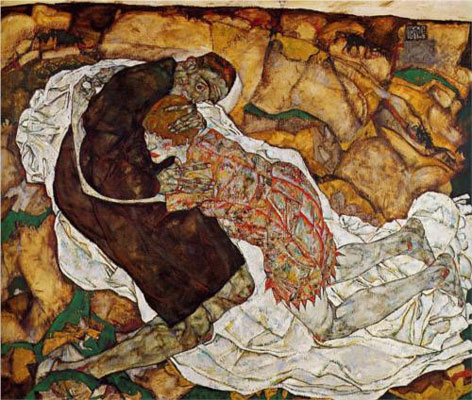
Egon Schiele- Death and the Maiden

Egon Schiele- Death and the Maiden

Going to the Neue Galerie the other day rekindled my fascination with the work of Austrian artist Egon Schiele.  There’s a lot of disturbing material in some of his work as well as in his bio that is hard to overlook even as I admire the work.  But Egon Schieledespite that, Schiele created, to my way of thinking, one of the most provocative and  distinct bodies of work in modern art– all before an all too early death from the Spanish Flu in 1917.
He was 28 years old.

I think of  that and then think of looking closely at the beauty and quality of his brushwork, I can only wonder what might have come in later years.  What masterpieces he might have created.  But as it is, he left us a rich and varied body of work, one that constantly both satisfies and provokes.

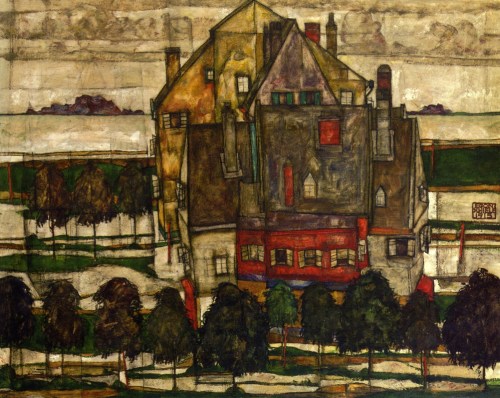
I particularly love his landscapes and cityscapes.  Their abstract qualities and coloring just draw me in immediately.  I always find myself inspired after looking at his work, like there’s something pushing out from it that runs into my own need for expression.

I am showing some of my favorites here:

Egon Schiele  Einzelne Häuser 1915 Egon Schiele - Krumau Town Crescent I  1915 Egon Schiele Hauswand um Fluss Egon Schiele Houses with Washed Clothes Egon Schiele -Landscape at  Krumau Egon Schiele Summer Landscape Egon Schiele Town Among the Greenery egon-schiele_agony1


Read Full Post »

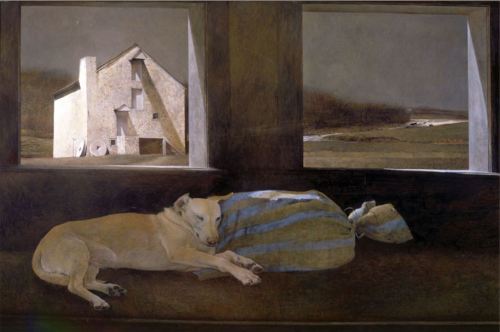
Andrew Wyeth- Night Sleeper 1979

Andrew Wyeth- Night Sleeper 1979

I dream a lot. I do more painting when I’m not painting. It’s in the subconscious.

Andrew Wyeth

**************

Andrew Wyeth- Trodden Weed

I love this short quote from the great Andrew Wyeth.  That second sentence speaks to how I view my own  relationship with what I do– I do more painting when I’m not painting.  The mind is always clicked on, seemingly always seeking that something, that one inside thing that is crying out to be expressed.

It’s a built-in thing, one that can hardly ever be turned off.  You would think it would be a maddening quality but it has become a normal way of functioning and I would probably panic if I found my mind not churning in some way.

Sometimes it is in the form of day-dreaming, just letting the imagination run free.  Other times it takes place in the words or sounds or images of others. Like pulling a new thread from an existing fabric.

Inspiration comes in many different forms and the mind is always looking for them.

Here’s a neat short film from artist/filmmaker Andrew Zuckerman that shows Wyeth describing how he sometimes find inspiration.

Andrew Wyeth from Andrew Zuckerman Studio on Vimeo.

Read Full Post »

Harald Sohlberg-Night 1904 There’s a good possibility that you haven’t heard of  Harald Sohlberg, a Norwegian painter who lived from 1869 until 1935.  I know he was not on my radar until I stumbled across a few of his images.  In fact, there is not a lot of info about him outside of a short perfunctory bio.
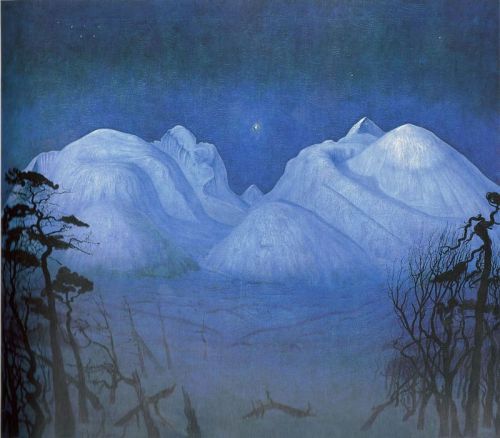
This kind of stumped me but it wasn’t until I came across the short essay shown below that this made sense, giving me a lot more insight into the man behind the work.  I particularly identified with his connection with the landscape and his feelings as expressed in the final paragraph where, as an old man, he desired that people see his work not for the simple scenes they seemingly portrayed but ” for the pictorial and spiritual values on which I have been working consistently throughout the years.”

As an artist, that is your greatest hope– that people will look beyond the surface and see the emotional and spiritual content that the artist uses as a catalyst.  Take a moment and read this essay from a 1995 exhibit at the National Academy of Design in NYC that featured the work of Sohlberg and Edvard Munch.  At least take a moment to give these few Sohlberg’s paintings a good look.

In an obituary, Pola Gauguin [son of Paul Gauguin and a painter and art critic of the time] wrote that as an artist, Harald Sohlberg was alone and forgotten: “A name which was famous in its day.” Now that Sohlberg was dead, Gauguin thought, “the coldness which he helped surround it with, will thaw.” Sohlberg’s isolation was partly the tragic result of his wholehearted endorsement of the myth of genius as formulated by Romanticism and adopted by the Symbolists. Like Munch, he was obsessively preoccupied with denying that the influence of other contemporary artists had been important to him. He dissociated himself from the discussion about where he belonged in the history of art, relegating the origins of his artistic awakening outside of art to his own psyche.

Sohlberg wrote that his form sprang forth subconsciously from his first awareness of the landscape. The difference in texture of the sky and earth gave him a sense of standing on a heavy and firm planet gazing out into boundless space. He attributed the simple forms and great lines of his pictures to this first awareness of the landscape. The point of departure was the personal experience. Thus, the artist’s experience of his subject preceded the picture. Sohlberg was preoccupied with the concrete local landscape that surrounded him and his emotional reaction to it. The place, in itself, was charged with meaning. For this reason, where he sought his subjects was important. He experienced the landscape in Norway as nature in strong and intense moods and gave form to the echoes of these moods in his mind. He agreed with many of his generation who, taking their point of departure in Andreas Aubert’s writings about Norwegian art, were of the opinion that there existed distinctive, Nordic colors, clear and strong colors created by the clear, intense light of the North. Once artists realized this, it would be possible for an independent Nordic art to develop. Sohlberg believed that, along with the unique construction of the Nordic landscape, local color ought to result in a style of its own. Experience and interpretation of nature determined the choice of colors. For Sohlberg, the main color should assemble the picture and be as strong as possible.

The function of line in painting according to him was to express feelings. It could be lonely, down to earth, or melancholy. It could be willful and persevering as required. It should be developed according to the nature of the subject and the artist’s dialogue with nature. Because the picture was bound by a perceived reality, Sohlberg paid tribute to reality by portraying it naturalistically. But his gaze carried with it the legacy of picture formulas that transformed and adapted nature. He was an artist who rarely put a stroke on the canvas before the picture was clear to him in his imagination. As an artist, he was a substitute viewer. What interested him was his own experience and interpretation, regardless of how naturalistic his pictures appeared to be. Ideally everything in the picture was controlled by his will.

As an older man, Sohlberg longed for confirmation that the public saw the values he wished to impart: “it is probably true that for simple and naive reasons my works have aroused sympathy. But I maintain that they have by no means been properly understood for the pictorial and spiritual values on which I have been working consistently throughout the years.” The quotation contains three words which are keys to an understanding of Sohlberg: “Pictorial,” “spiritual,” and “consistently.” The pictorial is means for expressing the spiritual, and one was obliged to stick to the spiritual values one held true. 

– From Ivind Storm Bjerke, Edvard Munch, Harald Sohlberg: Landscapes of the Mind

Harald Sohlberg-A Street in Oslo 1911Harald Sohlberg-Night in the Mountains 1914Harald Sohlberg- After The Snowstorm Harald Sohlberg-Storgaten_Røros_1904

Read Full Post »


"La Vigne Rouge"- The Only Painting Sold in Van Gogh's Lifetime

“La Vigne Rouge”- The Only Painting Sold in Van Gogh’s Lifetime

I came across an interesting little film, Painting in the Dark:The Struggle For Art in a World Obsessed With Popularity, from video essayist Adam Westbrook that speaks about the life and struggles of Vincent Van Gogh.

While already a well documented tale, one with which many of us are very well acquainted, Westbrook uses Van Gogh’s life in a way that makes us question whether we would have the same sort of inner urge to continue creating without the encouragement of others.  Van Gogh, after all, basically painted for an audience of only himself and his brother throughout his entire creative life yet painted incessantly, producing work at a prodigious pace.

Autotelic DefinitionHe also introduces us to the word autotelic, taken from the book, Flow, from famed psychologist Mihaly Csikszentmihalyi.  The word refers to a self contained activity, one that is not done with the expectation of future benefit, but simply because the doing itself is the reward.  In short, it’s what you do when you are your only audience, when you are the only one who can judge the work.

I think of my current Icon series in that way, even though I have been sharing the work here.  It is done solely for my own pleasure and satisfaction, without a thought of trying to please someone else with it.  It’s just something I have to do and what will become of it is of no concern to me at this point.

There’s something very liberating in that but whether I could sustain this passion for it through a decade of hardship is a difficult question, one that I hope to never have to face.

This film is a little over 10 minutes in length and very well done so if you have the time, take a look.  If you like the work of  Adam Westbrook check out his site which contains his video essays, delve.  Or his regular website. Or if you would like to lend financial support, you can visit his page on Patreon.


The Long Game Part 3: Painting in the Dark from Delve on Vimeo.

Read Full Post »

« Newer Posts - Older Posts »