 My current Icon series has been a real pleasure for myself in that it’s refreshing to work on pieces that I realize are only for myself, not worrying if they strike a chord with anyone else. For me, it’s fulfilling to flesh out some of my ancestors and their stories, to give them an image that I an hold on to. As I’ve said these are meant as symbols– I’m not trying to recreate their actual appearance. In most cases, there is nothing to work with, nothing that would give me a clue as to how they might really look. So, this is how I see them in my mind.
The painting at the top is a 12″ by 12″ canvas that is titled Icon: François. He is my 9th gr-grandfather, born in 1640 in the area around Boulogne, France. It is on the English Channel not to far from Calais. He was a soldier in the Grandfontaine Company of the Carignan Regiment, which was sent in 1665 to Quebec in what was then called New France. The troops came in several ships, François arriving in August aboard the ship L’Aigle d’Or— the Golden Eagle.
These 1200 troops were sent to protect the new settlements that France had established and to aide in fort construction along the Richelieu River. They were also sent in order to help populate New France. Some were offered money or land to stay in the new country and build a life there. François, I believe, fell into that category as he showed up soon after in census listings as a master woodworker living in Quebec. While I am not positive that he received any
incentives to stay in New France, such is not the case with his wife and my 9th gr-grandmother, Marguerite Paquet, She was one of the Filles du Roi, or the King’s Daughters. Between 1663 and 1673, King Louis XIV sponsored this program which offered young French women, all single and many orphaned, free transportation and settlement to New France along with a dowry of money or land in the new land if they agreed to marry one of the men living there. You see, the first settlers were overwhelmingly male. I have at least two or three Filles du Roi in my line as do most French Canadians.
François died as relatively young man in 1675 but not before he and Marguerite had three children which set off a long line that runs through Canadian history to today, spawning hundreds of thousands, if not millions, of decendents.
I see François is this painting as an Adam-like character, naked and in a new world that he will help populate, The brushstrokes radiating from the halo represent the generations that descend from the choice he and his wife made to seek a new life in the new world. It’s a simple painting and a relatively simple story– at least as simple as you can make one’s entire life into a short tale.

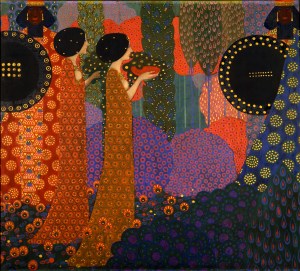 Looking for more info I found that background info on Zecchin was sketchy. He was raised on Murano, one of the famed islands of Venice known for its glass-making. His father was a glass-maker and Zecchin grew up immersed in color and form. He studied art but, feeling his voice would not be heard in the somewhat conservative artistic atmosphere of Venice at the time, put it aside in his early 20’s to pursue a job as civil servant. However, he came back to painting around the age of 30, spurred on by a new movement in Venice of artists inspired by Klimt and other artists.
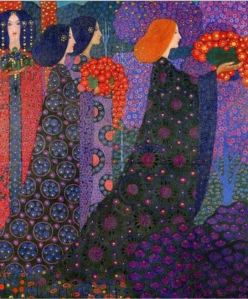 All of this pieces shown here are from his grandest work, a mural completed in 1914 for the Hotel Terminus that consisted of 11 or 12 panels ( I have found conflicting reports) that measure around 300 feet in total length. Called Les Milles et Une Nuit ( A Thousand and One Nights), it depicts the entourage of kings, queens, princesses and princes as they bear gifts to encourage the Sultan to give his daughter’s hand to Aladdin. You can see the influence of Klimt but more importantly you can see the influence of the glass and color of Venice. Unfortunately, the panels are no longer together, having been dispersed throughout the art world over the years.


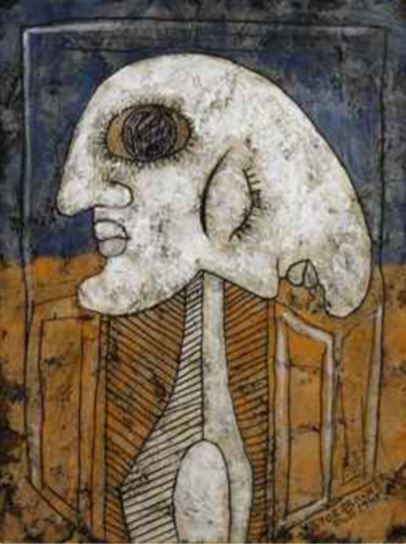

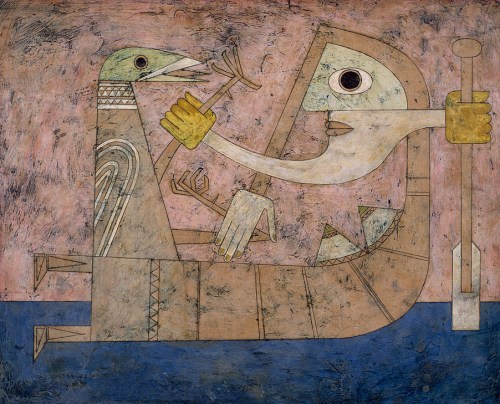


 Chaim Soutine was yet another brilliant but tragically short lived painter, dying at the age of 50 in 1943. He was a Russian Jew who studied art as a youth in his native Belarus then emigrated to Paris in 1913. There, among the many diverse artistic influences, his distinct expressionistic style found its voice and over the next two decades he produced a powerful body of work. However, he wasn’t hailed as the great painter he truly was until the days just before the start of World War II.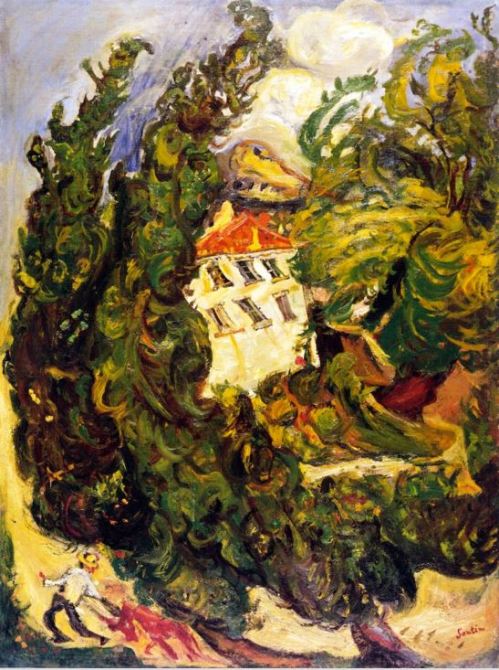


 I just love the paintings of Henri Rousseau. It’s not something that I can quantify in any way. It’s not just the harmony of color and form or the subject matter or even the way it is painted. There’s just such a great sense of rightness in the work, a great sense that this is the artists’s reality. It just reaches out and allows you to step easily into it while still maintaining a feeling of depth and emotion, a quality that many artists seek but few find.









 Redtree Times