Feeds:
Posts
Comments

Archive for the ‘Influences’ Category

GC Myers- Time Frames  smI’ve been working on trying to create a patterned underpainting  in my work, inspired by a dream I had a few weeks back.  It still is moving ahead and is not yet what I saw (or, at least, what I recall seeing) in that dream.  It may never get to that state but it acts as a catalyst,  something that pushes me forward.  This small piece, a 9″ by 12″ canvas, uses blocks or plates much like those I saw in my dream to form a pattern that hovers barely vsisble in the sky.  It doesn’t have the intensity of the color of the dreamed vision but it still creates what I think is an interesting effect on this piece.  It serves as both a step forward and a self-contained entity.

I call this piece Time Frames, alluding to the shapes of the plates in the sky here. Like much of the underlying textures in my work, it refers to those  forces and knowledge that have untold influence on our world and our lives yet remain just beyond our perceptions.

All that we do not know.

At the moment, we are at the leading edge of all knowledge here in this world.  Yet, it is an edge that is always moving forward and what we believe today with all certainty may one day be revealed to be proved false.  Future generations may look back on us and wonder at some of the things we believed to be true.

But you live with what you know and what you see.  Blissfully in the moment even while obscured ultimate truths may be oh so near…

Read Full Post »

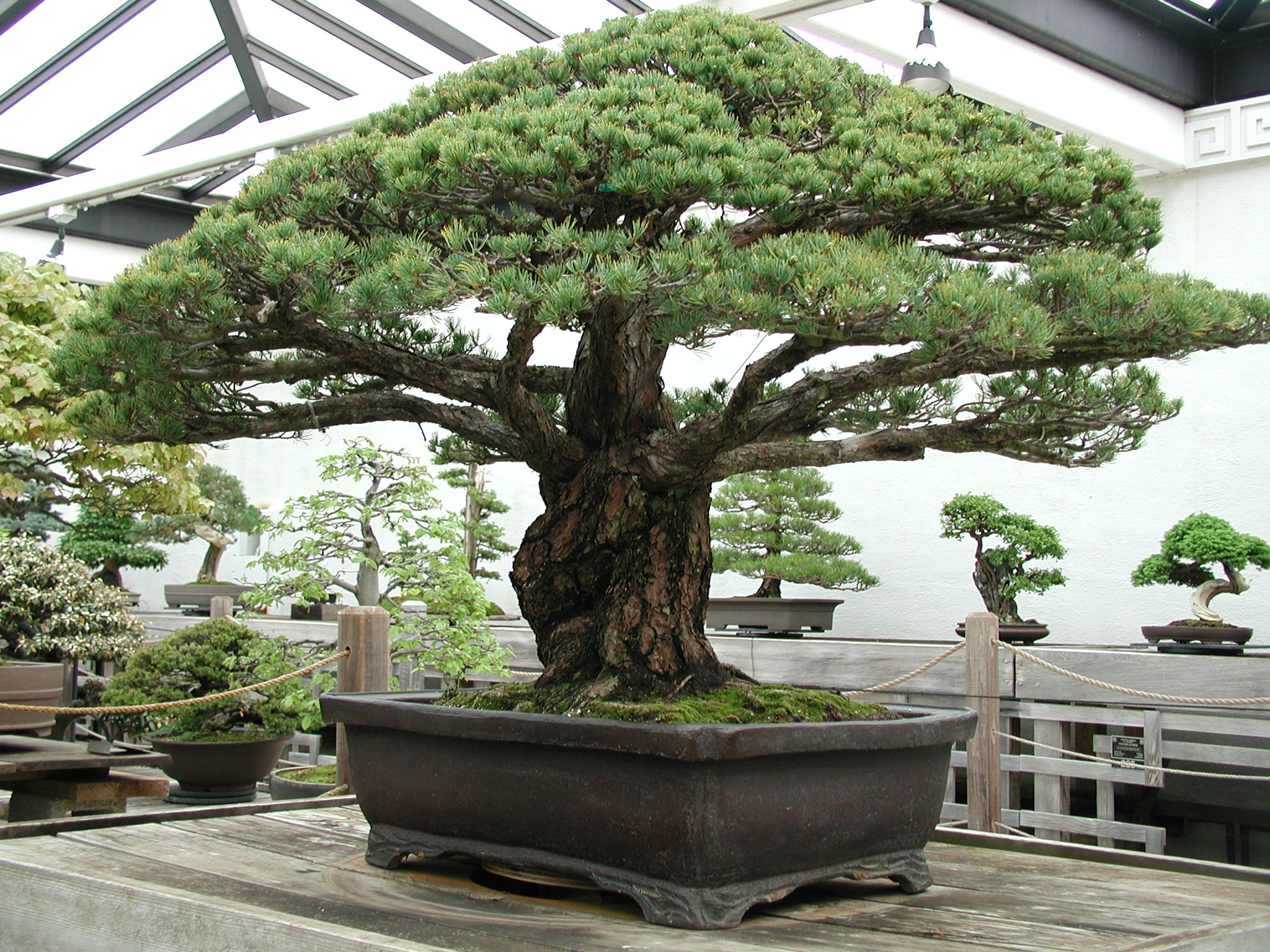
Hiroshima Survivor Bonsai US National Arboretum

Today is the 70th anniversary of the atomic bomb being exploded over Hiroshima.  I am not looking to get into an exploration of whether it was right or wrong, don’t want to justify or condemn the decision.

It happened.  And with horrifying effectiveness.

No, instead of focusing on our ability to destroy I would rather today feature a story of natural endurance and beauty.  I am talking about the now 390 year-old bonsai tree, shown above, that now resides at the U.S. National Arboretum in Washington, DC.  It has made it intact through the centuries of history including surviving the Hiroshima blast which took place less than two miles from its then home.

It started its life on the Japanese island of Miyajima back in 1625.  Think about that.  Here, we were five years into the Plymouth colony, still struggling to gain our footing in this land while on an island half a world away this tree was beginning its life.  And since that time, this tree has received constant daily care, allowing it to thrive and live well beyond the life expectancy of a normal bonsai.

At some point in its life, this rare tree came into the possession of the Yamaki family which ran a commercial bonsai nursery for several generations near Hiroshima.  It was at this location when the bomb exploded.  The tree was sheltered by a wall and the blast fortunately only caused minor injuries to the family, mainly lacerations from flying glass.

In 1976, bonsai master Masaru Yamaki donated the prized tree as part of the Japanese people’s gift to the U.S. in recognition of our Bicentennial.  It has lived the last 39 years, one tenth of its existence, at the National Bonsai & Penjing Museum at the National Arboretum. It has witnessed the world changing in so many ways yet it stands still.

Serene and beautiful. With our care.

Let us hope that we begin to realize that we gain so much more by nurturing this world than through destruction.

Just look to the tree…

Read Full Post »

GC Myers  Destiny Bound framedThis coming Saturday, August 1, I will be giving a Gallery Talk at the West End Gallery in support of my current show, Home+Land, that is hanging there.  It starts at 1 PM and, as many of you who regularly read this blog will know, ends with a drawing where one person in attendance will take home a painting of mine.

It’s something I’ve done for several years now at my Gallery Talks  and is something that really gives me great pleasure.  I’ve always felt so fortunate to have found my current life as a painter that this allows me to express my gratitude in a tangible way.  As a result, I try to carefully choose the works that I give away, not wanting to just go the far corner of the closet where I hide those early experiments that make me grimace to look at them now.

No, I want to give away paintings where I feel a pang of loss in giving them away, want them to have some sort of meaning for me so that this is not just an empty gesture. So, for this Saturday’s drawing, I have chosen the painting shown above.  It’s called Destiny Bound and is a 16″ by 20″ canvas so it has the size to give it a real presence.  It’s a painting that was only shown publicly once for a very short time before I brought it back to the studio.  It is sort of an anomaly in my body of work in the way it is framed, using a gold-leafed plein air frame rather than my signature frame.  I tried this frame style for a handful of pieces several years ago and decided that I wanted to stay solely with the continuity of my normal frames.  This is the one painting that remains in a gold frame and I chose to keep it as I’ve just become used to seeing it that way.

So, even though it has a unique overall appearance for my work, the painting itself is what I consider a great example of what has been called my Dark Work, work that first appeared in the months after 9/11 but has evolved over the years.  I am really attracted to overall presence of this painting and the deep colors and line work as well. And the expressiveness of the tree on the right.  That tree  has always felt like it pays tribute in some way to Thomas Hart Benton with its curves and lines.  While it reminds me of some his figures or trees, off the top of my head I can’t cite a particular painting of his that might feature such a tree or figure.

But that connection and the way the tree seems animated jumps out at me whenever I look at this piece. I just plain like this painting.  And I am giving it away on Saturday.  So, stop in at the West End Gallery on Saturday for what I hope will be an entertaining talk and maybe you can take  Destiny Bound home with you.  The talk starts at 1 PM and generally lasts about an hour.  Hope to see you there.

Read Full Post »

Jan_Toorop_Fatalisme 1893I recently came across the work of the artist Jan Toorop and really found myself attracted to his imagery.  I hadn’t heard of him but at the first glimpse immediately wanted to see more.  Toorop  was another of those artists who have not garnered as much attention outside his home in the Netherlands as you might expect when you consider the work and the influence it had on other artists of the time. Toorop’s work largely influenced the work of Gustav Klimt and other Symbolist painters of Northern Europe.  You can see this in the piece above, Fatalisme.

Jan Toorop was a Dutch-Indonesian artist born on Java in 1858 who moved to the Netherlands as boy.  He worked in many styles in his early career, sometimes in pure Realism but often following the trends of the time.  He produced work in a decidedly Pointillist style as well as work that was purely Impressionistic.  But in the early 1890’s he began to develop the style that garnered the attention of many other artists.  It was Symbolist imagery based on Javanese motifs carried by dense and curvilinear line work.  Eventually, this led to him working in an Art Nouveau style later in his career.

Toorop died in 1928.  There is a Jan Toorop Research Center that has a site that displays the wide range of his work in a chronological fashion. I like this way of showing the work as you can see the evolution in style over time.  His daughter, Charley Toorop, was a celebrated painter as well who produced a series of wonderful self-portraits throughout her life and had another very accomplished painter for  a son (and grandson of Jan), Edgar Fernhout.  A very talented family, indeed.

Compelling work for you to consider…

Jan Toorop Oh Grave Where is Thy Victory 1892 Jan Toorop Three Brides Jan_Toorop_-_The_New_Generation_ 1892 Jan Toorop The Song of Time 1893


Read Full Post »

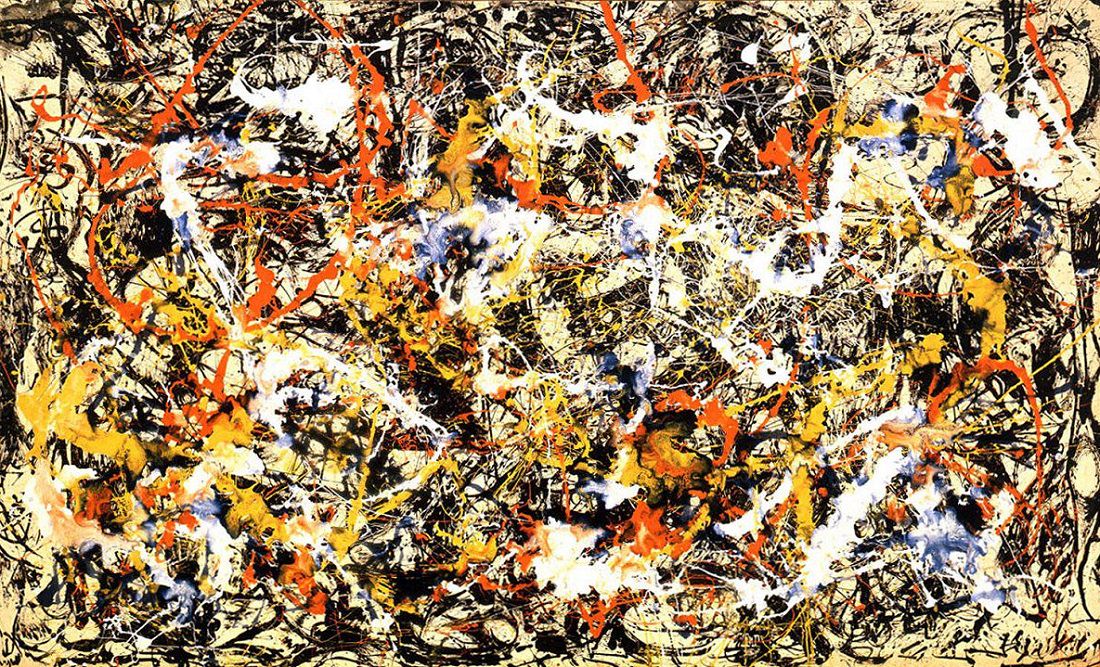
Jackson Pollock -Convergence 1952Painting is a state of being…Painting is self discovery.  Every good painter paints what he is.

–Jackson Pollock

*********************

In yesterday’s The Guardian, here was a review of a current exhibit at the Tate Liverpool of Jackson Pollock paintings.  Writer Jonathan Jones describes Pollock’s work around 1950, in the period when he was briefly liberated from his chronic alcoholism,  as being the pinnacle of his career. As he put it : Pollock was painting at this moment like his contemporary Charlie Parker played sax, in curling arabesques of liberating improvisation that magically end up making beautiful sense.

GC Myers-Under TextureThat sentence really lit me up, as did the words of Pollock at the top of the page.   In Pollock’s work I see that beautiful sense of which Jones writes. I see order and rhythm, a logic forming from the seemingly incomprehensible. The textures that make up the surfaces of my own paintings are often formed with Pollock’s paintings in mind, curling arabesques in many layers.  In fact, one of the themes of my work is that same sense of finding order from chaos.

 To some observers, however, Pollock’s work represented the very chaos that plagued the world then and now.  But true to his words, Pollock’s work was indeed a reflection of what he was– a man seeking grace and sense in a chaotic world.

Painting is, as Pollock says, self discovery and indeed every painter ultimately paints what they are.  I know that in the work of painters I personally know I clearly see characteristics of their personality, sometimes of their totality.

I believe that my work also reveals me in this way.  It shows everything– strengths and weaknesses, hopes and fears.  You might think that a painter would be clever enough to show only those positive attributes of his character, like the answers people give when asked to describe their own personality.  There are some that try but it comes off as contrivance. Real painting, real art, is in total revelation, showing the chaos and complexity of our true self and attempting to find order and beauty within it.

Read Full Post »

GC myers-Sanctuary A couple of days ago I wrote about the theme behind my upcoming Home+Land show at the West End Gallery, briefly describing that feeling of feeling at home in a place.  This homing instinct has been noted by others including a passage in the book Desert Solitaire from late author/environmentalist Edward Abbey.

Written in 1968, the book tells of his time as seasonal park ranger at Utah’s Arches National Park in the 1950’s and has been compared to Thoreau‘s Walden for the philosophical ruminations that run alongside his stories of working the park.  I read it probably well over thirty years ago and had forgotten this short passage until running across it on another site.  It fit so well into the other day’s post that I thought I would share it:

Every man, every woman, carries in heart and mind the image of the ideal place, the right place, the one true home, known or unknown, actual or visionary.  A houseboat in Kashmir, a view down Atlantic Avenue in Brooklyn, a gray gothic  farmhouse two stories high at the end of a red dog road in the Allegheny Mountains, a cabin on the shore of a blue lake in spruce and fir country, a greasy alley near the Hoboken waterfront, or even, possibly, for those of a less demanding sensibility, the world to be seen from a comfortable apartment high in the tender, velvety smog of Manhattan, Chicago, Paris, Tokyo, Rio or Rome—there’s no limit to the human capacity for the homing sentiment. Theologians, sky pilots, astronauts have even felt the appeal of home calling to them from up above, in the cold black outback of interstellar space.

I know that this homing instinct, the need to be peacefully at ease in a place, has been a prime motivator in many parts of my life and it shows itself in my work on an a regular basis.  The example at the top very much reflects this sense of home and is called, fittingly, Sanctuary.  It is part of my show Native Voice which hangs now at the Principle Gallery and ends July 6.


Read Full Post »

I wasn’t going to write anything today.  Getting ready for the new show at the West End Gallery has kept me exceedingly busy but I came across a clip from a Viktor Frankl lecture that I liked and wanted to share.  Frankl ‘s book, Man’s Search For Meaning, has been an important book in my life and his ability to find hope in the darkest of times always provides inspiration.  The clip, from 1972, shows this optimism and even though it is from 1972, it speaks for any time.  Honestly, the idea that this man who has experienced the worst side of mankind can find hope for mankind makes me slightly ashamed at the cynicism I sometime find in myself when I consider the future of this planet.

You can find Frankl’s book on YouTube as a free audiobook by clicking here.

To preface the clip I thought I would share a blogpost and painting from five years back:

GC Myers- LifebloodWe who lived in concentration camps can remember the men who walked throughout the huts comforting others, giving away their last piece of bread. They may have been few in number, but they offer sufficient proof that everything can be taken away from a man but one thing: the last of the human freedoms — to choose one’s attitude in any given set of circumstances, to choose one’s own way.

———-Viktor Frankl

************

I don’t know why this came to mind today but it did.  Viktor Franklwas an Auschwitz survivor who, after the war, createdlogotherapy, one of the important schools of psychotherapy alongside those of Freud, Adler and Jung.  It was a therapy based on finding meaning in one’s life, a reason to struggle onward.  In his best known book, Man’s Search For Meaning, he recounts his time in the concentration camp and how he and others who survived  seemed to have something in common– the discovery of a purpose and meaning in living.  It might be love. It might  be the will and drive to create.  Just something to set on their horizon to pull them ahead despite the horror around them.

Maybe it was this painting, Lifeblood,  that brought back Frankl for me.  I had come across his work a number of years ago and and his words and example have helped me through some desperate, foundering times of my own.  There is a certain power in knowing that we all are fated to suffering of some sort, just by the sheer nature of existence.  There will be pain, there will be death.  No one is exempt from the distresses of  life.  But these can be endured through the knowledge that we have the choice in how we react to such events, how we perceive the deprivations of our lives.  We can choose to wallow, to give in,  or we can forge ahead.

Maybe that’s how I see this painting, as a path through the pains of living, symbolized by the blood red of the ground.  All the leaves, everything it had,  have been stripped from the tree yet it still stands.  It reaches for the light above, seeks a meaning for its suffering.

I didn’t see it that way when I first painted this.  It was simply color and form.  Simplicity and harmony.  But sometimes there’s an associative power to a piece that gnaws at you, begs you to look deeper and find what it’s trying to say.  And maybe the ideas of Viktor Frankl hide in this piece for me…

Read Full Post »

GC Myers Home+Land smThe ache for home lives in all of us, the safe place where we can go as we are and not be questioned.

–Maya Angelou

*****************

This is the title painting, Home+Land,  for my next solo show which opens July 17 at the West End Gallery in Corning.  It’s a pretty large painting at 36″ high  by 48″ wide on canvas and one that fairly represents my feelings on how we are tied to the land, how we identify home with a sense of place.  This is the theme for this show as well as for much of my work in general.

I have long equated the idea of home with the landscape, with how we are shaped by those places that we know from an early age.  The rhythm, the shapes and the perspectives of the landscape that surrounds us becomes part of who we are , something that travels with us throughout our lives. Wherever we go, we look for similarities to that feeling of our home landscape.

It might be in the actual landforms or the way in which the vegetation interacts with the land and the structures of the homes there. It simply looks like home.  Or it might be just in the way the light strikes the land or the rhythm and flow of movement within the landscape that create a level of comfort that equates to that feeling of home.

I know, for myself, that there have been places where I have been where the landscape has been so different from the hills and fields surrounding my original home yet I still feel a sense of being at home.  And there are other places that, while similar in shape and having beauty and charms of their own, leave me uneasy and feeling out of place.  And there are places in which I immediately feel out of place in an alien way, places to which I could never fully adapt.  Definitely not at home.

I guess what I am trying to say is that home is a mix of feeling and place.  It is that place where you feel as comfortable and satisfied in place as the Red Tree in the painting above.


Read Full Post »

paul-gauguin-the-alyscamps-in-arlesDo not paint too much after nature. Art is an abstraction; derive this abstraction from nature while dreaming before it, and think more of the creation which will result than nature.

-Paul Gauguin

******************

Although I wouldn’t probably call Paul Gauguin one of my favorite artists, I do admire and respect much of his work.  More importantly, there are a lot of things I’ve taken from his work over the years, including the advice offered in the above quote.  The idea that the painter could paint the landscape not exactly as it were before them but, rather, in how they felt they saw it was a mind expanding thought.  It meant that the artist could take liberties with color, space and form to find their own expression of nature.

Another thing I culled from looking at Gauguin’s paintings was his use of multiple colors within his surfaces.  I remember seeing an exhibit quite a few years ago at the MFA in Boston.  Looking closely at some of his Tahitian scenes, I noticed that while one would say the overriding color of each piece might be green there were other colors among the greens of the tropical landscape, most noticeably large flecks of vermillion, that gave the overall color so much more depth and interest.  I knew that I needed to increase the complexity of my own colors.

I’ve also talked quite a bit about Native Voice, about painting in a way that was purely natural and distinct like a signature to the artist.  Gauguin’s work is to me a perfect example of this native voice.  His ease in being himself on his surfaces made it easier for me to be myself.  Whenever I get a chance to look closely at his work I take the opportunity because I almost always find something in it that helps me in my own work.

 It always has something to say and share.  And that in itself is an influence and a hope for my own work.

Paul Gauguin A Farm in Brittany

Read Full Post »


Helen Frankenthaler -Sirocco

Helen Frankenthaler -Sirocco

I received a nice letter yesterday from the American Ambassador to Kuwait, Douglas Silliman,  expressing thanks for the loan of a painting of mine to hang at their residence at the embassy in Kuwait City.  In describing  how they came to choose the works that hang there, he mentioned that one of the other pieces in the embassy exhibit was Sirocco from the late Helen Frankenthaler.

This really interested me because she was an artist whose unorthodox use of materials greatly influenced my own thoughts on how I worked.  It brought to mind a quote from her that I have used several times here in the past that expresses just this point.  One time I used this quote was from a post from over two years ago that I would like to rerun today, called Willingly Off Balance:

gc-myers-feb-2013-smThis is a new piece that I started over the weekend.  It’s a fairly large canvas, 24″ by 48″,  gessoed and blackened before I began to lay out the composition in the red oxide that I favor for the underpainting.   I went into this painting  with only one idea, that it have a mass of houses on  a small hilltop.  That is where I began making marks, building a small group of blocky structures in a soft pyramid.   A little hilltop village.  From there, it went off on its own, moving down the hill until a river emerged from the black.   An hour or two later and the river is the end of a chain of lakes with a bridge crossing it.  We’ll see where and what it is when  it finally settles.

I like this part of the process, this laying out of the composition.  It’s all about potential and problem-solving, keeping everything, all the elements that are introduced, in rhythm and in balance.  One mark on the canvas changes the possibility for the next.  Sometimes that possibility is limited by that mark, that brush of paint.  There is only one thing that can be done next.  But sometimes it opens up windows of potential that seemed hidden before that brushstroke hit the surface.  It’s like that infinitesimal moment before the bat hits the pinata and all that is inside it is only potential.  That brushstroke is the bat sometimes and when it strikes the canvas, you never know what will burst from the rich interior of the pinata, which which is the surface of the canvas here.  You hope the treats fall your way.

One of the things I thought about as I painted was the idea of keeping everything in balance.  Balancing color and rhythm and compositional weight, among many other things, so that in the end something coherent and cohesive emerges.  It’s how I view the process of my painting.  Over the years,  keeping this balance becomes easier, like any action that is practiced with such great regularity.  So much so that we totally avoid problems and when we begin to encounter one, we always tend to go with the tried and true, those ways of doing things that are safest and most predictable in their results.

It’s actually a great and safe way to live.  But as a painter who came to it as a form of seeking,  it’s the beginning of the end.  And as I painted, I realized that many of my biggest jumps as an artist came because I had allowed myself at times to be knocked off balance.  It’s when you’re off balance that the creativity of your problem-solving skills are pushed and innovation occurs.

It brings to mind a quote from Helen Frankenthaler that I used in a blogpost  called Change and Breakthrough from a few years back:   There are no rules. That is how art is born, how breakthroughs happen. Go against the rules or ignore the rules. That is what invention is about. ”  

 You must be willing to go outside your comfort zone, be willing to crash and burn.   Without this willingness to fail, the work becomes stagnant and lifeless, all the excitement taken from the process.  And it’s that excitement  in the studio that I often speak of  that keeps me going, that keeps the work alive and vitalized.

It’s a simple thing but sometimes, after years of doing this, it slips your mind and the simple act of reminding yourself of the importance of willingly going off balance is all you need to rekindle the fire.

This is a lot to ponder at 5:30 in the morning.  We’ll see what this brings in the near future.  Stay tuned…

*********************

By the way, this is the end product of the painting started above, Game of Life.

GC Myers- Game of Life 2013

GC Myers- Game of Life 2013

Read Full Post »

« Newer Posts - Older Posts »