Feeds:
Posts
Comments

Archive for the ‘Influences’ Category

Marc Chagall Sun of ParisWhen I am finishing a picture I hold some God-made object up to it / a rock, a flower, the branch of a tree or my hand / as a kind of final test. If the painting stands up beside a thing man cannot make, the painting is authentic. If there’s a clash between the two, it is bad art.

–Marc Chagall

**************

I haven’t mentioned Marc Chagall  here but once over the 6+ years I have been doing this blog and I very seldom list him as one of my influences or even one of my favorite artists.   But somehow he always seems to be sitting prominently there at the end of the day, both as a favorite and an influence.

One way in which his influence takes  form is in the way in which he created a unique visual vocabulary of symbology within his work.  His soaring people, his goats and horses and angels all seem at once mythic yet vaguely reminiscent of our own dreams, part of each of us but hidden deeply within.

They are mysterious but familiar.

marc-chagall-fishermans-family-1968And that’s a quality– mysterious and familiar– that I sought for my own symbols: the Red Chair, the Red Tree and the anonymous houses, for examples.  That need to paint familiar objects that could take on other aspects of meaning very much came from Chagall’s paintings.

He also exerted his influence in the way in which he painted, distinct and as free-flowing as a signature.  It was very much what I would call his Native Voice.  Not affected or trying to adhere to any standards, just coming off his brush freely and naturally.

An organic expression of himself.  And that is something I have sought since I first began painting– my own native voice, one in which I painted as easily and without thought as I would write my signature.

  So to read how Chagall judged his work for authenticity makes me consider how I validate my own work.  It’s not that different.  I use the term a sense of rightness to describe what I am seeking in the work which is the same sense one gets when you pick up a stone and consider it.  Worn through the ages, untouched for the most part by man, it is precisely what it is.  It’s form and feel are natural and organic. There is just an inherent  rightness to it.  I hope for that same sense when I look at my work and I am sure that it is not far from the feeling Chagall sought when he compared his own work to a rock or a flower or his own hand.
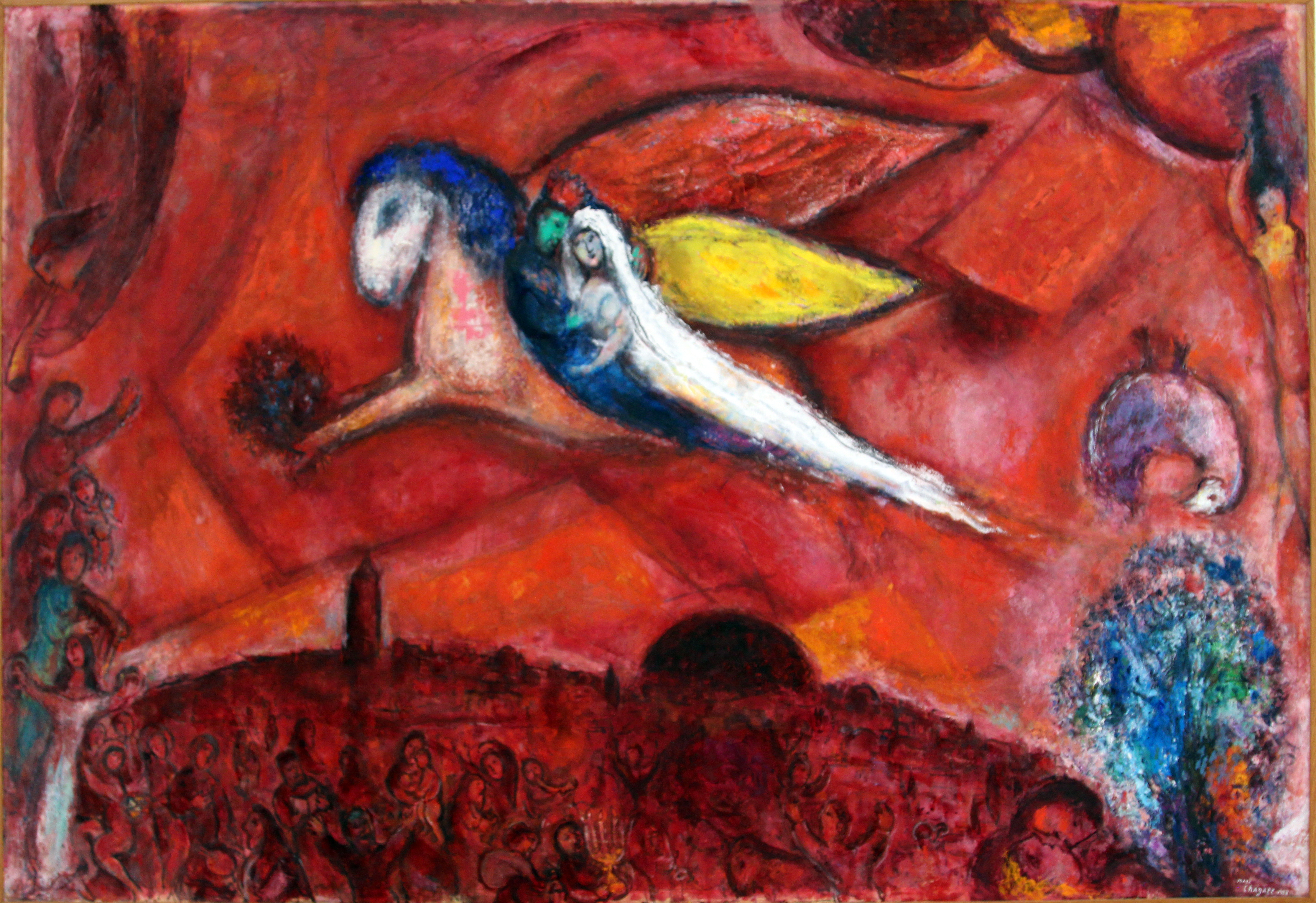
Marc Chagall Song of Songs

Read Full Post »

Trey Ratcliff - china-deep-in-the-guangxi-provinceSometimes you can look at something and it immediately translates into something for you, something from which  you can take inspiration and  make something new.  That’s what came to mind for me when I came across this great image from photographer Trey Ratcliff.  It’s a panoramic view of a fairytale-like  landscape in the Guangxi region of  China that he took after scaling a peak similar to those you see in the photo.

It’s just a great image, one that gets my motor racing.  I immediately find myself comparing it to my own landscapes, noting  how the forms flow together to create a wonderful rhythm in the image.  There’s so much that will easily convey into my own work that it is in place before I really have time to think about it.  It’s like a jolt of creative electricity.  I just need to get to the easel before it rolls to the back of the line of imagery that is formed in my head.

For more of Trey Ratcliff’s incredible photograph’s from around the world, visit his website Stuck in Customs.  And check out the image shown above on Google+— it’s a 19,000 pixel  high def shot that is fully zoomable so that  you can fly in and out of the little valleys in the distance.  Pretty remarkable.


Read Full Post »

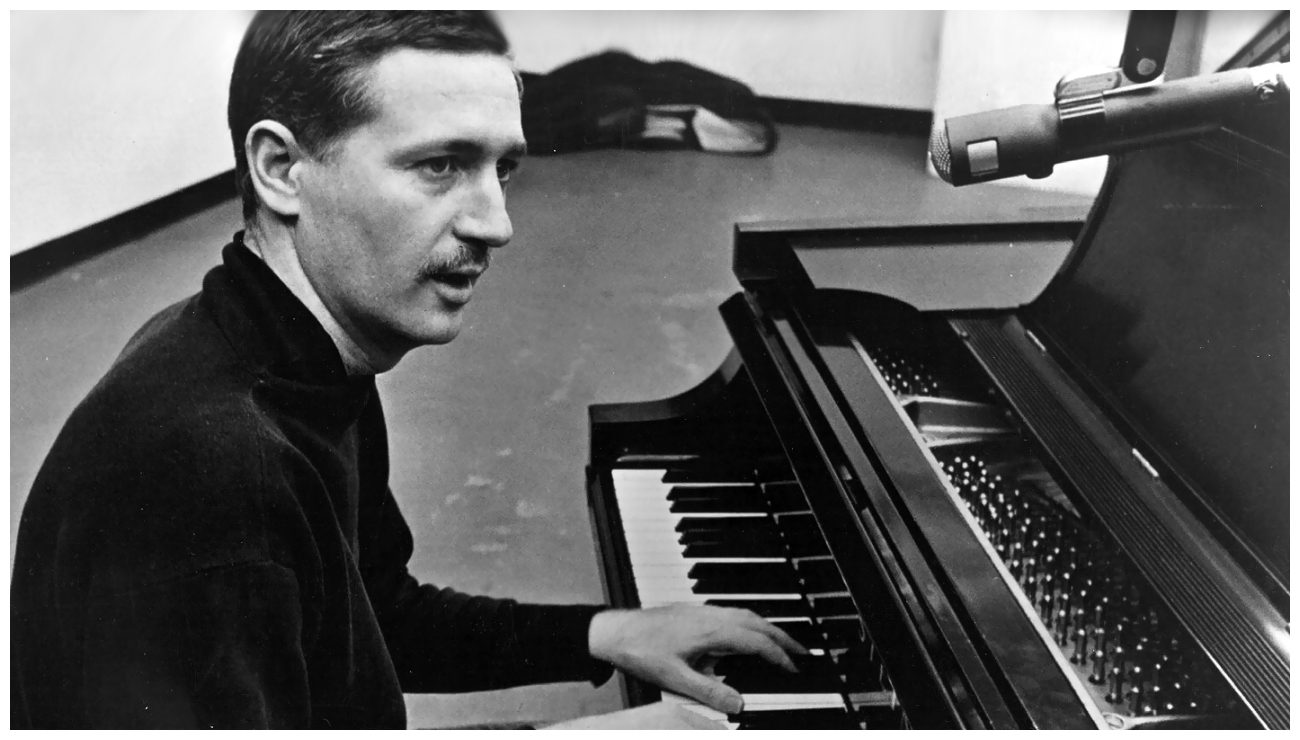
mose-allison_1Artistic influences,  seeing how a certain artist will take the work of others and transform it into their own, is a fascinating thing.  Sometimes it’s very obvious especially when the influence is of equal renown or when one artist directly copies the work of another.  But sometimes there are great influences that you may not even recognize.

Mose Allison (born in 1927) is such a person, a name you probably don’t know.  But for many musicians in the who found their voice in the 60’s, he was a huge influence.  Jimi Hendrix,  The Rolling Stones, The Who, The Animals, Tom Waits, Van Morrison and many, many others have all cited him as a strong influence on their work.  But Mose Allison, while achieving considerable fame, never became the household name like so many of his admirers.

He was pretty hard to pigeonhole as a musician- at times very bluesy, himself strongly influenced by the delta blues of his home in Mississippi, other times very jazzy or even pop tinged.  But always a unique and individual sound that allowed him to take a song, his own or those written by others, and  give it a new perspective.  I have to admit that I didn’t know much about Mose Allison until just recently but have been thrilled to find his work and can easily see it in the work of so many others.  I encourage you to seek out his work and give it a listen.

To that end, here’s a small sample for this Sunday morning.  It’s his version of the Willie Dixon blues classic The Seventh Son, a song that became a pop hit for Johnny Rivers.  But here, it definitely feels all Mose Allison.  Enjoy and have a great Sunday.

Read Full Post »

I was struggling this morning with the blog and was just about to say enough and just move on to my work when I came across the latest entry on BrainPickings.  It is a poem from the late Nobel Prize-winning Polish poet Wislawa Szymborska (July 2, 1923–February 1, 2012) called Possibilities.  It is basically a laundry list of her personal preferences.   Some are small and some significant but all contribute mightily to her wholeness as a person.  We are all the totality of our own laundry lists of preferences that define our character and personality  just as our DNA determines our physical characteristics.

It’s a simple yet thought-provokingly complex poem that leave me wondering about my own preferences, my own possibilities.  What are those small things that give you shape, make you who you are?

The poem is below but if you would prefer the spoken version there is a recording at read by performer Amanda Palmer.

POSSIBILITIES

I prefer movies.
I prefer cats.
I prefer the oaks along the Warta.
I prefer Dickens to Dostoyevsky.
I prefer myself liking people
to myself loving mankind.
I prefer keeping a needle and thread on hand, just in case.
I prefer the color green.
I prefer not to maintain
that reason is to blame for everything.
I prefer exceptions.
I prefer to leave early.
I prefer talking to doctors about something else.
I prefer the old fine-lined illustrations.
I prefer the absurdity of writing poems
to the absurdity of not writing poems.
I prefer, where love’s concerned, nonspecific anniversaries
that can be celebrated every day.
I prefer moralists
who promise me nothing.
I prefer cunning kindness to the over-trustful kind.
I prefer the earth in civvies.
I prefer conquered to conquering countries.
I prefer having some reservations.
I prefer the hell of chaos to the hell of order.
I prefer Grimms’ fairy tales to the newspapers’ front pages.
I prefer leaves without flowers to flowers without leaves.
I prefer dogs with uncropped tails.
I prefer light eyes, since mine are dark.
I prefer desk drawers.
I prefer many things that I haven’t mentioned here
to many things I’ve also left unsaid.
I prefer zeroes on the loose
to those lined up behind a cipher.
I prefer the time of insects to the time of stars.
I prefer to knock on wood.
I prefer not to ask how much longer and when.
I prefer keeping in mind even the possibility
that existence has its own reason for being.

Read Full Post »

"Mr Wyndham Lewis as a Tyro"- Wyndham Lewis

“Mr Wyndham Lewis as a Tyro”- Wyndham Lewis

For many years now, one of my favorite books to just sit and flip through is my now very worn copy of  A Dictionary of Art Quotes by Ian Crofton.  It has great quotes by artists and critics about artists, schools of art and assorted other things that have to do with art.  The thing that I like most is that Crofton keeps it subjective, often having opposing points of view under each heading.  You might read one quote praising an artist while the very next might be one that portrays him as a hack. It’s interesting to see this contrast of perceptions, often by the artist’s contemporaries.

Some artists receive no negative words against their work or personality– Henri Rousseau, for instance, who was much beloved and respected by his contemporaries.  Most have positive quotes with an occasional barb thrown in their direction.  But the section concerning one artist, Percy Wyndham Lewis, really stuck out when I read it.  There is not anything that could be perceived as positive–Ernest Hemingway even said he had the “eyes of a rapist.”  Not knowing much about this artist, it prompted to find out a little more about Wyndham Lewis, as he preferred to be called.

It didn’t take much research to discover reasons behind the vitriol directed at him.

First, a little background.  Lewis was born in Nova Scotia in 1882, educated in England, lost his eyesight in the late 1940’s and died in 1957.  He was an extraordinarily talented painter and writer and the founder of the Vorticists, an art and literary movement derived from Cubism that flourished in the years before World War I but died out in the aftermath.   He painted and drew , wrote well received novels and published a ground-breaking art magazine, Blast.  No lack of talent, that is for sure

"T.S. Eliot"- Wyndham Lewis

“T.S. Eliot”- Wyndham Lewis

But from what I can deduct, he was a very contentious and very opinionated, always seeking an argument or looking to tweak those he viewed as his intellectual inferiors.  He ruffled more than his share of feathers.  As he said, “It is more comfortable for me, in the long run, to be rude than polite.”   But his biggest offense came in the early 1930’s when he wrote in favor of Hitler and the Fascists, believing them to be the keys to maintaining peace in Europe.  That was, to be sure, not well received and was for many unpardonable even though Lewis did reverse his views later after a 1937 trip to Berlin when it became obvious to him that he had gravely misjudged the intent of Hitler.  He wrote a number of items against Hitler and Fascism and in defense of the Jews of Europe but the damage was done: he was a persona non grata.
He basically disappeared from the art scene although he continued to write prolifically, even after the loss of his sight. There was a re-interest in his painting  and Vorticism in the mid-50’s , just a year or two before his death and in subsequent years his profile as an artist has regained some of its lost stature. He is consdiered among the finest of British portrait painters.  His painting of poet T.S.. Eliot, shown here, is considered one of his finest and one of the great examples of British portrait painting.

I picked up a book on his portraiture and find it very compelling.  The self portrait at the top of the page, Mr Wyndham Lewis as Tyro, really stood out for me as did the ominous Praxitella, below.  An interesting character.  I was glad to come across his work and will continue to explore it.

Wyndham Lewis -Praxitella

Praxitella– Wyndham Lewis

A Battery Shelled- Wyndham Lewis

A Battery Shelled- Wyndham Lewis

Wyndham Lewis- Seated Figure

Seated Figure- Wyndham Lewis


Read Full Post »

GC Myers- Unpuzzled Hesse QuoteThis quote came from Hermann Hesse‘s most famous book, Steppenwolf. A great book but my favorite Hesse book is Demian, which I have referenced here a couple of times in the past.  It was a book that I read at a time when I was at a crossroads in my life and it was very influential in my heading in the direction which led to this point.  I think this quote very much jibes with my perception of the world portrayed in my work, that being that it is a real entity, a real place.

It has as much substance as the outer world to me.   It has depth and layers.  It has breath and light.  It has emotion and its truth comes the fact that it is a precise portrayal of itself– not a replication of the outer world.

It just is.

That may sound nutty or perhaps egotistical to some.  I get that.  But without this belief in the reality of this inner world, the validity of the work to myself comes undone.  It fades to nothingness and certainly doesn’t move across to others.  It loses all meaning for everyone, myself included, without this certainty in its being real.

I’m going to stop at this point.  I may have said too much already.  That is, too much for the outer world.  In here, in my world, it sounds right…

Read Full Post »

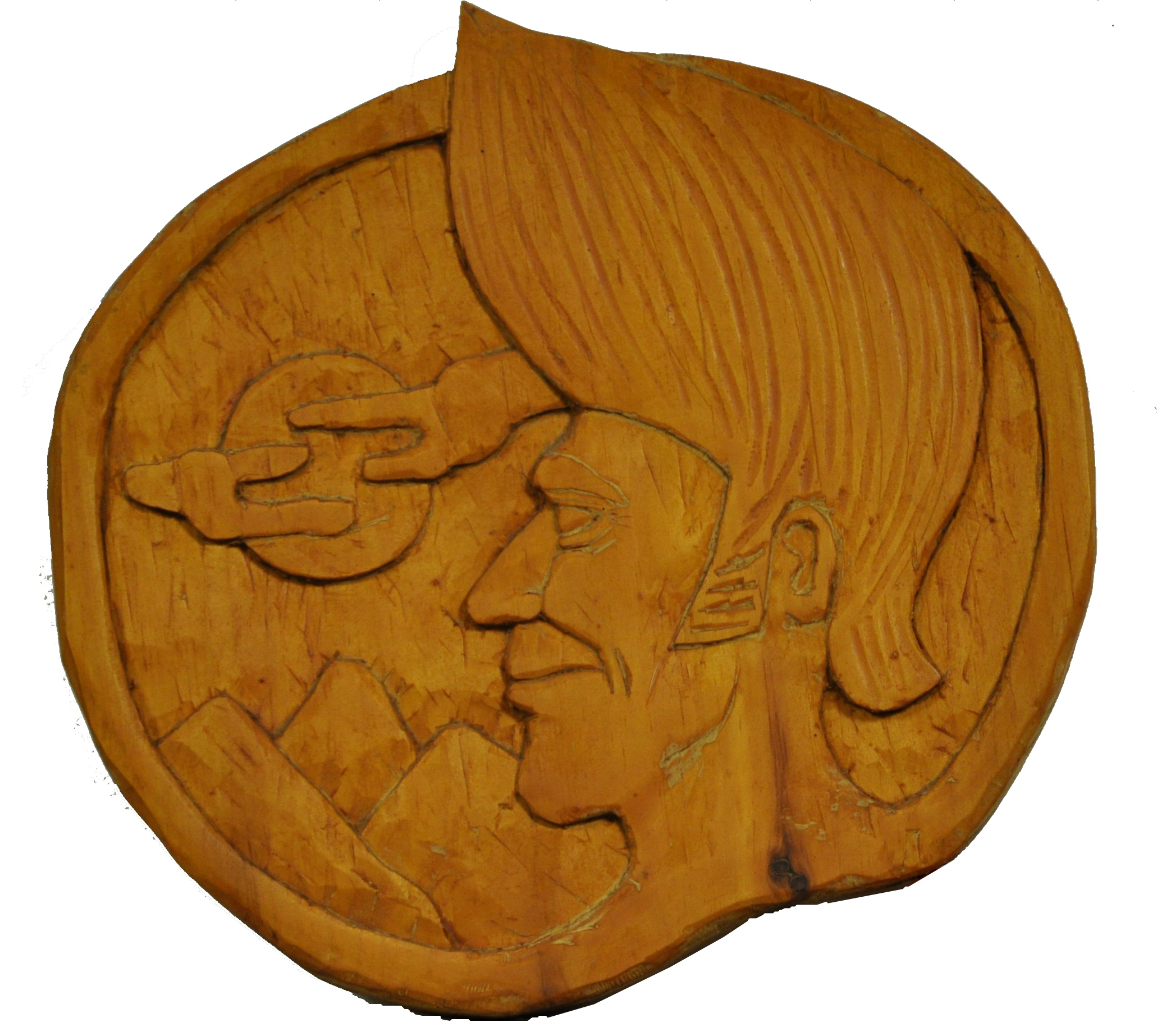
GC Myers Sun CarvingOur internet  connection was down here for most of the day yesterday which was not really a surprise given the -19° on the thermometer.  Cold enough to make today’s puny 1° reading look appealing.  But because I didn’t have to focus on writing the blog I took the time to rearrange a couple of things in the studio, things that I often look at from my seat at the computer.  On the large stone wall that holds the fireplace in my studio there are three half-round stone shelves that hold several  wood carvings.

One is an inexpensive carving of Don Quixote that my sister gave me for Christmas when I was a kid and another is a beautiful carving of a crow from artist Don Sottile,  a talented sculptor from my home Finger Lakes region.  Then there are a few of my own carvings from the early 90’s, predating my first attempts at painting by a couple of years.  They are not nearly as well executed as Mr. Sottile’s work but they mean a lot to me, if only as a reminder that they were keys to a door in my mind that I was desperately trying to open at that time, one that would eventually lead me here.

I thought I would take this opportunity to rerun a blog entry about these pieces from back in early 2009:

GC Myers- Hank CarvingImmediately before I started painting in the mid-90’s, my form of expression was wood carving.  It was unpolished and rough but it provided the vehicle that I needed to spark further creativity.  Most were created with an inexpensive set of small chisels and scrap lumber, usually just pine boards leftover from projects.

Actually, the technique that is used in these carvings is linked very much to my earliest efforts at painting which consisted of a heavy layer of paint then removing the parts that didn’t belong leaving the desired image.  This is a technique that I use to this very day.


 GC Myers Poseidon CarvingThe thing that I learned most from doing these pieces is that I wanted to emphasize expression over technique.  By that I mean I did not want to focus so much on refining technique to obtain a very polished final product that the piece became more about craft and less about expression of emotion.  By doing so I realized the pieces would retain my own identity and idiosyncrasies.  It was my first real stab at creating a visual look and vocabulary of my own. 

I also took the idea of the work having a tactile feel to it.  The attraction of these for me was in holding them and feeling the wood and the weight of it in my hands.  When I first started painting I worked primarily on paper and I got this same feeling from the cotton of the watercolor papers.  It’s something that I also try to insert into my work today as well, through the use of texture and in the way I present the paintings.

When I look at these I’m not particularly impressed by them as art but I do appreciate them for the lessons they provided at a time when I needed guidance, lessons which I took to heart.  To me they are touchstones to a certain part of my life and as such are important to my development as an artist.

Read Full Post »

Blues Twilight Cover Richard BoulgerMost  mornings in the studio I will click on to the Pandora site for a little music while I write the blog.  Normally I will choose the  Chet Baker channel which is a blend of his music along with many others in a wide variety of jazz styles.  I find that it’s a great sound to drive my thoughts without overpowering them, energetic and moody at once.  Being able to step in and out of the music while I am thinking make it a great soundtrack to work by in the morning.

Listening to this has exposed me to a lot of artists and their music that were unknown to me beforehand.  Can’t say I know much about jazz or its history, primarily a few of the better known tracks from the legends.  But I try to keep an open mind and don’t turn myself off to it because of my own lack of knowledge, an attitude I hope a lot of folks who say they know nothing about art will maintain as well.  Try it on– maybe it will fit you better than you might think.

So, for this week’s Sunday music I chose a piece from a musician that was totally unknown to me not too long ago, Richard Boulger.  His horn work is beautiful and his compositions flow really well.  I heard this piece one morning and was totally taken by it and now find myself listening to it once or twice a day now while I paint.  It just fits me well.

Here’s Miss Sarah from Boulger’s 2008 album Blues Twilight.  Hope you’ll enjoy it and have a great Sunday.


Read Full Post »

Traditions are lovely things- to create traditions, that is, not to live off of them… the great shapers do not search for their form in the fogs of the past.

–Franz Marc

******************

Franz Marc- The Yellow Cow 1911

Franz Marc- The Yellow Cow 1911

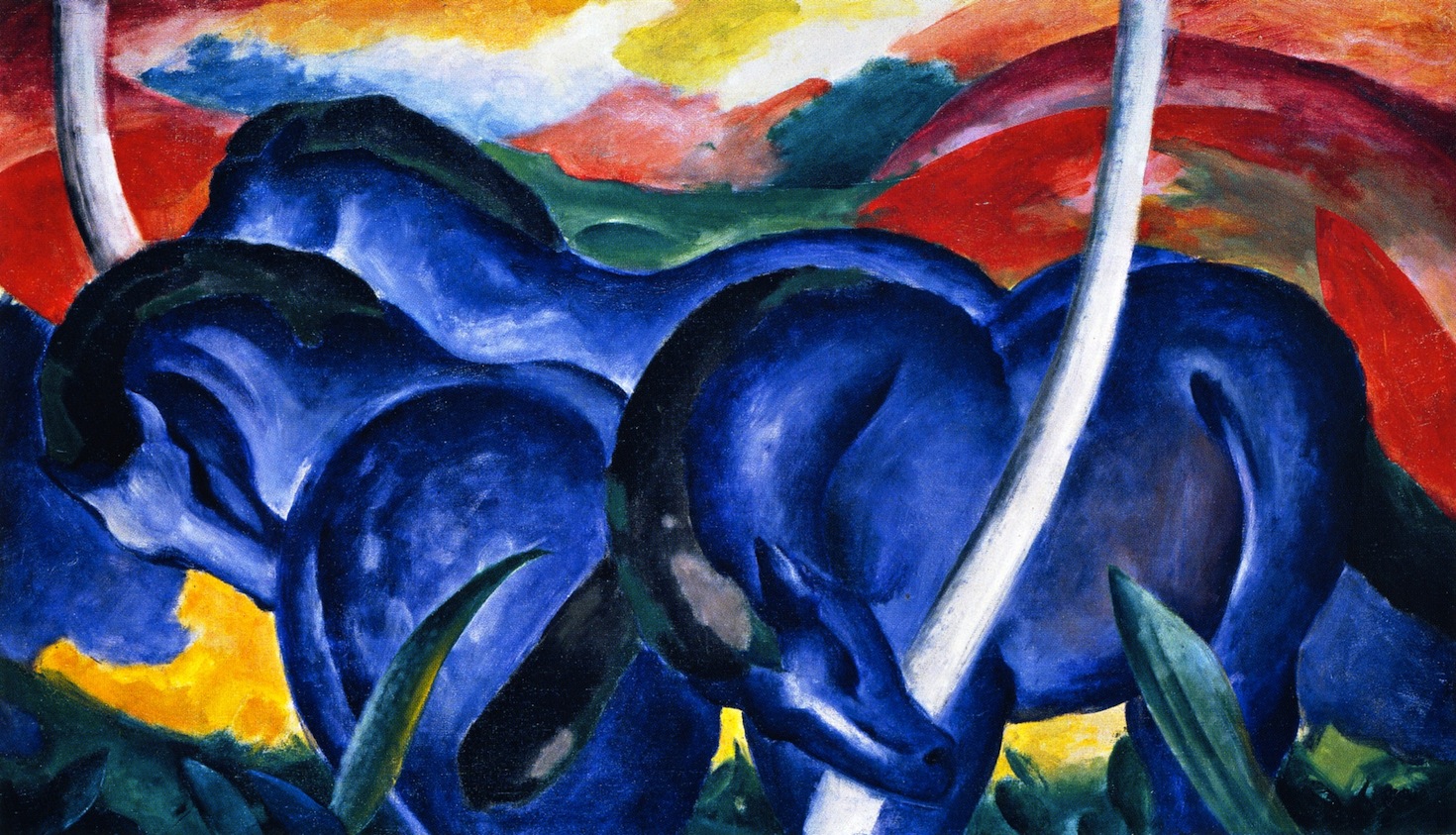
I chose today’s quote from German painter Franz Marc because he was an influence for me early on.  Not so much in the style or subject matter that he employed but simply in the fact that he created work that stood out and was identifiable as his from across a gallery space.  This is basically what he is pointing towards in this aphorism–to not toil in the fields planted by earlier artists but to carve out your own space and work it in the way that suits and  best expresses you.

Franz Marc- Large Blue Horses

Franz Marc- Large Blue Horses

He is not downplaying the influences of the past.  Early in his career  Marc copied the works of other artists from before and contemporary to him, using it as a way in which to find an avenue of expression that meshed with his vision.  He did not want to remain a replicator but wanted instead to be a creator.  And that was the attraction for me.

There was safety and security in remaining in this symbolic field with others but it would often be as an anonymous member of a larger group, your furrow always directly compared to the furrow of those alongside you, your harvest compared to their’s.

Breaking away and heading out was risky.   You had to believe that in taking this leap of faith that you would be able to work your little spot in your own way away from others and produce a harvest that is uniquely appetizing to others in some manner.   But you might end up toiling in barren soil, creating crops that appealed to no one but yourself.  It was scary to think that your field might never expand but you were at least nourishing yourself.

This was the type of thinking that drove my work early on, fueled by looking at the work of Marc and others who veered from the traditions of the past in their times.

Unfortunately, Franz Marc only worked his fields for a relatively short time, dying in WW I at the Battle of Verdun.  He was 36 years old.  But his crop still lives on, surviving being labeled as degenerate art in the 1930’s by Hitler and the Nazi regime.

It is unique and his own tradition.

Franz Marc- The Waterfall 1912

Franz Marc- The Waterfall 1912

Read Full Post »

James Ensor Christs Entry Into Brussels in 1889I’ve been spending some time recently looking at the work of painter the Belgian painter James Ensor who lived from 1860 until 1949 in the seaside town of Ostend.  It’s not a name that you probably recognize and even seeing the work may not ring a bell for you.  I know that it didn’t for me.  But the work did excite me, especially given the context of the time in which much of it was created.   He began creating his visionary and sometimes macabre world in the 1880’s when the Impressionists were still taking shape.  Given the look and subject matter, it came as no surprise that he is considered a major influence on the Surrealists and Expressionists of later generations.

James Ensor Christs Entry Into Brussels in 1889 DetailBut it was new to me and captivated me at once, especially the piece at the top of this page , Christ’s Entry into Brussels in 1889.  It is a massive piece, over 8 foot tall and 14 foot  in length.  It is a Mardi Gras parade ( Happy Fat Tuesday, by the way– bon temps rouler!) of caricatured figures escorting Christ into modern day Brussels in 1889.  It is loud and aggressive and roughly painted, so unlike the prevailing style of the time.  Filled with energy, it is a treasure trove for the eye.

Here is the description from the Getty Center in LA where it now resides and is shown:

James Ensor took on religion, politics, and art in this scene of Christ entering contemporary Brussels in a Mardi Gras parade. In response to the French pointillist style, Ensor used palette knives, spatulas, and both ends of his brush to put down patches of colors with expressive freedom. He made several preparatory drawings for the painting, including one in the J. Paul Getty Museum’s collection.

Ensor’s society is a mob, threatening to trample the viewer–a crude, ugly, chaotic, dehumanized sea of masks, frauds, clowns, andcaricatures. Public, historical, and allegorical figures along with the artist’s family and friends made up the crowd. The haloed Christ at the center of the turbulence is in part a self-portrait: mostly ignored, a precarious, isolated visionmary amidst the herdlike masses of modern society. Ensor’s Christ functioned as a political spokesman for the poor and oppressed–a humble leader of the true religion, in opposition to the atheist social reformer Emile Littré, shown in bishop’s garb holding a drum major’s baton leading on the eager, mindless crowd.

After rejection by Les XX, the artists’ association that Ensor had helped to found, the painting was not exhibited publicly until 1929. Ensor displayed Christ’s Entry prominently in his home and studio throughout his life. With its aggressive, painterly style and merging of the public with the deeply personal, Christ’s Entry was a forerunner of twentieth-century Expressionism.

Looking at this piece sends my mind whirling and makes me want to break free of my comfort zone, to think outside of the box in which I have been comfortably residing for a while now.  It rekindles old ideas that have laid dormant, untouched, for many years and makes me wonder if I have the nerve to execute them now.  For me, this excitement to expand is true validation of the power and energy of this work.

Now to decide how to use that inspiration…


Read Full Post »

« Newer Posts - Older Posts »