Feeds:
Posts
Comments

Archive for the ‘Influences’ Category

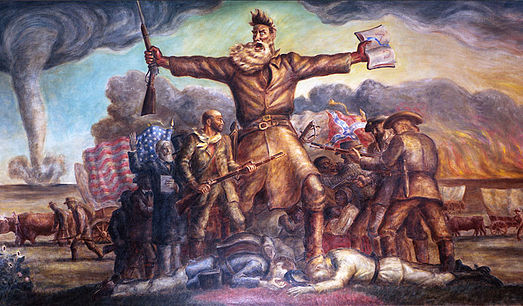
John Steuart Curry-- "Tragic Prelude" Mural depicting John Brown in Kansas

John Steuart Curry– “Tragic Prelude” Mural depicting John Brown in Kansas

One of my favorite genres of art is that of  American Regionalism.  You can lump painters like Grant Wood, Thomas Hart Benton  and  John Steuart Curry together as some of the  better known names in this group.  I am not particularly fond of the use of the word regionalist which seems to hint at some sort of narrow provincialism, a label that Eastern critics tried to pin on this Midwest-based movement of the 1930’s and 40’s.  But these painters and others who have been branded as Regionalists were not sentimental or naive.

In fact they espoused views that were often more aligned with progressive and socialist ideals.  Many of these artists were looking to make their work more accessible to the working class, something that they felt was lacking in the more elitist Modernist work of the time and simply used the landscape and people around them as the vehicle to convey these ideals.  This gave the work an inclusive populist quality that is especially appealing to me.  I like that their work is often simple to approach yet reveals so much more upon deeper inspection.

I have written about some of the more well known Regionalists such as Wood and Benton, as well as some of the lesser known names such as Alexander Hogue and Paul Sample but hope to shed some light in future posts on some of the more obscure names in this genre.

Read Full Post »

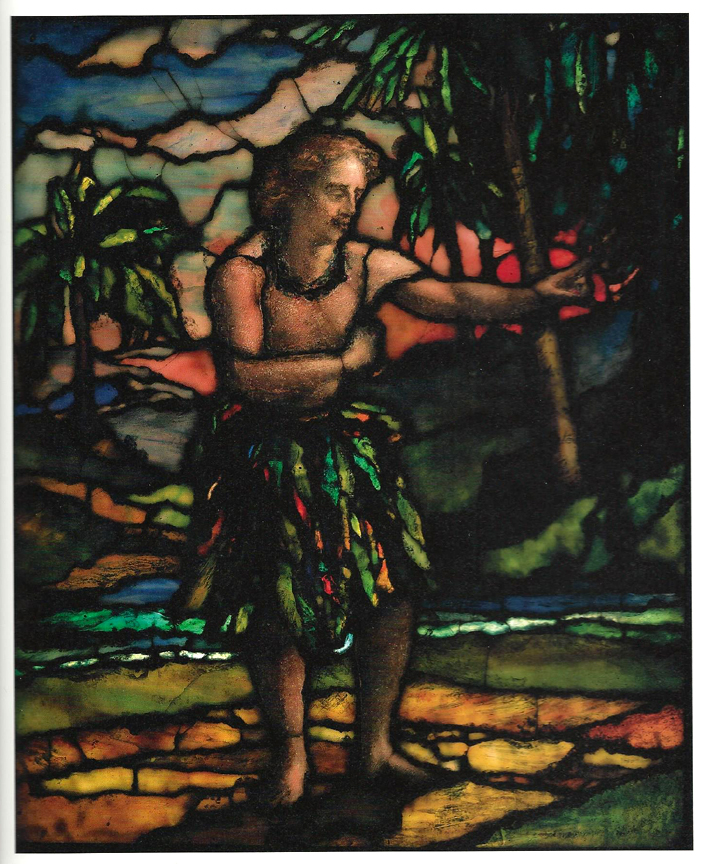
John LaFarge- Samoan Dancing a Standing Siva 1909I am a big fan of stained glass windows.  It has influenced my work in many ways, from trying to emulate the brilliance and glow of the colors to the way in which I see and compose my work.  I have been lucky enough to live in an area with access to the work of Louis Comfort Tiffany who is easily the best known and most stylish of stained glass makers.  The Corning Museum of Glass has a number of his pieces, which are remarkable,  as do several churches in the area.

But there is someone to rival, if not eclipse, the works of Tiffany, someone who actually paved the way for Tiffany’s work with his innovative work in stained glass.  This was John LaFarge.  I can’t remember the exact piece or location of the first time I saw his work except that it was somewhere in NYC.  But I do remember the stunning colors and the lead work which held the glass pieces together.  It  was so different than that of other stained glass windows I had seen which was normally clean and neat, fitting for the solemnity of a church.  But the LaFarge lead work I saw was rough and dark, dividing the opalescent glass but also becoming part of the composition in itself.  His lines were organic and integral to the composition.  It was remarkable.

I came across the image shown above recently,  Samoan Dancing a Standing Siva, in a book about LaFarge’s travels to Tahiti and other South Pacific islands in the early 1890’s and about how this expedition changed his work.  It’s interesting that the other artist whose work was transformed by Tahiti, Paul Gauguin, arrived on the island just days after LaFarge departed.

This piece of stained glass excites me very much in the use of line, especially in the naturalness and organic feel of them, as well as the contrast between the brilliance of the colors and the the darknesses that surround them.  To me,this is simply magnificent, possessing those things that I want to see in my own work.

There is a Pinterest page with many of LaFarge’s more famous stained glass pieces, most of which are a bit more formal than this piece above.  But it gives a nice overview of his work on one page.  To see it click here.

Read Full Post »

GC Myers-  Time of Peace smThis season always signals the end of one year and the beginning of the next and generally sets me to thinking about pasts and futures, thinking about their connection and how it affects my life and work.  One way to examine the past is to delve into genealogy, something that I began doing in earnest several years ago and continue on a regular basis, especially at this time of the year.  It has provided a background, a basis for being and a connection with my environment that I often felt was missing as I grew up.

I will talk a little bit about it with family members, trying to pass on my findings, but have gotten so used to glassy-eyed looks of disinterest that I now seldom bring it up in conversation.  Not everyone wants to look back and I can respect that.  For me, however, it has been essential to my own progress forward, providing me with perspective and a sense of being.  I wrote a bit about this several years ago on this blog, documenting a relative’s pitiable existence and how it relates to my work.  I think it says as much about how I define my purpose as an artist as well as anything I have written before or since.

_________________________

I woke up much too early this morning.  Deep darkness and quiet but my mind racing.  Oddly enough I found myself thinking of a person I had come across in my explorations in my personal genealogy.  It was a cousin  several generations back, someone who lived in the late 1800′s in rural northern Pennsylvania.  The name was one of those you often come across in genealogy, one with few hints as to the life they led.  Few traces of their existence at all. 

 At the time, it piqued my curiosity for some reason I couldn’t identify.  He was simply a son of  the brother of one of my great-great grandparents.  As I said, you run across these people by the droves in genealogy, people who show up then disappear in the mist of history, many dying at a young age.  But this one had something that made me want to look further.  I could find nothing but a mention in an early census record then nothing.  No family of any sort.  No military service.  No land or property.  No listings in the cemeteries around where he lived.  I searched all the local records available to me and finally came across one lone record.  One mention of this name at the right time in the right place, a decade or so from when I lost sight of them.

It was a census record and this person was now in their late 30′s.  It was one line with no other family members, one of many in a long list that stretched over two pages.  I had seen this before.  Maybe this was a jail or a prison.  I had other family members in my tree who, when the census rolled around, were incarcerated and showed up for those years as prisoners.  So I went to the beginning of the list and there was my answer.

It wasn’t a prison.  Well, not in name.  It was the County Home.  This person was either insane or mentally or physically handicapped and was living out their life in a home when they could or would no longer be cared for by family.  It struck me at the time that this was someone who lived and experienced as we all do and who has probably not been thought of in many, many decades.  If ever.

This all came back to me in a flash as I laid there in the dark this morning.  I began to think of what I do and, as is often the case when I find myself wide awake  in the dark at 3:30 AM, began to question why I do it and what purpose it serves in this world.  Is there any value other than pretty pictures to hang on a wall?  How does my work pertain to someone like my relative who lived and died in obscurity? 

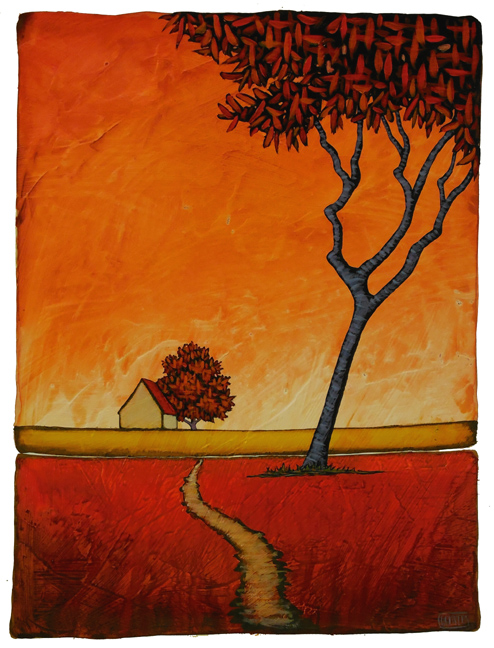
In my work, the red tree is the most prominent symbol used.   I see myself as the red tree when I look at these paintings and see it as a way of calling attention to the simple fact that I exist in this world.  I think that may be what others see as well– a symbol of their own existence and uniqueness in the world. 

If I am a red tree, isn’t everyone a red tree in some way?  Isn’t my distant cousin living in a rural county home, alone and apart from family, a red tree as well?  What was his uniqueness, his exceptionalism?  He had something, I’m sure.  We all do.

And it came to me then, as I laid in the blackness.  Maybe the red tree isn’t about my own uniqueness.  Maybe it was about recognizing the uniqueness of others and seeing ourselves in them, recognizing that we all have special qualities to celebrate.  Maybe that is the real purpose in what I do.  Perhaps this realization that everyone has an exceptionalism that deserves recognition and celebration is the reason that I find it so hard to shake the red tree from my vocabulary of imagery. 

 Don’t we all deserve to be a red tree, in someone’s eyes?

There was more in the spinning gears this morning but I want to leave it at that for now.  It’s 5:30 AM and the day awaits…

Read Full Post »
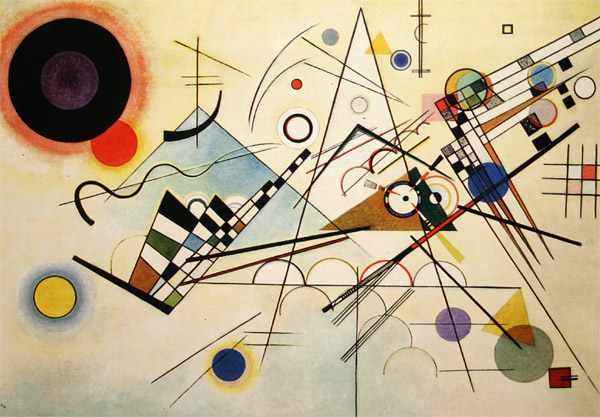
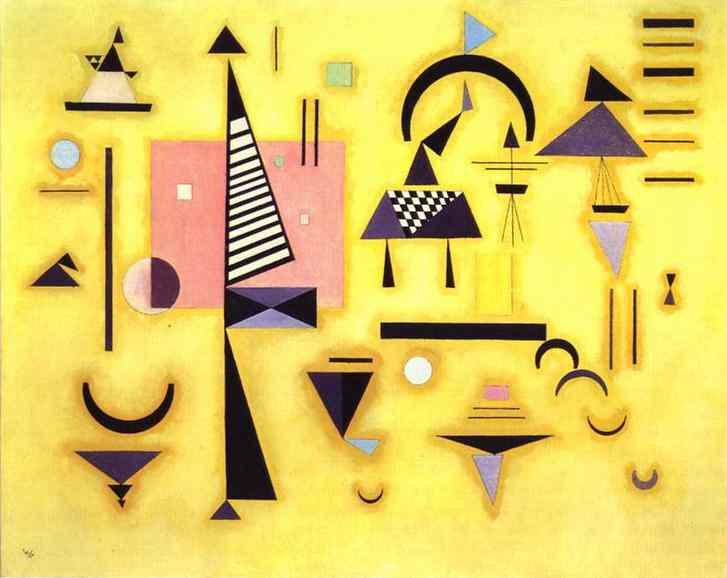
Wassily Kandinsky- Composition VIII  1923In the final analysis, every serious work is tranquil….Every serious work resembles in poise the quiet phrase, ” I am here.” Like or dislike for the work evaporates; but the sound of that phrase is eternal.

Wassily Kandinsky

********************

The above quote is from Wassily Kandinsky and concisely captures what might be the primary motive for my work. I think, for me, it was a matter of finding that thing, that outlet that gave me voice, that allowed me to honestly feel as though I had a place in this world. That I had worth. That I had thoughts deserving to be heard. That I was, indeed, here. 

That need to validate existence is still the primary driver behind my work. It is that search for adequacy that gives my work its expression and differentiates it from others. I’ve never said this before but I think that is what many people who respond to my work see in the paintings- their own need to be heard. They see themselves as part of the work and they are saying, “I am here.” 

Hmmm….

***********************

I wrote the above a little over five years ago in one of the early posts on this blog.  I came across it and was going to re run it alone because I still feels it sums up a lot of what I feel about  my work but I also wanted to expand just a bit more on Wassily Kandinsky, who ended up not really getting much notice in this outside of his quote.

Kandinsky, who was born in Moscow in  1866  and died in Paris in 1944, was one of the most influential artists of the 20th century,  leading the  way into abstraction in painting.  I have sometimes been ambivalent about his work- some I have found entrancing but others have done nothing for me.  But seeing it chronologically, from his earliest efforts until the years just before his death, has made me see him in a different light.  Seeing his evolution from a painter strongly influenced by his mentors  and contemporaries to an artist with a distinct voice of his own is remarkable to witness.  This was a man who was always seeking more than he was seeing, an artist who didn’t rest at a plateau.  Seeing this evolution gave me a new respect for the work of Kandinsky

To see this clearly and for yourself, I suggest you go to WassilyKandinsky.net.  His career is divided into four sections and  each has a chronological gallery of work that you can scroll down.  It’s worth a look.

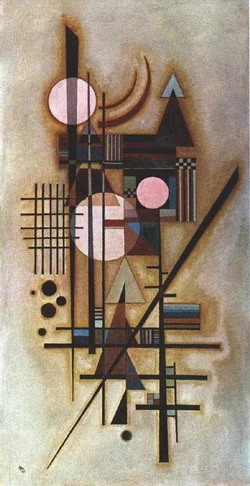
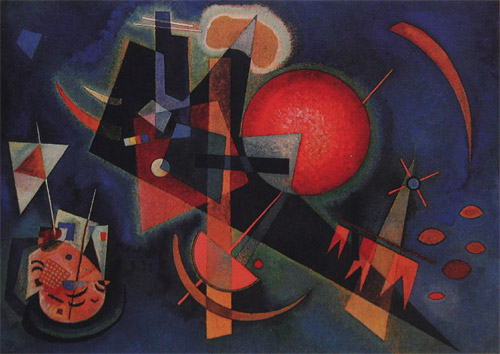
Wassily Kandinsky- Couple Riding   1906 Wassily Kandinsky-  Murnau. A Village Street  1908 Wassily Kandinsky  -Softened Construction 1927     1925Wassily Kandinsky- In Blue  1925  1923Wassily Kandinsky  - Decisive Pink  1932

Read Full Post »

Flow Chart--mihaly csikszentmihalyiI wrote the other day about my search for that intangible thing in my work, that quality that will set me off on a new path.  I’ve been thinking about it and what I think I am really looking for comes down to one word:  Flow.   There’s a famous book, Flow: The Psychology of Optimal Experience, from psychologist Mihaly Csikszentmihalyi ( please don’t ask me how to pronounce his name) that describes flow as a sense of being in the zone or in the groove, of being so totally immersed in the task before you that the external world is blocked out.  He describes it as being like playing jazz, where each action, thought and movement rises from the previous one.

He points out that this flow occurs when there is a balance between the level of the challenge and the skill of the person facing it.  Basically, this person is working at the far end of their skill level, pushing themselves to their boundaries in order to conquer the task before them.  There can be no thought other than that thing before them.  Total concentration and dedication.  I think of it in terms of a mountain climber facing a climb that seems at the far end of their limits, who must muster up all their knowledge and concentrate on each movement in order to scale the daunting peak before them.

I have known this feeling, this flow that he describes, in painting.  I have often described this feeling of immersion, of a level of concentration where each action leads to the next and time seems to fade into nothingness.  I don’t hear the music playing, don’t feel thirst or hunger, don’t think about other things that I need to do or things that might be worrying me.  When I have been in this state it seems so real and so concrete that it feels as though it is always right there and attainable.  It is intoxicating.

But it is not sustainable forever without creating new challenges.  One you have conquered one peak, you need a new one to face down.  Without this challenge, you are at a  comfortable plateau, something I have attempted to describe in the recent past.  Your skill exceeds the challenge and total immersion is not necessary.  While there is a level of needed concentration to simply maintain this elevation, there is also room for outside thoughts and concerns.  The once difficult task has become the normal course.  Comfortable.

And this is fine  and, as I have said before, most artists reach a comfortable level and settle in for the long  term at this high level.  But deep inside, at least for me at the moment, there is a gnawing feeling to find myself hanging  tenuously on a new, scary ascent, pushing my abilities to new levels.  Riding the flow of the thrill of this tunnel-like focus.

That’s where I find myself at the moment– at a plateau, looking up for a new peak to attack.

Read Full Post »

GC Myers- First View 1994It’s that time of the year when I get to take a deep breath and begin to look forward into the next year, trying to determine where my path will lead next.  It’s never an easy time doing this, trying to see change of some sort in the work  especially after so many years of being what I am and painting as I do.  It always comes back to the same question: What do I want to see in my paintings?

That seems like a simple question.  I think that any degree of success I may have achieved is due to my ability to do just that,  to paint work that I want to see myself, work that excites me first.  So I have been doing just that for most of my career, painting pictures that I want to see.  But there is another layer to the question.

What am I am not seeing in my work that I would like to see?

That’s a harder question.  How can you quantify that thing that you don’t know, might not even have imagined yet?

It might be a case of  knowing it when you see it.  I know that my first real breakthrough was like that.  I was simply fumbling along , looking for something that nagged at the edge of my mind.   I wasn’t sure what it would look like, had not a concrete idea of what it might be.  It was just there in a gaseous form that I couldn’t quite grasp.  But when the piece emerged in a tangible form– which is the painting at the top here, First View from 1994– I instantly knew what it was that I had stumbled on  and that it was something that  very important to me.

It might not look like much to the casual viewer now but in an instant I could see in this little painting everything I was sensing in that gaseous, intangible form that hovered at the edges of my mind.  I could see a realization of all of the potential in it.  Even now, after years of evolving from it, I can see how it connects to everything in my work, even those things I had could not yet see when I painted it.

And that’s where I find myself at the moment.  There’s something out there ( or in there, I probably should say) that I want to see, might even need to see.  But I don’t know what it is yet.  But I will know it when I see it.

And, trust me,  I do plan on seeing it. 

Read Full Post »

Charles Burchfield- Sun and Rocks- Albright-Know Art GalleryAn artist must paint not what he sees in nature, but what is there. To do so he must invent symbols, which, if properly used, make his work seem even more real than what is in front of him.

–Charles Burchfield

*********************

I am a big fan of the work of Charles Burchfield (1893-1967), a western  New York painter who lived and painted in the Buffalo area for most of his life.  His work was decidedly visionary in its scope, taking the environment that he knew around western New York and embellishing it with a life force and energy that he sensed beneath the surface.  That’s what he was referring to in the quote above– taking what you see around you and not simply recording it but painting how it moves you emotionally.  To me, his work is as emotionally charged in the same way as that of Van Gogh.

Charles Burchfield- An April Mood- Whitney Museum of American ArtCreating symbols, as Burchfield refers to in the quote, have been a big part of my work.  I have long emulated his use of creating a visual vocabulary that moved through a body of work.  It becomes a sort of language of its own  that people who take it in and understand it find easy to read and absorb as they move from picture to picture.  Those who can’t read it find less in the images and feel less drawn into them.  In an earlier post  about Burchfield I wrote about an artist friend who just didn’t get Burchfield’s work in any sense.  He just one of those people who couldn’t read the language clearly written in the work.

I also have been influenced by the way Burchfield would constantly go back to earlier work and use it as a new starting point, as though the added knowledge gained through the years would take this work in a new direction.  I often do the same thing, constantly revisiting images and motifs from years ago looking for a thread or path to follow anew.

Even this post is a revisitation, going back and looking at an influence, trying to pull that original inspiration from it.  With Charles Burchfield, that’s always an easy thing to accomplish.

Charles Burchfield- Childhood's Garden

Read Full Post »

GC Myers- The Long Way Home smHome is a name, a word, it is a strong one; stronger than magician ever spoke, or spirit ever answered to, in the strongest conjuration.

  ~Charles Dickens

**************

This is a newer painting that went to the Principle Gallery recently.  It’s a 12″ by 16″ painting on paper that I call The Long Way Home.  Home, as a concept,  plays a large part in my work as it is the destination for the life journey that is the basis for much of what I do.  I don’t necessarily see home as a physical place but rather that interior space where we are comfortable with who and what we are.  For me, our real journey in life is always internal.

Everything leads inward.

We often set out on treks through the external world trying to find a place, a physical location where we  feel accepted and at home.  But it never happens until we find that inner peace and acceptance in that inner realm that is always with us.  Though we may have traveled a million miles, home is always within reach if we only stop and look inward.  And I think that is what this piece is communicating.  The title reflects on the search that always leads back to that internal place we often overlook in our zeal to find that place we call home.

Home is always with us.

Read Full Post »

GC Myers-  QuiescenceI had a quote on the last post with a quote from artist Jean Arp about man turning his back on silence.  Instead of savoring the quiet, he runs from it, instead distracting himself with all manner of noise.  Anything to keep him from facing the fears that the quiet represents to him.

It’s a theme that has been large in the background of my work.  Early on, when I felt that I wanted to be a writer, I would find myself writing about large open spaces and the caverns of silence that rested in these places.  I called it the Big Quiet.  Of course, it’s a pretty limited subject and there is a certain redundancy in writing about silence and stillness.  I mean, how can you use the noise of words to aptly describe the absence of noise?

So I gave up writing about it and went on with my life, always with an eye out for this Big Quiet.  I don’t know that I was craving it or fearing it at most points.  My life was pretty much filled with the noise of the world, all the snaps and pops of sound and distraction that creep into every living space.  The sounds that I hoped would lessen my anxiety but instead fed it.  I was like so many others who needed the security blanket of sound to protect them from what they might discover if they were forced to face the silence.

But painting gave me a path to finding this Big Quiet.  It was wordless and calm, creating an inner space absent of the sounds of the world  that I was and am still occupying.  It became a destination, an oasis to turn to when the din of world became too loud, too overbearing.  It eased my fears of looking inward and allowed me to savor the quiescence of the brief moments I actually myself there in those scenes of stillness and calm.  It became real and necessary to me.

I don’t know where this going, this wordy noise I’m creating about the stillness I find now.  I just felt that I should add a bit of context to my work, to give a an understanding of what I hope to take from it for myself.  This moment came about from running across the image above, a piece from several years ago that is called, fittingly, Quiescence.  It’s a piece that brings me quiet immediately and seeing it again made me again think of why I paint.

Read Full Post »

Becoming

GC Myers- Regal One The thought manifests as the word;

The word manifests as the deed;

The deed develops into habit;

And habit hardens into character;

So watch the thought and its ways with care,

And let it spring from love

Born out of concern for all beings…


As the shadow follows the body,

As we think, so we become.

 —From the Dhammapada,

Sayings of the Buddha

***********************

I’vebeen writing this blog for over five years now which I find hard to believe.  Some days I have nothing to say but still feel the need to keep this habit alive.  Sometimes I read through older blog posts to gather inspiration and in doing so, I came across this bit of wisdom from the Buddha that I featured in a 2009 post.  When I used it at that time, I was referring to people’s words and deeds of  incivility eventually hardening into character.  This was of course inspired by extremist nature of the political climate.  But today when I read it, these words didn’t strike me in a cautionary way.

Instead, it seemed like good advice for the young artist or anyone aspiring to something more.  For me it was: Think as an artist.  Act as an artist.  Eventually, the thoughts, words and actions become part of who you are– an artist.  It took many years before this habit hardened into character.  I often questioned the validity of the claim over the years but slowly these doubts faded , replaced by a belief in those words and deeds.  I had practiced the habit of being an artist for so long that I could no longer  feel that doubt.

As I said, this applies to so many things, even simply being happy.  If you think of joy, speak of joy and act with joy, eventually happiness becomes part of who you truly are– your hardened character.  It’s a simple precept, almost too simple to be taken seriously especially on those days when it is challenging to remain joyful.  But it holds true, as the Buddha instructed, for those who can maintain the way.

Have a great Sunday and be happy…

Read Full Post »

« Newer Posts - Older Posts »