Feeds:
Posts
Comments

Archive for the ‘Neat Stuff’ Category

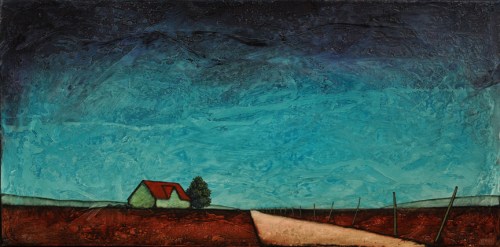
GC Myers- The Dark Blue Above

Well, I’m not going to Kathmandu.

This painting  is, however.

Titled The Dark Blue Above, it was chosen by the  newly appointed US Ambassador to Nepal, Scott DeLisi, to adorn the his offices at the US Embassy in Kathmandu.  The Principle Gallery in Alexandria was approached by Ambassador DeLisi’s office concerning this piece and, as a result, it will hang in Nepal for the next three years as part of the US State Department’s Art in Embassies Program, which arranges American art for its diplomatic locations worldwide.

I feel honored to have a piece of mine chosen to be a representative piece of American art in another country and I’m particularly pleased that this painting was the choice to go to Nepal.  If you had asked me to choose a painting of mine to send there, this would have jumped to mind.  I can’t say this with any knowledge but I get the sense this piece will translate very well there.  Perhaps it’s the rich, bright blue in that sky or the the feeling of atmosphere.

I don’t know.  Just a feeling.

I wonder if I can visit it?

Read Full Post »

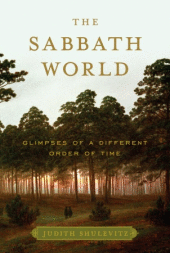
I saw Judith Schulevitz on The Colbert Report last night promoting her book, The Sabbath World: Glimpses of a Different Order of Time, and it brought a lot of things to mind.  Her book, from what I take, examines the concept of our need for a sabbath and how we have lost the benefits of this day of stoppage as we have become more and more entrenched in a hectic 24/7 world.   Our concept of time has been altered by our change as a society.  We see time spent in activity of ant sort as more meaningful than any spent in stillness.

I am old enough to remember when the Blue Laws of the past were still in play in this part of the world and how most businesses were closed on Sunday.  It was hard to find a gas station open.  You couldn’t buy alcohol.  Almost all retail stores were closed.  Traffic was lighter and Sundays had a quieter tone in general, even for my family which was not religiously observant in any way.

I used to think, when reminiscing about those days, that this slower pace and quiet was nothing more than the fact  that I was a kid and lived on the more casual, relaxed kidtime.  No deadlines.  No schedules.  Just be a kid and let time flow naturally.  But as I remember more, it really seemed to be a quieter and calmer time for the adults as well.  There was something very comforting in knowing that everyone’s week had this common day when we would all reset and realign.  A common stopping point where we could all reflect on the week that was past and regroup for the coming week..

Of course, that could never happen now.  We are too invested as a culture of perpetual motion now and to try to put on the brakes would take a revolution of sorts.  But people like Judith Schulevitz and her family are trying to return to that feeling of reflection.  It’s a small step but if only a few families can regain that sense of of calming the hands of the ever spinning clock, then it’s a worthy effort.

Here’s an article Judith Schulevitz wrote for the NY Times, several years ago that is the seed for this book and more clearly defines what I’m struggling to say.  For example:

What was Creation’s climactic culmination? The act of stopping. Why should God have considered it so important to stop? Rabbi Elijah of Vilna put it this way: God stopped to show us that what we create becomes meaningful to us only once we stop creating it and start to think about why we did so. The implication is clear. We could let the world wind us up and set us to marching, like mechanical dolls that go and go until they fall over, because they don’t have a mechanism that allows them to pause. But that would make us less than human. We have to remember to stop because we have to stop to remember.

Take a look and this Easter Sunday, relax.  Reset the clock…

Read Full Post »

Living History

In today’s local paper, there was a story about an annual event that our local school system has held for the past seven years.  It is held at a local war plane museum and brings together eighth grade history students and the people who fought and lived through World War II, allowing the young ones to have one-on-one contact with these survivors.  They get to hear history brought to life so that they might better understand our proximity to history and to carry it forward.

There was a Marine who survived Iwo Jima.  A fighter pilot who flew over sixty missions over Germany and France.  Front line soldiers and people who worked behind the lines. People who supported the war effort on the home front.  All recounting their experiences for these young ears.

I think it’s a brilliant concept and I envy the kids.  I would love to be with them going from table to table, listening to the stories and asking questions.

I often wish I could do the same with relatives who have passed away before I even knew I had questions for them.  I would love to sit with my grandfather and ask him about his early life as a pro wrestler and his time as a stage manager in vaudeville.  What stories I bet he could tell!  And I wish I could ask my grandmother about the logging camps her father ran and what is was like living  in the Adirondacks  in the early part of the last century.  About unknown relatives that I have only recently uncovered while doing genealogical research.  So many questions.

We often let living history slip away with many stories untold and lost for eternity.  That is truly a shame and it’s good that these eighth-graders are fortunate enough to hear stories that will now live on.  It’s something we should all strive to do in our own lives: listen and learn to the living history that is all around us.

Read Full Post »

Kuna Molas

Traditional Kuna Mola

Sometimes you’re reminded how expansive this world is and how little you know about so many things in it.

This is a good thing.  It reawakens the curiosity.  Makes you want to spackle over the cracks and gaps in your knowledge with new information.  And gaining new knowledge is never a bad thing.

A few days ago I presented a new painting, Through the Labyrinth, and a reader commented that it reminded her very much of the molas of the Kuna people.  To my dismay, I realized I had never heard of the Kuna people of Panama nor was I familiar with their brightly colored and intricately patterned shirts, which are called molas.

So, this morning I have been taking a crash course on the molas and culture of the Kuna people, who are an indigenous people living in Panama and Colombia.  The molas evolved from a traditional form of body painting into the present textile versions with the coming of the Spanish colonizers and missionaries.  They often use geometric patterns as well as colorful representations of tropical birds and animals.

I was most taken with the geometric patterns of the molas.  They have a great sense of completeness about them.  I can’t fully explain what I mean by that.  It’s as though, while being representative of things in the Kuna world, the patterns are a complete world  unto themselves.  Maybe I simply mean that they have universal meaning.

I don’t know.  They’re just wonderful to look at and take in.  And I’m sure you’ll see elements from these creep into my work at some point soon.  It can’t be helped.

Kuna Flag of 1925

Now, if the pattern directly above reminds you of  the swastika, don’t be alarmed.  The swastika was and is a symbol for many cultures throughout all the world, including the Kuna people, often symbolizing stability and harmony.  It was actually used in the flag which was used as a symbol of their autonomy in a revolt against the Panamanian government in 1925.  They changed the flag less than two decades later when the Nazis forever altered the world’s perception away from the swastika’s true meaning.  But for the Kuna the swastika still holds its ancient meaning and, hopefully, always will.

Hopefully, always in peace in their native land…

Read Full Post »

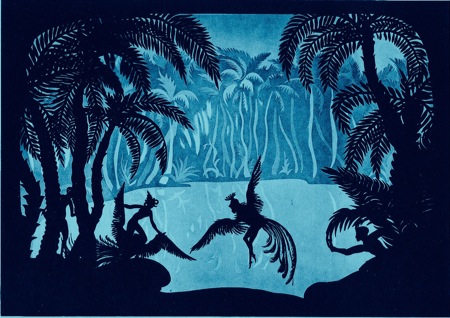
The Adventures of Prince Achmed (1926)

I first saw a film, The Adventures of Prince Achmed,  from Lotte Reiniger several years ago in a series about early silent films.  It was made in 1926 Germany and was one of the first animated films made.  It’s a form of animation that Reiniger pioneered and mastered, based on Eastern shadow theatre.   Using silhouette figures, each is painstakingly cut and hinged then  filmed in small movements with time lapse photography to produce motion in the film.  This film took three years to complete.

Lotte Reiniger At Work

In this telling of the Arabian Nights stories, I was immediately struck by the beauty and movement of the colors in the film.  Each cell was tinted by hand to produce intense bursts of color that gave the film a gorgeous surreal quality.  The movements of the figures in the film are smooth and natural,  very subtle.  I found myself so taken with watching the movements and changes that I found myself not following the story.  But I didn’t care.  It was beautiful to see and sparked the imagination.

Lotte Reiniger (1899-1981), born in Germany and living most of her post-WW II life in Britain,  left quite a body of work from a career that spanned over 50 years, including one of the first film versions of Hugh Lofting’s Doctor Dolittle. She’s pretty much unknown in popular culture which is a great shame.  Her work is marvelous and deserves to be seen.

Here’s a small clip of Prince Achmed:

Read Full Post »

Today is  St. Patrick’s Day and I was going to write about the day and how it was my late mother’s birthday.   She would have been 78 today.  But today I’m interested in a story in the news as of late brought about by the recent publication of a book by Rebecca Skloot, The Immortal Life of Henrietta Lacks.

It tells the story of the amazing cells of Henrietta Lacks that survive to this day, almost 59 years after death.  You see, Henrietta was a poor African-American woman living in the Baltimore area in 1951.  She was 31 years old when she was diagnosed with cervical cancer and her treating physician took a sample of her cancer cells without her knowing, which was common at the time.  Later that year, Henrietta succumbed to the cancer and died.

In most cases, the life of a 31 year old poor black woman who died so long ago might only be remembered by a very small group of family and friends, and even then, only fleetingly.  But Henrietta’s name is very much alive today. 

Her name and her cells.

You see, the cells taken from other humans have been found to have  short lifespans outside the body,  usually days.  But not Henrietta’s.  Hers were unlike all others and continued to live.  And live and live and live. This was a boon for medical research.  Her cells , now called HeLa Cells, were used by Jonas Salk in developing the polio vaccine and in the years since have been part of almost all new vaccines and medical developments.  Her cells continue to grow and have become a factory of sorts as there are companies that mass produce her cells for use in medical research. 

 In fact, over 50 million metric tons of her cells have grown in those decades.  To put  that into perspective, that would be enough to fill the space of the Empire State Building– 15 times.

There’s more to the story.  Her immediate family was not aware until 1976  that her cells were stll alive and being produced for sale and were, in fact, a multi-billion dollar business.  They have never seen a penny and are ironically without health insurance and in need of  treatments that have been developed with Henrietta’s cells.

I don’t want to get into a rant over the ethics of big business and healthcare but it brings to light a question of what constitutes life and ownership of our own cells outside our body.  I don’t really know where I stand on the subject.  I would like to think that those cells are indeed a part of Henrietta Lacks and that her life continues in them.  It would be a lovely concept to think of her cells forming an immortality that extends beyond the memory of a small group of family.  That the spirit her family saw in her lives on.

Is it so?  I certainly don’t know.  It would be nice if her family could see even a token gesture from the companies that have been built on the legacy of her cells.  Then maybe her cells could live on in other ways as well.

Happy Birthday, Mom.

Read Full Post »
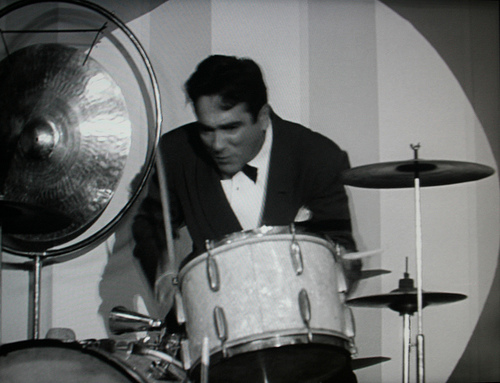
I was painting in the studio yesterday and I threw on a movie that I hadn’t seen in years, Ball of Fire starring Gary Cooper and Barbara Stanwyck.  It’s a great comedy from1941, written by Billy Wilder and featuring some of the great character actors of the time.

I only mention  this because there’s a great scene of Stanwyck performing as a nightclub singer with Gene Krupa, the legendary drummer , and his band.  They perform Drum Boogie and if you ever doubted that your parents or grandparents knew how to rock, this will put those doubts to rest.

Try to stay with it to the end.  Krupa does a part where he changes Drum Boogie to Matchbox Boogie and plays the song with wooden matches as his sticks.  There’s a lesson in there for artists about the power of contrasts.

Good stuff…

Read Full Post »

There’s an old piece of film that I have often seen in snippets, usually in a montage about the earliest days of film in the late 1890’s.  It’s a short film of a dancer with swathes of fabric twirling, very modern dance-ish in style, and as she spins the fabric changes color.  It’s a pretty mesmerizing piece of fim, even more so given the infancy of the medium of the time.

Doing a little research I found that this was filmed by the French film pioneers, the Lumiere Brothers, in 1896.  Each film cell is handpainted to achieve the color effects.  The dancer in the film is Loie Fuller, an American-born pioneer of modern dance who was the toast of Paris in the 1890’s, starring often at the Folies-Bergere

I find this film quite enchanting which is pretty amazing considering how many different  moving images, how much computer generated animation and other advances in film-making I, like most people, have witnessed in this time, over 110 years in the future.  Can you imagine how mind-blowing this must have seemed to the average person of the day?

This point is well illustrated in the movie, The Magic Box, a 1951 film in which Robert Donat portrayed British inventor, William Friese-Greene, who had invented and patented the motion picture camera a year before Edison but never received any credit and died in virtual anonymity.  In the film, when he finally is able to fully demonstrate the motion picture with his invention he is alone in his lab, late at night.  He is frantic with excitement and runs out into the London streets to let the world know of his triumph.  The only person he encounters is a London police officer, played by Laurence Olivier.  The bobby suspiciously goes along with Friese-Greene thinking he has a psychotic on his hands.  He hesitantly agrees to look at Friese-Greene’s demonstration and when the film rolls and the images of the London citizens strolling in Hyde Park appear, he is frozen with amazement.  It is as though he is looking on a true miracle.  And perhaps he was– the miracle of invention.

Anyway, take a look to see a beginning point and realize how far we have come…

Read Full Post »

I was thinking of Dan Hicks and His Hot Licks the other day.  I’ve got a couple of  his albums from the early 70’s and periodically some of his songs pop into my mind.  It’s hard to categorize his music but their was always an eccentricity factor with it.  He’s been around for something like 40 years or more but probably achieved his greatest success with his early work and his appearances on popular TV variety shows of the time. 

 One such appearance was on The Flip Wilson Show in 1972 which I’m showing here.  I was going to show only this clip, given that it’s such a great snapshot of that time in popular culture,  but I thought it would be interesting to also show him a few years later to show the evolution.  Somewhat.

Anyway, here are a couple of Dan Hicks’ songs for your consideration.  The first is from 1972

The second is from around 1990 from the short-lived late night show Night Music with David Sanborn…

Read Full Post »

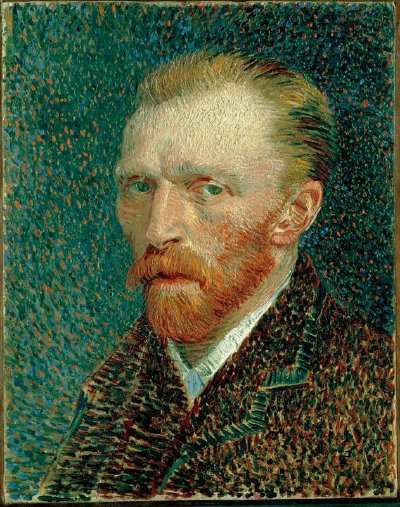
Last year I featured a video called Women In Art that featured portraits of women from over the past 500 years morphing one into another.  It was a really well done piece of work from Phillip Scott Johnson and was a YouTube sensation, having more than 10 million hits.  He has also given the self-portraits of Vincent Van Gogh the same treatment.

It’s a short piece and it’s interesting to see how the familiar views of Van Gogh relate to one another and how his appearance or, at least,  his perception of it, changed through the years.   His state of mind is evident in each piece, with some showing a vibrant, seemingly healthy man and others showing the more tortured Van Gogh that we have come to know.

It’s an interesting little piece, coming in at under a minute.  Give a look…

Read Full Post »

« Newer Posts - Older Posts »