Feeds:
Posts
Comments

Archive for the ‘Opinion’ Category

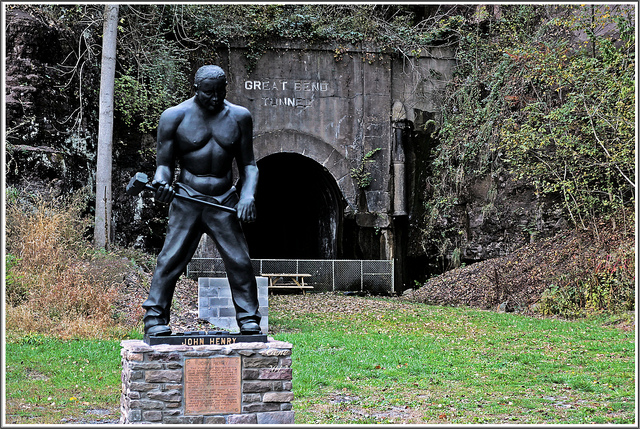
John-Henry-statueAnother Labor Day weekend.

I usually focus on the labor aspect of this holiday when writing about it, trying to point out how much our country was shaped by both the toil of the workers as well as the labor unions who fought for and won many of the rights that we now take for granted.  But this year I thought I would focus on a folk song that addresses the role and importance of labor in our lives:

John Henry–  that steel driving man who faced off in an epic battle of man against machine, defeating the steam drill that threatened to take away his job.  Well, sort of defeating it.  I guess a victory is still a victory even if you die in the wake of your triumph.
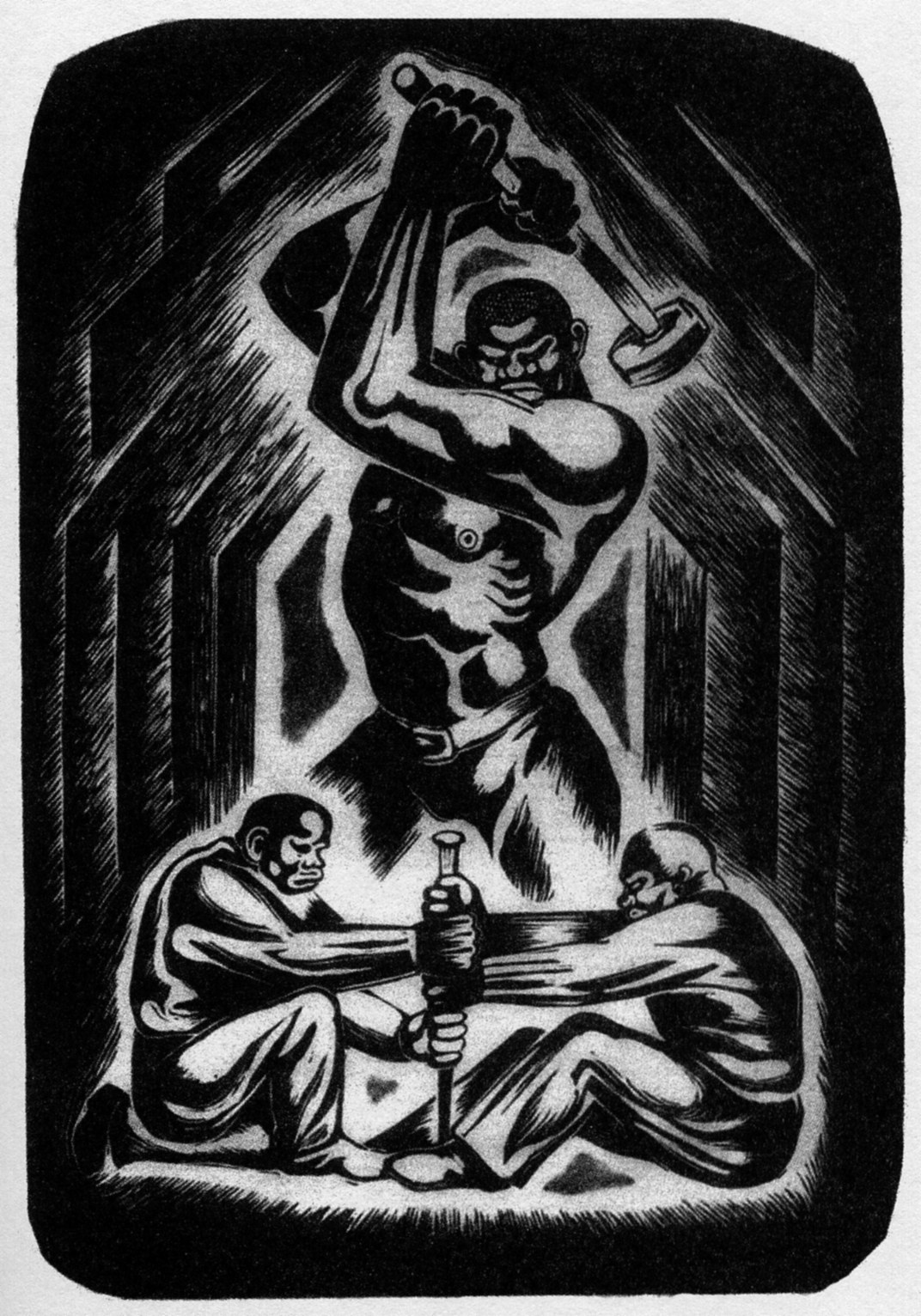
john_henry_by_fw_long_dehtUnfortunately, John Henry’s great efforts ultimately didn’t save the jobs of the workers who would be displaced by the steam drill.  But it did illustrate the importance of  labor and the purpose it adds in our lives.  Labor has always been that thing by which we have provided for ourselves and our families, from the time we were primarily hunter/gatherers and farmers (which was not that long ago) to the present day.  To take away that ability to provide is to strip away one’s pride and definition as a human.

In that aspect, John Henry’s victory  was more than a triumph of blood and bone over steel and gears.  It was a triumph of the human spirit, a crying out of our need to be necessary in some way, to be undiminished.  And despite John Henry paying the ultimate price for his victory, I think that is why this song still strikes a strong chord with us.

So for this Sunday’s music I will play one of my favorite versions (among many) of John Henry.  It’s from Johnny Cash from his 1963 album, Blood, Sweat and Tears, an album which focused on labor.  I think it captures that idea of purpose really well.

Have a great Labor Day weekend but try to remember the idea behind the holiday.
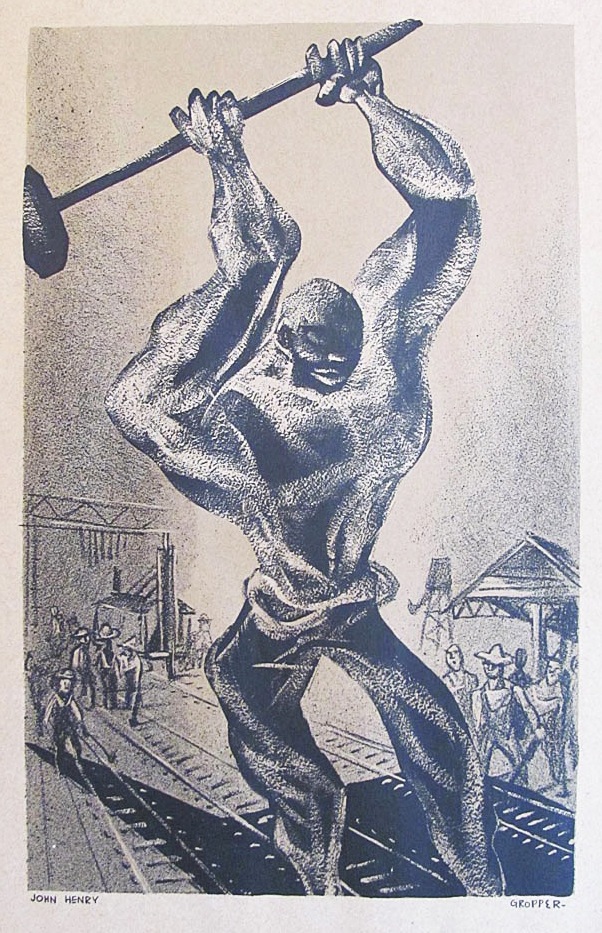
John Henry William Gropper
 

Read Full Post »

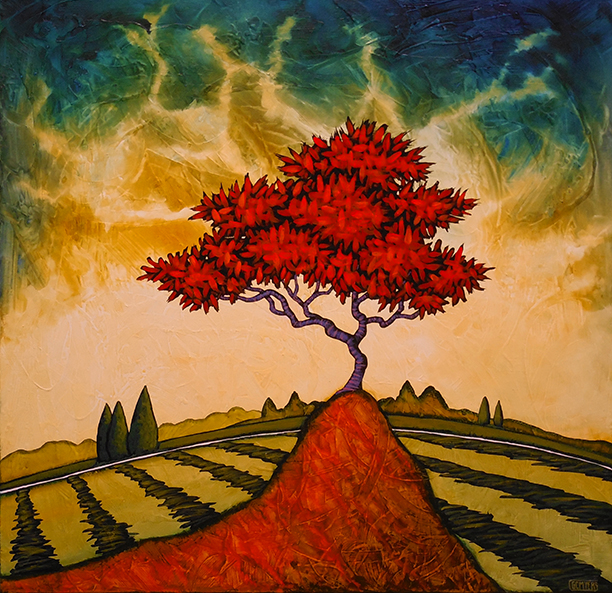
GC Myers- In the Air of Freedom smI am free because I know that I alone am morally responsible for everything I do. I am free, no matter what rules surround me. If I find them tolerable, I tolerate them; if I find them too obnoxious, I break them. I am free because I know that I alone am morally responsible for everything I do.

 —Robert A. Heinlein

*********************

Freedom is a word that gets thrown around a lot by politicians and pundits.  It is the basis for untold numbers of credos, adages, maxims and bumper stickers. But for all its use,  I don’t think many of us give even a single thought to what the word means for ourselves.

I’m not here to try to define the word. I think it has personal meaning for each of us that can’t be easily contained in one single definition.   My idea of freedom may not match yours and your freedom may not seem like freedom at all to me.  And maybe that’s the main thing in freedom– we are free to define our freedom as we wish.

The only constant is the moral responsibility that we take for our actions, as famed sci-fi author Robert Heinlein lays out so well in the quote above. We can never be free from the responsibility we must take for our actions nor from the repercussions  from others in response to our actions.  That is one freedom to which we will never be entitled.

The painting at the top is a new painting, a 24″ by 24″ canvas, that is part of my Home+land show that opens this Friday at the West End Gallery.  Titled In the Air of Freedom, it represents for me the freedom that I have found in the last twenty years of painting.  Painting has given me a means of free expression, a voice to send out into the world, a contentment and purpose that I struggled and failed to find to find in the years before I came to it.  It has come to define my own freedom.  I see the Red Tree representing that free expression and the fields behind it representing for me the labor and responsibility that accompany it.

As I said, freedom seems like it should be something we can easily put into words but it it turns out to be a much more complex creature.  Take a minute and really think about it.  How do you define your own freedom?  What makes you feel free?


Read Full Post »

GC Myers- In the Moment of GraceThis is a new piece, an 18″ by 24″ painting on panel, that  is part of my upcoming show at the West End Gallery.  It is titled In the Moment of Grace.  Fittingly, it was finished in the time that I listened to President Obama‘s stirring eulogy for the victims of the Charleston tragedy on Friday in which he pulled its theme from the classic hymn Amazing Grace.  Although I was already fully invested in  this painting, that fact added so much more meaning to it for me.

That eulogy was the culmination of a remarkable and historic week, one that found the Supreme Court issuing decisions that upheld the Affordable Care Act (ACA) and made Gay Marriage a right throughout the nation.  And if that wasn’t enough, the Confederate flag finally came down in South Carolina, though it took the act one young black woman willing to be imprisoned for her civil disobedience rather than the act of an intransigent State House and Senate.  The President’s words over the fallen in South Carolina framed the end of this week perfectly.

Amazing Grace.

Despite the wonder of it all, I know there is much more to be done and more conflicts to be faced in the struggle for equality and fairness for all.  That is the nature of change and change is the nature of America.  And I think that is the point that is missed by so many of those who hold so tightly onto the past,  those people who say that they want “their country” back: America is not a monolith, not owned by one group or region and cannot be defined by one thing, person, place or time.

That is its strength.  Like a great work of art, it lives always in the present.  And the present is an inclusive and shifting prism, a kaleidoscope or, yes, a rainbow of diverse people who make up this nation.  It has eventually always made room for all who sought to live in that light and it is that spirit of inclusion that separates us from the rest of the world.  Tolerance unifies a disparate people and brings us closer to grace.

As I said, there are many more hurdles to be overcome, more work to be done.  I could continue preaching here for a while but I wish to just sit back for a moment and relish the present.  So, for this Sunday morning music I thought a little Amazing Grace would be appropriate.  Her is a truly beautiful version from Judy Collins and the Boys Choir of Harlem, sung on the National Mall in Washington, DC.

Have a good Sunday and reflect for a moment on this remarkable week.


Read Full Post »

The_Torment_of_Saint_Anthony_(Michelangelo)A man paints with his brains and not his hands.

-Michaelangelo Buonarroti

***********************

I am a little intimidated in quoting the words of a man who is believed to have painted the piece shown above, The Torment of Saint Anthony, at the tender age of 12 or 13.  Pretty amazing.  It’s obvious from this and almost everything of his that came after that Michaelangelo had both brains and hands–craftsmanship of the highest degree and thought and feeling that brought his work to life.

But his words ring true for any painter.  Painting should not be mere craft, not formulaic process nor exact replication of the reality before them.  No, it is beyond  that.  It is how the artist imbues the work with their own thought and emotion, their own spirit, their own essence– an investment of the self— that elevates the work above craft.

Doing that is the trick.  At first glance, it seems both a tall task and a simple one.  But it comes down to simply feeling emotion in what you are doing and being willing to openly display it without reserve.

Now, maybe I am misinterpreting Michaelangelo’s words to fit my own subjective view of painting.  Perhaps in these ten words he was speaking about taking a more scientific or mathematical approach to painting and composition. That I don’t know.  But when I read it, it made sense to me because the differentiating quality I see in painting, from self-taught outsiders to the highest level of traditional representational painters, is how much of themselves a painter is willing to invest in their creations.

It is the thought process of the artist that makes the painting, not the mechanical process.

Read Full Post »

Cabbage Row- Catfish Row Charleston SCFirst things first, a happy Father’s Day to all you fathers out there, including my own living down in Florida.  I was going to say more about him today and some recent cognition troubles he’s been experiencing but I think I will keep it simple and just send out my wishes for a Happy Father’s Day.

Being Sunday, it’s time for some Sunday Morning Music.  I was going to play something with a father-y theme but this week’s tragic event down in Charleston has been on my mind.

In the late 1980’s, my parents lived  for a couple years on one of the sea islands outside of Charleston so we were able to visit a few times.  It was hard not to embrace the place with all its charms, its people and history always on display.  I’ve had a soft spot for that area ever since and when the Principle Gallery opened a new location there two years ago I was thrilled in that it might give me an excuse to visit that place once more.

So when a hate-filled , weak-minded coward given  power through a gun takes the lives of nine innocent people in that city, I am filled a multitude of emotions.  Sadness for the families and friends of those victims, for the city itself and for this nation that seems to accept this type of tragedy more and more as the norm.  Anger at the killer and at ridiculous hatred he possesses.  Anger at the societal mindset that incubates or tolerates this hatred, especially in a state where the Confederate flag brazenly flies about the state capital.  Anger at those people who believe that this is somehow “their”country and that it is their duty to somehow take it back.  Anger at politicians who give lip service but little else in the aftermath, only looking to put the event in a perspective that suits their own agenda.

How many more times will we tolerate this?  Many, many more I am sure because there is no easy answer here, no magic pill that wipes away racism, especially in a society where the constant thinly-veiled racism shown  in the contempt and disrespect for our president is accepted as the normal.  We can’t continue the way we have int he past, simply accepting this as the everyday event it is quickly becoming.  We must not tolerate intolerance. We must choose to change.

But Charleston will survive, will get past this time as it has so many other dark days.  This morning I am playing a song that has a foot in those earlier days of Charleston.  It’s a song from George and Ira Gershwin’s opera Porgy and Bess based on the Dubose Heyward novel, Porgy, set in the the real Cabbage Row area of Charleston.  This became Catfish Row in the story so that it could be relocated to the seafront.  The photo above with the Catfish Row sign is the actual site of Cabbage Row where families of freed slaves lived in the late 1800’s and ealry 1900’s, selling cabbage from the windowsills.

The song is I Loves You, Porgy from the late and oh so great Nina Simone.  She was one of the greatest and most distinct interpreters of song ever.  I don’t think I’ve ever heard her sing anything that didn’t become hers once it was sang.  This song is a tour de force among many version of it from a wide range of singers. Enjoy and have a great Sunday and a great Father’s Day.

Read Full Post »

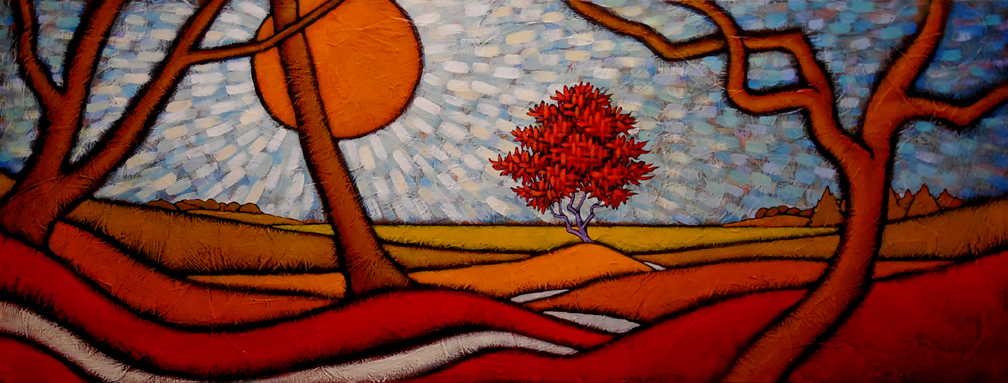
GC Myers-  Nova Harmonia smThis painting, a 16″ by 40″ canvas, is another piece from the Native Voice show and is titled Nova Harmonia.  That loosely translates as New Harmony but it doesn’t really anything to do with the short-lived 19th century Utopian community of that name in Indiana although the utopian aspect might apply.

The feeling and theme of the piece is very much about the concept of living in harmony with the forces of the world around us and that might seem like some far-fetched utopian concept to some.  And that’s  a shame because this coexistence we share with the earth should be something that we naturally accept and make part of our lives.  Far too many think of the earth as being something that we dominate, a servant– no, a slave– that provides us with a never-ending supply of fuel, food and everything else we can strip from it.

But that is so wrong in so many ways, mainly in its hubris, greed and short-sightedness.  We are temporary tenants here on a world that has seen many species and civilizations come and go before us. one that will be still revolving around that sun long after we are but a distant memory.

Instead, it should be viewed as our partner or our ward, something that we watch over with care and respect in exchange for the great bounty it has provided.  Perhaps it will allow us to inhabit its richness for a bit longer that way.

That’s the message I glean from this painting.  It has an optimism and unity that I find reassuring and hopeful.  In short, this painting makes me feel good.

As I said above, this piece is at the Principle Gallery for my Native Voice show which opens Friday, June 5.

Read Full Post »

Civil War Soldier DageurrotypeMemorial Day weekend.  I’m no historical anthropologist so I can’t be completely certain when I say that I don’t believe there is any one group of people on this planet who have not been touched by war in some significant way. The history of this world has been written in the bloody ink of war.

A few years back, when I began doing genealogy for the families of my wife and myself, I was surprised at the many, many generations in each line who had taken part in the wars of their times, putting their lives aside to give so much of themselves– in some cases, their very lives– for causes that often might have been mere abstractions to them.

Part of me is proud that these people have answered the call to be a small part in something bigger.  But another part of me is simply sad to think that they were called on to give so much in  order to satisfy or deny the baser motives of those in power.  War has usually been about greed and acquisition, nationalistic pride or ethnic and religious hatred– in each instance proposed with the greatest conviction and certainty by the leaders of each side of the cause.

And on Memorial Day, we remember the people who actually fulfilled the pleas of these leaders, be they right or wrong.  These citizens did what they were asked and what they felt was necessary in their time and place.  And I have nothing but respect for that.

For today’s image, I chose the daguerreotype of the Civil War soldier at the top because there was something in him that seemed to show the sacrifice of war.  Maybe it’s the steely stare of his eyes.  Or maybe it was his belt that is cinched in to what looks to be a ridiculously tiny diameter, showing how emaciated he appears to be.  I’m not exactly sure but there is something in him that seems contemporary, less dated.

And for today’s Sunday musical selection, I have chosen the song Ben McCulloch from Steve Earle.  It tells the story of two brothers who enlist in the Confederate Army in the Civil War and discover the hard realities of war as they serve under General McCulloch, who was a real person who died in battle in 1862.  The chorus probably echos the sentiments of many soldiers through time for their commanding officers as they face overwhelming odds.

So have a great Sunday and a Memorial Day filled with some appreciation of what the day really encompasses.


Read Full Post »

He knows all about art, but he doesn’t know what he likes.

–James Thurber

******************

James Thurber Cartoon Art CriticThis may not technically qualify as a quote but who cares?  The message in this cartoon from the great James Thurber is so simply put and true and that’s what I am looking for in a good quote.

 And art.

That’s what I like.

In the past I’ve talked about how many people are intimidated by the idea of art, feeling that they don’t know anything about art.  This leaves them not trusting their own eyes and their own reactions to any given piece of art.

And that is a pity because art is mainly about the reaction to it.  Art is a reactive agent, reaching out and stirring something in the viewer.  All of the knowledge in the world about a piece of art cannot make you like that piece of work if it doesn’t first strike that chord that raises some sort of emotional response within you.

And I think most of us know within a few moments whether a work of art speaks to us or leaves us cold.  The trick comes in recognizing this realization and feeling okay with it.

I’ll admit that there are many celebrated works of art out there that do absolutely nothing for me.  They may have historical importance or elements of beauty or great craftsmanship in them but they simply don’t raise any emotional response within me.

I might be able to appreciate them but the bottom line is that I don’t like them, plain and simple.  That doesn’t mean I’m right or wrong.  It just means I know what I like.

And I accept that criteria from anybody, even with my own work.  While it would be nice to think that it speaks to everyone, I know this is an impossibility.  I’ve had people tell me that they didn’t like my work– in polite and respectful terms, thankfully– and I’m okay with that.

They know what they like.  And that’s good enough for me.

Read Full Post »

pablo_picasso_les_femmes_d_alger_  Photo by ChristiesThis is Les Femmes d’Alger (Version “O’), a 1955 painting from artist Pablo Picasso.  It created quite a stir yesterday when it became the most expensive artwork ever sold at auction when it went for a cool $179.36 million at Christie’s.

And while that might seem like an unfathomable amount of money to pay for any piece of art- or a small town for that matter- it is only the tip of the iceberg for extravagance in the recent art market.  At the same auction, a life size sculpture, Pointing Man, from Alberto Giacometti became the most expensive sculpture sold at auction when it fetched $143.3 million.

Paul Gauguin- When Will You Marry?

Paul Gauguin- When Will You Marry?

And keep in mind that these records are for pieces sold in auction, not those sold privately by dealers or other collectors.  In February, When Will You Marry? from Paul Gauguin sold privately for a whopping $300 million to a Swiss collector.  There are rumors of many other similar private sales with fantastic sums of money attached.

It’s always interesting to see the prices that these pieces bring and how we, the public, respond to these over the top sales, almost like a cheering crowd at the big game rooting the bidders to go ever higher.  We do like a spectacle. The shame is that the focus becomes all about the money and less about the artwork.  But then again, these big sales really have little to do with the actual art.  These exhibits of extreme affluence have become performance art in themselves with the artwork a mere prop that acts as a catalyst in setting off a series of actions that result in prices that boggle the mind of the average person.  It’s the Picasso and Gauguin now.  In time they will be replaced by a new crop of props designed to set off the same reactive chain.

Do I believe these works deserve these incredible prices?  Well, I do believe they are great pieces of art, high in the pantheon of art history with stories behind them that deserve telling.  They would be great without those prices attached to them.  No, these prices aren’t the value of the work itself– they are the price someone is willing to pay to attach their own name and ego to the history of the piece.

It’s kind of a reverse provenance.  Normally, an artist’s work is validated and gains value when it becomes part of a prestigious collection.  In this scenario, it is the collector who is trying to gain prestige and validation through the attainment of the artwork.  And at the moment, the going price to get that kind of thing is well over a 100 mil.

I think both Picasso and Gauguin would be more than a little amused at these prices.  And probably a little pissed off that they missed out on this kind of loot in their own lifetimes. For myself, I don’t give a damn what someone else paid for the work.  I would prefer that someone with those kind of resources would try to use them in helping others rather than conspicuously consuming but that is not my decision, is it?

In the end, it is what it is, as they say…


Read Full Post »

Theodore Rousseau- Under The Birches  1842

Theodore Rousseau- Under The Birches 1842

It is better in art to be honest than clever.

–Theodore Rousseau

*************************

Theodore Rousseau (1812-1867) was part of the Barbizon school of painters, an art movement in 19th century France that was instrumental in moving away from from formalism and towards naturalism and artistic expression of emotion.  It was very influential on many of the painters who later created the Impressionist movement.

Rousseau and Jean-Francois Millet, best known for his peasant scenes, were the two artists from this school whose work really spoke to me, seeming to have honest emotional content in them.  Perhaps that is why his short quote resonated so strongly with me.  That and the fact that I have found myself less impressed with cleverness than honest expression through the years.  I have always believed that art comes from tapping into the subconscious, something other than the part of our brain that produces conscious thought.

I guess I just don’t think we are that smart.  Or clever.

I know I am not.  My work is at its best when it comes from a place of honesty and real emotion, when it is made with more intuition than forethought.  When it is too thought out and directed it begins to feel stilted and contrived, losing its naturalness and rhythm and becoming heavy-handed.

That is probably the reason I tell young or beginning painters to focus not so much on the actual idea of a painting but more on things like paint handling and color quality, those things that make up the surface of a painting and convey the real meaning of the painting. And I think that is what Rousseau was probably getting at in his terse quote.

But maybe not.  Like I said, I am not that clever.

Read Full Post »

« Newer Posts - Older Posts »