Feeds:
Posts
Comments

Archive for the ‘Painting’ Category

This Sunday morning’s musical selection is tied somewhat to a group of new work that has been rekindling my fire here in the studio. I’ve shown a couple of images of new paintings here and on social media of what I might call my Mask pieces.

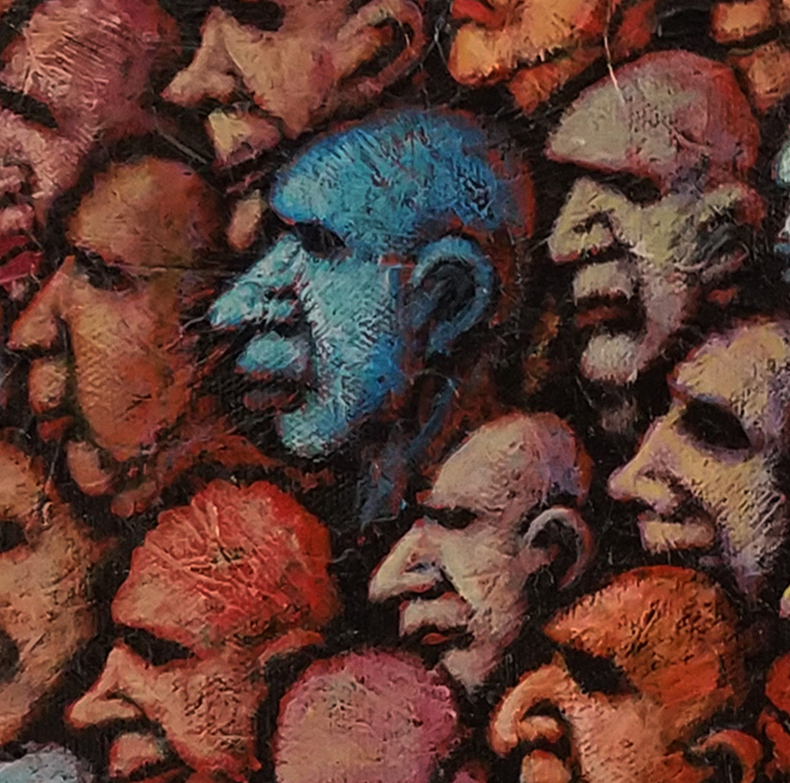
Each has been a group of faces that is done in quick strokes from a single brush, starting from one point and filling the canvas. It is unplanned in almost every way. No color plan. No theme. Just intuitively and roughly formed faces that stem from a lifelong collection of faces that have been stacked in my head, culled from looking intently at clouds, woodgrains and patterns of all sorts through the many decades. Seeing them spill out in this way has been energizing in a way that I know from experience will spill over into the rest of my work even if this particular work remains for me privately.

I haven’t been thrilled with how the camera is catching the images thus far. They have been quick photos that don’t fully capture much of the subtlety in the closer parts of the painting. So when the musical selection came up this morning, this section of one of the paintings jumped out at me. I thought showing it in detail would better show how I am seeing the work.

The song selection is the jazz standard Born to Be Blue, written by Mel Torme in 1946. It’s been performed by scores of singers over the years but it became a signature piece for the late Chet Baker.which is the version I am sharing below. In fact, a 2015 film biography of his life starring Ethan Hawke as Baker uses the song title as the film’s title. This version highlights his vocals rather than his horn work and features great piano playing from Bobby Scott.

Hearing it made me think of a blue face that I consider a central character in one of these pieces. At least my eye always lands on him first before roaming across the rest of the picture. The image at the top is a detail featuring him and shows better some of the surface and textures that compose the painting.

That being said, I am eager to get back to work on a new piece in this same style. Enjoy the song and have a great Sunday.

Read Full Post »

Max Beckmann- The Actors 1941

*****************************

What I want to show in my work is the idea which hides itself behind so-called reality. I am seeking for the bridge which leans from the visible to the invisible through reality. It may sound paradoxical, but it is in fact reality which forms the mystery of our existence.

–Max Beckmann

*****************************

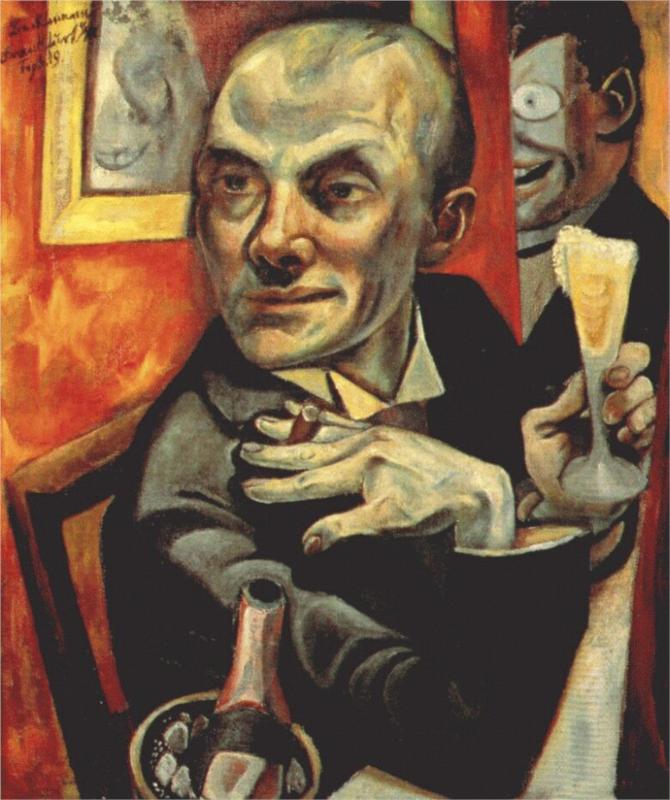
For some reason, the work of Max Beckmann has never found its way to this blog. I have had an affinity with his work for many years. Part of that no doubt comes from the black linework that is present in much of his work as a result of his beginning his paintings on a black painted surface, which is something very familiar to my own process. This allowed his colors to expand off the surface, again something with which I can associate. This made his colors feel brighter and bolder, giving his work a look that separated itself from the bulk of other artists in the German Expressionist movement with which he is most often associated.

Max Beckmann- Self Portrait with Champagne Glass 1919

Beckmann was born in Leipzig, Germany in 1884 and from an early age showed a talent for painting. His first self portrait was painted at the age of 14. His self portraiture was an important aspect of his work as he painted at least 85 versions over the course of his life. Perhaps only Picasso and Rembrandt have documented themselves more.

Beckmann served as a medic during the First World War and the chaos and violence he experienced served to inspire his work for coming decade of the 1920’s. Working in Berlin in post-war Weimar Germany, Beckmann became a star, his work darkly documenting the existential doom that seems to mark Berlin of that time. But with the rise of Hitler, Beckmann’s light faded in Germany. He was a major target for Hitler’s wrath toward what he termed Degenerate Art and fled to Amsterdam in 1937. There, he desperately (and unsuccessfully) tried a number of times to get a visa to the USA.

But he survived the war and in 1948 emigrated to the USA. Over the course of the next three years, he taught painting at Washington University in St. Louis and the Brooklyn Museum. He died from a heart attack days after Christmas in 1950 on a Manhattan street corner as he was on his way to see one of his paintings at the Metropolitan Museum.

As I said, I have always felt drawn to his work. His words speak equally as powerfully to me. He often writes of his attempts to decipher the mystery of existence that is present in the mundane. I think I can understand that.

Hope you can take some time to look over his work a bit more.

Max Beckmann- Family Picture 1920

Max Beckmann- Still Life with Three Skulls 1945

Max Beckmann- Self Portrait with Trumpet 1938

Max Beckmann- The Night 1918-1919

Max Beckmann- The King 1938

Max Beckmann- Paris Society 1931

Max Beckmann- Before the Masked Ball 1922

Read Full Post »

********************************

“The sun –the bright sun, that brings back, not light alone, but new life, and hope, and freshness to man–burst upon the crowded city in clear and radiant glory. Through costly-coloured glass and paper-mended window, through cathedral dome and rotten crevice, it shed its equal ray.”

― Charles Dickens, Oliver Twist

********************************

I guess it’s wishful thinking to be discussing a painting based on light and warmth on a day when we are just beginning to feel the brunt of the bitter cold that has swept down from the polar regions. It’s below 0° right now and it won’t get much above that for the next few days around here. Brrr! So the hope contained in a rising sun and the light and heat from it becomes something to really think about.

The painting above is a new one, a 24″ by 24″ canvas, that I am calling Reaching For The Light. The jumble of upward rising buildings has a new addition to go with the regular roofs and spires–chimneys. This new element gives the effect of an appendage reaching upward from each building to get to the sunlight.

I like that feeling that it gives.

I thought the descriptive snip above from Dickens’ Oliver Twist fit this painting. I often have images based on Dickens’ vivid descriptions of cityscapes from Victorian England in mind when I am working on these type of paintings that are cramped and crowded with buildings. His words created an imagery that stuck firmly in my mind from when I first read them so many years ago.

It was a place of darkness, soot, and shadows. The idea of the sun cutting through the grayness with its cleansing light and warmth is one of hope, one of moving to a better situation beyond the squalor and despair of the moment.

That’s how I am seeing this painting with the Red Tree serving as the symbolic central figure acting out this idea of grasping for the light.

So, on this coldly bitter day, I have to find hope in the same sun that we have come to fear as the ever increasing effects of global climate change become apparent.

Stay warm, folks.

Read Full Post »

Been working on a few new small pieces for the upcoming Little Gems show at the West End Gallery, which opens February 8. As I’ve noted here before, the annual Little Gems show has special meaning for me. It was the first show in which I ever participated and served as a springboard to a career as an artist that I never anticipated. Without that first show, I have no idea what I might otherwise be doing at this time. Pretty sure it wouldn’t be writing this blog.

I usually try out some new things for this show or at least try to show some small oddities, pieces with themes or looks that may not find their way into my regular visual vocabulary. Such is the piece at the top, a 6″ by 6″ painting on panel that is called Midnight Rider, based on and using the lyrics from the classic Allman Brothers song from 1970. Little piece of trivia: This was the A side of a single with another classic, Whipping Post, as the B side.

I really enjoy working on these sort of pieces. It’s a different mindset from my normal painting and it has the effect of cleansing the palate. Or maybe it’s palette in this case. These pieces have been fun and freeing. How they fit into my regular body of work, I can’t say. Guess it doesn’t really matter because even though I will show these pieces, they are actually done mainly for myself.

For this Sunday morning music, the song is–surprise,surprise!- Midnight Rider. I am showing two versions. The first is from the late Sharon Jones and her Dap-Kings. It was produced for a Lincoln Mercury ad but that doesn’t take away from the strength of the performance. The second is from a performance from the also now-deceased Gregg Allman on the Cher variety TV show in 1975. It features a vintage dance performance from Cher, the kind of thing that was a regularly seen on the variety shows of that time. You don’t see much of this kind of stuff anymore– maybe for good reason. But it’s fun, in a weird kind of way.

Take a look and enjoy your Sunday.

***************

Read Full Post »

Ben Shahn

Ben Shahn -Jersey Homesteads (Roosevelt NJ) Mural

********************

The artist must operate on the assumption that the public consists in the highest order of individual; that he is civilized, cultured, and highly sensitive both to emotional and intellectual contexts. And while the whole public most certainly does not consist in that sort of individual, still the tendency of art is to create such a public – to lift the level of perceptivity, to increase and enrich the average individual’s store of values… I believe that it is in a certain devotion to concepts of truth that we discover values.

–Ben Shahn

********************

Born in Lithuania in 1898, Ben Shahn emigrated to America with his family in 1906. Throughout his career, up until his death in 1969, Shahn’s early training as a lithographer and graphic designer played a large part in his work, giving it a symbolic visual impact that made him one of he leading lights of social realist artists. His work often dealt with the human condition, particularly that of the common man.

Ben Shahn- The Passion of Sacco and Vanzetti

While many of the themes in his work were labeled as leftist, his work championed civil rights and workers’ rights and stood against injustice and prejudice. He did a large series of works devoted to Sacco and Vanzetti. Designed to communicate a distinctly human point of view, his work always had a profound voice, one that called for the betterment of all people.

His was the work of the Everyman.

As he said: The natural reaction of the artist will be strongly towards bringing man back into focus as the center of importance.

I think that is a very important thing to keep in mind as is the quote at the top of the post, about how an artist must aspire to the highest human values of the public, even though they may not actually possess these qualities, with the hope that the artist’s work can lift them to a higher level. It’s a thought that should linger in the mind of any artist who hopes and desires to make a true difference in this world with their work.

I am not giving a lot of details here about the life and career of Shahn. But I hope the few that I have shared along with some of his images will inspire you to take a closer look at this interesting and important voice in modern art.

Ben Shahn- Father and Child 1946

Ben Shahn- The Burial Society

Ben Shahn- Nocturne

Ben Shahn- Four Piece Orchestra 1944

Ben Shahn- Self Portrait Among Churchgoers

Ben Shahn- Two Witnesses

Ben Shahn- Unemployment


Read Full Post »

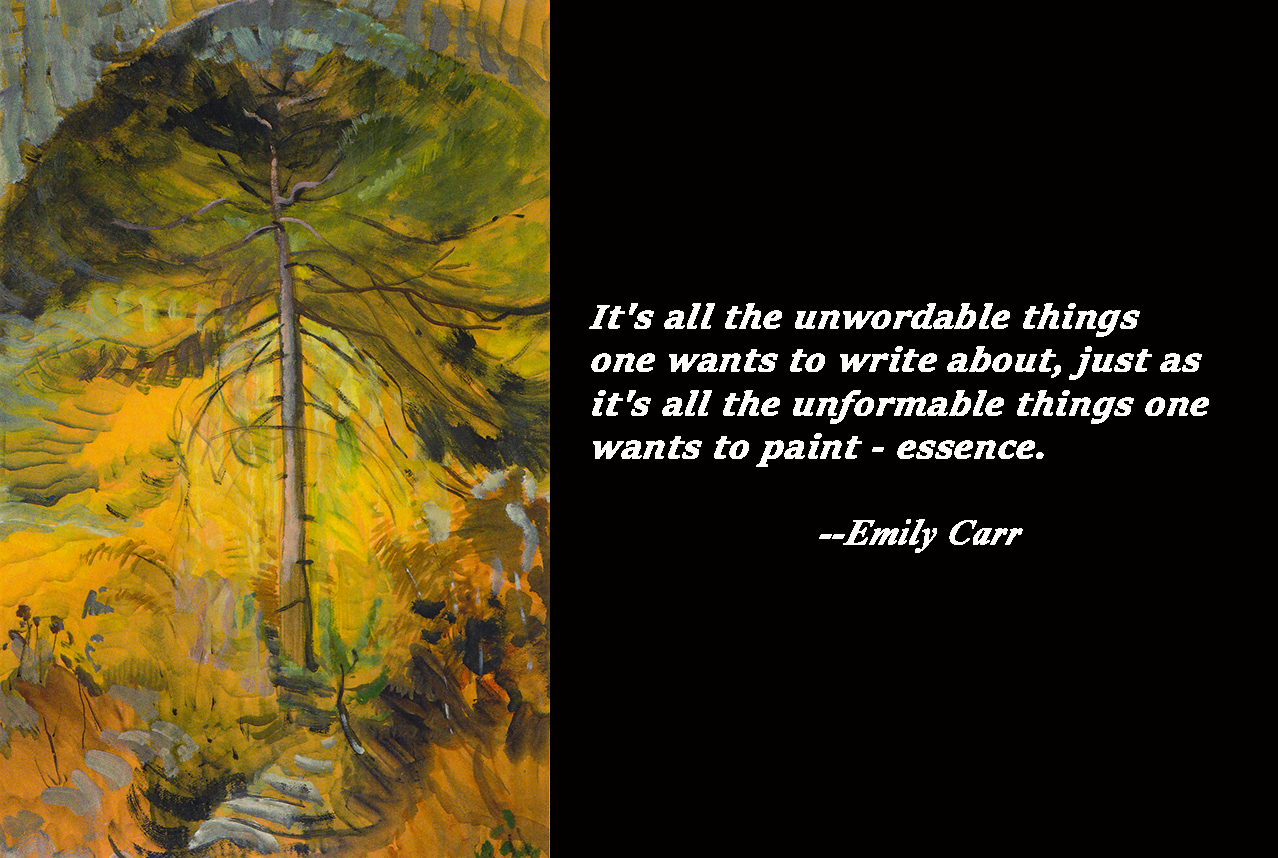
When I read the line above taken from the journal of the great Canadian artist Emily Carr (1871-1945), it really hit close to the bone for me. I thought about my early forays in my youth when I believed I wanted to be a writer.

I loved the words and their power, their ability to create emotion and reaction in the mind of the reader. But I cared little about creating narrative, about the details, the nuts and bolts, involved in storytelling. It was the essence of things that interested me, the atmospheres of silence and distance and empty space.

It was all too heady for an uneducated and inexperienced kid. I didn’t know what to do with writing that evolved into what seemed to be ethereal nothingness. More and more, it became a frustrating exercise.

And I think that is where painting came in for me, at a time when I truly needed it. I found that painting, especially landscape painting, was less about narrative and more about that essence, about capturing moments of atmosphere and perceived emotion and spirit.

The unwordable and the unformable, as Emily Carr put it.

I definitely see this evocation of essence in the work of Emily Carr and can only hope to find the same in my own.


Read Full Post »

**********************

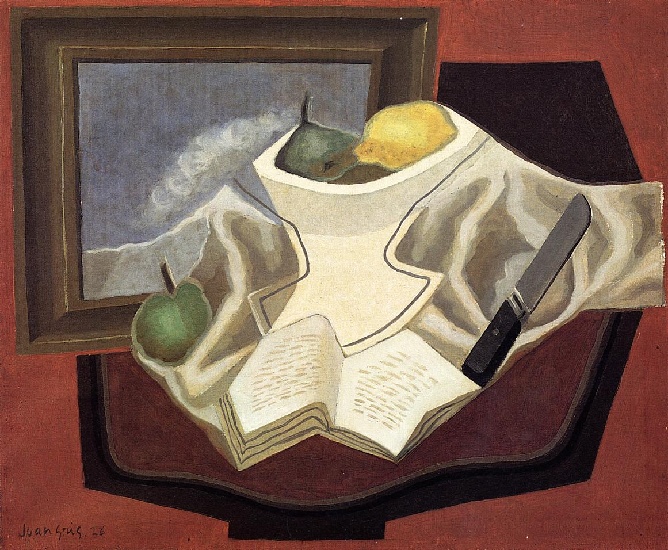
Painting for me is like a fabric, all of a piece and uniform, with one set of threads as the representational, esthetic element, and the cross-threads as the technical, architectural, or abstract element. These threads are interdependent and complementary, and if one set is lacking the fabric does not exist. A picture with no representational purpose is to my mind always an incomplete technical exercise, for the only purpose of any picture is to achieve representation.

–Juan Gris

**********************

I like this idea of painting being a fabric with a weft and a warp of elements that bring the representation to its full realization. It’s this idea that allows for such differing versions of the same image. One set of threads bring the recognizable form while the other allows for the individual artistic interpretation. Some fabrics are richer and some are coarser. Some are stronger and some are weaker.

I may not be explaining it very well but I understand it.

This comes from the great Cubist painter Juan Gris, who was born in Spain in 1887 and died in France in 1927, leaving behind a consistently wonderful  body of work. He is thought of as one of the most important of the Cubists, perhaps only eclipsed by Picasso and Braque.

Since he died at such a relatively young age– 40 years old– it makes one wonder how his work would have evolved in the later years of maturity that he never obtained. As it is, there is a lot to see in his work.

His most famous piece, Still Life with Checked Tablecloth from 1915, is at the top of this page. It sold at auction in 2014 for $57.1 million and is in the collection of the Metropolitan Museum. You can click here and go their Met Collects site to get a closer look at the painting. Being able to look closely at the surfaces is very illuminating to me. Take a look for yourself.

Read Full Post »

Kay WalkingStick- New Mexico Desert 2011

**********************

Avoid methodology. If what you’re doing is about technique, that’s not art.

–Kay WalkingStick

**********************

Very much agree with this quote from contemporary landscape painter Kay WalkingStick. Soon to be 84 years old, Kay WalkingStick is a member of the Cherokee Nation who was raised in Syracuse and was an art professor at nearby Cornell University for a number of years. She incorporates Native American symbols and patterns in her work, which are often executed in diptych forms.

Even though there has been a physical proximity. I don’t know a lot about her work. I would love to see it up close to examine the surfaces, to see how the pieces speak in person.

Her advice about not tying yourself solely to process is a most valuable lesson for all artists. I think you need to live in the fringes of technique, always ready to stray into territory of material use that is new to you as an artist. You need to feel a bit lost so that you react intuitively, using what little you do know in new ways.

That is where the magic sometimes happens, where art takes place.

Read Full Post »

*************************

My originality consists in putting the logic of the visible to the service of the invisible.

Odilon Redon

*************************

This is a bit of a continuation of yesterday’s post where Magritte spoke of poetry and mystery in his work. The above quote from Odilon Redon (1840-1916) describes very much that same sentiment.

A work of art should have a sense of logic to it even if it might go against all that we know of the natural world. This created logic allows us to accept what we see before us, permits us to fully absorb the poetry and mystery–the invisible elements to which Redon alludes–without question.

This acceptance allows us to move beyond the visible, allows us to perceive our reality in a different manner, perhaps in an enhanced way.

As a viewer, I know the works of art that move me most of all fall into this category. They may not seem unusual at first look. Their subject might even seem mundane. They seem outwardly logical but there is something that moves them into that area of mystery and poetry, that gives them an sense of the indefinable.

As an artist, it is something you hope to achieve but don’t really know how to explain how you do it because you don’t really know for sure. It sometimes either happens or it doesn’t.

And that is its own mystery.

It’s a mystery that keeps the artist wanting to always move ahead with the hope that it will all someday be revealed.

Will it one day be revealed? Who knows? It’s a mystery.


Read Full Post »

************************

People who look for symbolic meaning fail to grasp the inherent poetry and mystery of the images.

Rene Magritte

************************

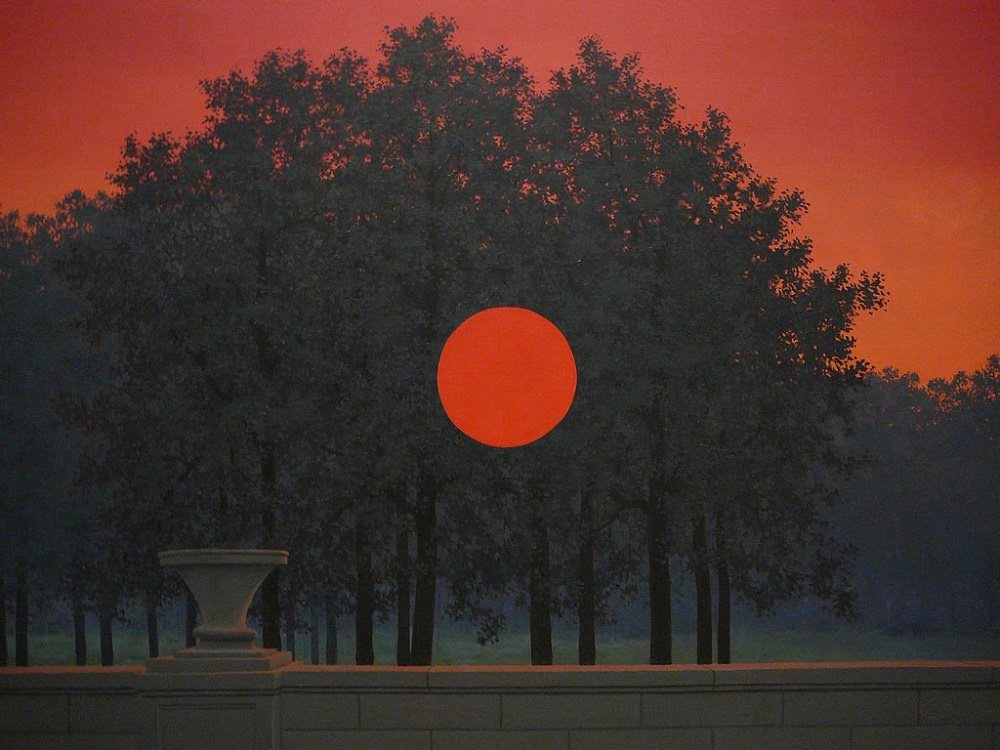
I absolutely love this painting, The Banquet, from Rene Magritte in 1958. It has the effect where I don’t question anything about it. I just accept it as it is presented. I am not looking for symbolism in it at all, not looking for a reason why the red ball of sun is hovering low in front of the trees. The colors, the contrast, the composition– they create a whole sensation doesn’t need a why or what or how.

As Magritte points out, it contains poetry and mystery.

And that is something to try to understand. I know I often feel the need to try to explain my work, to point out where I find an emotional base in a piece. Sometimes that is easy, almost jumping out at you. But sometimes it is not so obvious and it is simply the mystery of the created feel, a great intangible pulse, that makes a particular painting work.

You see it, feel it, accept its reality yet you don’t fully understand the why and how.

And maybe that is just as it should be. Not all we behold can or should be explained. Sometimes, maybe we simply need to experience poetry and mystery.

Read Full Post »

« Newer Posts - Older Posts »