Feeds:
Posts
Comments

Archive for the ‘Painting’ Category

A blog post that ran here a couple of years back with some advice from poet e e cummings is consistently one of my most popular, always getting a number of hits. For example, there was quite a pop in its numbers yesterday. I don’t know what brought it on but it made me want to revisit the post. Reading it again made me appreciate even more the words. Even though it was aimed at potential poets it rang equally true for me as a painter, especially when I substituted the word painter for poet, paint for words, and painting for poetry.

I thought I’d replay it today doing just that. Where there is a word like [thiswith brackets, I have substituted an equivalent word. And if you’re not a painter, feel free to use any word that describes what it is you do to express yourself.

I think you might find it inspiring.

+++++++++++++++++

Whenever I am asked to speak with students I usually tell them to try to find their own voice, to try to find that thing that expresses who they really are. I normally add that this is not something that comes easily, that it takes real effort and sacrifice. It is a never-ending struggle.

The great poet e e cummings (you most likely know him for his unusual punctuation) offered up a beautiful piece of similar advice for aspiring poets that I think can be applied to most any discipline.

Or to anyone who simply desires to feel deeply in this world.

I particularly like the line: To be nobody-but-yourself in a world which is doing its best, night and day, to make you everybody else-means to fight the hardest battle which any human being can fight; and never stop fighting. That line alone speaks volumes.

Take a moment to read this short bit of advice and see what you think– or feel.

*******************

A [Painter’s] Advice To Students

Borrowed from (e e cummings)

A [painter] is somebody who feels, and who expresses his feeling through [paint].

This may sound easy. It isn’t.

A lot of people think or believe or know they feel-but that’s thinking or believing or knowing; not feeling. And [painting] is feeling-not knowing or believing or thinking.

Almost anybody can learn to think or believe or know, but not a single human being can be taught to feel. Why? Because whenever you think or you believe or you know, you’re a lot of other people: but the moment you feel, you’re nobody-but-yourself.

To be nobody-but-yourself in a world which is doing its best, night and day, to make you everybody else-means to fight the hardest battle which any human being can fight; and never stop fighting.

As for expressing nobody-but-yourself in [paint], that means working just a little harder than anybody who isn’t a [painter] can possibly imagine. Why? Because nothing is quite as easy as using [paint] like somebody else. We all of us do exactly this nearly all of the time-and whenever we do it, we’re not [painters].

If, at the end of your first ten or fifteen years of fighting and working and feeling, you find you’ve [painted one part of one real painting], you’ll be very lucky indeed.

And so my advice to all young people who wish to become [painters] is: do something easy, like learning how to blow up the world-unless you’re not only willing, but glad, to feel and work and fight till you die.

Does this sound dismal? It isn’t.

It’s the most wonderful life on earth.

Or so I feel.

Read Full Post »

**********************************

“The world concerns me only in so far as I owe it a certain debt and duty, so to speak, because I have walked this earth for 30 years, and out of gratitude would like to leave some memento in the form of drawings and paintings—not made to please this school or that, but to express a genuine human feeling.”

Vincent van Gogh, The Letters of Vincent van Gogh

**********************************

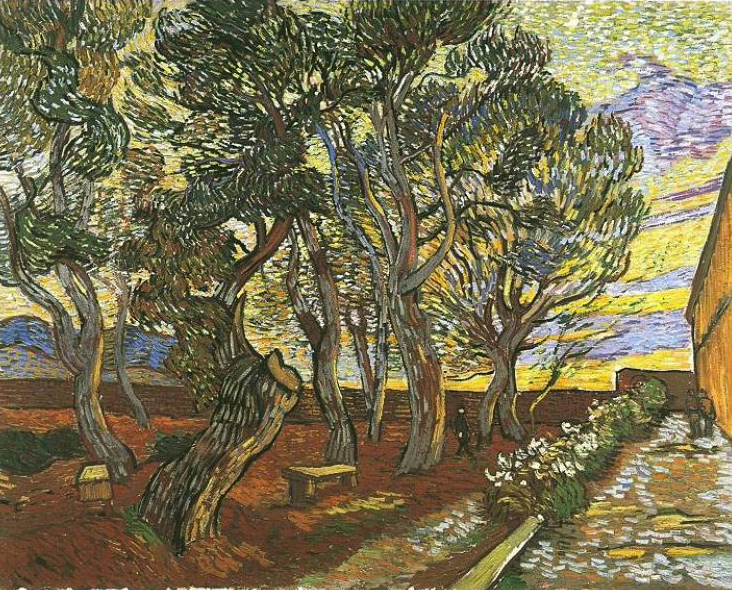
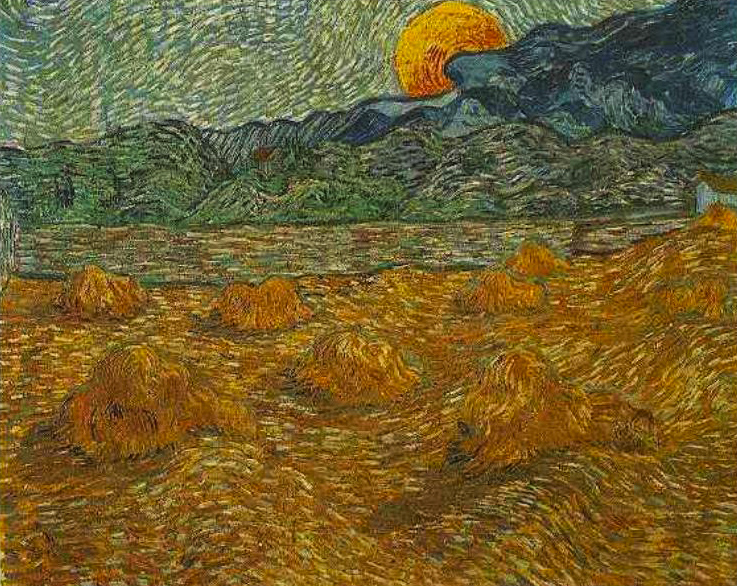
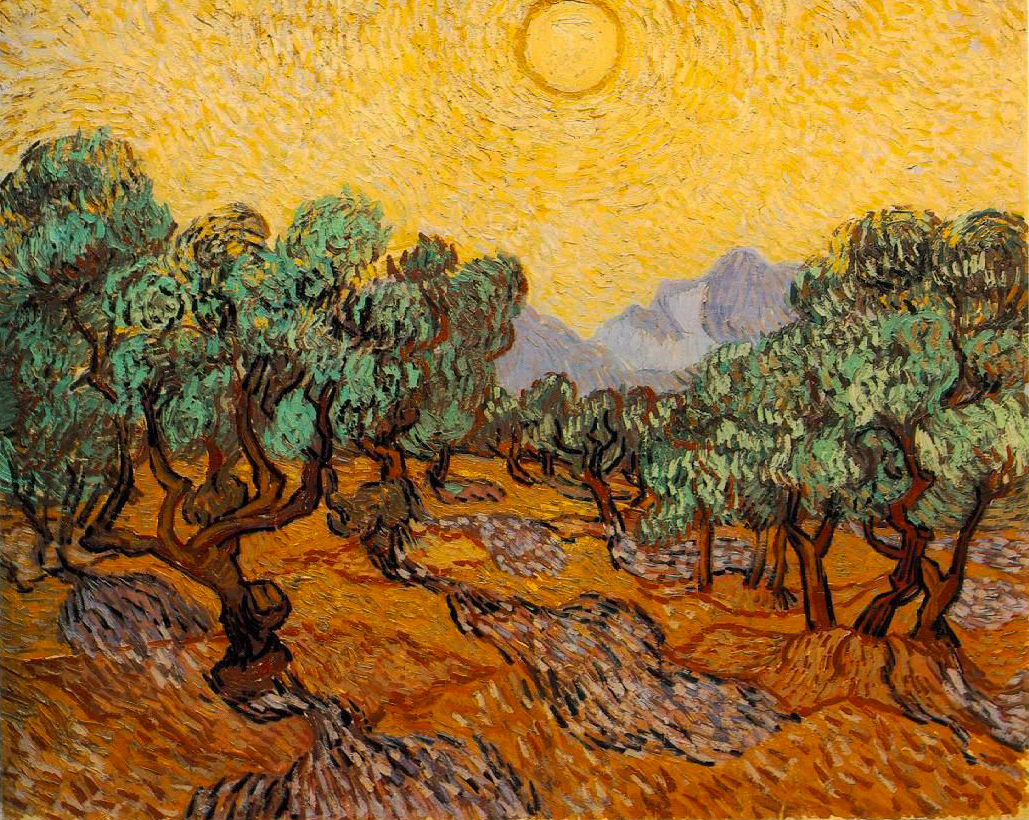
Thought a good way to kick off this week might be to share a few paintings from Vincent van Gogh along with a quote from one of his letters that speaks very much to my own feelings about my own reasons for doing what I do. These are not his better known paintings, though some of you may well know these pieces. They’re pieces that speak to my own personal inclinations. You might notice that most of these paintings have his ball sun/moon.

The idea of feeling a need to leave a memento behind that expresses one’s gratitude and one’s expression of self is one that is not foreign to me. I often think about how my work will speak for me after I am gone. Actually, if it will speak into the future at all and if so, will it be an honest reflection, a true representation of my voice.

I know that an artist, for all of the ways they try to guide the narrative about their work and life, have little control on the future.

What will be, will be.

Their voice might echo but it is always just that, an echo, a one-sided conversation from the past. Hopefully, what is said in that echo reverberates and speaks to someone of that future time so that they can fully understand and connect to the feeling behind it. And if so, with the hope that they might respond to that voice in some small way that continues to give life to it.

As I said, an artist has little control over this outside of doing their work with honest efforts and emotions. It’s obvious this was the case in the work of van Gogh and we continue to have a conversation with his echoes from the past, his mementos of gratitude.

Read Full Post »

***************************

To have a sacred place is an absolute necessity for anybody today. You must have a room or a certain hour of the day or so, where you do not know who your friends are, you don’t know what you owe anybody or what they owe you. This is a place where you can simply experience and bring forth what you are and what you might be.

–Joseph Campbell

***************************

I was thinking about my studio and how it shapes the work I do. It’s size sets some limitations on how large I can work and I sometimes wish I had twenty foot ceilings where I could do massive canvasses. But that mild complaint does little to take away from how wonderful a space it has been in which to work on a daily basis.

It is comfortable and warm with views that look out on a very private yard with mature trees, several huge rhododendrons and a constant parade of wildlife. It has room to work with a large, well appointed basement for framing and prepping my surfaces. One of the three bedrooms serves as a library and the other two hold paintings and papers. The stone fireplace that I face most of each day in my main space gives me an elemental, grounded feeling and the light that streams muted by the trees provides a coolness to play off the warmth of the space.

The seclusion it offers is all I could ask for. My large front window looks out on the driveway that curves gently in and whenever I see anyone coming in, it almost feels like an affront, like an invasion into my private world. A private world that is an extension of the internal one that provides the landscapes I paint. My studio complements that inner world so well, creating a sacred space for me to hopefully bring forth what I am and what I might be, as Joseph Campbell points out in the quote at the top.

It might be the one place on this earth where I feel completely at ease. Not always, but most of the time.

I thought I’d share a shot today of the studio, my sacred space, in all its cluttered glory. It has come to reflect me and I, it.

Read Full Post »

**********************

The real voyage of discovery consists not in seeking new landscapes, but in having new eyes.

Marcel Proust

**********************

This painting is titled To the Fields of Fortune. It’s one of those pieces that I to which I personally respond strongly. Maybe it’s the mood I feel from it or simply a chemical reaction to the juxtaposition of colors, forms and contrasts. Who really knows what truly causes a visceral reaction to art or music?

But the meaning that I attach to this painting has some influence on my reaction. I call these type of paintings my Acres of Diamonds pieces alluding to a story that I have replayed here a few times over the years. It is basically a tale of a farmer who sells his land and heads out, seeking to find his fortune in diamonds. He travels all over for years in his fuitle search, failing at each attempt until he ultimately takes his own life. Meanwhile, his original homestead turned out to be the location of the biggest diamond mine in Africa, where this story takes place.

What he sought was right beneath him all the time, if only he had taken the time to see what he had at hand.

And isn’t that too often the case with many of us? We believe that the grass is always greener elsewhere, making us think we need to seek far and wide when what we really need is with us, sometimes within us, all the time. As the author Marcel Proust states above, the real voyage of discovery comes in having new eyes to see what is already all around us.

There are diamonds waiting for us to simply bend down and pick them up, if only our eyes will see.

****************

This piece, along with a few other newer paintings, will be headed to the West End Gallery within the next few days.

Read Full Post »

*********************

What was Avery’s repertoire? His living room, Central Park, his wife Sally, his daughter March, the beaches and mountains where they summered; cows, fish heads, the flight of birds; his friends and whatever world strayed through his studio: a domestic, unheroic cast. But from these there have been fashioned great canvases, that far from the casual and transitory implications of the subjects, have always a gripping lyricism, and often achieve the permanence and monumentality of Egypt.

Mark Rothko, 1965

*********************

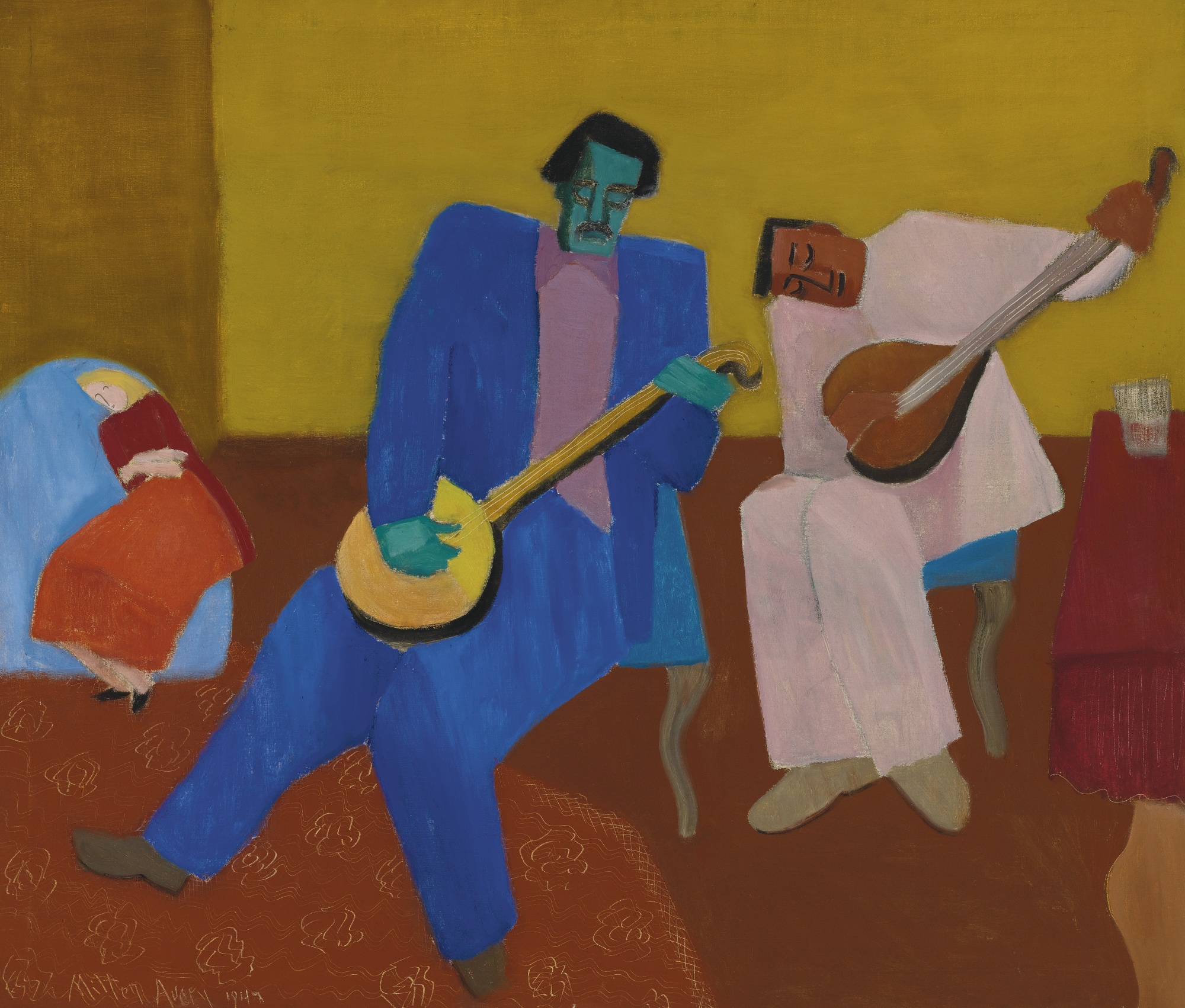
While not a huge fan of the paintings of Milton Avery upon my first encounters with it, I find myself respecting and appreciating his work the more I look at and read about it.

Born in 1885, Avery worked blue-collar jobs into his thirties. He felt a desire to paint and began taking classes while still toiling as a laborer, working in obscurity for many years. He moved from pure representation of his subjects to an abstracted representation built on blocks of color and a flattening of the picture plane that became his signature style. His work eventually was recognized by a wealthy collector who set out to make it better known by distributing it among various American museums.

It worked and Avery became a leading light of the early abstract movement with his abstracted takes on representation and was considered a master colorist, sometimes referred to as the American Matisse. He died in 1965 at the age of 80.

I find that there are commonalities between us that give me a better sense of his work. First, there is his late entry in the world of art and a prior existence as a blue-collar worker. I certainly can relate to that.

Then there is his use of blocks of color, especially colors that seem radical for the subject. Looking at his work, I can easily relate to how he composed his paintings, how each block of color relates to those around it.

I also like the fact that Mark Rothko pointed out the lyricism of his work which refers to the fact that his painting, even when the subject matter seems most mundane, has high emotional notes that give it great weight beyond the subject matter. That lyric quality is something I desire in my own work.

I also like some of the writings from Avery especially one quote that rings true for me:

I try to construct a picture in which shapes, spaces, colors, form a set of unique relationships, independent of any subject matter. At the same time I try to capture and translate the excitement and emotion aroused in me by the impact with the original idea.

That is exactly what I trying to do– trying to capture the excitement and emotion aroused in me— each day in the studio. I think I often use those very words when talking about my work practices.

So, these common bonds allow me me to see Avery’s work in a better light. I find myself liking the consistency of his work, how he confidently used his native voice to express himself.

Respect is now there.

Read Full Post »

I’ve got several things on my plate this morning so time is short. Thought I’d rerun the post below because it describes a bit the dark to light process I often use. I also liked this simple painting but, as I write below, I wasn’t sure about it at the time, wasn’t sure it would translate well to others. Time has passed and I still find myself liking this painting. Plus, it quickly found a new home so someone saw something similar in it. Give a look and have a great day.

**************************

***********************

“A painter should begin every canvas with a wash of black, because all things in nature are dark except where exposed by the light.”   

-Leonardo Da Vinci

***********************

I’ve been working on a number of pieces lately that start on a black base of paint, rising from the darkness as each subsequent layer adds more and more light. I still think of this additive process as being a form of sculpture, one that starts with a flat surface and builds out in contours that give it definition and texture. Each layer of paint is like adding clay to the supporting armature of the sculpture. It’s a process that is hard to pull away from when I immerse myself in it. There’s something about seeing the colors grow more and more vibrant on the surface that becomes mesmerizing. I guess that’s why I often refer to this work as obsessionism.

This small experiment, a 10″ by 12″ piece on paper, is in this vein. It’s one of those pieces that I’m just not sure about because I like it but I’m not sure if I like it for what it actually is or for the experience, the obsession of the moment in painting it.

Or because it is simply from my own hands, part of myself. Like a parent looking at something their child has done and wondering if they like it because it is truly good or simply because it was done by their child, their flesh and blood.

Sometimes I can finish a piece and it instantly stands apart and on its own, complete and independent. Ready to move on like a young person proclaiming their emancipation from their parents. Other times, there are pieces that cling closer to me, perhaps too attached to yet stand on their own, at least in my eyes. Because I am unsure, I become more protective of these pieces because they do feel more personal, more of me.

It’s a hard thing to describe, this uncertainty in a piece, especially when it feels objectively right. Can a parent ever fully take out their own subjective view of their offspring and see them objectively as they really are?

Read Full Post »

+++++++++++++++++++

“Living right in the heart of Tokyo itself is quite like living in the mountains – in the midst of so many people, one hardly sees anyone.”

― Yūko Tsushima, Of Dogs and Walls

++++++++++++++++++++

This is a new painting, a 24″ by 24″ canvas, that was inspired in part by the older painting I showed here last week, Raise Your Eyes.  Unlike my normal Red Roof structures which have a closed off feel without doors or windows, these cityscapes are all doors and windows.

All eyes, ears, and mouths.

But as the late, esteemed Japanese writer Yuko Tsushima described in the words above, even with the presence of so many buildings filled with so many people, there is often a sense of anonymity. Perhaps it is the scale of the buildings which sometimes seem like looming mountains that overshadow anything beneath them. Or maybe it is the sheer number of people, so many that the faces and shapes blend into an amorphous blur in passing.

I’m not sure exactly what it is that gives this sense of anonymity but I find the paradox in it fascinating. Maybe that’s one reason why I enjoy painting these pieces so much. The main reason I believe is in the focus required in putting these together. Starting at the bottom of the canvas with no predetermined endpoint in mind, the picture rises slowly with each new structure leading to the next, all the while trying to ascertain how each new move changes the weight and feel of the whole.

Every stroke is a solution to one problem and the beginning of the next.

For me, the result is kind of like looking inside my head. It resembles a jumble, sometimes sloppy and tangled. But somehow, through the mess, it is always trying to create a sense of wholeness, of rightness.

Trying to find order in chaos.

Sometimes, I find it. Sometimes, I don’t.

I am still not sure this painting is finished. I am calling it for time being Around the Clock but for a time had considered calling it Witnesses or Hit and Run. I saw it with a body on the pavement of the intersection at the bottom right of the piece. and maybe a silhouette or two in the windows that look out on it. But I am not sure that I want to add that narrative thread, not sure that I want to change what I am looking at now in that manner.

So, I will dwell on it for a bit before I do anything. Or don’t.

We shall see…

Read Full Post »

I have been looking at this painting quite a bit lately. It’s from back in 2010 and is titled Raise Your Eyes. Featured in my 2012 exhibit at the Fenimore Art Museum, it’s a piece that I find myself coming back to examine quite often.

It’s different in many ways from the larger body of my work. For one thing, there are plenty of windows and doors, things I seldom use in my regular work where I prefer the blank  anonymity of windowless and doorless houses. This painting is all detail, even though its not extremely fine detail.

In some ways it reminds me of my Archaeology series, mainly because there is so many small touches to examine beyond the greater whole. I think that’s why I come back to this painting so often. Every new look reveals something I haven’t noticed since I first painted it. There are so many individual decisions here that dictate how the painting comes together, how it reads and expresses itself. Each window and door, each ledge and building top is a decision. Looking at them closer makes me appreciate the thought process behind it.

I mention  this painting today because I am working on a new piece that is based loosely on it. At least, it goes back to the process behind it and fills the canvas with thousands of small but vital decisions. It’s been exciting to revisit and I like what I have so far. Keep an eye out for it in the near future.

I also thought it might be a good painting to remind you to support your local small businesses on this Small Business Saturday. Every artist and every gallery owner is a small businessperson that rolls much of their income back into their respective local economies. Your patronage of artists and galleries. as well as so many other small local businesses, is vital to your local community.

I know that I can’t do this, can’t maintain a career as an artist without your support. And I am deeply grateful for that support and hope you’ll continue to patronize the galleries that show my or anybody else’s work.

Art is more than decoration, more than a product. It is an expression of humanity and a message that, in its best form, communicates through time. It is who we are.

And that is worth supporting.

Read Full Post »

+++++++++++++

The purpose of my work was never to destroy but always to create, to construct bridges, because we must live in the hope that humankind will draw together and that the better we understand each other the easier this will become.

Alphonse Mucha

+++++++++++++

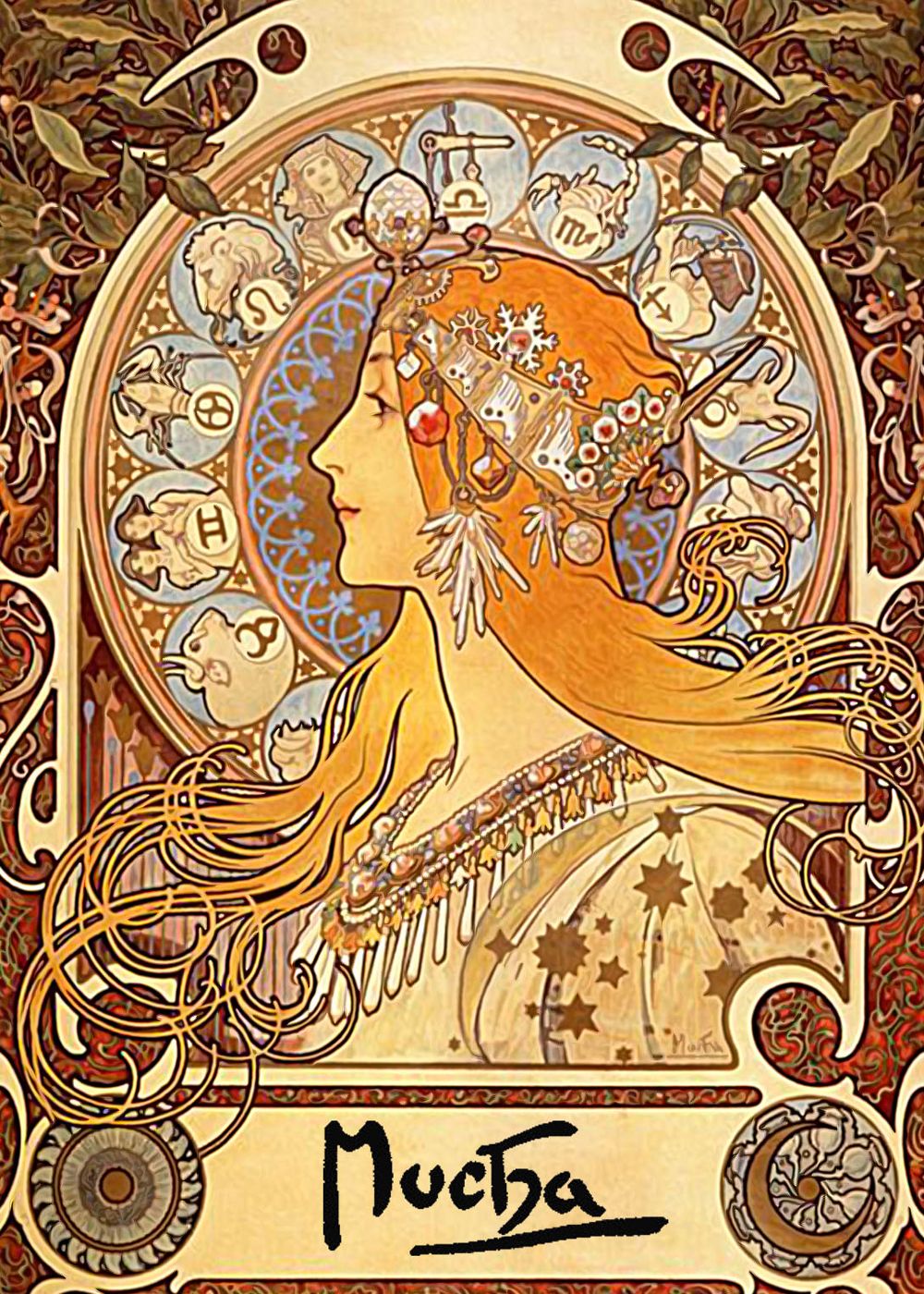
You most likely know the work of Czech painter Alphonse Mucha (1860-1939) for his extremely popular posters that set the style for and were the epitome of the Art Nouveau movement. It was beautiful and graceful work much like the piece shown here on the right.

That was definitely the extent of my knowledge about Mucha’s work. And that alone would be a worthy enough achievement for most artists. But his greatest work may well be his monumental Slav Epic series.

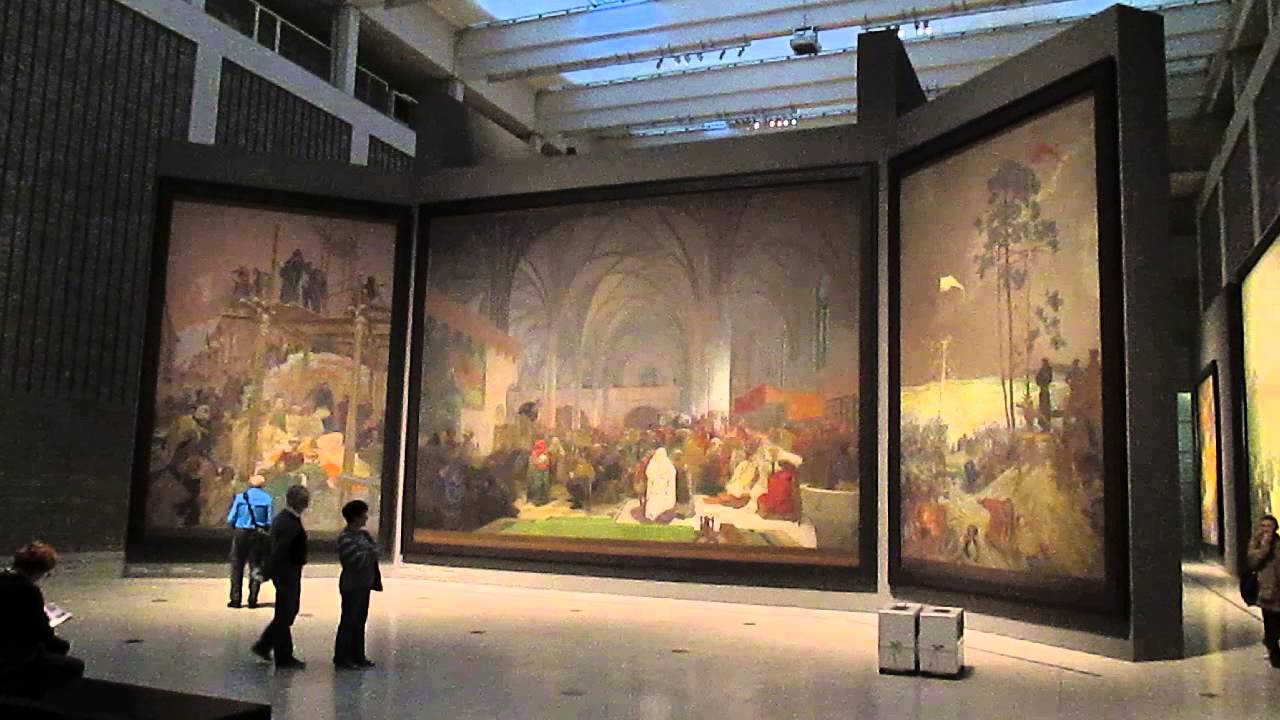
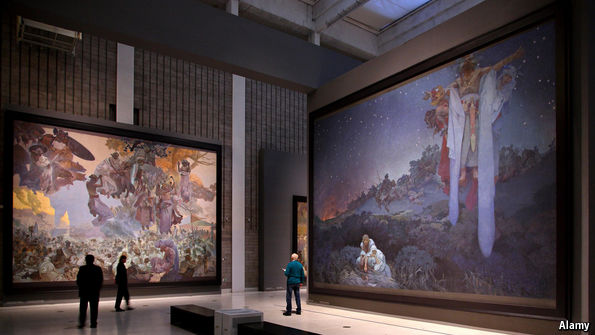
The Slav Epic is comprised of 20 large works that depict the history and the mythology of the Slavic people. It was painted over the course of 16 years with the aid of financial support of American industrialist/philanthropist Charles Crane. The works are all painted on a grand scale with some of them measuring 20 feet in height and 25 feet in width.

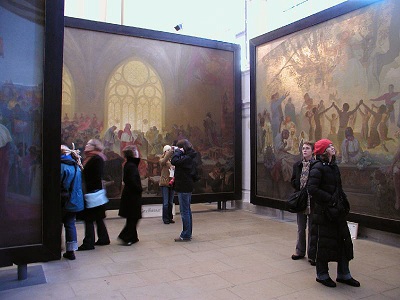
They somehow survived Czech occupations by both Nazis and Soviets who both saw the work as being counter to their ideologies. Mucha died soon after being interviewed by the Gestapo in 1939. The paintings are now in possession of the Czech government who are in the process of creating a museum to permanently display this magnificent work. I am sharing a number of images below that show them with viewers so as to give  an idea of the sheer scale of the works.

Pretty amazing. Good reason to get to Prague.

Alphonse Mucha- Slavs in Original Homeland

Read Full Post »

I have a new painting in a show that opens this Friday, November 16, at the the West End Gallery. The name of the show is “Masterpieces: A Collection of Kick*** Artwork” and it focuses on the process of the artist behind each piece. There are photos, studies and writings that document how each piece came to be.

From the work I have seen from the show thus far, it lives up to its name.

My contribution to the show is  48″ high by 24″ wide painting on canvas that I am calling And the Glimmer Comes... It is shown here on the right.

I decided for this show to do the painting for this show using studies and drawings, something I almost never use.

Normally, I start with a surface that is prepared with multiple layers of gesso and, more often than not recently, a top layer of black paint. Then I just begin with a block of color, usually the red oxide that I use for composing my underpainting and usually in the lower half of the composition.

Then I let the painting grow organically, the first block of color guiding me to the second and the second to the third and so on. After the piece is fully composed this way, I build out the colors from darker to lighter tones.

In the very simplest terms, that is my normal process.

Rough Sketch- GC Myers

But for this piece I decided to go with two studies. The first would be a rough sketch that would set out the basic composition of the painting. When I say rough, I mean rough, as you can see. I take only a minute or so to create it as I am only looking for a basic silhouette, a blocked out map to follow with little detail or nuance. It is not meant to be anything on its own, just a bit of shorthand to guide me in the next step.

The next step is the creation of a study, a smaller (24″ by 12″) version of the final larger painting. I followed the sketch with my underpainting and it was pretty much in line. But I have a small problem in making studies which are usually more loosely painted than the final version. My problem is that once I begin painting I treat that piece as a final version. I have spent many years treating every piece I paint as nothing less than a complete painting unto itself, something that is not less or subservient to any other painting in my body of work.

Lightbreak–24″ x 12″ – GC Myers

Once I started working on this “study” I couldn’t help but continue smoothing off the piece, making it whole. It was not a study at all as it quickly evolved into an autonomous painting with its own voice, its own life.  I am showing it as such with the title Lightbreak.

My next step was to transfer this image to the larger canvas. My first move was to block in the house much as it was in the sketch and the smaller version, although I did add an addition and another small roof to it. At this point I  could see new potentials in the open space of the larger canvas as well in the unique texture it possessed. It just begged for and explicitly pointed me to something different from the other pieces.

I immediately changed the composition to add a couple of rolling knolls leading a body of water that would extend to a horizon between two tongues of land that would jut in from either side. It began to speak in its own voice at once and was telling me how to proceed with the sky.

The larger surface created more open space so I opted for an additional underlying layer of clouds that would have a darker tone to contrast with those in the forefront. Doing so created an interestingly shaped negative space comprised of the blue-green color of the sky in its middle, That form became a structural element in this piece.

Building out the colors brought changes as well. The piece of land in the forefront were richer in color and more vibrant, mainly because I felt that the larger space it occupied required a bolder and more pronounced treatment. It acts as a strong foundation in this painting.

The final touches come in creating the glimmer at the horizon. That simple step made the whole of the painting gather together, creating a wonderful geometry between the various elements of the painting. It felt to me like the high note of climax in a dramatic aria.

That is a very condensed version of how the final painting came to be. Whether it lives up to the title of the show is not for me to say. The most I can say is that I feel this painting fits well among what I consider my better work. So maybe in that aspect it lives up to the show’s title.

Come out to the West End Gallery and see for yourself.


Read Full Post »

« Newer Posts - Older Posts »