Feeds:
Posts
Comments

Archive for the ‘Painting’ Category

**************************

There are in every man, always, two simultaneous allegiances, one to God, the other to Satan. Invocation of God, or Spirituality, is a desire to climb higher; that of Satan, or animality, is delight in descent.

–Charles Baudelaire

**************************

The words above from the poet Baudelaire sum up the paradox of our existence, at least in the way it seems to me. We are creatures forever torn between opposing forces.

Good and evil. Love and hate. Desire and indifference. The physical and the spiritual.

It’s something that I try to represent in much of my work in terms of contrasts of dark and light. The warmth and coolness of colors. High and low tones.

Showing the contrast of the light of hope alongside the darkness of despair.

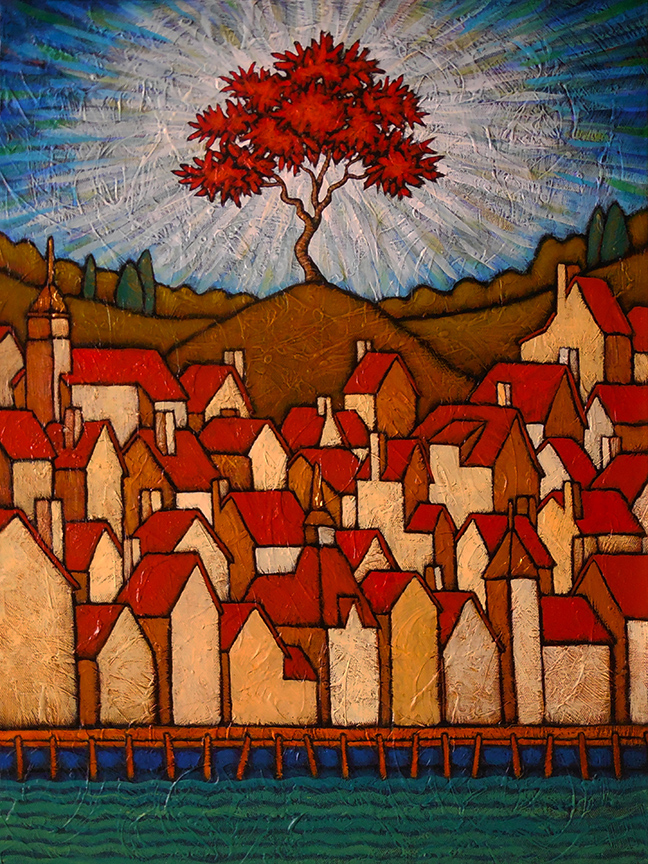
This newer piece, an 18″ by 24″ canvas, seems to follow Baudelaire’s words quite literally. Titled The Calling Out, the Red Tree here seems to have climbed to the loftiest point to appeal to a higher source as represented by the light emanating from the sun. There is a great, enveloping warmth in this painting but  for me, it is the underlying darkness that makes this piece effectively come alive.

Even the sun has a darker tone than the light it emits. This unnatural sun gives the piece an almost ominous feel but it is that same contrasting light coming from it that brings a redeeming sense of hope to the painting. It lives firmly between the darkness and light much like man according to Baudleaire’s words.

And that is where I want my work to live: Seeking the light but ever aware of its own darkness.

That, of course, is just how I see it. You might well see it in different terms and that is, as always, as it should be.

Read Full Post »


James Ensor- “Intrigue”

*******************

The mask means to me: freshness of color, sumptuous decoration, wild unexpected gestures, very shrill expressions, exquisite turbulence.

–James Ensor

*******************

As has been pointed out here, I have been working recently on some new work with large groups of faces, heads, masks, multitudes or whatever one sees in them. It has been exhilarating, with the work pulling me back into a rhythm where I am eager to see what the next work brings. While that is a great feeling in itself, I am still deliberating over where the work might take me, still trying to decide if it is work that is just meant to cleanse the system or if it is a new path to follow in some way.

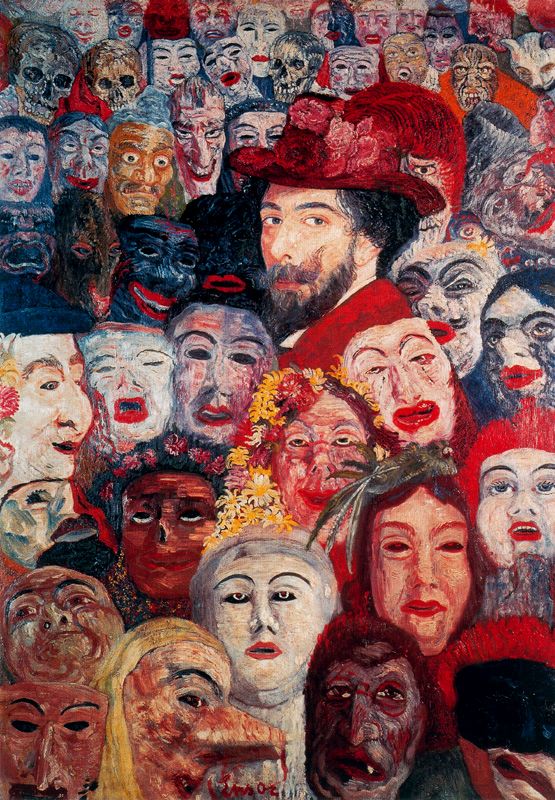
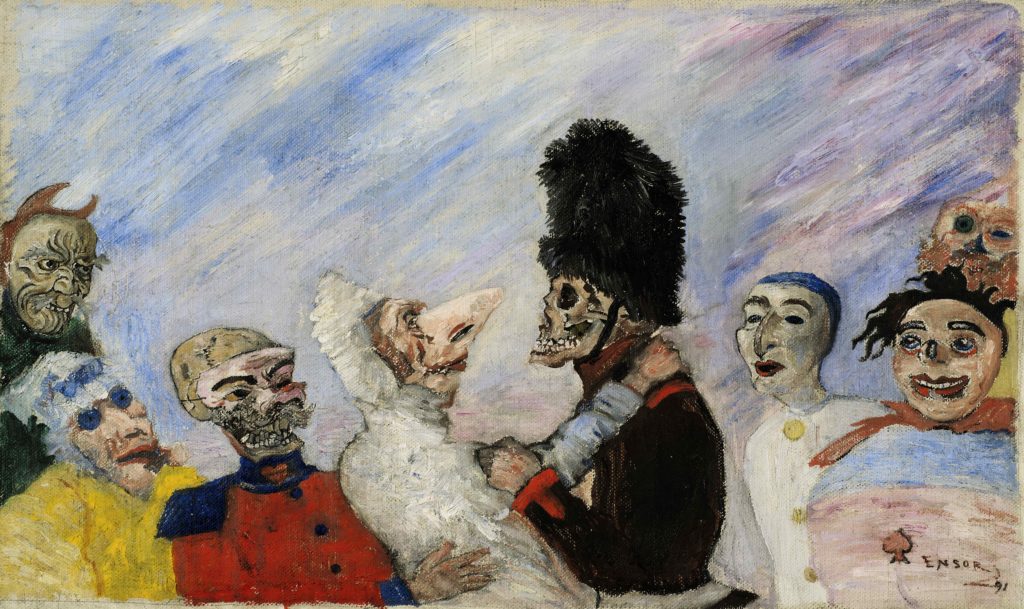
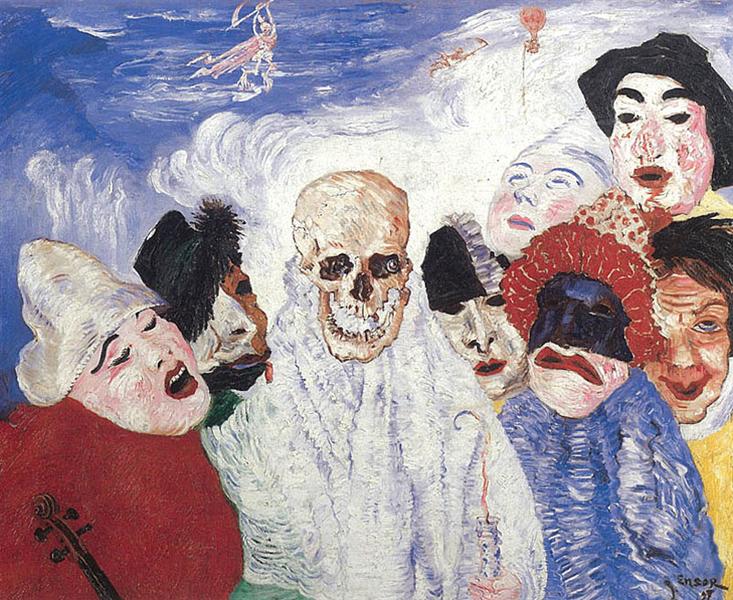
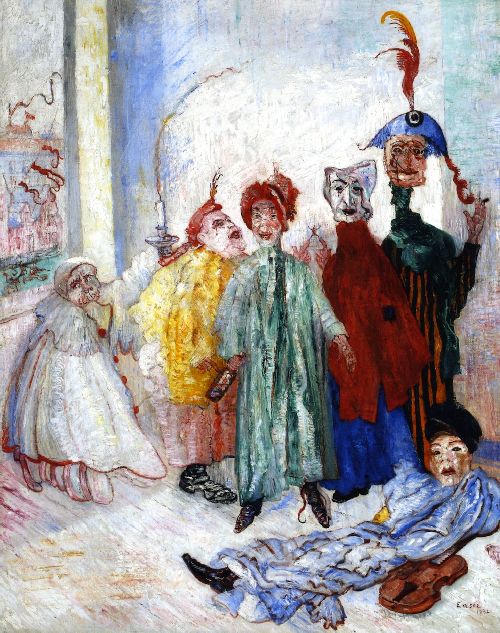
I turn for a bit of advice from art history going back to James Ensor (1860-1949), who I featured here a few years back with a post about his famed  painting Christ’s Entry into Brussels in 1889.  Ensor was well known for his paintings featuring groups people wearing contorted and strange, even grotesque, masks. Many were based on the masks seen at the carnivals and festivals of the time in his native Belgium.  But seen out of context, they were pretty controversial, as you might imagine, in the late 1800’s, given the subject matter and the rough method of much of his painting. This was around the time that the work of the Impressionists was still considered scandalous so you can imagine how the image of a soldier with a skull for a face embracing a maiden with a gigantic nose mask might play.

It’s fascinating work. Wish I could tell you more but the images themselves tell me a lot and inform my own work by providing fresh inspiration for new work. Just looking at this work this morning has me itching to get to the easel.

Take a look at some of the work of James Ensor and see if it does anything for you.

Ensor- “Christ’s Entry into Brussels in 1889”

Ensor- “Portrait of the Artist Surrounded by Masks”

James Ensor- Squelette Arretant Masques

James Ensor- Old Lady with Masks

James Ensor – ” Death and the Masks”

James Ensor- “Strange Masks”

James Ensor- “Masks Confronting Death”

James Ensor- “The Despair of Pierrot”

Read Full Post »

****************************

The artist performs only one part of the creative process. The onlooker completes it, and it is the onlooker who has the last word.

Marcel Duchamp

*******************************

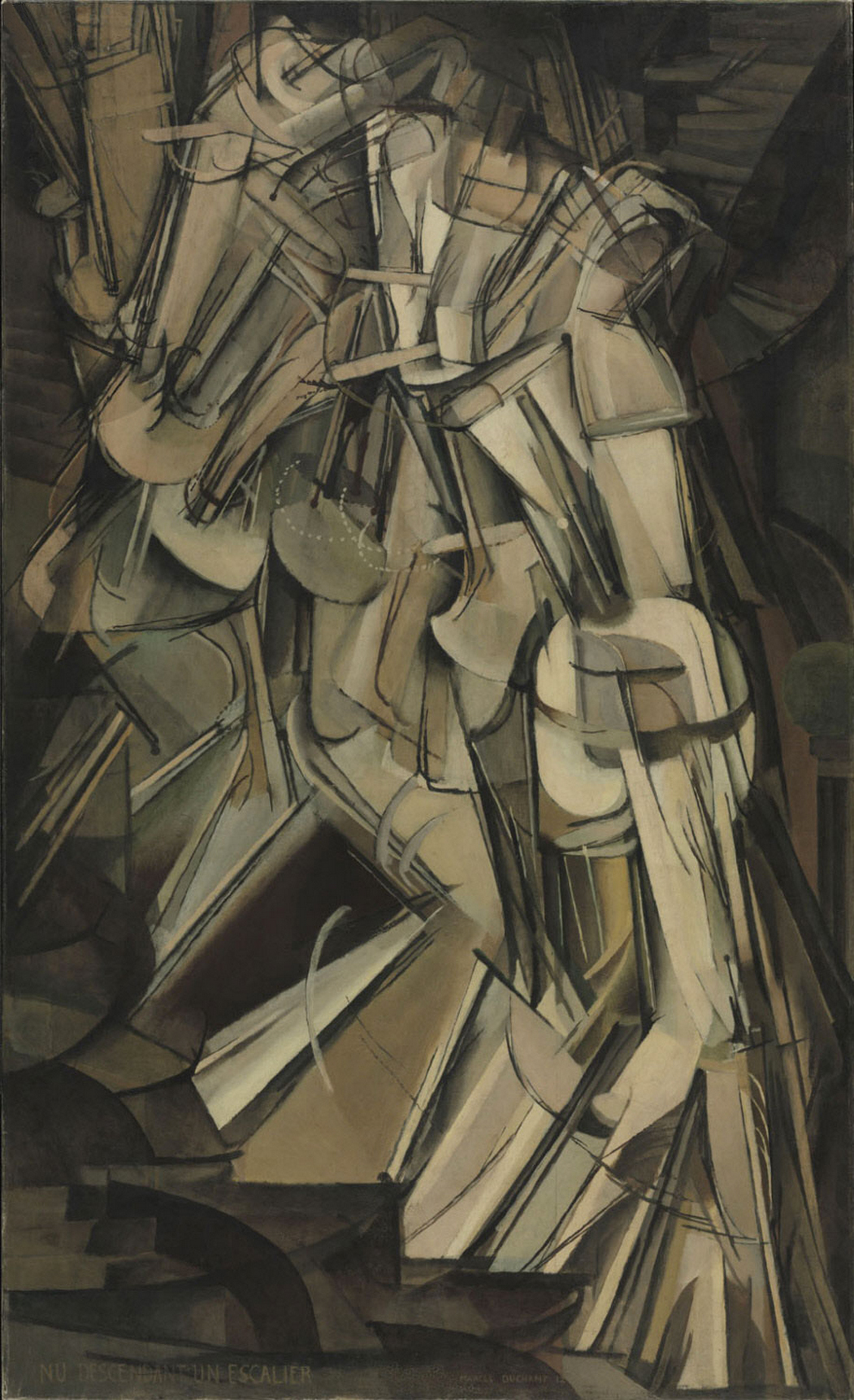
I can’t say I have always fully appreciated or understood all of the work of Marcel Duchamp (1887-1968). The French born artist is best known for his Nude Descending a Staircase #2 (above) which was the center of the fabled and highly influential Armory Show of 1913. The Cubist painting was considered a shocking departure from the norm, breaking the human form and its motion into abstracted blocks and lines. For an art world that was still basically reeling from the push of Impressionism against traditional academic style painting, it seemed like a gateway to total chaos.

Perhaps it was the notoriety from  this show and the effects of World War I that pushed Duchamp even more away from the art establishment of that era. His work became more and more provocative, as he became associated with the Dada movement which rejected all the norms of traditional art. You may know his 1917 sculpture, Fountain, which was a urinal signed with the pseudonym R. Mutt. Shocking the world at the time, it is considered a Dada masterpiece and one of the most influential works of the 20th century.

The thing I find interesting is that after the late 1920’s, Duchamp, still a relatively young man, more or less gave up the making of art and focused on playing chess. He viewed the game as more pure than art in that it was beyond commercialization. He did little art making in the time until his death in 1968.

But while Duchamp, with his contrarian nature, remains an enigmatic character for me, I do heartily agree with his words above. Art is not completely in the making of it. It is the viewer and the impression of the work that they carry with them that completes the artwork. Regardless of how or why the artist created the work, it is the impression that the work makes on the viewer that matters. A deeply personal piece that is that is beautifully crafted may not have the same impact as one that is rough and crudely executed.

That remains the last word of the viewer and what the see and feel in the work.

And that will always be a mysterious and sometimes confounding thing that is beyond the control of the artist.


Read Full Post »

*******************************

“The muses are ghosts, and sometimes they come uninvited.”

Stephen KingBag of Bones

*******************************

Finished this piece up a week or so back. The final product was never imagined beforehand. It was intended to be a canvas filled with faces but somewhere along the line something changed. Maybe, like the Stephen King words above, it was the uninvited act of a ghostly muse that caused this painting to form.

Who knows?

I do know that when I stepped back feeling that I was done, the whole of it surprised me very much. Mainly because it very much attracted me and raised so many questions, both about what the painting was and where it fit in my body of work.

I could even say it perplexed me. Part of me felt that it wasn’t even my painting, that it belonged to someone else’s mind. It was so unlike my other work that I wondered if this simply a one off event, something that pops up, maybe with the help of some vaporous muse, and never comes around again, or if it was a new direction that had pushed its way into my consciousness.

I can’t say but it sure keeps me looking its way.

It has some size at 24″ high by 30″ wide which gives it even more oomph in the room. I know that in a studio that is filled with new work, it dominates my eye every time I turn its way. There is a confectionary quality to it that passes on a delight of sorts to myself as I look at it. But it also has an ominous feel that makes me wonder where this ship is going and from where it came.

It feels as though there is a lot of mystery here, questions that will never be answered.

It’s been a struggle trying to pin down a title for this piece. I am leaning towards Ghost Ship. Thinking of a boat floating aimlessly on the sea that is empty but for the host of spirits of past travelers that hang on, their stories waiting to be told. Sounds right to me at the moment.

All in all, it pleases and perplexes. I am glad to have it with me for the next few months so that I can better consider its meaning for myself. It might be one of those pieces that is meant only for me.

Who knows?

Read Full Post »

Funny how the mind works sometimes.

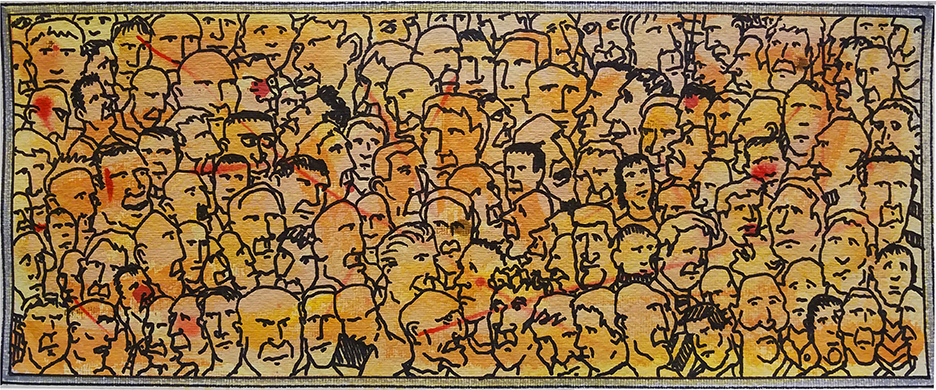
Lately I’ve been showing some paintings from a new series that features masses of faces. Last week I wrote that these groups of faces reminded me of the artifact from the subterranean layers from my Archaeology series. I thought that was a new observation as was the whole idea of this series.

But yesterday I was going through a bin of old work that I haven’t looked through in years and came across the piece shown above. It was done in the early days of 2008 when I was trying to break from a painting funk as I prepared for my annual show at the Principle Gallery that June. The Red Tree had been firmly entrenched as my trademark in the eight prior shows and I felt that it was boxing me in and that I was running out of gas.

It was becoming harder and harder to create the excitement in myself from the work that was needed to make it come alive.

So I turned to a task that a 5th grade art teacher had given me years before. He gave us large sheets of paper and told us to simply fill them, in pen and ink, with anything that came to mind. It could be simple shapes but he suggested making it a junkyard of objects. So I would start at the bottom of the page, drawing things piled on top of other things until the page was full.

It was an exercise that became a regular thing with me in adulthood as I would doodle this way in the margins of newspapers and in journals. Being blocked as I was back in early 2008, I pulled out a Sharpie and many sheets of watercolor paper. I spent a week or so just filling these sheets and at the end of that time the idea of the Archaeology series evolved from this work.

But since then I had completely forgot that I has did one of these sheets with simply drawn faces. It’s not particularly great in any way. It is rough and sloppy but I can see in it the beginnings of the Multitudes series. Around that time, I was drawing faces with a blunt Sharpie, trying to create an expressive face with as few lines and detail as possible. Here’s are two examples from that time taken from an old art business calendar that used as a sketchbook.

So, the idea that I am currently chasing is not new at all. It was forgotten, sitting in some far corner of my mind, biding its time until I was ready for it. Apparently that time has come.

Funny how the mind works sometimes.

Read Full Post »

************************

Men, it has been well said, think in herds; it will be seen that they go mad in herds, while they only recover their senses slowly, one by one.

Charles MacKay,

Extraordinary Popular Delusions and the Madness of Crowds

**************************

I am still in the midst of a frenzy of faces.

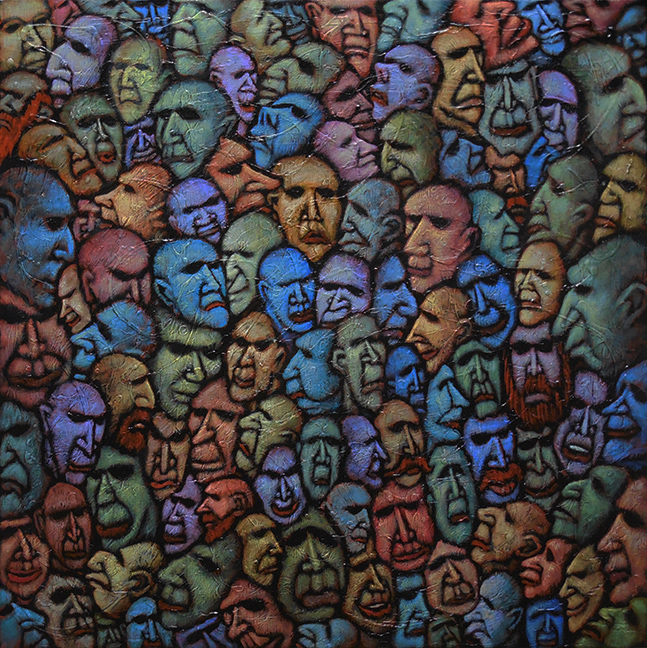
I call this group of work, like the newer painting above, a 20″ by 20″ canvas, Masks or Multitudes. This particular piece is still untitled although I am seeing it as The Crowd for the moment.

Still not sure what the meaning is behind these pieces.

Maybe there is no meaning. Maybe they are just familiar shapes and it is a matter of color and form that is attracting me.

Maybe attracting is the wrong word because it is not really attraction that has me painting them. A better word might be compelling. I feel compelled to paint these at this time.

Why is another thing altogether.

On one hand, I see it in the terms of Walt Whitman‘s voice in Song of Myself, as I wrote here recently– I am large, I contain multitudes. In this rationale, the faces are part of me, individual pieces of a whole. It makes sense as I have been seeing these faces all my life. They seem part of me.

Maybe that is what these paintings are.

But then sometimes I see something different in them and think that they are quite something else. Something less benign. Something more strange.

Strange because I have become more and more averse to crowds, especially the collective behavior of crowds. While I try to subscribe to Will Rogers‘ mantra of I never met a man I didn’t like, I find myself leery of crowds. I would change Roger’s line a bit, to something more like I never met a crowd I liked with one caveat–I only feel somewhat comfortable with crowds at my gallery talks or openings. I don’t fear and sort of understand the common denominator of those groups.

But mob thought in general worries and alarms me. It seems too easy for one to be swept up in the frenzy of a mob, to sacrifice aspects of yourself for a collective aspect that might not normally be seen in you when you as an individual.

That might even apply to the overall intelligence of a crowd. You would think the level of intelligence would rise with the inclusion of more minds but actually it seems to lower to compensate for the common denominator. As the late writer Terry Pratchett put it:  The intelligence of that creature known as a crowd is the square root of the number of people in it.

As a result the crowd is subject to manipulation, to being led astray from what the individual knows is right when they really consider it in solitude. It becomes easy to believe things that might otherwise seem ridiculous or outrageous.

We have plenty of examples of that in our current state of affairs here in the USA.

Sometimes I see this work in that way, as representing the mob. But then again when  look deeper and see the faces individually, they seem less threatening and more along the lines of Whitman’s thought.

I just don’t know. That they compel me might be all I can say with any certainty. I find myself being both uneasy and comforted by this work. And there’s something to be said for that paradox and contrast. They are important aspects of art, the part that imparts meaning.

Hope that is what I am looking at.

Read Full Post »

Rothko/Experience

Mark Rothko- Red and Black 1968

*****************

A painting is not a picture of an experience, but is the experience.

Mark Rothko
.
*****************
This quote from Mark Rothko made me stop this morning. I hear a lot of artists talk about capturing a moment with their work. I am pretty sure those words have come out of my mouth when I am just blathering on. But a piece of art works best when it causes the viewer (for visual artists) to feel as though they are experiencing something new in that moment when they stand in front of it.
.
Not a representation of a moment but a moment in itself.
.
But how do you do that?
.
I can’t really say for sure. Maybe it comes in being fully engaged emotionally during the creation of the work. Perhaps that moment of emotion becomes part of the piece and it is that which the viewer senses and experiences in the work.
.
I don’t really know but it is something I will consider when I am in front of the easel in a few minutes.

Read Full Post »

********************************

The masses do not see the Sirens. They do not hear songs in the air. Blind, deaf, stooping, they pull at their oars in the hold of the earth. But the more select, the captains, harken to a Siren within them… and royally squander their lives with her.

–Nikos Kazantzakis

********************************

I am still working on the Multitudes paintings with their masses of eyeless faces. It’s work that is consuming, acting as a siren of sorts, drawing me to it and keeping me from moving on to other things. It is much like author Nikos Kazantzakis describes above.

It reminds me also of a newer painting shown at the top that was finished just before jumping into the Multitudes pieces. It is a 24″ by 18″ canvas that I am titling Call of the Siren. It incorporates the Red Tree and the Red Roofs along with a band of color at the bottom that represents the sea.

This bottom section has a pattern that seen with the vertical piers of the dock creates a pattern that feels Greek to me. It wasn’t intended and I can’t say if this pattern, as I see it, is really Greek in origin. But it feels that way to me and perhaps brings the thought of the Sirens of Greek mythology to mind when I look at this piece.

Another thing I note in this painting is the the massed buildings of the town seem to form a fence It is another barrier, beyond the sea journey that brought them here, that must be overcome for those who are called by the Sirens. And once one has made it over wide waters and through treacherous cities, there is still a hill to be climbed.

The Sirens never makes things easy.

I know this to be true– I’ve royally squandered much of my life chasing their song.


Read Full Post »

*********************

Walt Whitman: Song of Myself, Part 51


The past and present wilt—I have fill’d them, emptied them.

And proceed to fill my next fold of the future.

Listener up there! what have you to confide to me?

Look in my face while I snuff the sidle of evening,

(Talk honestly, no one else hears you, and I stay only a minute longer.)

Do I contradict myself?

Very well then I contradict myself,

(I am large, I contain multitudes.)

I concentrate toward them that are nigh, I wait on the door-slab.

Who has done his day’s work? who will soonest be through with his supper?

Who wishes to walk with me?

Will you speak before I am gone? will you prove already too late?


*******************************

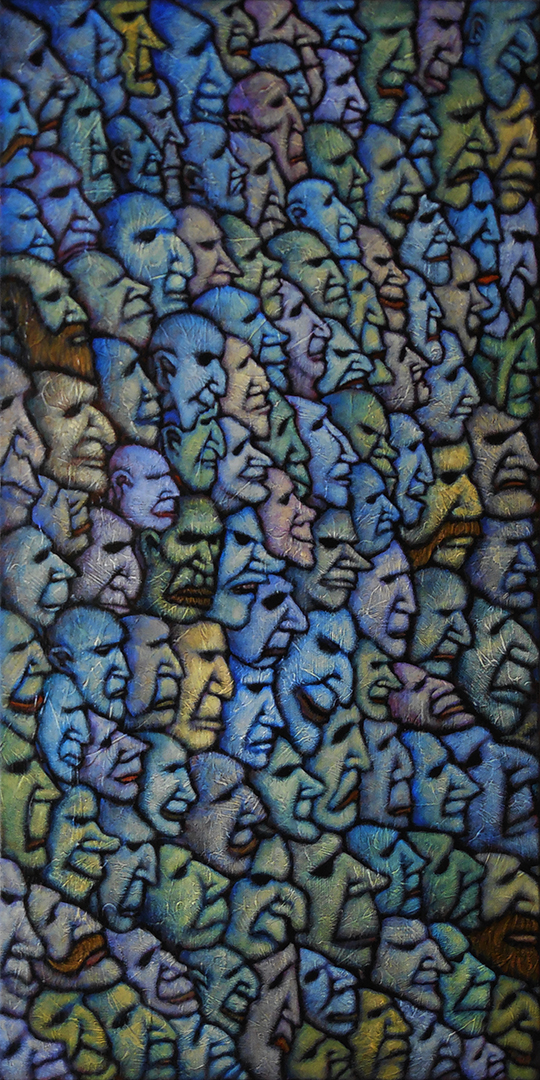
The image shown on the right is another new painting, a 36″ by 18″ canvas that is part of a new group that has drawn a great deal of my attention lately in the studio. They are large groups of faces that are painted in an almost subconscious manner, with little if any forethought given as to how they relate to the surrounding faces. They emerge from dashes of paint and quickly rendered shapes that cause me to simply find human form in them.

It is very intuitive work. It reminds me very much of the process involved in painting the subterranean artifact layers in my Archaeology series. Just make a mark then transform it into something tangible, something possible.

I have known most of these faces for forty or fifty years. They have lived in me, have emerged periodically on bits of paper, on journal pages and in the margins of the newspaper. Some have shown themselves individually in some of my work through the years– the Exiles, Outlaws and Icons series for example.

But they all seem familiar to me. Some possess a pleasant and friendly aura and others much less so. Some are ugly and bitter in appearance. Some even seem evil and worry me a bit, causing me to ask if they are all just variations of my own self.

I don’t really know.

Part of me says yes. I was instantly reminded of the line from Walt Whitman’s Song of Myself  (shown above):  Do I contradict myself?/Very well then I contradict myself,/(I am large, I contain multitudes.)

Whitman’s grand poem had him speaking as the voice of the collective consciousness of mid-18th century America, a voice that encompassed all sorts of people and attitudes that make up the stewpot that is this country, then and now. As an artist, the hope is that your own work taps into that same vein, that it speaks to connects with the wider spectrum of people. So, in doing this, in attempting to access this collective multitude, to pull them all from your own inner self.  To do so, you have to find that part of yourself that is part of all of them.

Can it be hope and love? Fear and anger? Or just the emotion of being?

I don’t really know.

What I do know is that there is something in this work that seems right for the moment.  Seeing these groups of faces had me wondering how this had slipped by me for so long. It feels natural, like it should have been part of my work for some time now.

So how had I not did this before? I think the answer is that I needed to develop the skills and visual vocabulary to do these pieces in a way that used the faces in the most impactful way. If I had did this years ago, I think it would have been lacking the color, rhythm and forms needed to make them effective. Those are all things that have come from years and many tens pf thousands of hours in the studio. For me, these paintings are a great coupling of subject-these crude faces– and those elements– color, rhythm and form. I find myself attracted as much by the colors and shapes as I am by the individual faces.

I am considering calling this group Multitudes from the line from Uncle Walt. Or it might still be Masks from the for the appearance the faces have with their dark eyelessness.

I am still trying to figure this out so excuse this off the cuff writing. There are a lot of thoughts emerging and growing even as I write this so I reserve the right to change to contradict myself at some later point. Like Walt, if I contradict myself, so be it — I am large, I contain multitudes.


Read Full Post »

There is an exhibit currently hanging at the Rockwell Museum in Corning of photos from photographer Yousuf Karsh, who had an incredible ability to capture the essence of his subjects. Many of his shots of the celebrated figures of the 20th century are the best known images of those folks. I saw an exhibit of his work years ago and was really inspired by it. It played directly into a piece from my Exiles series at the time that I wrote about here back in 2008 that I am sharing again below.

The Karsh exhibit at the Rockwell Museum in Corning hangs until May 5.

*****************

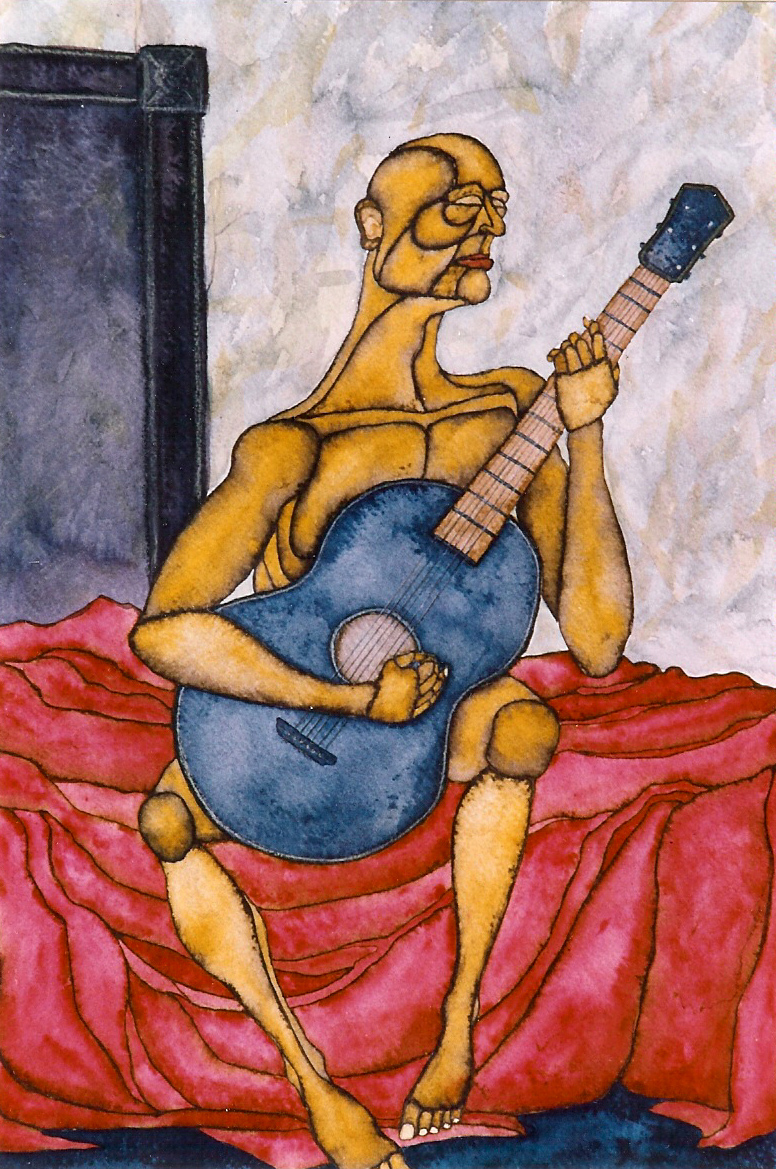
Blue GuitarThis is another of the paintings from the Exiles series, a piece titled Exiles: Blue Guitar. This was larger than the other paintings in the series and was the most intricate in design. It was the only piece to show a full body, more or less. The crimson sheets beneath the figure are certainly not typical of my work. Even the blue guitar was an anomaly. I think these things, in themselves, make this a distinctive painting and one that is perhaps the one piece I most regret letting go.

I remember painting this piece back in ’96 with great clarity. The face was based on a portrait of the Finnish composer Sibelius taken by Karshthe famed photographer. I had seen the photo at a wonderful and powerful exhibit of Karsh portraits at the MFA in Boston that knocked me out. Karsh had a knack for revealing the essence of his subjects in a single image.

I was immediately taken with the image of Sibelius’ face. It expressed bliss, but not joy. A painful bliss, perhaps an ecstasy tempered by the knowledge that the world is an imperfect one and that this moment of grace is a fleeting one, soon to be gone. It was exactly the expression I saw for my guitarist and one that I wanted the whole piece to convey.

This painting was the centerpiece of my first exhibit many years ago and remains vividly in my memory. Eventually, I went back in and darkened the background which made the guitarist pop even more. But the images of that change have been lost over the years which I greatly regret. This piece sold years ago and I now have no idea of where this painting ended up. I hope that whoever possesses this piece appreciates all that it represents and gives this sad, blissful guitarist a bit of attention now and then.

*****************

Note: The opening for the for the 25th Anniversary exhibit at the Principle Gallery is next Friday, February 22. I mistakenly wrote here the other day that it was tonight because, well, I get confused and make mistakes sometimes. My apologies for any confusion. Hope you can make it to the show next week!

Read Full Post »

« Newer Posts - Older Posts »