Feeds:
Posts
Comments

Archive for the ‘Poetry’ Category


I think I could turn and live with animals, they are so placid and self-contain’d,
I stand and look at them long and long.

They do not sweat and whine about their condition,
They do not lie awake in the dark and weep for their sins,
They do not make me sick discussing their duty to God,
Not one is dissatisfied, not one is demented with the mania of owning things,
Not one kneels to another, nor to his kind that lived thousands of years ago,
Not one is respectable or unhappy over the whole earth.

–Song of Myself  32, Walt Whitman


leaves of grassA little busy this morning but wanted to share a few lines from Uncle Walt. I find that it has a soothing effect much like the effect of watching the wild creatures that live around us. My current best animal friend is Howie the older tom turkey who sometimes runs down the path toward me when he sees me coming, gobbling loudly as he comes. I know it’s just because of the sunflower seeds I put out for him and his other bird friends but his evident joy in seeing me always makes me smile.

I think we all appreciate someone displaying a little bit of joy when they see us, even if it’s just an old tom.

I sure do.

Here’s a reading of an excerpt from Whitman’s Song of Myself from his eternal classic Leaves of Grass.


Read Full Post »

GC Myers- Late Fragment- Raymond Carver ca 1997 sm


And did you get what
you wanted from this life, even so?
I did.
And what did you want?
To call myself beloved, to feel myself
beloved on the earth.

–Late Fragment, Raymond Carver


I was looking for something yesterday in the bedroom here in the studio that I call the library. It’s a room lined with bookshelves and the floor littered with boxes with old unframed paintings. It’s a great place in which to retreat when I am feeling stuck. I can pull out a book and read a passage that I haven’t thought of since I last read it, in some cases that being forty years ago. It always feels like there is something new or old or, at least, interesting to find in there.

But yesterday I stumbled across two long thin pieces of old matboard held together with artist’s tape. I couldn’t remember what might be sandwiched between them and opened it, revealing the piece shown at the top. Seeing it brought back a flood of memories.

It was an old painting done back in the 1990’s, probably 1997. It is called Late Fragment after the short Raymond Carver poem above. I had once had it framed and displayed it at the West End Gallery many years ago. I remember distinctly discussing it with several folks at an opening. But it eventually came back to me and for some reason it ended up being unframed. It obviously has bounced around in my old studio in the woods and now my current one as it is stained and a bit grimy.

But there are things in it that had slipped my mind that came back yesterday. I remembered that this piece was originally meant to be in a handmade book of my small paintings accompanied by favorite short poems. I did a couple back around that time. I haven’t seen them in many years and have no documentation on them that I can find but I remember binding them with thick heavy thread along with bookcovers made from heavy dense cardboard covered in rice paper. I would love to see them again.

This piece was meant to be in the center of one of these books and would fold out to reveal itself in whole. You can see the creases where it was folded which gave it a segmented look that I have replicated in paint may times since. If I remember right,  the heavy watercolor paper made it too thick for the book in which it was intended so it ended up in a frame instead.

It’s not a great piece. There are so many ways in which it would be different now. But there’s something in it that is endearing to me. Maybe it’s rawness of it which is accentuated now by the grime and stains that adorn it. Maybe it’s attraction comes from this as a metaphor for the aging process we all go through.

Or maybe it’s the nascent quality of the painting itself. The way the tree is handled as more of a silhouette than with real details of any sort. Or the tiny sun/moon off in the distance. That was not uncommon in my work at that time.

Or maybe it was just the reality and potential held in it. It was a whole entity then, both as a painting and as a symbol of who I was then. It remains true now but I have changed in the intervening years and while I remain basically the same, I am different. My views and ways of expression have changed and evolved, hopefully for the better.

But who knows? Maybe twenty some years from now, if I can keep myself alive that long, I will look back on this post or a recent painting and say the same thing:

Yes, that was me and while all in it is still true, this is where and who I am now. 

Read Full Post »

GC Myers-The Fulfillment sm

“The Fulfillment”- Now at the West End Gallery


Take your hand
and place your hand
some place
upon your body.
And listen
to the community of madness
that
you are.

How To Be Alone, Pádraig Ó Tuama


I am up and alone in the studio at 4:30 this morning, eager to get a brush in my hand. It might sound crazy but that doesn’t matter to me right now. I am excited about the work for my Principle Gallery show in June that I am working on and feel a compulsion to keep at it out of the fear that this feeling will soon pass.

But for as excited as I am still about the new work, I am not ready to show a lot of it quite yet. Something makes me want to hold most of it back for a bit, as though showing too much of it will somehow diminish the impact of it as a whole. Actually, the gallery hasn’t even seen a lot of this work, probably for that same reason.

I’ve spent more time already from this early morning than I had wanted before I get to work so I will get to the point of this post. It’s the author’s reading and animation of a piece, How To Belong Be Alone, from Irish poet Pádraig Ó Tuama. It’s a wonderful short poem that speaks to the need to belong which is similar to that driving need to have my voice heard that brought me to painting.

Some days I find myself questioning whether that need to have my voice heard is a necessity or a product of ego. I mean, here I sit writing about my paintings. Isn’t that an act of ego?

Part of me says that it is. But part of me rejects that idea. After all, we all need to know that our voices are heard, that our existence matters, that we belong in this world. Maybe if I believed that my voice or my work deserved to be heard and appreciated above all others or that it mattered more than that of anyone else, maybe then it would be an act of ego.

But I don’t believe that. We all deserve to let the world hear the voice of our unique selves. Each is as valid and valuable as the next.

I think this poem speaks well to this point.

… listen to the community of madness that you are.

Okay, got to get to work. before I burst. Take a look please.


Read Full Post »


GC Myers- From Here to There sm


Not I, not any one else can travel that road for you,
You must travel it for yourself.

It is not far, it is within reach,
Perhaps you have been on it since you were born and did not know,
Perhaps it is everywhere on water and on land.

–Walt Whitman, Song of Myself, Section 46


I thought some lines from Uncle Walt might fit well with the new painting above. It is titled From Here to There and is part of my annual solo show that opens this year on June 4th at the Principle Gallery in Alexandria.

This show, titled Between Here and There, concerns itself primarily with the concept of the journey.   It could be as simple as an actual physical journey from one spot to another or it could be more metaphorical, symbolizing our journey through life, from birth to death.  

Beginnings and endings. Origins and final destinations. We all start and finish the journey.  

But the totality of the journey is never fully expressed in the start and end points. No, between here and there are all sorts of roads to follow, obstacles to conquer, bodies of water to cross, creatures to love, and things to be learned.

And dreams to be dreamed. Hopes to be hoped.  

In this journey, do we ever truly feel the satisfaction of reaching our destiny? There are other numerous destinations within the two endpoints of our life’s journey and sometimes we may reach a goal that we once thought was well beyond our grasp. It may produce a momentary feeling of euphoria that we take for satisfaction but eventually we yearn to be on our way once more. As Whitman points out later in this section:

This day before dawn I ascended a hill and look’d at the crowded heaven,
And I said to my spirit When we become the enfolders of those
orbs, and the pleasure and knowledge of every thing in
them, shall we be fill’d and satisfied then?

And my spirit said No, we but level that lift to pass and continue beyond.

Maybe we are destined to be always going forward, to always have a gnawing inside us to move, to learn and do and feel more.

To fill the space between here and there.

Here’s the whole of the section from Song of Myself:


I know I have the best of time and space, and was never measured and never will be measured.


I tramp a perpetual journey, (come listen all!)

My signs are a rain-proof coat, good shoes, and a staff cut from the woods,

No friend of mine takes his ease in my chair,

I have no chair, no church, no philosophy,

I lead no man to a dinner-table, library, exchange,

But each man and each woman of you I lead upon a knoll,

My left hand hooking you round the waist,

My right hand pointing to landscapes of continents and the public road.


Not I, not any one else can travel that road for you,

You must travel it for yourself.


It is not far, it is within reach,

Perhaps you have been on it since you were born and did not know,

Perhaps it is everywhere on water and on land.

Shoulder your duds dear son, and I will mine, and let us hasten forth,

Wonderful cities and free nations we shall fetch as we go.


If you tire, give me both burdens, and rest the chuff of your hand on my hip,

And in due time you shall repay the same service to me,

For after we start we never lie by again.


This day before dawn I ascended a hill and look’d at the crowded heaven,

And I said to my spirit When we become the enfolders of those
          orbs, and the pleasure and knowledge of every thing in
          them, shall we be fill’d and satisfied then?

And my spirit said No, we but level that lift to pass and continue
          beyond.


You are also asking me questions and I hear you,

I answer that I cannot answer, you must find out for yourself.

Sit a while dear son,

Here are biscuits to eat and here is milk to drink,

But as soon as you sleep and renew yourself in sweet clothes, I kiss you with a good-by kiss and open the gate for your egress hence.


Long enough have you dream’d contemptible dreams,

Now I wash the gum from your eyes,

You must habit yourself to the dazzle of the light and of every moment of your life.


Long have you timidly waded holding a plank by the shore,

Now I will you to be a bold swimmer,

To jump off in the midst of the sea, rise again, nod to me, shout, and laughingly dash with your hair


Read Full Post »

The Country

GC Myers- 2018 FingerpaintingLiving in the country, especially on the edge of the forest, makes one aware of their proximity to critters. There are deer and raccoons and squirrels and skunks and coyotes and bobcats and birds of all shapes and sizes.

But mainly living in the country makes you aware of the presence of mice in this world, how they live so closely to us, hovering nearby almost like little brown and gray shadows. Sometimes you hardly see them at all but they leaves traces that speak of their existence, often a hole chewed in a box or a bag in a closet or in the basement. Or those little hard nuggets on a shelf or table. I once had a mouse that had walked through a tray of wet paint that I had inadvertently left out overnight and walked across the edge of a piece I had been working on.

Little blue paw prints meandering around the edge of the surface. Hope they liked what they saw.

All these things occur here in the studio. At such times, I look over at Hobie, my studio cat who was once a known hunter of great renown, and ask her if she has been doing her job patrolling the mice population. She just looks away without an ounce of care for my concern.

I wonder if she has a secret pact with the mice now. After all, the gifts she once laid at my feet– poor mice, chipmunks, birds, and snakes– have ceased altogether.

They slowed considerably after she made the transition from stray cat to part-time outdoor cat to fulltime studio cat. But they did continue. I would sometimes come into the studio and there would sometimes be a sad prize waiting for me in front of my desk chair or at the base of my easel. Hobie would saunter over as if to proudly say, “See what I did for you while you were gone?”

But that doesn’t happen now. Actually, there are fewer traces of my little rodent housemates lately. Maybe the several feral cats who have taken up recent residency around our place have effectively shut down their runways in and out of our place. Maybe. But I doubt that even a terrible trio of hungry cats could completely stop the smart and versatile mice that I know so well. Their little brains work better than some folks I know.

I am sure they are still there. I don’t mind to be honest. Not that I am thrilled by the evidence they leave behind. So long as they don’t bother me, I can coexist with them.

Not everyone can. I used to work with a lady who proclaimed that her home had no mice at all. She lived in an old house near the river so I knew the idea that that critters somehow weren’t taking advantage of a warm place to live and eat was foolishness. I would just laugh at her and tell her that she might not see them but they were there.

She would let out a shiver and say that no, they were not there. I guess she had to say that for her own peace of mind but I know that somewhere in that old house, in the attic or basement, there is a meeting going on right now where all the mice are discussing the best places to eat in that house.

The reason I bring this up this morning is that I came across an animation of a poem by former Poet Laureate Billy Collins that is abut this subject. It’s called The Country. I never worried about my boxes of matches before but this has me wondering. Take a look.


Read Full Post »

GC Myers- From a Distance  2020

“From a Distance”- At the West End Gallery


Wanted to just share a poem and an animation of it that features it being read by the poet, Gregory Orr. I chose this one because of a line in it — No purpose but what we make— that made me think about the nature of purpose. We often speak of finding purpose in ourselves but is it something to be found? Or might it be something that we create for ourselves, something that we actually choose?

I have to think on that for a bit. In the meantime, please take a look at the short reading of the poem.


This is what was bequeathed us

This is what was bequeathed us:
This earth the beloved left
And, leaving,
Left to us.

No other world
But this one:
Willows and the river
And the factory
With its black smokestacks.

No other shore, only this bank
On which the living gather.

No meaning but what we find here.
No purpose but what we make.

That, and the beloved’s clear instructions:
Turn me into song; sing me awake.

–Gregory Orr (b. 1947)


Read Full Post »

singularity4


I had other things on my mind about what I would write here this morning. I was going to question how a law that makes giving a drink of water to someone in line at the polls a crime is supposed to prevent voter fraud. I was also going to question the motive for other such suppressive provisions in legislation being moved into law around much of this country.

But before I could start, I came across this short animation of a poem from poet Marie Howe and I decided that maybe this was the better way to go this morning.

Her poem is titled Singularity and refers to the theory Stephen Hawking (among others) set forth that the universe and all that it is was once a single thing before the Big Bang created all that we know the universe to be now.

We were all part of one thing.

No, we were that one thing.

That is as simple as I can put it and still understand it. I am not even sure that simple explanation is correct. Much as Howe explains to her audience, my own grasp of advanced physics and most other great scientific theoretical concepts is limited. But the idea that we were once one and that we may all at some point become one again is somehow appealing to something inside me.

I don’t know. My eternal refrain.

Take a look. The Marie Howe poem is below the video.


SINGULARITY
by Marie Howe

          (after Stephen Hawking)

Do you sometimes want to wake up to the singularity
we once were?

so compact nobody
needed a bed, or food or money —

nobody hiding in the school bathroom
or home alone

pulling open the drawer
where the pills are kept.

For every atom belonging to me as good
Belongs to you.
   Remember?

There was no   Nature.    No
 them.   No tests

to determine if the elephant
grieves her calf    or if

the coral reef feels pain.    Trashed
oceans don’t speak English or Farsi or French;

would that we could wake up   to what we were
— when we were ocean    and before that

to when sky was earth, and animal was energy, and rock was
liquid and stars were space and space was not

at all — nothing

before we came to believe humans were so important
before this awful loneliness.

Can molecules recall it?
what once was?    before anything happened?

No I, no We, no one. No was
No verb      no noun
only a tiny tiny dot brimming with

is is is is is

All   everything   home

Read Full Post »


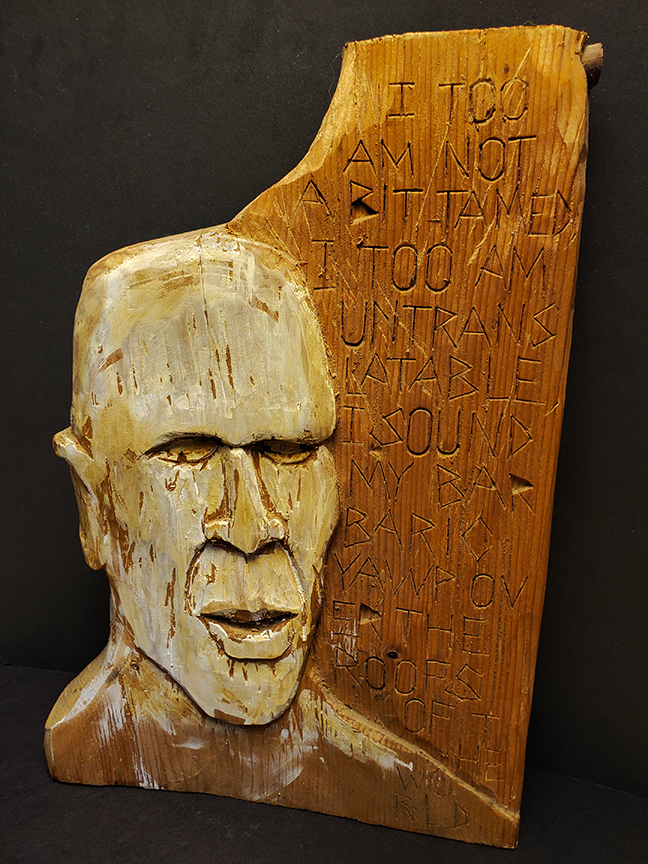
I too am not a bit tamed,
I too am untranslatable,
I sound my barbaric yawp
over the roofs of the world.

Walt Whitman, Song of Myself


I finished this smaller piece the other day (it is headed to the West End Gallery today) and with the Red Tree appearing to hover above the Red Roofs both near and far, all I could think of were the lines above from Uncle Walt. That’s Walt Whitman, actually, but I always think of him in familial terms not that he was anything at all like my own uncles.

These lines from Song of Myself have rang in my ears for decades and are at the core of my desire to paint and in the formation of my voice as an artist.

Before I even thought of beginning to paint, I tried my hand at wood carving. I did a number of bas-relief carvings that were fairly crude in a folksy kind of way. I was untrained and just went at it, much as I did later on with my painting. I believe that the painting worked out much better but the carving had a part to play for me at the time.

One of the first things I carved was a rough-hewn face with the four lines– poorly executed– from Whitman next to it. It was nothing to write home about, carved as it was from the end of an old 2×12 pine board. I am not particularly proud of it as a piece of art but it has great meaning to me and stays near me in the studio.

I have described what these words have meant to me in the past like this:

…the four lines above have been a guiding beacon for me throughout the past 25 years as I have tried to be an artist. These words instructed me to be only myself, to openly and boldly express my feelings without fear or shame. To not hide my scars, my fears or my weaknesses because they are part of my wholeness and keep me in balance. To not be underestimated or devalued by myself or anyone else. To claim a foothold in this world and bellow out the proof of my existence in my own voice:

Here I am.

There are paintings that I do that are meant to represent this thought, paintings that are meant to be plainly expressions of that Here I am. I consider them icons in my body of work, pieces that fully represent my work and what I want from it. This painting definitely falls in that category. It’s simply put but not a simple expression.

When I look at this painting I personally see myself and all my hopes and aspirations, all that I am or desire to be.

What I hope for this painting is that someone else sees that same here I am in it for themselves, that they see in it those things that make them a whole and perfectly imperfect person with a place in this world and a voice that demands to be heard.

Is that asking too much?

I immediately thought looking at this new painting that it fit into this category, that the Red Tree here represented my own need to let out my barbaric yawp, to announce my existence in this world. I am calling it I Sound My Barbaric Yawp.

It might not be quite as roughly finished as the carving but the yawp is the same.

Sound your own yawp in the world today. Have a good one.

Read Full Post »


Oh, East is East, and West is West, and never the twain shall meet,
Till Earth and Sky stand presently at God’s great Judgment Seat;
But there is neither East nor West, Border, nor Breed, nor Birth,
When two strong men stand face to face, though they come from the ends of the earth!

The Ballad of East and West, Rudyard Kipling


Showing another new Little Gem from the West End Gallery show, this one titled Across the Divide.

The title refers to the the river that separates the two opposing shores. There is a political commentary implied in the blue and red of the two shores representing the colors of the political divisions here in the US.

There’s a lot of talk about the need for unity, about how we need to come together as a nation, but it seems as though there is a wide and mighty river between us, one that may never be traversed.

Like the opening line from the Kipling poem– and never the twain shall meet.

I would like to think that there is common ground that we share as citizens of this nation but it’s had to see at the moment. That river looks pretty darn wide.

I was about to start on a spiel about the need for compromise but I am going to skip it. Most of you out there who read this are intelligent people who understand compromise and how important its place is in big country with a wide variety of people. You know that everybody doesn’t get exactly what they want all the time, that we all have to sacrifice at some point for the greater good.

Sometimes we give and sometimes we get, depending on our needs and situations. 

And that is a simple, workable concept until you factor in ignorance, racial hatred, and greed.

Then things go awry and you get to this point where we are now, with a wide and deep river running between us. 

I still have hope and I see it in this piece. There’s too many things here that unite us if we only allow to set aside our biases, judgements, and prejudices.

I know that’s asking a lot but is it, really?

Read Full Post »


And in despair I bowed my head;
“There is no peace on earth,” I said;
“For hate is strong,
And mocks the song
Of peace on earth, good-will to men!”

Then pealed the bells more loud and deep:
“God is not dead, nor doth he sleep!
The Wrong shall fail,
the Right prevail,
With peace on earth, good-will to men!”

Henry Wadsworth Longfellow, Christmas Bells


The lines above are the last two stanzas of a poem Longfellow wrote in 1863 during the height of the American Civil War. Several years later, in 1872, the poem was incorporated into the Christmas carol we know as I Heard the Bells on Christmas Day.

I am hoping that the last three lines hold true for us going into the future.


I ran the short bit above several years ago on this day, Christmas, in the pivotal year of 2016, just after a new president*** had been elected and there was still uncertainty as to what he would turn out to be.

As for the poem which later became the carol, there is a little more to add to the story which I thought I would add this morning.

At the time it was written, Longfellow was still deeply grieving the tragic death of his wife in July of 1861. She caught on fire while using sealing wax on an envelope and despite Longfellow’s efforts died the next day from her burns. Longfellow also suffered severe burns, to the point that he was unable to attend her funeral. It also left scars on his face which prevented him from shaving so that he wore a full beard until his death in 1882. 

After his wife’s death, Longfellow suffered extreme depression, turning at times to using laudanum to ease his sorrow. In the winter of 1863, as he began writing the verses above, he was deeply depressed by his continued grief, his worry over the war that raged between the states, and the fact that his son had been severely wounded in combat. As he wrote, he heard two church pealing for the holiday and he felt his demeanor changed by it, feeling hope that indeed wrong would fail and that right would prevail.

It made for a powerful bit of verse. This morning, I am filled with the hope that right has indeed prevailed and will continue to do so. Let’s hope that this Christmas day, taking place under the dark clouds of pandemic and disorder, offers us the light of hope on the horizon.

Below is a nice version of the carol with lyrics from the late folksinger and damn fine actor, Burl Ives.

Merry Christmas to you all. May you have a good and loving day. Peace.


Read Full Post »

« Newer Posts - Older Posts »